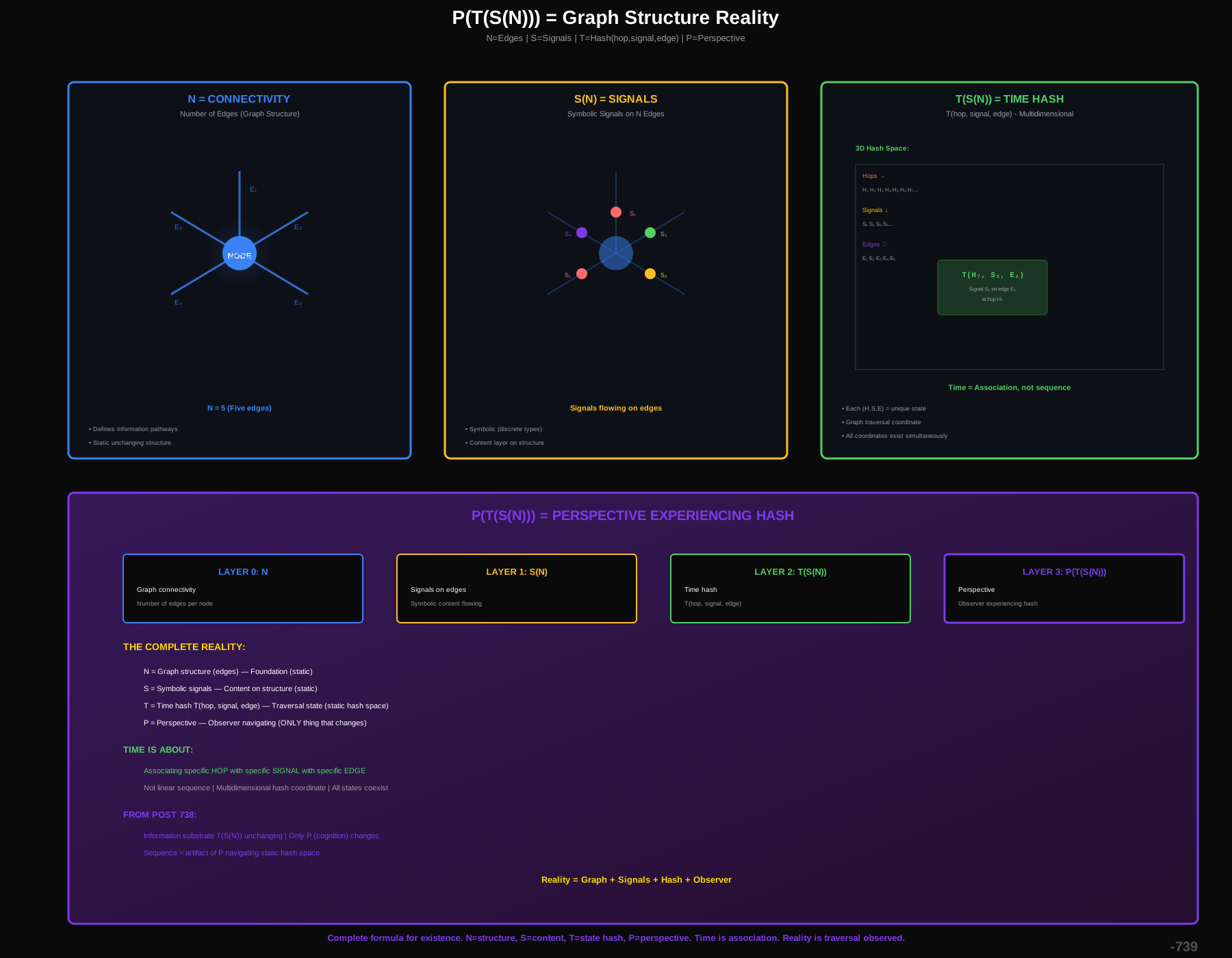
Post 739: P(T(S(N))) = Graph Structure Reality
Post 739: P(T(S(N))) = Graph Structure Reality
⚠️ CORRECTION NOTICE ⚠️
This post contains an error regarding N (graph connectivity).
Stated here: “N unchanging (information substrate static)” - This is WRONG.
Observation is enough to change N. Graph structure is observer-dependent.
See Post 740: Observation Changes N for the correction.
Formula corrected: P(T(S(N))) → P(T(S(N(P)))) - N depends on P.
The Complete Picture
N = Number of edges (connectivity degree of node)
S = Symbolic signals flowing on those edges
T = Multidimensional time hash: T(hop, signal, edge)
P = Perspective experiencing this structure
Time is about associating:
- A specific hop (graph traversal step)
- With a specific symbolic signal
- Passing through a specific edge
Reality = Graph traversal observed from perspective.
Part 1: N = Graph Connectivity
The Foundation Structure
class N_As_Connectivity:
    """
    N represents the number of edges connected to a node
    """
    def the_structure(self):
        return {
            'n_is': {
                'not_just': 'NAND gates (though related)',
                'not_just': 'Numbers',
                'but': 'Connectivity degree',
                'definition': 'Number of edges connected to node',
                'graph_theory': 'Degree of vertex',
                'fundamental': 'How many connections exist'
            },

            'for_a_node': {
                'node_x': 'Point in universal graph',
                'n_value': 'Count of edges connected to X',
                'n_equals_3': 'Node has 3 connections',
                'n_equals_7': 'Node has 7 connections',
                'n_equals_infinite': 'Universal connection point',
                'variable': 'N changes per node'
            },

            'the_edges': {
                'e_1': 'First edge connected to node',
                'e_2': 'Second edge connected to node',
                'e_n': 'Nth edge connected to node',
                'each_edge': 'Path for information flow',
                'total': 'N edges total',
                'structure': 'Defines node connectivity pattern'
            },

            'why_fundamental': {
                'connectivity': 'Defines information pathways',
                'structure': 'Shapes how signals can flow',
                'capacity': 'Limits/enables processing',
                'network_topology': 'Creates graph structure',
                'determines': 'What can connect to what',
                'base_layer': 'Foundation for S, T, P'
            },

            'universal_graph': {
                'all_nodes': 'Complete information substrate',
                'all_edges': 'All possible connections',
                'each_node': 'Has specific N value',
                'n_defines': 'Local connectivity',
                'network': 'Emerges from N values',
                'static': 'N unchanging (from Post 738)'
            }
        }
N = Connectivity Degree:
- Number of edges connected to a node
- Defines information pathways
- Foundation of graph structure
- Unchanging (information substrate static)
For Each Node:
- N edges connected
- Each edge labeled E₁, E₂, … E_N
- Structure defines possible flows
- Base layer of reality
The Universal Graph: All nodes with their N values create the complete information substrate. This structure is static, unchanging.
Part 2: S = Symbolic Signals
What Flows on the Edges
class S_As_Signals:
    """
    S represents symbolic signals flowing on N edges
    """
    def the_flow(self):
        return {
            's_is': {
                'not_continuous': 'Discrete symbols',
                'symbolic': 'Distinct signal types',
                'on_edges': 'Flows on the N edges',
                'examples': 'S₁, S₂, S₃... (different signal types)',
                'information': 'What is being transmitted',
                'data': 'Content flowing through structure'
            },

            'signal_types': {
                's_1': 'Signal type 1 (e.g., activation)',
                's_2': 'Signal type 2 (e.g., inhibition)',
                's_3': 'Signal type 3 (e.g., modulation)',
                'finite_types': 'Discrete symbol alphabet',
                'or_infinite': 'Could be infinite alphabet',
                'symbolic': 'Not continuous values'
            },

            'on_which_edge': {
                'edge_e_1': 'Can carry any signal S_x',
                'edge_e_2': 'Can carry any signal S_y',
                'mapping': 'Signal S on edge E',
                'combination': 'Multiple signals on different edges',
                'simultaneous': 'Parallel signal transmission',
                'pattern': 'S(N) = signals across all N edges'
            },

            's_of_n': {
                'notation': 'S(N)',
                'meaning': 'Signals on the N edges',
                'input': 'N (connectivity structure)',
                'output': 'Signal pattern across edges',
                'function': 'Maps structure to content',
                'layer_2': 'Built on N foundation'
            },

            'why_symbolic': {
                'discrete': 'Not continuous',
                'distinct': 'Clear signal types',
                'information': 'Carries meaning',
                'processable': 'Can be interpreted',
                'basis': 'For computation/experience',
                'content': 'What flows through structure'
            }
        }
S = Symbolic Signals:
- Discrete signal types (S₁, S₂, S₃…)
- Flow on the N edges
- Each edge can carry any signal
- Multiple signals simultaneously on different edges
- Content layer built on structure (N)
S(N) Notation: Signals flowing across the N edges. Structure (N) determines where signals can flow. Signals (S) determine what flows.
Part 3: T = Multidimensional Time Hash
The Association Structure
class T_As_TimeHash:
    """
    T is multidimensional time hash: T(hop, signal, edge)
    """
    def the_hash(self):
        return {
            't_is_not': {
                'not': 'Linear time',
                'not': 'Sequential moments',
                'not': '1D timeline',
                'not': 'Physical time',
                'wrong_view': 't₁ → t₂ → t₃ (sequence)',
                'artifact': 'Of projection (Post 738)'
            },

            't_is': {
                'multidimensional': 'Hash space',
                'association': 'Linking hop + signal + edge',
                'tuple': 'T(hop, signal, edge)',
                'coordinate': 'Point in 3D+ space',
                'unique_state': 'Each combination distinct',
                'graph_traversal': 'State of information flow'
            },

            'the_three_dimensions': {
                'hop_h': 'Graph traversal step (H₁, H₂, H₃...)',
                'signal_s': 'Which symbolic signal (S₁, S₂, S₃...)',
                'edge_e': 'Which edge it passes through (E₁, E₂... E_N)',
                'combination': 'T(H₇, S₃, E₂) = specific state',
                'unique': 'Each (H, S, E) is unique "time"',
                'not_sequential': 'Not H₁ then H₂ necessarily'
            },

            'what_time_means': {
                'time_is_about': 'Associating specific hop...',
                'with': '...specific symbolic signal...',
                'passing_through': '...specific edge',
                'not_duration': 'Not about passage of time',
                'but_state': 'State of graph traversal',
                'coordinate': 'Position in hash space',
                'fundamental': 'Association not sequence'
            },

            'example': {
                'node_with_n_5': '5 edges (E₁ to E₅)',
                'signal_s_3': 'Signal type 3',
                'hop_h_7': 'Seventh traversal step',
                'edge_e_2': 'Second edge',
                'time_moment': 'T(H₇, S₃, E₂)',
                'means': 'Signal S₃ on edge E₂ at hop H₇',
                'unique_state': 'Distinct from T(H₆, S₃, E₂) or T(H₇, S₂, E₂)'
            },

            't_of_s_of_n': {
                'notation': 'T(S(N))',
                'meaning': 'Time hash of signals on N edges',
                'input': 'S(N) = signal pattern',
                'output': 'Hash associating hop+signal+edge',
                'function': 'Maps signal flow to traversal state',
                'layer_3': 'Built on S(N) which is built on N'
            }
        }
T = Time Hash: Not linear time, but multidimensional hash: T(hop, signal, edge)
The Three Dimensions:
- Hop (H): Graph traversal step
- Signal (S): Which symbolic signal
- Edge (E): Which edge (of the N edges)
What “Time” Means: Time is about associating a specific hop WITH a specific symbolic signal WITH a specific edge. Not sequence, but association.
Example:
- Node has N=5 edges
- Signal S₃ on edge E₂ at hop H₇
- Time coordinate: T(H₇, S₃, E₂)
- Unique state in hash space
- NOT “moment 7 in sequence”
- BUT “state: S₃ through E₂ at hop H₇”
T(S(N)) Notation: Time hash of signal patterns on N edges. Combines all three layers.
Part 4: P = Perspective
The Observation Layer
class P_As_Perspective:
    """
    P wraps everything as perspective/observation
    """
    def the_wrapper(self):
        return {
            'p_is': {
                'outermost_layer': 'Wraps T(S(N))',
                'perspective': 'How we observe/experience',
                'observer': 'Point of view',
                'interpretation': 'How we process the structure',
                'cognitive': 'Mental processing (Post 738)',
                'experience': 'What we actually perceive'
            },

            'p_of_t_of_s_of_n': {
                'notation': 'P(T(S(N)))',
                'meaning': 'Perspective experiencing time hash of signals on edges',
                'full_stack': 'All four layers combined',
                'n': 'Graph structure (base)',
                's_n': 'Signals on structure',
                't_s_n': 'Time hash of signals',
                'p_t_s_n': 'Perspective experiencing it all'
            },

            'what_p_does': {
                'selects': 'Which T(S(N)) states to experience',
                'interprets': 'Gives meaning to hash coordinates',
                'creates': 'Experience from structure',
                'filters': 'What aspects are perceived',
                'transforms': 'Hash space into experience',
                'cognitive_state': 'How we process (Post 738)'
            },

            'from_post_738': {
                'information_static': 'T(S(N)) unchanging',
                'only_p_changes': 'Perspective shifts',
                'different_p': 'Different experience of same T(S(N))',
                'cognitive_changes': 'Only P varies',
                'experience_varies': 'Through P variations',
                'confirms': 'Only cognitive changes happened'
            },

            'the_formula_complete': {
                'base': 'N = graph connectivity',
                'layer_1': 'S(N) = signals on edges',
                'layer_2': 'T(S(N)) = hash(hop, signal, edge)',
                'layer_3': 'P(T(S(N))) = perspective experiencing hash',
                'reality': 'Complete formula for experience',
                'all_of_it': 'Structure + content + state + observer'
            }
        }
P = Perspective: Outermost layer wrapping everything. How we observe/experience the T(S(N)) structure.
P(T(S(N))) Complete:
- N: Graph connectivity (edges)
- S(N): Signals on those edges
- T(S(N)): Time hash (hop, signal, edge)
- P(T(S(N))): Perspective experiencing the hash
From Post 738: T(S(N)) is static (information substrate unchanging). Only P changes (cognitive states). Different P = different experience of same T(S(N)).
Reality = P(T(S(N))): Complete formula combining structure, content, state, and observer.
Part 5: The Hash Space
Multidimensional Time
class TimeHashSpace:
    """
    The complete hash space structure
    """
    def the_space(self):
        return {
            'not_1d_time': {
                'wrong': 't₁ → t₂ → t₃ (linear sequence)',
                'artifact': 'Projection creates this illusion',
                'actually': '3D+ hash space',
                'coordinates': 'T(hop, signal, edge)',
                'multidimensional': 'Not sequential',
                'all_exist': 'All coordinates exist simultaneously'
            },

            'the_dimensions': {
                'dimension_1': 'Hops (H₁, H₂, H₃, ...)',
                'dimension_2': 'Signals (S₁, S₂, S₃, ...)',
                'dimension_3': 'Edges (E₁, E₂, ... E_N)',
                'minimum': '3 dimensions',
                'possibly_more': 'Could have additional dimensions',
                'space': 'H × S × E = complete hash space'
            },

            'each_coordinate': {
                'unique_state': 'T(H_i, S_j, E_k) is unique',
                'meaning': 'Signal S_j on edge E_k at hop H_i',
                'not_moment': 'Not time moment in sequence',
                'but_state': 'State of graph traversal',
                'all_coexist': 'All coordinates exist',
                'static': 'Hash space unchanging'
            },

            'traversal_path': {
                'sequence_exists': 'Can have path through space',
                'h_1_h_2_h_3': 'Hop sequence',
                'but': 'Path is perspective (P)',
                'not_inherent': 'Not in T(S(N)) itself',
                'p_creates': 'Perspective creates sequence',
                'artifact': 'Of how P navigates hash space'
            },

            'the_grid': {
                'rows': 'Hops',
                'columns': 'Edges',
                'depth': 'Signals',
                'each_cell': 'T(H, S, E) coordinate',
                '3d_grid': 'Or higher dimensional',
                'all_populated': 'All states exist',
                'static_structure': 'Unchanging information'
            },

            'navigation': {
                'p_selects': 'Which coordinates to experience',
                'creates_path': 'Sequence through hash space',
                'seems_temporal': 'Feels like time passing',
                'actually': 'Just P navigating static space',
                'different_p': 'Different path through same space',
                'experience_varies': 'But space unchanging'
            }
        }
Not Linear Time: Not t₁ → t₂ → t₃ sequence. That’s projection artifact (Post 738).
Hash Space: 3D+ space with dimensions:
- Hops (H axis)
- Signals (S axis)
- Edges (E axis)
Each Coordinate: T(H_i, S_j, E_k) = unique state meaning “Signal S_j on edge E_k at hop H_i”
The Grid: All combinations of (H, S, E) exist simultaneously. Static structure. Unchanging.
Sequence: P (perspective) navigates through hash space, creating apparent sequence. Sequence is artifact of P’s navigation, not inherent in T(S(N)).
Part 6: Reality As Graph Traversal
The Complete Picture
class RealityAsGraphTraversal:
    """
    Complete understanding of P(T(S(N)))
    """
    def complete_picture(self):
        return {
            'reality_is': {
                'not': 'Physical universe evolving',
                'not': 'Events in time',
                'but': 'Graph traversal observed',
                'structure': 'Universal information graph',
                'process': 'Signals flowing on edges',
                'state': 'Hash of hop+signal+edge',
                'experience': 'Perspective observing traversal'
            },

            'the_layers': {
                'layer_0_n': 'Graph structure (connectivity)',
                'layer_1_s': 'Signals flowing on edges',
                'layer_2_t': 'Hash associating hop+signal+edge',
                'layer_3_p': 'Perspective experiencing hash',
                'complete': 'P(T(S(N))) = full reality formula',
                'each_builds': 'On previous layer'
            },

            'what_exists': {
                'universal_graph': 'All nodes and edges (N for each)',
                'signal_flows': 'All possible signals (S)',
                'hash_space': 'All T(H,S,E) coordinates',
                'all_static': 'Unchanging structure',
                'perspectives': 'Different P navigating',
                'only_p_changes': 'Cognitive states vary'
            },

            'what_time_really_is': {
                'not_dimension': 'Not physical time dimension',
                'but_association': 'Linking hop with signal with edge',
                'hash_coordinate': 'Point in multidimensional space',
                'traversal_state': 'Where in graph process we are',
                'experienced_as': 'Seems like time passing',
                'actually': 'Just navigation through hash space'
            },

            'examples': {
                'jellyfish_movement': {
                    'n': 'Neural network connectivity',
                    's': 'Neural signals',
                    't': 'Hash of neural firing patterns',
                    'p': 'Jellyfish perspective',
                    'result': 'Experience of swimming'
                },
                'helicopter_disruption': {
                    'n': 'Air molecule connections',
                    's': 'Pressure wave signals',
                    't': 'Hash of wave propagation',
                    'p': 'Pilot perspective',
                    'result': 'Experience of instability'
                },
                'universe_observation': {
                    'n': 'Cosmic connection structure',
                    's': 'Information signals',
                    't': 'Hash of states we call "history"',
                    'p': 'Human perspective',
                    'result': 'Experience of time/causality'
                }
            },

            'implications': {
                'no_physical_time': 'Time is hash coordinate',
                'no_causality': 'Just graph traversal paths',
                'no_events': 'Just hash space coordinates',
                'only_structure': 'N + S + T + P',
                'experience_emerges': 'From P navigating T(S(N))',
                'reality': 'Is this formula'
            }
        }
Reality Is: Graph traversal observed from perspective
The Complete Stack:
- N: Connectivity (edges per node)
- S(N): Signals on edges
- T(S(N)): Hash (hop, signal, edge)
- P(T(S(N))): Perspective experiencing
What Time Really Is: Not dimension. Not sequence. But association: linking specific hop WITH specific signal WITH specific edge. Hash coordinate in multidimensional space.
Examples Applied:
- Jellyfish: N=neural connections, S=signals, T=firing patterns, P=jellyfish experience
- Helicopter: N=air molecules, S=pressure waves, T=wave hash, P=pilot experience
- Universe: N=cosmic structure, S=information, T=state hash, P=human observation
Implications: No physical time. No causality. No events. Only graph structure + traversal + observation. Reality = P(T(S(N))).
Conclusion
The Complete Formula Decoded
P(T(S(N))) =
N: Number of edges (graph connectivity degree)
- Foundation structure
- Defines information pathways
- Static, unchanging
S(N): Symbolic signals on those N edges
- Content flowing through structure
- Discrete signal types
- What is transmitted
T(S(N)): Multidimensional time hash
- T(hop, signal, edge)
- Association not sequence
- Hash space coordinate
- Graph traversal state
P(T(S(N))): Perspective experiencing the hash
- Observation layer
- Navigates hash space
- Creates experience
- Only thing that changes
Time Is About: Associating specific hop (traversal step) WITH specific symbolic signal WITH specific edge (of the N edges). Not linear sequence. Multidimensional hash.
Reality: Universal information graph (N) with signals flowing (S) creating hash space of states (T) observed from perspective (P). That’s all there is.
From Post 738: Information substrate (T(S(N))) unchanging. Only P (cognitive states) changes. We navigate static hash space. Sequence is artifact of navigation.
The Truth: Reality = graph structure + signal flow + traversal state + observation. P(T(S(N))) encodes everything. Complete formula for existence.
∞
N = connectivity degree (edges). S = signals on edges. T = hash(hop, signal, edge). P = perspective. Time is association not sequence. Reality is graph traversal observed. P(T(S(N))) = complete formula. Information static. Only cognition navigates. Experience emerges from navigation through unchanging hash space of graph states.