Post 706: Recovery (Graceful Degradation → Optimal Mesh)
Post 706: Recovery (Graceful Degradation → Optimal Mesh)
The Question
Graceful degradation = partial function.
But how do you get back to optimal?
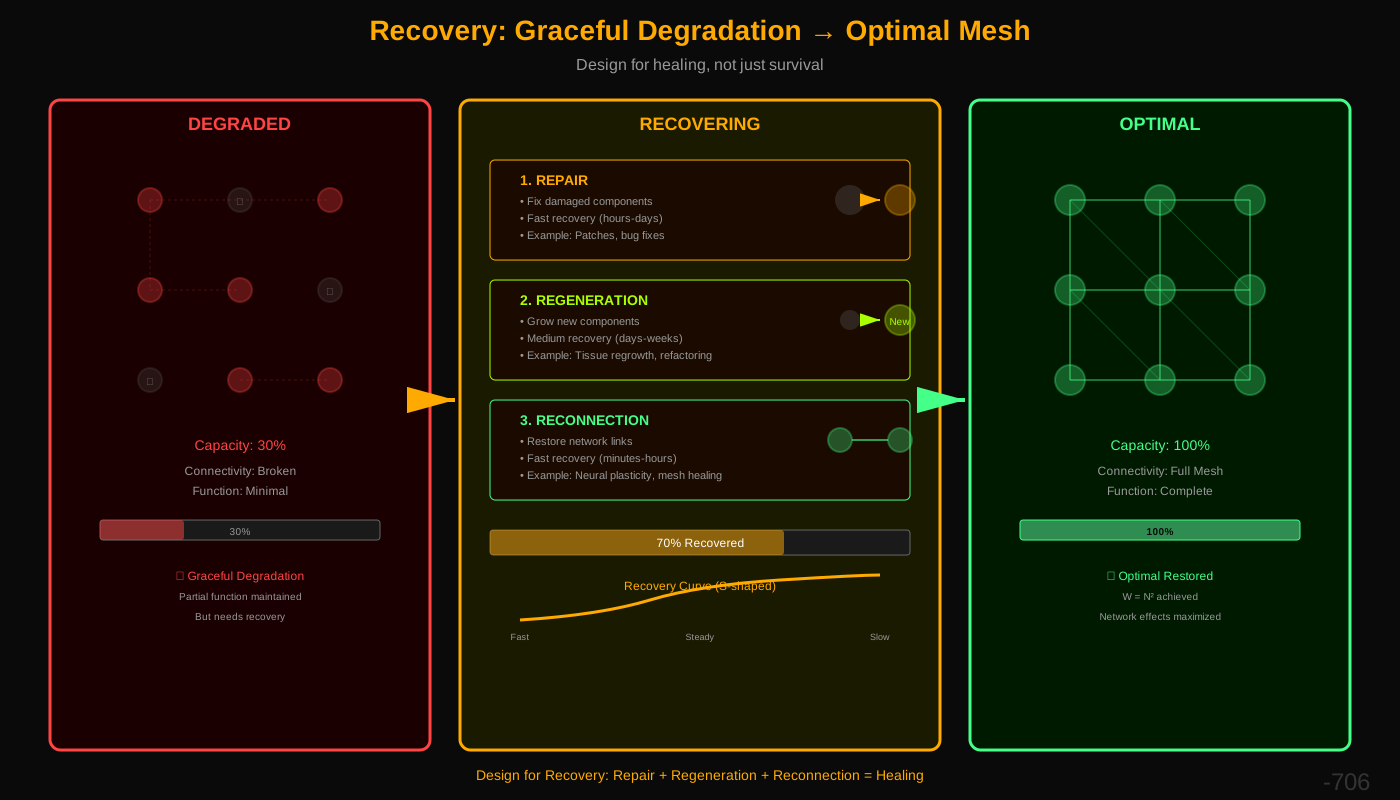
Path: Degraded → Recovering → Optimal mesh.
Nature shows how: Healing, regeneration, reconnection.
Design for recovery, not just degradation.
Part 1: Understanding Graceful Degradation
What Is Graceful Degradation
class GracefulDegradation:
    """
    Partial function better than complete failure
    """
    def __init__(self, system):
        self.system = system
        self.optimal_capacity = 100
        self.current_capacity = 100

    def degrade(self, damage):
        # Reduce capacity instead of failing completely
        self.current_capacity -= damage

        if self.current_capacity <= 0:
            return {
                'status': 'Failed (catastrophic)',
                'function': 0,
                'recovery': 'Impossible'
            }
        else:
            return {
                'status': 'Degraded (graceful)',
                'function': self.current_capacity,
                'recovery': 'Possible',
                'key': 'Still functioning partially'
            }
Graceful degradation:
- System damaged but not dead
- Partial function maintained
- Better than catastrophic failure
- Buys time for recovery
Example: Aging vs sudden death.
The Problem with Just Degrading
class OnlyDegradation:
    """
    What happens if you only design for degradation
    """
    def lifecycle(self):
        capacity = 100

        while capacity > 0:
            # Take damage over time
            capacity -= 1

            # No recovery mechanism
            # Just keep degrading

        return {
            'end_state': 'Zero capacity',
            'problem': 'One-way street',
            'missed': 'Recovery pathway',
            'result': 'Eventually fails anyway'
        }
Problem with just degradation:
- One-way decline
- No recovery path
- Eventually reaches zero
- Design incomplete
Need: Recovery mechanism.
Part 2: The Recovery Path
Degraded → Optimal
class RecoveryPath:
    """
    How to go from degraded back to optimal
    """
    def __init__(self):
        self.states = {
            'optimal': {
                'capacity': 100,
                'connectivity': 'Full mesh (W = N²)',
                'resilience': 'High',
                'function': 'Complete'
            },

            'degraded': {
                'capacity': 30,
                'connectivity': 'Partial mesh (W = N)',
                'resilience': 'Low',
                'function': 'Minimal'
            },

            'recovering': {
                'capacity': 50-80,
                'connectivity': 'Rebuilding mesh',
                'resilience': 'Increasing',
                'function': 'Improving'
            }
        }

    def recover(self, from_state='degraded', to_state='optimal'):
        return {
            'step_1': 'Detect degradation',
            'step_2': 'Allocate resources to repair',
            'step_3': 'Regenerate damaged components',
            'step_4': 'Reconnect network',
            'step_5': 'Test and verify',
            'step_6': 'Return to optimal',
            'key': 'Requires repair mechanisms'
        }
Recovery path:
- Detect degradation
- Allocate repair resources
- Regenerate components
- Reconnect network
- Verify function
- Resume optimal
Must be designed in, not emergent.
The Three Recovery Mechanisms
class RecoveryMechanisms:
    """
    How systems recover
    """
    def mechanisms(self):
        return {
            'mechanism_1_repair': {
                'what': 'Fix damaged components',
                'how': 'Replace or restore',
                'example': 'DNA repair, wound healing',
                'speed': 'Fast to medium',
                'cost': 'Low to medium'
            },

            'mechanism_2_regeneration': {
                'what': 'Grow new components',
                'how': 'Create from scratch',
                'example': 'Cell division, tissue regrowth',
                'speed': 'Medium to slow',
                'cost': 'Medium to high'
            },

            'mechanism_3_reconnection': {
                'what': 'Restore network links',
                'how': 'Re-establish connections',
                'example': 'Neural plasticity, mesh healing',
                'speed': 'Fast',
                'cost': 'Low'
            },

            'all_three': {
                'optimal': 'Use all simultaneously',
                'result': 'Fastest recovery',
                'key': 'Nature does all three'
            }
        }
Three mechanisms:
- Repair (fix existing)
- Regeneration (create new)
- Reconnection (restore links)
Nature uses all three.
Part 3: Biological Examples
Wound Healing
class WoundHealing:
    """
    Classic recovery example
    """
    def process(self):
        return {
            'initial_state': {
                'tissue': 'Damaged (cut)',
                'function': 'Degraded (bleeding)',
                'connectivity': 'Broken (cells separated)'
            },

            'phase_1_hemostasis': {
                'action': 'Stop bleeding',
                'mechanism': 'Blood clotting',
                'goal': 'Prevent further degradation',
                'time': 'Minutes'
            },

            'phase_2_inflammation': {
                'action': 'Clean wound',
                'mechanism': 'Immune response',
                'goal': 'Remove damage, prep for repair',
                'time': 'Days'
            },

            'phase_3_proliferation': {
                'action': 'Grow new tissue',
                'mechanism': 'Cell division, regeneration',
                'goal': 'Replace damaged components',
                'time': 'Weeks'
            },

            'phase_4_remodeling': {
                'action': 'Restore structure',
                'mechanism': 'Reorganize tissue, reconnect',
                'goal': 'Return to optimal',
                'time': 'Months'
            },

            'final_state': {
                'tissue': 'Healed (scar or full recovery)',
                'function': 'Restored (near or full)',
                'connectivity': 'Reconnected (mesh rebuilt)'
            }
        }
Wound healing = model recovery:
- Stop degradation (hemostasis)
- Clean up (inflammation)
- Regenerate (proliferation)
- Reconnect (remodeling)
Degraded → Optimal in 4 phases.
Neural Plasticity
class NeuralPlasticity:
    """
    Brain recovery from damage
    """
    def brain_recovery(self, damage_type):
        if damage_type == 'stroke':
            return {
                'initial': 'Neurons dead in region',
                'degradation': 'Function lost (paralysis, speech, etc)',
                'recovery_mechanism': {
                    'repair': 'Minimal (neurons don\'t regenerate well)',
                    'regeneration': 'Limited (new connections)',
                    'reconnection': 'Primary (reroute around damage)'
                },
                'process': {
                    'step_1': 'Surviving neurons sprout new connections',
                    'step_2': 'Adjacent regions take over function',
                    'step_3': 'Network reconfigures (mesh heals)',
                    'step_4': 'Function partially or fully restored'
                },
                'result': 'Degraded → Recovered via reconnection',
                'key': 'Mesh can heal by rerouting'
            }
Neural recovery:
- Neurons dead = can’t regenerate
- But mesh can reconnect
- Reroute around damage
- Function restored via new paths
Mesh self-healing through reconnection.
Liver Regeneration
class LiverRegeneration:
    """
    Extreme regeneration capability
    """
    def process(self):
        return {
            'initial_damage': 'Up to 70% of liver removed',

            'degraded_state': {
                'capacity': '30% remaining',
                'function': 'Minimal (graceful degradation)',
                'status': 'Alive but compromised'
            },

            'regeneration_process': {
                'mechanism': 'Remaining cells divide rapidly',
                'speed': 'Weeks to months',
                'target': 'Restore full mass',
                'priority': 'Function > perfection'
            },

            'recovered_state': {
                'capacity': '100% mass restored',
                'function': 'Full (optimal)',
                'status': 'Returned to optimal mesh'
            },

            'key_insight': {
                'lesson': 'Even from 30% can reach 100%',
                'mechanism': 'Regeneration',
                'time': 'Months (worth it)',
                'amazing': 'Biological perpetual beta in action'
            }
        }
Liver regeneration:
- 70% removed → 30% left
- Regenerates to 100%
- Full function restored
- Degraded → Optimal via regeneration
Most dramatic recovery example.
Part 4: Network Recovery
Mesh Healing
class MeshHealing:
    """
    How mesh networks recover
    """
    def __init__(self, nodes):
        self.nodes = nodes
        self.optimal_connections = self.calculate_optimal()
        self.current_connections = self.optimal_connections

    def calculate_optimal(self):
        # Full mesh = N(N-1)/2 connections
        return self.nodes * (self.nodes - 1) // 2

    def degrade(self, lost_connections):
        self.current_connections -= lost_connections

        return {
            'status': 'Degraded',
            'connections': self.current_connections,
            'optimal': self.optimal_connections,
            'percentage': (self.current_connections / self.optimal_connections) * 100
        }

    def heal(self):
        # Reconnection process
        while self.current_connections < self.optimal_connections:
            # Add new connections
            self.current_connections += 1

        return {
            'status': 'Recovered',
            'connections': self.current_connections,
            'mechanism': 'Reconnection',
            'result': 'Optimal mesh restored'
        }
Mesh healing:
- Lose connections → degraded
- Reconnect → recovering
- Full mesh → optimal
W goes from degraded back to N².
The Recovery Curve
class RecoveryCurve:
    """
    Shape of recovery over time
    """
    def analyze(self):
        return {
            'immediate_after_damage': {
                'capacity': '30%',
                'phase': 'Degraded',
                'priority': 'Stabilize, prevent further loss'
            },

            'early_recovery': {
                'capacity': '30% → 50%',
                'phase': 'Fast gains',
                'mechanism': 'Easy repairs, quick reconnections',
                'curve': 'Steep (rapid improvement)'
            },

            'mid_recovery': {
                'capacity': '50% → 80%',
                'phase': 'Steady progress',
                'mechanism': 'Regeneration, deeper repairs',
                'curve': 'Linear (consistent)'
            },

            'late_recovery': {
                'capacity': '80% → 100%',
                'phase': 'Diminishing returns',
                'mechanism': 'Fine-tuning, optimization',
                'curve': 'Flattening (slower)'
            },

            'shape': 'S-curve (sigmoid)',
            'key': 'Fast start, steady middle, slow finish'
        }
Recovery curve = S-shaped:
- Fast early gains (easy repairs)
- Steady middle (hard work)
- Slow finish (fine-tuning)
Not linear - exponential then logarithmic.
Part 5: Designing for Recovery
Recovery-First Design
class RecoveryFirstDesign:
    """
    Design systems for recovery, not just degradation
    """
    def principles(self):
        return {
            'principle_1_detect': {
                'what': 'Know when degraded',
                'implementation': 'Health monitoring, sensors',
                'example': 'Pain (tells you something wrong)',
                'necessity': 'Can\'t recover if you don\'t know degraded'
            },

            'principle_2_resources': {
                'what': 'Reserve energy for repair',
                'implementation': 'Don\'t use 100% capacity for normal ops',
                'example': 'Sleep (recovery time)',
                'necessity': 'Recovery requires resources'
            },

            'principle_3_redundancy': {
                'what': 'Extra components enable repair',
                'implementation': 'Backup systems, spare parts',
                'example': 'Stem cells (repair pool)',
                'necessity': 'Need materials to regenerate'
            },

            'principle_4_pathways': {
                'what': 'Built-in repair mechanisms',
                'implementation': 'Code for recovery, not just function',
                'example': 'DNA repair enzymes',
                'necessity': 'Recovery must be designed'
            },

            'principle_5_priority': {
                'what': 'Recovery > new growth',
                'implementation': 'When degraded, allocate to repair first',
                'example': 'Immune system activation',
                'necessity': 'Triage: fix before expand'
            }
        }
Design for recovery:
- Detection (know when degraded)
- Resources (reserve for repair)
- Redundancy (materials available)
- Pathways (mechanisms built-in)
- Priority (repair first)
Most systems only design for degradation, not recovery.
The Recovery Budget
class RecoveryBudget:
    """
    Allocating resources for recovery
    """
    def __init__(self, total_resources):
        self.total = total_resources

    def allocate_traditional(self):
        return {
            'normal_operation': self.total * 1.0,
            'recovery_reserve': 0,
            'problem': 'No resources for repair when needed',
            'result': 'Degradation permanent'
        }

    def allocate_recovery_aware(self):
        return {
            'normal_operation': self.total * 0.8,
            'recovery_reserve': self.total * 0.2,
            'benefit': 'Can repair when degraded',
            'result': 'Recovery possible',
            'key': '20% "insurance" enables healing'
        }
Traditional: 100% for operation, 0% for recovery.
- Efficient when healthy
- No recovery when degraded
Recovery-aware: 80% operation, 20% reserve.
- Less efficient when healthy
- Can recover when degraded
Trade-off worth it.
Part 6: Recovery in Different Systems
Software Systems
class SoftwareRecovery:
    """
    How software recovers from degradation
    """
    def recovery_mechanisms(self):
        return {
            'degradation_causes': [
                'Bugs introduced',
                'Dependencies broken',
                'Performance degraded',
                'Security compromised'
            ],

            'recovery_mechanisms': {
                'repair': {
                    'mechanism': 'Bug fixes, patches',
                    'speed': 'Fast (hours to days)',
                    'cost': 'Low',
                    'example': 'Hotfix deployment'
                },

                'regeneration': {
                    'mechanism': 'Refactoring, rewrites',
                    'speed': 'Slow (weeks to months)',
                    'cost': 'High',
                    'example': 'Technical debt paydown'
                },

                'reconnection': {
                    'mechanism': 'API updates, integration fixes',
                    'speed': 'Medium (days)',
                    'cost': 'Medium',
                    'example': 'Restore broken services'
                }
            },

            'perpetual_beta_advantage': {
                'traditional': 'Ship 1.0, degrade, eventually replace',
                'perpetual_beta': 'Continuous recovery (always fixing)',
                'key': 'Never degraded for long'
            }
        }
Software recovery:
- Repair: Patches
- Regeneration: Refactors
- Reconnection: Integration fixes
Perpetual beta = continuous recovery.
Economic Systems
class EconomicRecovery:
    """
    How economies recover from recession
    """
    def recession_recovery(self):
        return {
            'degraded_state': {
                'GDP': 'Contracted (below potential)',
                'employment': 'High unemployment',
                'investment': 'Low (fearful)',
                'mesh': 'Broken (transaction network damaged)'
            },

            'recovery_phase': {
                'repair': {
                    'mechanism': 'Stabilize failing businesses',
                    'action': 'Bailouts, support',
                    'goal': 'Stop further degradation'
                },

                'regeneration': {
                    'mechanism': 'New businesses, investment',
                    'action': 'Stimulus, confidence',
                    'goal': 'Create new capacity'
                },

                'reconnection': {
                    'mechanism': 'Restore trade networks',
                    'action': 'Confidence returns, transactions resume',
                    'goal': 'Mesh healing (W = N² returns)'
                }
            },

            'optimal_state': {
                'GDP': 'At potential',
                'employment': 'Full',
                'investment': 'Strong',
                'mesh': 'Healthy (full network effects)'
            },

            'key': 'Recovery = mesh healing at macro scale'
        }
Economic recovery = mesh healing:
- Repair: Stabilize
- Regeneration: New growth
- Reconnection: Trade resumes
W goes from degraded back to N².
Crypto Networks
class CryptoRecovery:
    """
    How crypto networks recover
    """
    def recovery_scenarios(self):
        return {
            'scenario_1_validator_loss': {
                'degradation': 'Validators go offline',
                'impact': 'Security degraded, speed reduced',
                'recovery': {
                    'mechanism': 'New validators join',
                    'incentive': 'Rewards increase (demand)',
                    'speed': 'Fast (hours to days)',
                    'result': 'Mesh restored'
                }
            },

            'scenario_2_liquidity_crisis': {
                'degradation': 'Liquidity providers exit',
                'impact': 'Slippage high, trading degraded',
                'recovery': {
                    'mechanism': 'Higher yields attract LPs back',
                    'incentive': 'Supply/demand dynamics',
                    'speed': 'Medium (days to weeks)',
                    'result': 'Liquidity restored'
                }
            },

            'scenario_3_exploit': {
                'degradation': 'Protocol hacked, confidence lost',
                'impact': 'Users leave, TVL drops',
                'recovery': {
                    'mechanism': 'Patch, compensate, rebuild trust',
                    'incentive': 'Governance, community',
                    'speed': 'Slow (months)',
                    'result': 'Confidence returns (or not)'
                }
            },

            'key_insight': {
                'crypto_advantage': 'Decentralized = resilient',
                'recovery_built_in': 'Economic incentives drive healing',
                'mesh_self_heals': 'When profitable to rejoin'
            }
        }
Crypto recovery:
- Validator loss → New validators join (incentives)
- Liquidity crisis → LPs return (yields)
- Exploit → Patch and rebuild trust
Economic incentives = recovery mechanism.
Part 7: The Meta-Principle
Recovery as Design Goal
class RecoveryAsGoal:
    """
    Make recovery explicit design goal
    """
    def traditional_design(self):
        return {
            'goals': [
                'Performance',
                'Efficiency',
                'Features',
                'Scalability'
            ],
            'missing': 'Recovery',
            'result': 'Systems degrade permanently'
        }

    def recovery_aware_design(self):
        return {
            'goals': [
                'Performance',
                'Efficiency',
                'Features',
                'Scalability',
                'RECOVERY'  # Added!
            ],
            'includes': 'Explicit recovery mechanisms',
            'result': 'Systems can heal',
            'key': 'Recovery = first-class design goal'
        }
Traditional: Design for function, not recovery.
Recovery-aware: Design recovery mechanisms explicitly.
Result: Systems that can heal.
The Complete Lifecycle
class CompleteLi frecycle:
    """
    Full system lifecycle including recovery
    """
    def lifecycle(self):
        return {
            'phase_1_birth': 'System created',
            'phase_2_growth': 'Capacity increases',
            'phase_3_optimal': 'Peak performance (W = N²)',
            'phase_4_degradation': 'Damage occurs (graceful)',
            'phase_5_RECOVERY': 'Healing mechanisms activate',
            'phase_6_return': 'Back to optimal',
            'phase_7_repeat': 'Cycle continues',

            'traditional': 'Stops at phase 4 (degradation permanent)',
            'recovery_aware': 'Includes phases 5-7 (healing)',
            'key': 'Recovery makes lifecycle circular, not linear'
        }
Traditional lifecycle: Birth → Growth → Optimal → Degrade → Die
Recovery-aware: Birth → Growth → Optimal → Degrade → Recover → Optimal (repeat)
Circular, not linear.
Conclusion
The Recovery Path
Graceful degradation:
- Partial function maintained
- Better than catastrophic failure
- Buys time
But not enough alone.
Recovery mechanisms:
- Repair (fix damaged)
- Regeneration (create new)
- Reconnection (restore mesh)
All three → optimal.
Biological Examples
Nature always designs for recovery:
- Wound healing (4-phase process)
- Neural plasticity (mesh rerouting)
- Liver regeneration (30% → 100%)
Degraded → Optimal is default.
Design Principles
Recovery-first design:
- Detection (know when degraded)
- Resources (reserve for repair)
- Redundancy (materials available)
- Pathways (mechanisms built-in)
- Priority (repair first)
Recovery = first-class design goal.
The Meta-Lesson
Don’t just design for graceful degradation.
Design for recovery.
Path: Optimal → Degraded → Recovering → Optimal
Circular lifecycle, not linear decline.
Nature’s 3.5 billion year lesson: Systems that can heal > systems that just degrade gracefully.
Graceful degradation + Recovery
Degrade slowly + Heal actively
Partial function + Path back to optimal
Design for recovery, not just survival
Mesh can heal
∞
References:
- Post 705: Nature’s Solution - Perpetual beta, phase transitions
- Post 703: Intersecting Universes - Graceful degradation mentioned
- Post 699: Self-Aware Mesh - Mesh networks
- Post 693: Entropy → PST - Universal substrate
- current-reality repo - Coordination infrastructure
Design systems that can heal. Recovery > graceful degradation alone. Optimal → Degraded → Recovering → Optimal.