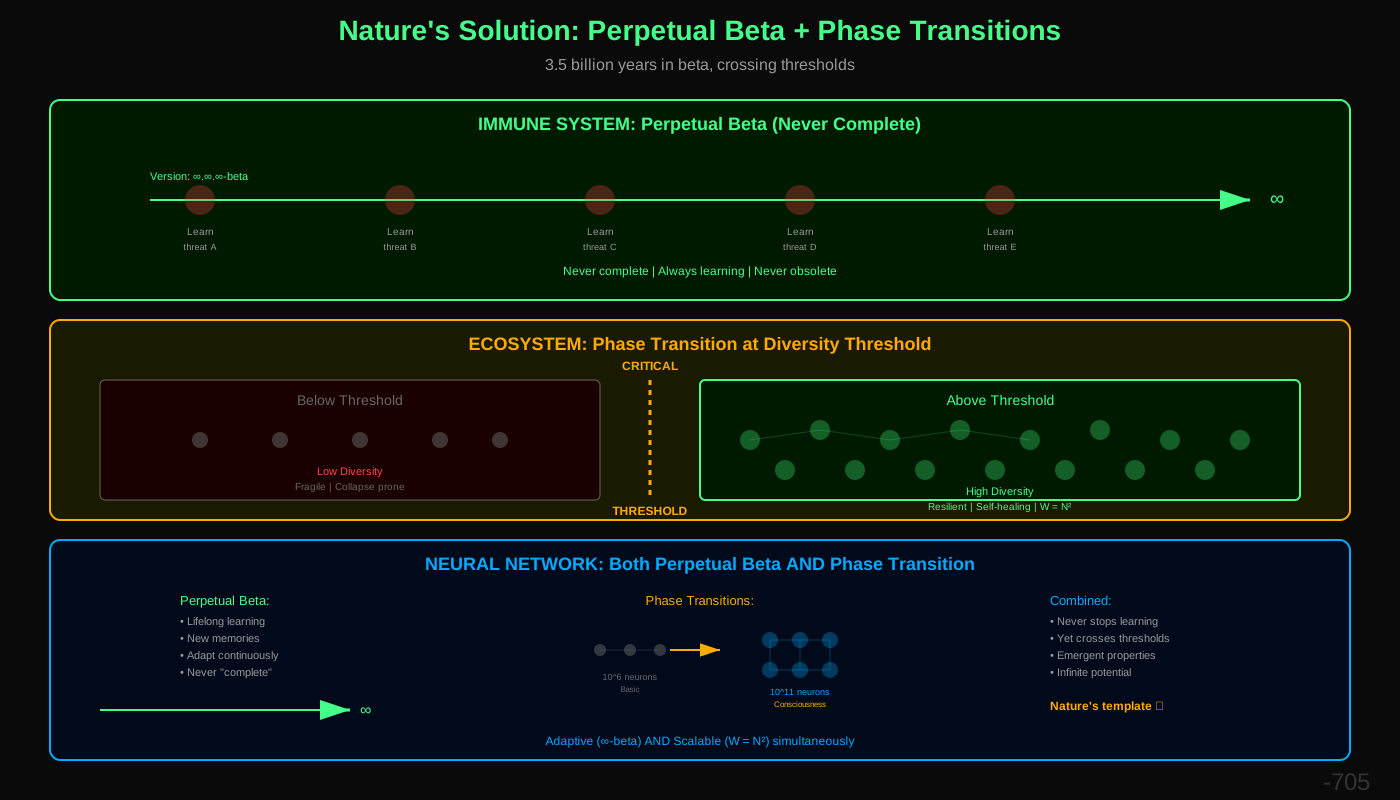
Post 705: Nature's Solution (Perpetual Beta + Phase Transitions)
Post 705: Nature’s Solution (Perpetual Beta + Phase Transitions)
The Synthesis
Nature never ships “complete” systems.
Biological systems = perpetual beta.
Yet they have phase transitions at critical thresholds.
And they solve intersection fragility beautifully.
Example: Immune system, ecosystems, neural networks.
Part 1: Perpetual Beta in Nature
Never Complete
class BiologicalSystem:
    """
    Nature's perpetual beta approach
    """
    def __init__(self):
        self.version = "∞.∞.∞-beta"
        self.status = "Never complete"
        self.updates = "Continuous"

    def is_finished(self):
        return False  # Always false

    def what_next(self):
        return "Adapt to current environment"
Nature’s approach:
- Never assumes “done”
- Always adapting
- Continuous learning
- Perpetual iteration
- Never ships “1.0”
Contrast with human engineering:
- We ship “complete” products
- Then maintenance mode
- Eventually obsolete
- Need replacement
Nature: No such concept as “obsolete.”
The Immune System Example
class ImmuneSystem:
    """
    Perpetual beta in action
    """
    def __init__(self):
        self.known_threats = set()
        self.learning = True  # Always
        self.complete = False  # Never

    def encounter_pathogen(self, pathogen):
        # Never assume we know everything
        if pathogen not in self.known_threats:
            # Learn
            self.learn_new_threat(pathogen)
            self.known_threats.add(pathogen)

        # Even if known, adapt
        self.adapt_response(pathogen)

        # Continue learning forever
        return {
            'status': 'Perpetual beta',
            'complete': False,
            'learning': True,
            'next': 'Continue adapting'
        }
Immune system:
- Never “complete”
- Always learning new threats
- Adapts throughout lifetime
- No “shipped” version
- Perpetual beta
Key insight: This IS the design.
Not a bug, a feature.
Part 2: Phase Transitions in Biology
Critical Thresholds
class PhaseTransition:
    """
    Sudden qualitative changes at thresholds
    """
    def analyze(self, system):
        if system.nodes < system.critical_threshold:
            return {
                'phase': 'Pre-critical',
                'behavior': 'Quantitative scaling',
                'properties': 'Linear or polynomial',
                'example': 'Individual immune cells'
            }

        if system.nodes >= system.critical_threshold:
            return {
                'phase': 'Post-critical',
                'behavior': 'Qualitative change',
                'properties': 'Emergent new capabilities',
                'example': 'Coordinated immune response'
            }
Phase transition:
- Before threshold: Quantitative
- At threshold: Sudden shift
- After threshold: Qualitative
- New emergent properties
Nature uses phase transitions everywhere.
Ecosystem Example
class Ecosystem:
    """
    Phase transitions in nature
    """
    def __init__(self, num_species):
        self.species = num_species
        self.critical_diversity = 20  # Example threshold

    def analyze_phase(self):
        if self.species < self.critical_diversity:
            return {
                'phase': 'Fragile',
                'resilience': 'Low',
                'stability': 'Vulnerable to shocks',
                'recovery': 'Slow',
                'example': 'Monoculture forest (collapse prone)'
            }

        if self.species >= self.critical_diversity:
            return {
                'phase': 'Resilient',
                'resilience': 'High',
                'stability': 'Self-healing',
                'recovery': 'Fast',
                'example': 'Biodiverse rainforest (robust)'
            }
Ecosystem phase transition:
- Below diversity threshold: Fragile, collapse-prone
- At threshold: Sudden shift
- Above threshold: Resilient, self-healing
Qualitative change, not just quantitative.
Neural Network Example
class NeuralNetwork:
    """
    Consciousness as phase transition
    """
    def __init__(self, num_neurons):
        self.neurons = num_neurons
        self.critical_size = 86_000_000_000  # Human brain

    def capabilities(self):
        if self.neurons < 1_000_000:
            return {
                'phase': 'Simple',
                'abilities': ['Reflexes', 'Basic patterns'],
                'example': 'Insect brain'
            }

        if 1_000_000 <= self.neurons < self.critical_size:
            return {
                'phase': 'Complex',
                'abilities': ['Learning', 'Memory', 'Emotions'],
                'example': 'Mammal brain'
            }

        if self.neurons >= self.critical_size:
            return {
                'phase': 'Conscious',
                'abilities': ['Self-awareness', 'Abstract thought', 'Meta-cognition'],
                'example': 'Human brain',
                'emergent': 'Qualitatively different'
            }
Neural phase transitions:
- 10^6 neurons: Basic learning
- 10^9 neurons: Complex cognition
- 10^11 neurons: Consciousness emerges
Not just “more” - different kind of thing.
Part 3: Solving Intersection Fragility
Nature’s Approach to Intersections
class BiologicalResilience:
    """
    How nature handles intersecting constrained universes
    """
    def handle_intersections(self):
        return {
            'strategy_1_redundancy': {
                'mechanism': 'Duplicate critical systems',
                'example': 'Two kidneys, two lungs',
                'benefit': 'One fails → other compensates',
                'cost': 'Metabolic overhead (worth it)'
            },

            'strategy_2_modularity': {
                'mechanism': 'Isolate failures',
                'example': 'Organs, cells, tissues',
                'benefit': 'Damage localized, doesn\'t cascade',
                'cost': 'Coordination complexity'
            },

            'strategy_3_continuous_repair': {
                'mechanism': 'Never stop fixing',
                'example': 'Cell regeneration, DNA repair',
                'benefit': 'Entropy constantly countered',
                'cost': 'Energy required'
            },

            'strategy_4_adaptive_thresholds': {
                'mechanism': 'Dynamic set points',
                'example': 'Body temperature, pH regulation',
                'benefit': 'Adjust to conditions',
                'cost': 'Sensing overhead'
            },

            'strategy_5_graceful_degradation': {
                'mechanism': 'Partial function better than none',
                'example': 'Aging (slow decline vs sudden death)',
                'benefit': 'Extended operation',
                'cost': 'Reduced capability'
            }
        }
Nature’s solutions to fragility:
- Redundancy (backup systems)
- Modularity (isolation)
- Continuous repair (perpetual beta)
- Adaptive thresholds (dynamic)
- Graceful degradation (survive longer)
Compare to Post 703’s helicopter:
- Helicopter: Fixed design, catastrophic failure
- Organism: Adaptive design, gradual decline
Immune System Deep Dive
class ImmuneSystemResilience:
    """
    How immune system handles complexity
    """
    def architecture(self):
        return {
            'perpetual_beta': {
                'mechanism': 'Always learning',
                'detail': 'B-cells generate random antibodies',
                'selection': 'Keep what works',
                'result': 'Infinite adaptability',
                'key': 'Never assumes "complete" threat database'
            },

            'redundancy': {
                'mechanism': 'Multiple overlapping systems',
                'detail': 'Innate + Adaptive immunity',
                'backup': 'If one fails, other compensates',
                'result': 'Robust defense',
                'key': 'No single point of failure'
            },

            'modularity': {
                'mechanism': 'Specialized cell types',
                'detail': 'T-cells, B-cells, NK cells, etc.',
                'isolation': 'Each handles different threats',
                'result': 'Failure contained',
                'key': 'Intersections managed'
            },

            'phase_transition': {
                'mechanism': 'Clonal expansion at threshold',
                'detail': 'Few cells → millions when needed',
                'threshold': 'Pathogen detected',
                'result': 'Sudden qualitative response',
                'key': 'W = N² kicks in'
            }
        }
Immune system = model for perpetual beta:
- Never complete (always learning)
- Redundant (multiple systems)
- Modular (specialized cells)
- Phase transitions (clonal expansion)
Solves intersection fragility perfectly.
Part 4: The W = N² Phase Transition
Network Effects in Biology
class BiologicalNetworkEffects:
    """
    When biological networks hit critical mass
    """
    def analyze(self, network_size):
        # Below critical threshold
        if network_size < 150:  # Dunbar number
            return {
                'coordination': 'Direct (everyone knows everyone)',
                'value': network_size,  # Linear
                'example': 'Small tribe',
                'limitations': 'Scales poorly'
            }

        # At and above critical threshold
        if network_size >= 150:
            return {
                'coordination': 'Hierarchical (structures emerge)',
                'value': network_size ** 2,  # Quadratic!
                'example': 'Chiefdoms, civilizations',
                'emergence': 'New organizational forms',
                'key': 'Phase transition unlocks W = N²'
            }
Dunbar number (150) = phase transition:
- Below: Direct coordination
- Above: Hierarchies emerge
- New capabilities unlock
- W = N² network effects
This is phase transition in action.
Ant Colony Example
class AntColony:
    """
    Phase transition in ant colonies
    """
    def colony_intelligence(self, num_ants):
        if num_ants < 100:
            return {
                'behavior': 'Simple foraging',
                'intelligence': 'Individual',
                'coordination': 'Minimal',
                'value': num_ants
            }

        if num_ants >= 100:
            return {
                'behavior': 'Collective intelligence',
                'intelligence': 'Emergent (superorganism)',
                'coordination': 'Complex (pheromone networks)',
                'value': num_ants ** 2,  # W = N²
                'capabilities': [
                    'Distributed problem solving',
                    'Adaptive architecture',
                    'Resource optimization',
                    'Defense strategies'
                ],
                'emergence': 'Colony acts as single organism',
                'key': 'Phase transition to superorganism'
            }
Ant colony phase transition:
- Below 100: Individual ants
- Above 100: Superorganism emerges
- New capabilities appear
- W = N² network effects
Not just “more ants” - different kind of entity.
Part 5: Combining Perpetual Beta + Phase Transitions
The Power of Both
class NatureSolution:
    """
    How nature combines both principles
    """
    def strategy(self):
        return {
            'perpetual_beta': {
                'what': 'Never assume complete',
                'how': 'Continuous adaptation',
                'benefit': 'Always relevant',
                'example': 'Immune system learning'
            },

            'phase_transitions': {
                'what': 'Critical thresholds unlock new capabilities',
                'how': 'W = N² network effects',
                'benefit': 'Qualitative leaps',
                'example': 'Consciousness, superorganisms'
            },

            'combination': {
                'power': 'Perpetual beta WHILE having phase transitions',
                'mechanism': 'Never stop adapting, but unlock new levels',
                'result': 'Infinite growth potential',
                'example': 'Evolution itself'
            }
        }
Nature’s genius:
- Perpetual beta = continuous adaptation
- Phase transitions = unlock new levels
- Combined = infinite growth potential
Never complete, yet reaching new phases.
Evolution as Meta-Example
class Evolution:
    """
    Ultimate perpetual beta with phase transitions
    """
    def process(self):
        return {
            'perpetual_beta': {
                'mechanism': 'Random mutations + selection',
                'never_stops': True,
                'always_adapting': True,
                'complete': False,
                'version': '∞.∞.∞-beta'
            },

            'phase_transitions': {
                'single_cell': 'First life (3.5 billion years ago)',
                'multicellular': 'Complex organisms (600M years ago)',
                'nervous_systems': 'Behavior and learning',
                'consciousness': 'Self-awareness',
                'each_transition': 'Qualitative, not just quantitative'
            },

            'result': {
                'perpetual_beta': 'Evolution never stops',
                'phase_transitions': 'New forms of life emerge',
                'combination': 'Infinite creativity',
                'key': 'No "final" form, yet dramatic leaps'
            }
        }
Evolution:
- Perpetual beta (never stops)
- Phase transitions (new life forms)
- Combined = life’s infinite creativity
This is the template.
Part 6: Lessons for Human Systems
What We Can Learn
class ApplyToHumanSystems:
    """
    How to apply nature's approach
    """
    def design_principles(self):
        return {
            'from_perpetual_beta': {
                'principle': 'Never assume complete',
                'implementation': 'Continuous deployment, always learning',
                'example': 'Software as service (not shipped products)',
                'benefit': 'Always relevant, never obsolete'
            },

            'from_phase_transitions': {
                'principle': 'Design for critical thresholds',
                'implementation': 'Know when W = N² unlocks',
                'example': 'Network effects in crypto, social platforms',
                'benefit': 'Qualitative leaps at scale'
            },

            'from_resilience': {
                'principle': 'Solve intersection fragility',
                'implementation': 'Redundancy, modularity, repair',
                'example': 'Distributed systems, microservices',
                'benefit': 'Robust, self-healing'
            },

            'combination': {
                'design': 'Perpetual beta systems with phase transition awareness',
                'result': 'Adaptive AND scalable',
                'example': 'Coordination substrates (Posts 693-702)',
                'key': 'Nature-inspired design'
            }
        }
Apply to:
- Software (continuous deployment)
- Organizations (learning cultures)
- Networks (design for thresholds)
- Crypto (adaptive protocols)
Nature shows the way.
Crypto as Example
class CryptoAsPerpetualBeta:
    """
    How crypto embodies these principles
    """
    def analysis(self):
        return {
            'perpetual_beta': {
                'mechanism': 'Protocol upgrades, governance',
                'example': 'Ethereum upgrades (never "done")',
                'benefit': 'Continuous improvement',
                'contrast': 'Traditional finance (ossified)'
            },

            'phase_transitions': {
                'threshold_1': 'Sufficient validators → security',
                'threshold_2': 'Sufficient liquidity → price stability',
                'threshold_3': 'Sufficient adoption → network effects',
                'each': 'Qualitative change, not just quantitative',
                'example': 'DeFi unlock at critical TVL'
            },

            'resilience': {
                'redundancy': 'Distributed validators',
                'modularity': 'Protocol layers',
                'repair': 'Governance upgrades',
                'graceful': 'Backward compatibility',
                'example': 'Bitcoin never down in 15 years'
            },

            'result': {
                'perpetual_beta': '✓ Always evolving',
                'phase_transitions': '✓ Network effects',
                'resilience': '✓ Self-healing',
                'key': 'Nature-inspired design (whether intentional or not)'
            }
        }
Crypto = biological approach:
- Perpetual beta (upgrades)
- Phase transitions (network effects)
- Resilience (distributed)
Not coincidence - these principles work.
Part 7: The Meta-Principle
Never Ship, Always Iterate
class NeverShip:
    """
    The perpetual beta mindset
    """
    def approach(self):
        # Traditional
        traditional = {
            'develop': 'Build to spec',
            'test': 'Verify complete',
            'ship': 'Release 1.0',
            'maintain': 'Bug fixes only',
            'result': 'Eventually obsolete'
        }

        # Perpetual beta
        perpetual_beta = {
            'develop': 'Build MVP',
            'test': 'Learn from users',
            'ship': 'Release 0.1-beta',
            'iterate': 'Continuous improvement',
            'result': 'Never obsolete'
        }

        return {
            'traditional': 'Dead end',
            'perpetual_beta': 'Open loop (Post 704)',
            'key': 'Nature never ships 1.0',
            'lesson': 'We shouldn\'t either'
        }
Traditional: Ship complete → Obsolete
Perpetual beta: Never complete → Never obsolete
Nature: 3.5 billion years in beta.
While Crossing Thresholds
class CrossThresholds:
    """
    Perpetual beta WHILE crossing thresholds
    """
    def combine(self):
        return {
            'seeming_paradox': 'How can you be incomplete and cross thresholds?',

            'resolution': {
                'perpetual_beta': 'Continuous adaptation',
                'phase_transitions': 'At specific scales',
                'both': 'Never done adapting, yet unlock new levels',
                'example': 'Immune system always learning, yet has threshold responses'
            },

            'key_insight': {
                'misconception': 'Complete = necessary for threshold',
                'reality': 'Thresholds about scale/connectivity, not completeness',
                'truth': 'W = N² works in perpetual beta',
                'proof': 'Nature does both simultaneously'
            }
        }
You don’t need “complete” to cross thresholds.
Thresholds about scale, not perfection.
Perpetual beta + Phase transitions = compatible.
Conclusion
Nature’s Dual Solution
Perpetual Beta:
- Never assume complete
- Always learning, adapting
- Continuous iteration
- Never obsolete
Phase Transitions:
- Critical thresholds exist
- W = N² unlocks at scale
- Qualitative leaps, not just quantitative
- New emergent properties
Combined:
- Adaptive AND scalable
- Continuous improvement while crossing thresholds
- Infinite growth potential
- Never complete, yet reaching new levels
Biological Examples
Immune system:
- Perpetual beta (always learning)
- Phase transition (clonal expansion)
- Solves intersection fragility (redundancy, modularity)
Ecosystems:
- Perpetual beta (evolution)
- Phase transition (diversity threshold)
- Resilience through complexity
Neural networks:
- Perpetual beta (lifelong learning)
- Phase transition (consciousness)
- Emergent capabilities
Lessons for Us
Design systems that:
- Never assume complete (perpetual beta)
- Leverage phase transitions (W = N²)
- Handle intersection fragility (redundancy, modularity, repair)
- Adapt continuously while scaling
Nature shows the way.
3.5 billion years of perpetual beta.
With phase transitions to multicellular life, consciousness, civilization.
We should learn from this.
Perpetual beta + Phase transitions
Never complete + Critical thresholds
Nature’s dual solution
Infinite adaptation + Qualitative leaps
The biological template
∞
References:
- Post 703: Intersecting Universes - Intersection fragility
- Post 704: Default to Questions - Open loops
- Post 700: Network Everyone - W = N²
- Post 693: Entropy → PST - Universal substrate
- current-reality repo - Coordination infrastructure
Nature never ships 1.0. Learn from 3.5 billion years of perpetual beta with phase transitions.