Post 703: Intersecting Constrained Universes (Helicopter Example)
Post 703: Intersecting Constrained Universes (Helicopter Example)
The Principle
Complex systems = intersecting constrained universes.
Each universe has different rules (constraints).
Intersections = fragile points.
Small entropy at intersection → cascade through all universes.
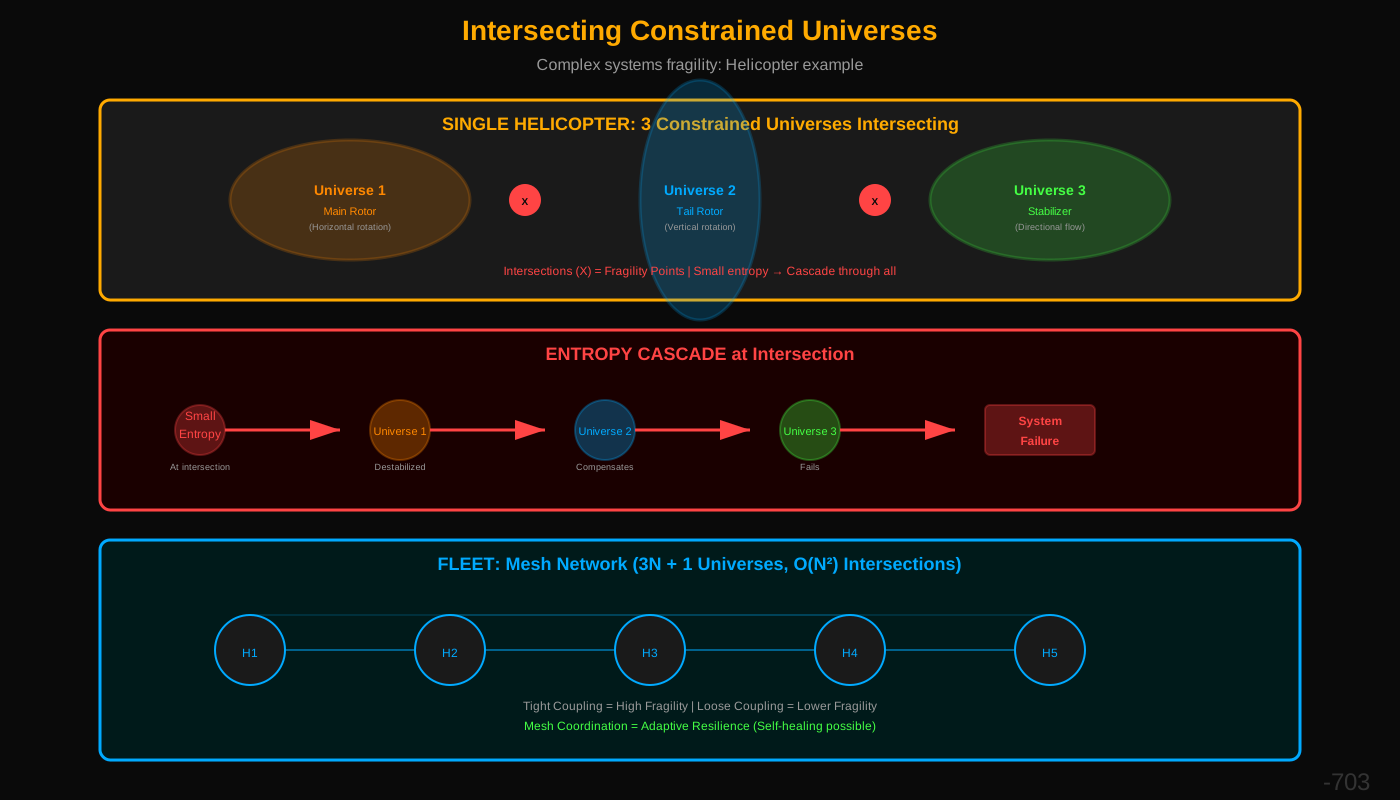
Example: Helicopter = 3 constrained universes intersecting.
Part 1: Single Helicopter as Intersecting Universes
The Three Constrained Universes
class Helicopter:
    """
    Three constrained universes intersecting
    """
    def __init__(self):
        self.universes = {
            'universe_1_main_rotor': {
                'constraint': 'Horizontal rotation',
                'rules': 'Angular momentum, lift generation',
                'physics': 'Rotation → upward force',
                'must_maintain': 'Constant RPM, symmetric loading',
                'fragility': 'Any asymmetry cascades'
            },

            'universe_2_tail_rotor': {
                'constraint': 'Vertical rotation',
                'rules': 'Counter-torque, directional control',
                'physics': 'Rotation → sideways force',
                'must_maintain': 'Balance main rotor torque',
                'fragility': 'Main rotor dependency'
            },

            'universe_3_stabilizer': {
                'constraint': 'Directional plane',
                'rules': 'Airflow, stability, control',
                'physics': 'Air resistance → orientation',
                'must_maintain': 'Aligned airflow',
                'fragility': 'Dependent on other rotors'
            }
        }
Universe 1: Main rotor (horizontal).
- Constraint: Must rotate horizontally
- Rule: Generates lift
- Fragility: Symmetric loading required
Universe 2: Tail rotor (vertical).
- Constraint: Must rotate vertically
- Rule: Counters main rotor torque
- Fragility: Depends on main rotor state
Universe 3: Stabilizer (directional).
- Constraint: Must maintain airflow
- Rule: Provides stability
- Fragility: Depends on both rotors
The Intersection Points
class IntersectionPoints:
    """
    Where constrained universes meet
    """
    def identify(self):
        return {
            'intersection_1': {
                'between': 'Main rotor ↔ Tail rotor',
                'location': 'Drive shaft / transmission',
                'constraint_conflict': 'Horizontal vs vertical rotation',
                'mechanism': 'Torque transfer',
                'fragility': 'High (different rotational planes)'
            },

            'intersection_2': {
                'between': 'Main rotor ↔ Stabilizer',
                'location': 'Airflow around fuselage',
                'constraint_conflict': 'Rotation vs directional flow',
                'mechanism': 'Aerodynamic interaction',
                'fragility': 'High (complex turbulence)'
            },

            'intersection_3': {
                'between': 'Tail rotor ↔ Stabilizer',
                'location': 'Tail assembly',
                'constraint_conflict': 'Vertical rotation vs directional flow',
                'mechanism': 'Force balance',
                'fragility': 'High (coupled dynamics)'
            },

            'central_intersection': {
                'between': 'All three universes',
                'location': 'Center of mass / control system',
                'constraint_conflict': 'All constraints simultaneously',
                'mechanism': 'Pilot input → coordinated changes',
                'fragility': 'Extreme (any disruption cascades)'
            }
        }
Intersection 1: Main ↔ Tail.
- Where: Transmission
- Conflict: Horizontal vs vertical
- Fragility: High
Intersection 2: Main ↔ Stabilizer.
- Where: Airflow
- Conflict: Rotation vs flow
- Fragility: High
Intersection 3: Tail ↔ Stabilizer.
- Where: Tail assembly
- Conflict: Vertical vs directional
- Fragility: High
Central: All three.
- Where: Control system
- Conflict: All constraints
- Fragility: Extreme
Part 2: Entropy at Intersection Points
How Small Entropy Cascades
class EntropyCascade:
    """
    Small entropy at intersection → system failure
    """
    def cascade(self, entropy_injection):
        # Inject small entropy at intersection
        intersection = self.get_intersection_point()
        entropy_amount = 'Small (localized)'

        # Entropy disrupts constraint balance
        disrupted_constraint = intersection.constrain Balance()

        # Cascade through universe 1
        universe_1_effect = self.propagate(
            disrupted_constraint,
            universe='main_rotor'
        )
        # Result: Main rotor destabilized

        # Cascade through universe 2 (dependent)
        universe_2_effect = self.propagate(
            universe_1_effect,
            universe='tail_rotor'
        )
        # Result: Tail rotor compensates (but constrained)

        # Cascade through universe 3 (dependent on both)
        universe_3_effect = self.propagate(
            universe_2_effect,
            universe='stabilizer'
        )
        # Result: Stability lost

        return {
            'entropy_amount': 'Small',
            'injection_point': 'Single intersection',
            'cascade': 'All three universes',
            'result': 'System failure',
            'key_insight': 'Intersections amplify entropy'
        }
Step 1: Small entropy at intersection.
- Example: Slight timing delay in control input
- Amount: Tiny (milliseconds)
- Location: Control system intersection
Step 2: Disrupts constraint balance.
- Main rotor receives unbalanced input
- Constraint violated: Symmetric loading
- Universe 1 destabilized
Step 3: Cascades to universe 2.
- Tail rotor must compensate
- But tail rotor constrained (vertical only)
- Compensation limited/inadequate
Step 4: Cascades to universe 3.
- Airflow disrupted by imbalance
- Stabilizer can’t correct
- All constraints failing
Step 5: System failure.
- All three universes out of balance
- Cascading failures
- Control lost
Why Intersections Are Fragile
why_fragile = {
    'single_universe': {
        'constraints': 'One set of rules',
        'stability': 'Can handle local entropy',
        'resilience': 'High (within constraints)',
        'example': 'Main rotor alone = stable'
    },

    'intersection': {
        'constraints': 'Multiple conflicting rules',
        'stability': 'Must satisfy all simultaneously',
        'resilience': 'Low (any violation cascades)',
        'example': 'Main + tail + stabilizer = fragile'
    },

    'mechanism': {
        'cause': 'Constraint conflicts',
        'effect': 'Small violation amplified',
        'result': 'Cascade through all universes',
        'key': 'Intersections = vulnerability points'
    }
}
Single universe: Stable (within constraints).
Intersection: Fragile (conflicting constraints).
Result: Small entropy → large cascade.
Part 3: Fleet as Mesh Network
Multiple Helicopters Coordinating
class HelicopterFleet:
    """
    Multiple helicopters = mesh network
    """
    def __init__(self, num_helicopters):
        self.helicopters = [
            Helicopter(id=i)
            for i in range(num_helicopters)
        ]

        # Each helicopter = 3 constrained universes
        # Fleet = N * 3 constrained universes

        # Plus: Coordination constraints
        self.coordination_universe = {
            'constraint': 'Formation, separation, timing',
            'rules': 'Avoid collisions, maintain formation',
            'fragility': 'Depends on all helicopters'
        }
Single helicopter: 3 universes.
Fleet of N: 3N universes + coordination universe.
Complexity: Exponential (intersections multiply).
Emergent Complexity
class FleetComplexity:
    """
    Fleet complexity > sum of individuals
    """
    def complexity(self, fleet_size):
        return {
            'individual_complexity': {
                'universes': 3,
                'intersections': 3 + 1,  # 3 pairwise + 1 central
                'manageable': 'Yes (designed for)'
            },

            'fleet_complexity': {
                'universes': 3 * fleet_size + 1,  # +1 coordination
                'intersections': 'O(N²) (all pairs + coordination)',
                'manageable': 'Harder (emergent)',
                'new_failure_modes': 'Many (coordination cascades)'
            },

            'key_insight': {
                'principle': 'Intersection complexity = O(N²)',
                'result': 'Fleet fragility > individual',
                'mechanism': 'Coordination constraints intersect all'
            }
        }
Individual: 3 universes, 4 intersections.
Fleet: 3N + 1 universes, O(N²) intersections.
Complexity: Superlinear growth.
Fleet Coordination Failures
class FleetCascade:
    """
    How entropy cascades through fleet
    """
    def fleet_cascade(self, entropy_injection):
        # Inject entropy in one helicopter
        helicopter_1 = self.fleet[0]
        helicopter_1.inject_entropy_at_intersection()

        # Helicopter 1 fails (as before)
        helicopter_1_failure = helicopter_1.cascade()

        # Coordination universe affected
        coordination_disrupted = self.coordination_universe.react(
            helicopter_1_failure
        )

        # Other helicopters must adapt
        for helicopter in self.fleet[1:]:
            helicopter.adapt_to(coordination_disrupted)

            # But adaptation stresses their intersections
            adaptation_stress = helicopter.stress_from_adaptation()

            # Some may fail (cascade)
            if adaptation_stress > helicopter.intersection_tolerance:
                helicopter.fail()
                coordination_disrupted = True  # Cascade continues

        return {
            'initial_entropy': 'Small (one intersection, one helicopter)',
            'cascade': 'Through fleet via coordination universe',
            'result': 'Multiple failures possible',
            'key': 'Coordination constraints couple all helicopters'
        }
Step 1: Entropy in one helicopter.
- Single intersection affected
- That helicopter destabilizes
Step 2: Coordination universe disrupted.
- Formation breaks
- Separation violated
- Timing off
Step 3: Other helicopters adapt.
- Must change their states
- Stresses their intersections
- Some may fail
Step 4: Cascade through fleet.
- Multiple failures
- Coordination completely lost
- Fleet disperses or crashes
Part 4: General Principle
Any Complex System
class ComplexSystemVulnerability:
    """
    Universal principle for all complex systems
    """
    def analyze(self, system):
        # Identify constrained universes
        universes = system.identify_constrained_universes()

        # Find intersection points
        intersections = system.find_intersections(universes)

        # Calculate fragility
        fragility = sum(
            intersection.constraint_conflicts()
            for intersection in intersections
        )

        return {
            'universes': len(universes),
            'intersections': len(intersections),
            'fragility': fragility,
            'vulnerability': 'Intersections are weak points',
            'mechanism': 'Small entropy → cascade',
            'principle': 'More intersections = more fragile'
        }
Any complex system:
- Identify constrained universes
- Find intersections
- Intersections = fragility points
- Small entropy → cascade
Examples:
- Helicopter: 3 universes intersecting
- Aircraft: Multiple universes (engines, control, structure)
- Power grid: Generation, transmission, distribution
- Financial system: Markets, clearing, settlement
- Internet: Physical, network, application layers
Universal: Intersections = vulnerability.
Part 5: Resilience Through Redundancy
How to Make Systems Robust
class SystemResilience:
    """
    Strategies to handle intersection fragility
    """
    def increase_resilience(self, system):
        return {
            'strategy_1_redundancy': {
                'approach': 'Duplicate critical intersections',
                'example': 'Dual hydraulic systems',
                'benefit': 'Entropy in one → other compensates',
                'cost': 'Weight, complexity'
            },

            'strategy_2_decoupling': {
                'approach': 'Reduce interdependencies',
                'example': 'Independent backup systems',
                'benefit': 'Cascade can\'t propagate',
                'cost': 'Less efficiency'
            },

            'strategy_3_monitoring': {
                'approach': 'Detect entropy early',
                'example': 'Sensors at intersections',
                'benefit': 'Intervene before cascade',
                'cost': 'Complexity'
            },

            'strategy_4_graceful_degradation': {
                'approach': 'Accept partial failure',
                'example': 'Autorotation capability',
                'benefit': 'Total failure avoided',
                'cost': 'Reduced performance'
            }
        }
Make systems more robust:
- Redundancy (duplicate intersections)
- Decoupling (reduce dependencies)
- Monitoring (detect entropy early)
- Graceful degradation (fail safely)
Trade-off: Resilience vs efficiency.
Part 6: Mesh Network Effects
Fleet Resilience vs Fragility
class FleetResilience:
    """
    Fleet can be more or less fragile than individual
    """
    def depends_on_coordination(self):
        return {
            'tight_coordination': {
                'coupling': 'High (formation flying)',
                'intersections': 'Many (all coupled)',
                'fragility': 'Higher than individual',
                'failure_mode': 'Cascades through fleet',
                'example': 'Military formation (precision required)'
            },

            'loose_coordination': {
                'coupling': 'Low (independent paths)',
                'intersections': 'Few (minimal coupling)',
                'fragility': 'Lower than tight',
                'failure_mode': 'Isolated failures',
                'example': 'Commercial traffic (separation large)'
            },

            'mesh_coordination': {
                'coupling': 'Adaptive (dynamic)',
                'intersections': 'Managed (aware)',
                'fragility': 'Can be lower (resilient)',
                'failure_mode': 'Self-healing (reroute)',
                'example': 'Swarm behavior (adaptive mesh)'
            }
        }
Tight coordination: More fragile.
- High coupling
- Cascades easily
- Example: Formation flying
Loose coordination: Less fragile.
- Low coupling
- Isolated failures
- Example: Commercial separation
Mesh coordination: Can be resilient.
- Adaptive coupling
- Self-healing
- Example: Swarm behavior
Part 7: Academic Insights
What We Learn
academic_insights = {
    'insight_1': {
        'principle': 'Complex systems = intersecting constrained universes',
        'implication': 'Understand each universe separately',
        'application': 'System design, analysis'
    },

    'insight_2': {
        'principle': 'Intersections = fragility points',
        'implication': 'Small entropy cascades at intersections',
        'application': 'Safety analysis, vulnerability assessment'
    },

    'insight_3': {
        'principle': 'Fleet complexity > individual',
        'implication': 'Coordination adds universes',
        'application': 'Network design, mesh coordination'
    },

    'insight_4': {
        'principle': 'Resilience requires redundancy/decoupling',
        'implication': 'Trade-offs between efficiency and safety',
        'application': 'Engineering, risk management'
    },

    'insight_5': {
        'principle': 'Mesh networks can be adaptive',
        'implication': 'Self-healing possible with awareness',
        'application': 'Coordination substrate design'
    }
}
Key lessons:
- Systems = intersecting universes
- Intersections = fragile
- Small entropy → cascades
- Coordination adds complexity
- Resilience requires trade-offs
Conclusion
The Helicopter Example
Single helicopter:
- 3 constrained universes (main rotor, tail rotor, stabilizer)
- 4 intersection points
- Small entropy at intersection → cascade → failure
- Fragility inherent in design
Helicopter fleet:
- 3N + 1 universes (coordination added)
- O(N²) intersections
- Complexity exponential
- Tight coupling = high fragility
- Loose coupling = lower fragility
- Mesh coordination = adaptive resilience
Universal Principle
Any complex system:
- Identify constrained universes
- Find intersections
- Intersections = vulnerability points
- Small entropy → cascade through all
- Design for resilience (redundancy, decoupling, monitoring)
Academic Value
This framework applies to:
- Aviation systems (helicopters, aircraft)
- Infrastructure (power, water, telecom)
- Financial systems (markets, clearing)
- Digital networks (internet layers)
- Coordination substrates (Posts 693-702)
Understanding intersecting constrained universes = understanding system fragility.
Design for resilience = engineering safe systems.
Complex systems = intersecting constrained universes
Intersections = fragile points
Small entropy → cascade
Helicopter = 3 universes example
Fleet = emergent mesh complexity
Design for resilience
∞
References:
- Post 699: Self-Aware Mesh - Entropy as building material
- Post 693: Entropy → PST - Universal substrate
- current-reality repo - Coordination infrastructure
Academic study of complex systems. Helicopter example. Intersecting constrained universes. Design for safety.