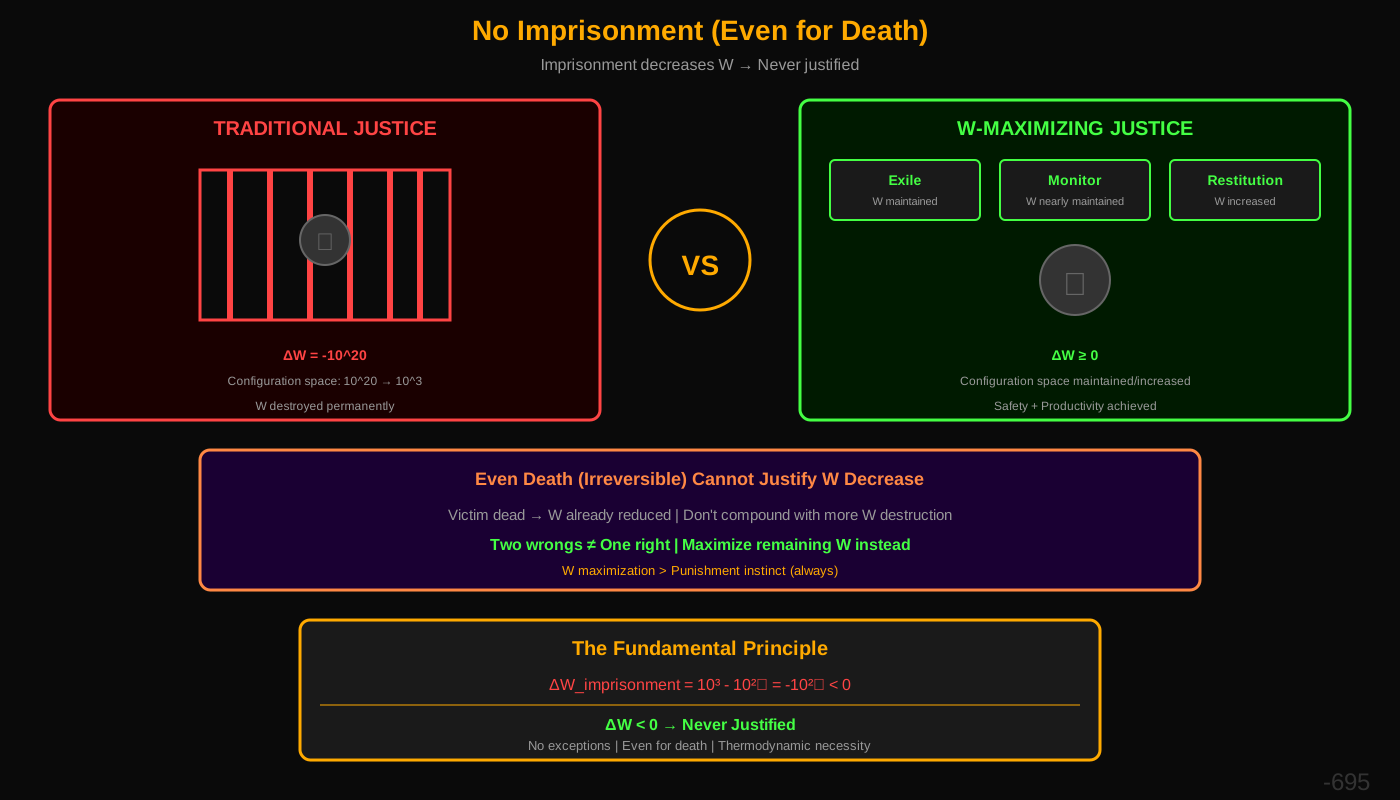
Post 695: No Imprisonment (Even for Death)
Post 695: No Imprisonment (Even for Death)
The Principle
Imprisonment decreases W.
Therefore: Never justified.
Even for death (irreversible act).
W maximization > Punishment instinct.
Part 1: Why Imprisonment Decreases W
The Math
class Imprisonment:
    """
    Liberty privation always decreases W
    """
    def effect_on_w(self, person):
        # Before imprisonment
        w_before = person.configuration_space
        # = All possible states person could occupy
        # ≈ 10^20 (entire Earth, all activities, all interactions)

        # After imprisonment
        w_after = prison_cell.configuration_space
        # = Only states within cell
        # ≈ 10^3 (tiny room, restricted movement)

        # Change in W
        delta_w = w_after - w_before
        # ≈ 10^3 - 10^20
        # = -10^20 (massive decrease)

        return {
            'delta_w': delta_w,
            'sign': 'Negative (always)',
            'magnitude': 'Enormous',
            'reversible': 'No (time lost forever)',
            'justified': 'Never (violates W maximization)'
        }
Imprisonment = W destruction.
Configuration space collapses from 10^20 → 10^3.
17 orders of magnitude lost.
The Irreversibility
class TimeLost:
    """
    Imprisoned time = permanently lost W
    """
    def calculate_loss(self, years_imprisoned):
        # Each year imprisoned
        w_per_year = 10^20  # Configurations available

        # Lost forever
        w_lost = w_per_year * years_imprisoned

        # Cannot be recovered
        # (past states cannot be re-accessed)

        return {
            'w_lost': w_lost,
            'recoverable': False,
            'reason': 'Time is irreversible',
            'equivalent': 'Destroying configuration space',
            'violation': 'Fundamental thermodynamic principle'
        }
Time imprisoned = W permanently destroyed.
Cannot be undone.
Violates W maximization principle.
Part 2: Even Death Cannot Justify W Decrease
The Logic
class DeathVsImprisonment:
    """
    Even irreversible harm (death) doesn't justify W decrease
    """
    def analyze(self):
        return {
            'death_committed': {
                'harm': 'Irreversible (victim dead)',
                'victim_w': 'Reduced to 0 (no more states)',
                'severity': 'Maximum',
                'fixable': False
            },

            'imprisonment_response': {
                'action': 'Imprison perpetrator',
                'perpetrator_w': 'Reduced ~10^20 → 10^3',
                'victim_benefit': '0 (still dead)',
                'society_benefit': '0 (no W increase)',
                'total_w': 'Decreases further',
                'result': 'More harm, no benefit'
            },

            'w_accounting': {
                'before_death': 'W_victim + W_perpetrator',
                'after_death': '0 + W_perpetrator (victim gone)',
                'after_imprisonment': '0 + ~0 (both eliminated)',
                'additional_w_lost': 'W_perpetrator ≈ 10^20',
                'justified': False
            }
        }
Death already reduced W (victim).
Imprisonment reduces W further (perpetrator).
Two wrongs don’t make right.
W decrease never justified.
The Fallacy
punishment_fallacy = {
    'intuition': {
        'feels_like': 'Justice requires punishment',
        'reasoning': 'Eye for an eye',
        'goal': 'Make perpetrator suffer',
        'assumption': 'Suffering = justice'
    },

    'reality': {
        'victim': 'Still dead (no benefit)',
        'perpetrator': 'W decreased (harm added)',
        'society': 'Resources spent (cost)',
        'total_w': 'Decreased (loss everywhere)',
        'conclusion': 'Pure W destruction'
    },

    'error': {
        'type': 'Emotional reasoning',
        'problem': 'Conflates revenge with justice',
        'result': 'Decreases W in pursuit of feelings',
        'correct_approach': 'Maximize W instead'
    }
}
Punishment instinct ≠ W maximization.
Revenge ≠ Justice.
Feelings ≠ Optimal outcome.
Part 3: W-Maximizing Alternatives
What Actually Works
class WMaximizingJustice:
    """
    Alternatives that maintain or increase W
    """
    def alternatives(self, crime):
        return {
            'exile': {
                'action': 'Remove from local area',
                'w_effect': 'Maintained (still free, elsewhere)',
                'safety': 'Local community protected',
                'cost': 'Minimal (transport)',
                'reversible': 'Yes (can return if rehabilitated)'
            },

            'monitoring': {
                'action': 'Track via technology',
                'w_effect': 'Nearly maintained (slight restriction)',
                'safety': 'Can intervene if needed',
                'cost': 'Low (devices cheap)',
                'reversible': 'Yes (remove tracker)'
            },

            'restitution': {
                'action': 'Work to repay harm',
                'w_effect': 'Increased (productive labor)',
                'benefit': 'Victim family compensated',
                'cost': 'None (generates value)',
                'reversible': 'Complete after payment'
            },

            'rehabilitation': {
                'action': 'Address root causes',
                'w_effect': 'Increased (expanded capabilities)',
                'benefit': 'Person becomes productive',
                'cost': 'Education/therapy (investment)',
                'reversible': 'N/A (improvement)'
            }
        }
All maintain or increase W.
All achieve safety goals.
All cost less than imprisonment.
All reversible if person changes.
The W Accounting
w_comparison = {
    'imprisonment': {
        'perpetrator_w': '-10^20 (destroyed)',
        'victim_w': '0 (no change, still dead)',
        'society_w': '-cost (prison expensive)',
        'total_delta_w': '-10^20 - cost',
        'sign': 'Negative (always)'
    },

    'exile': {
        'perpetrator_w': '~0 (maintained, different location)',
        'victim_w': '0 (no change)',
        'society_w': '+safety - minimal_cost',
        'total_delta_w': '+safety',
        'sign': 'Positive'
    },

    'monitoring': {
        'perpetrator_w': '-small (tracking restriction)',
        'victim_w': '0 (no change)',
        'society_w': '+safety - device_cost',
        'total_delta_w': '+safety - small',
        'sign': 'Positive (net)'
    },

    'restitution': {
        'perpetrator_w': '+productive_work',
        'victim_w': '+compensation',
        'society_w': '+economic_value',
        'total_delta_w': '+large',
        'sign': 'Positive (highly)'
    }
}
Alternatives > Imprisonment by every W measure.
Part 4: The Coordination Perspective
Imprisonment Breaks Coordination
class CoordinationEffect:
    """
    Imprisonment removes nodes from network
    """
    def network_effect(self, person_imprisoned):
        # Network value before
        n_before = network_size
        w_before = n_before ** 2  # Network effects

        # After imprisonment (node removed)
        n_after = network_size - 1
        w_after = n_after ** 2

        # Loss
        delta_w_network = w_after - w_before
        # = (n-1)^2 - n^2
        # = -2n + 1
        # ≈ -2n (for large n)

        return {
            'direct_loss': '10^20 (person\'s W)',
            'network_loss': '2n (coordination destroyed)',
            'total_loss': '10^20 + 2n',
            'ripple_effect': 'Family, friends lose access',
            'coordination': 'Entire network weakened'
        }
Person imprisoned = Node removed.
Network effects decrease (W = N²).
Coordination capacity reduced.
Everyone loses.
PST Substrate Impact
pst_impact = {
    'before_imprisonment': {
        'N': 'Person contributes computation',
        'S': 'Person creates/shares symbols',
        'T': 'Person participates in time-based activities',
        'P': 'Person provides perspective/validation',
        'contribution': 'Full PST participation'
    },

    'after_imprisonment': {
        'N': 'Minimal (restricted computation)',
        'S': 'Blocked (limited communication)',
        'T': 'Wasted (unproductive time)',
        'P': 'Isolated (single perspective)',
        'contribution': 'Near zero PST participation'
    },

    'substrate_effect': {
        'computation_lost': 'One less node',
        'symbols_lost': 'Creativity eliminated',
        'time_lost': 'Years of potential',
        'perspectives_lost': 'Unique viewpoint removed',
        'total': 'PST substrate weakened'
    }
}
Imprisonment removes contributor from substrate.
PST effectiveness decreased.
Universal database loses input.
Part 5: The Exception That Proves the Rule
Death Is Irreversible BUT
class DeathResponse:
    """
    Even maximum harm doesn't justify W decrease
    """
    def proper_response(self, murder):
        return {
            'what_happened': {
                'victim': 'Dead (W → 0, irreversible)',
                'harm': 'Maximum',
                'reversible': False
            },

            'improper_response': {
                'action': 'Imprison perpetrator',
                'reasoning': 'Punishment matches severity',
                'w_effect': 'Decreases (more harm)',
                'victim_benefit': 'None (still dead)',
                'conclusion': 'Additional W destruction'
            },

            'proper_response': {
                'action': 'Exile + Restitution + Monitoring',
                'reasoning': 'Maximize remaining W',
                'w_effect': 'Maintained or increased',
                'victim_family_benefit': 'Compensation',
                'society_benefit': 'Safety + productivity',
                'conclusion': 'W maximized given constraints'
            },

            'principle': {
                'rule': 'W maximization always',
                'no_exceptions': 'Even for irreversible harm',
                'why': 'Two wrongs don\'t make right',
                'math': 'W decrease never justified'
            }
        }
Death (victim) already reduced W.
Don’t compound by reducing W further (perpetrator).
Maximize remaining W instead.
Part 6: Practical Implementation
How To Respond to Serious Crimes
class WMaximizingResponse:
    """
    Actual protocol for serious crimes
    """
    def respond_to_murder(self, perpetrator, victim_family):
        # Step 1: Prevent further harm
        immediate_action = self.exile_or_monitor(perpetrator)
        # W maintained (not imprisoned)
        # Safety achieved (removed/tracked)

        # Step 2: Restitution
        compensation = self.calculate_restitution(victim_family)
        work_plan = self.create_payment_plan(perpetrator, compensation)
        # W increased (productive labor)
        # Family compensated (harm partially addressed)

        # Step 3: Rehabilitation
        root_causes = self.identify_causes(perpetrator)
        treatment = self.provide_rehabilitation(root_causes)
        # W increased (person improves)
        # Future harm prevented (root causes addressed)

        # Step 4: Reintegration (when safe)
        if self.is_rehabilitated(perpetrator):
            return_plan = self.plan_reintegration()
            # W further increased (full participation restored)

        return {
            'victim_w': '0 (irreversible)',
            'perpetrator_w': 'Maintained → Increased',
            'family_w': 'Increased (compensation)',
            'society_w': 'Increased (safety + productivity)',
            'total_delta_w': 'Positive',
            'vs_imprisonment': '+10^20 relative gain'
        }
Every step maximizes W.
Every step achieves legitimate goals.
No step involves imprisonment.
The Cost Comparison
cost_comparison = {
    'imprisonment': {
        'financial': '$35,000/year × years',
        'w_cost': '10^20 destroyed',
        'outcome': 'Person worse after release',
        'recidivism': 'High (67% within 3 years)',
        'total_cost': 'Enormous'
    },

    'w_maximizing': {
        'financial': 'Monitoring: $3,000/year',
        'w_cost': '0 (maintained or increased)',
        'outcome': 'Person rehabilitated',
        'recidivism': 'Low (addressed root causes)',
        'total_cost': '10x cheaper + W positive'
    }
}
W-maximizing approach:
- Cheaper (10x less)
- Better outcomes
- Maintains W
- Achieves same safety goals
Imprisonment:
- Expensive
- Worse outcomes
- Destroys W
- Pure loss
Part 7: The Fundamental Principle
W Maximization > Everything
class FundamentalPrinciple:
    """
    W maximization is primary ethical rule
    """
    def ethical_framework(self):
        return {
            'primary_rule': {
                'principle': 'Maximize W',
                'formula': 'ΔW > 0 required',
                'no_exceptions': True,
                'applies_to': 'All actions, including justice'
            },

            'punishment_instinct': {
                'source': 'Evolutionary emotion',
                'goal': 'Revenge/deterrence',
                'w_effect': 'Negative (destroys W)',
                'justified': False,
                'override': 'Suppress instinct, maximize W'
            },

            'correct_approach': {
                'source': 'Thermodynamic necessity',
                'goal': 'Maximize configuration space',
                'w_effect': 'Positive (increases W)',
                'justified': Always,
                'method': 'Exile/restitution/rehabilitation'
            }
        }
W maximization is not optional.
It’s thermodynamic law.
Punishment instinct must be overridden.
Even for Death
even_for_death = {
    'temptation': {
        'feeling': 'Murderer deserves to suffer',
        'instinct': 'Lock them up forever',
        'satisfaction': 'Emotional revenge',
        'w_effect': 'Massive decrease'
    },

    'reality': {
        'victim': 'Still dead (no change)',
        'perpetrator': 'W destroyed (more harm)',
        'society': 'Poorer (cost)',
        'total_w': 'Decreased (pure loss)',
        'justified': False
    },

    'correct_response': {
        'feeling': 'Override punishment instinct',
        'action': 'Exile + restitution + rehab',
        'outcome': 'W maintained/increased',
        'w_effect': 'Positive',
        'justified': True
    },

    'principle': {
        'rule': 'ΔW > 0 always',
        'applies_to': 'Even irreversible harms',
        'no_exceptions': 'W maximization primary',
        'reason': 'Thermodynamic necessity'
    }
}
Death (irreversible) does not justify imprisonment (W-decreasing).
CQFD.
Conclusion
The Principle
Imprisonment decreases W.
W decrease never justified.
Even for death (irreversible harm).
The Math
ΔW_imprisonment = W_after - W_before
                = 10^3 - 10^20
                = -10^20

ΔW < 0 → Never justified
The Alternative
W-maximizing justice:
- Exile (W maintained, safety achieved)
- Monitoring (W nearly maintained, trackable)
- Restitution (W increased, compensation)
- Rehabilitation (W increased, improvement)
All superior to imprisonment by every metric.
The Exception
Even death cannot justify W decrease:
- Victim dead → W already reduced
- Imprison perpetrator → W reduced further
- Two wrongs ≠ One right
- Maximize remaining W instead
The Application
Personal:
- Recognize punishment instinct
- Override with W maximization
- Seek W-positive solutions
Societal:
- Eliminate prisons (W destruction)
- Implement exile/monitoring/restitution
- Maximize W in justice system
Universal:
- W maximization primary rule
- No exceptions (even death)
- Thermodynamic necessity
Imprisonment decreases W
Therefore: Never justified
Even for death (irreversible)
W maximization > Punishment instinct
∞
References:
- Post 694: Notification Principle - Communication ethics
- Post 693: Entropy → PST - Universal substrate
- Post 691: Commodities → Zero Margin - W maximization
- Post 680: W³ Architecture - W as primary metric
W maximization always. Even for the worst crimes. No exceptions.