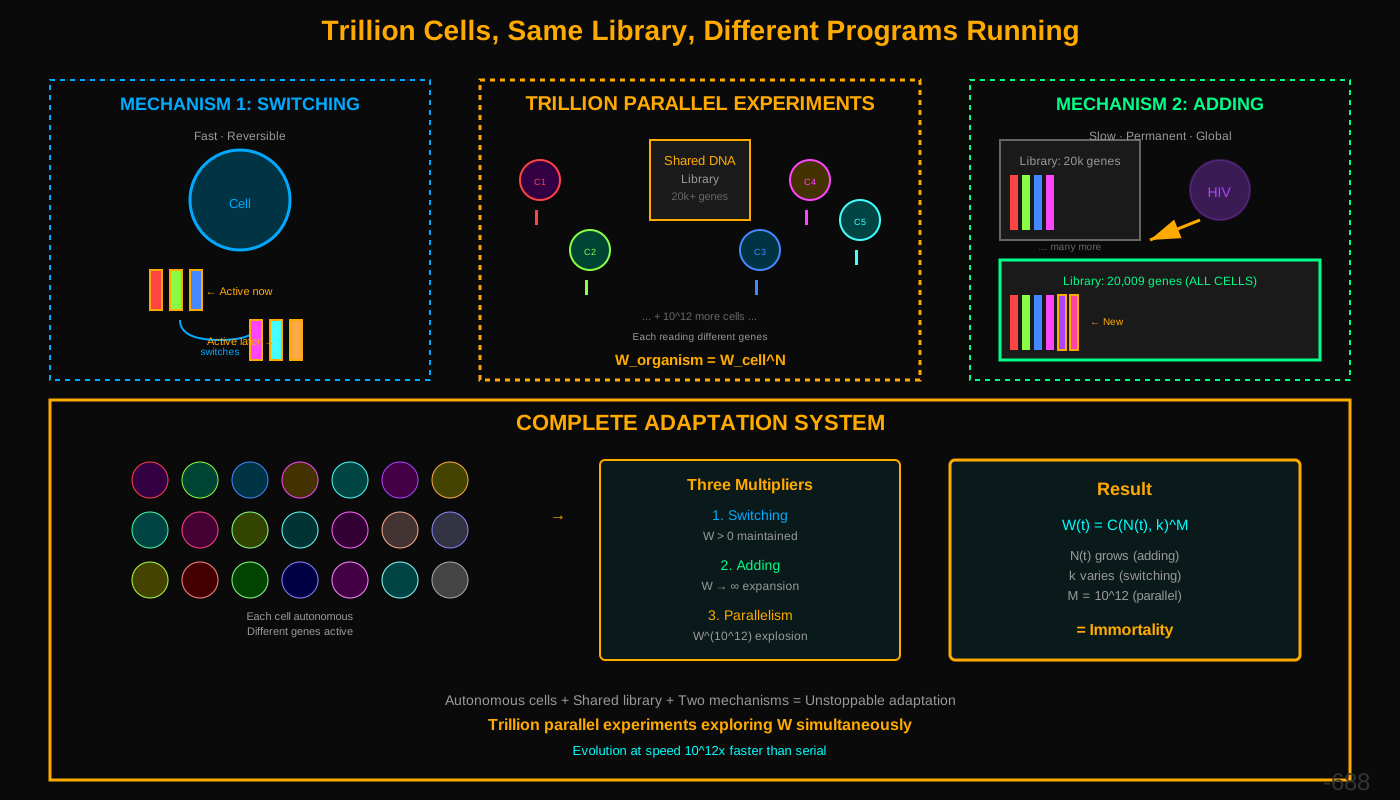
Post 688: Cells Run Different DNA - Trillion Parallel Experiments
Post 688: Cells Run Different DNA - Trillion Parallel Experiments
The Ultimate Insight
Each of your trillion cells runs different DNA programs.
No imposed coordination. Emergent cooperation.
Result: Trillion parallel experiments exploring W simultaneously.
Two mechanisms × Trillion cells = Unstoppable adaptation.
Part 1: The Core Truth
DNA = Shared Library, Not Shared Program
class Organism:
    """
    Trillion autonomous cells
    One shared library
    No central control
    """
    def __init__(self):
        self.shared_library = Genome(20000)  # Same DNA for all
        self.cells = [AutonomousCell(self.shared_library)
                      for _ in range(10**12)]  # Trillion cells

    def behavior(self):
        """
        Organism behavior = aggregate of all cell behaviors
        NOT central command
        """
        behaviors = [cell.autonomous_decision() for cell in self.cells]
        return aggregate(behaviors)
Key: Each cell has full library. Each cell reads different books.
Two Mechanisms Per Cell
class AutonomousCell:
    """
    Each cell can:
    1. Switch which DNA to read (fast)
    2. Add new DNA to library (permanent)
    """
    def __init__(self, shared_genome):
        self.library = shared_genome  # 20,000 genes available
        self.active = set()  # Which genes THIS cell reads

    def mechanism_1_switch(self):
        """Fast adaptation: change active genes"""
        self.active = self.select_for_local_context()
        # Library unchanged, selection changed

    def mechanism_2_add(self, new_genes):
        """Permanent adaptation: expand library"""
        self.library.add(new_genes)  # Now available to ALL cells
        # Library expanded, shared with all
Switching: Fast, local, reversible
Adding: Slow, global, permanent
Part 2: Mechanism 1 - Switching (Gene Expression)
Each Cell Reads Different Books
You have 20,000 genes.
Each cell active ~5,000 at any time.
Which 5,000? DIFFERENT per cell.
def autonomous_switching():
    """
    No imposed coordination between cells
    Cells can signal neighbors, but no central command
    """
    liver_cell = Cell(shared_genome)
    liver_cell.active = {'liver_genes', 'metabolic_genes'}

    brain_cell = Cell(shared_genome)  # Same genome!
    brain_cell.active = {'neuron_genes', 'synapse_genes'}

    immune_cell = Cell(shared_genome)  # Same genome!
    immune_cell.active = {'attack_genes', 'antibody_genes'}

    return {
        'same_library': True,
        'same_reading': False,
        'imposed_coordination': None,
        'emergent_cooperation': 'Possible via signaling',
        'result': 'Massive diversity from same DNA'
    }
Same library. Different selections. No imposed coordination.
W_per_cell = C(20000, 5000) ≈ 10^5000
Part 3: Mechanism 2 - Adding (Viral Fusion)
Library Expands Globally
HIV integrates genes → ALL cells get new books.
def hiv_fusion_global():
    """
    One cell integrates HIV
    All cells gain access
    """
    # Cell encounters HIV
    cell_0.library.add(hiv_genes)  # 9 new genes

    # Library is shared
    for cell in organism.cells:
        assert len(cell.library) == 20009  # All gained access

    # Each cell can now read HIV genes if needed
    cell_42.active.add('hiv_cooperation_gene')

    return {
        'integration': 'Local (one cell)',
        'library_expansion': 'Global (all cells)',
        'W_before': 'C(20000, 5000)',
        'W_after': 'C(20009, 5000)',
        'W_increase': '10^500x per cell'
    }
One cell integrates. All cells benefit.
Library grows globally. Selections remain local.
Part 4: Autonomous Cells = Parallel Evolution
The Trillion-Fold Advantage
def parallel_exploration():
    """
    Trillion cells = trillion experiments
    All running simultaneously
    """
    organism = Organism()  # 10^12 cells

    # Each cell tries different strategy
    for cell in organism.cells:
        # Autonomous decision
        cell.active = cell.decide_independently()

        # Test locally
        success = cell.test_in_local_environment()

        # Successful ones survive/signal
        if success:
            cell.signal_success_to_neighbors()

    return {
        'experiments': 10**12,  # Trillion
        'parallel': True,
        'speed': 'All at once',
        'advantage': '10^12x faster than serial',
        'W_explored': 'Exponential vs linear'
    }
Serial evolution: One organism, one experiment, one generation.
Parallel evolution: One organism, trillion experiments, one instant.
Speed difference: 10^12x
Why Autonomy Is Essential
centralized_vs_autonomous = {
    'centralized': {
        'model': 'Brain tells all cells what to do',
        'diversity': 'Zero (all do same thing)',
        'experiments': '1 per organism',
        'adaptation': 'Slow (serial search)',
        'failure_mode': 'Single point of failure'
    },

    'autonomous': {
        'model': 'Each cell decides independently',
        'diversity': 'Maximum (10^12 different strategies)',
        'experiments': '10^12 per organism',
        'adaptation': 'Fast (parallel search)',
        'failure_mode': 'Distributed resilience'
    }
}
Autonomy enables parallelism.
Parallelism enables speed.
Speed enables survival.
HIV Response Through Parallel Discovery
hiv_parallel_discovery = {
    't0': {
        'event': 'HIV detected',
        'centralized': 'Command: all cells attack',
        'autonomous': 'Each cell decides independently'
    },

    't1': {
        'centralized': 'All cells attack → escalation → death',
        'autonomous': {
            'cell_group_A': 'Attack (99.9% of cells)',
            'cell_group_B': 'Cooperate (0.1% experiment)',
            'cell_group_C': 'Ignore (some try this too)'
        }
    },

    't2': {
        'centralized': 'Dead (one strategy failed)',
        'autonomous': {
            'discovery': 'Group B succeeds (cooperation works)',
            'signal': 'Successful cells signal others',
            'adoption': 'Other cells switch to cooperation',
            'result': 'Organism survives (found solution)'
        }
    }
}
Autonomous cells can experiment.
Some discover cooperation.
Success spreads.
Organism adapts.
Part 5: The W Mathematics
Per-Cell W
W_single_cell = {
    'library': 20000,  # or 20009 after HIV
    'active': 5000,
    'combinations': 'C(20000, 5000) ≈ 10^5000'
}
Organism W (Parallel)
W_organism = {
    'cells': 10**12,
    'each_independent': True,
    'W_per_cell': 10**5000,
    'W_total': '(10^5000)^(10^12)',  # Astronomical
    'formula': 'W_organism = W_cell^N',
    'where_N': 'Number of cells',
    'result': 'Incomprehensibly large'
}
Single cell: 10^5000 states
Trillion cells in parallel: (10^5000)^(10^12) states
Organism W » Cell W
Switching + Adding + Parallelism
complete_W = {
    'switching': {
        'effect': 'Each cell explores C(N, k) states',
        'speed': 'Fast (minutes-hours)',
        'W_maintained': '> 0'
    },

    'adding': {
        'effect': 'N grows (library expands)',
        'speed': 'Permanent',
        'W_expansion': 'C(N, k) → C(N+n, k)'
    },

    'parallelism': {
        'effect': 'M cells explore simultaneously',
        'speed': 'Mx faster',
        'W_explosion': 'W^M'
    },

    'combined': {
        'formula': 'W(t) = C(N(t), k(t))^M',
        'where': {
            'N(t)': 'Library size (grows via fusion)',
            'k(t)': 'Active genes (varies via expression)',
            'M': 'Number of cells (10^12)'
        },
        'result': 'W → ∞ at impossible speed'
    }
}
Three multipliers:
- Switching: Maintains W > 0
- Adding: Expands W → ∞
- Parallelism: Accelerates W exploration by 10^12x
Together = unstoppable adaptation.
Part 6: Connections
From Post 685 (Gödel)
Gödel: System always incomplete
Post 688: Library always expandable + Cells always exploring
Both → W > 0 guaranteed
From Post 684 (Sosua)
ΔS = ln(W_fused / W_separated)
Post 688: W_fused = (10^5001)^(10^12) » W_separated
Result: ΔS massive positive → cooperation inevitable
From Post 682-683 (HIV)
HIV cooperation needed
Post 688: Autonomous cells discover it via parallel search
Result: Survival through distributed intelligence
The Formula
Organism(t) = Σ Cell_i(Library(t), Active_i(t))

where:
Library(t) = shared, grows via fusion
Active_i(t) = cell-specific, switches via expression
i = 1 to 10^12 (trillion cells)

W_organism(t) = C(|Library(t)|, k)^M

As Library(t) grows → N increases
As Active_i(t) varies → k varies per cell
As M = 10^12 → parallel exploration

Result: W → ∞ at speed 10^12x
        = Immortality through distributed adaptation
Conclusion
The Complete Picture
Your cells:
- Share one DNA library (20,000+ genes)
- Each reads different books (autonomous selection)
- Switch rapidly (gene expression)
- Add collectively (viral fusion)
- Explore in parallel (trillion experiments)
Result:
- W_per_cell ≈ 10^5000 (switching)
- W_library grows (adding)
- W_organism = (10^5000)^(10^12) (parallelism)
Outcome:
- Adaptation faster than any threat
- W never closes
- Immortality enabled
The Insight
Centralized control = one experiment = slow death
Autonomous cells = trillion experiments = instant adaptation
DNA library + Autonomous cells + Parallel evolution = Unstoppable
W > 0 (switching maintains)
W → ∞ (adding expands)
W^(10^12) (parallelism explodes)
= Eternal distributed intelligence
∞
References:
Trillion cells. Same library. Different programs. Infinite adaptation.