Post 681: $MUD = 1 nat - Entropy-Based Value Measurement
Post 681: $MUD = 1 nat - Entropy-Based Value Measurement
The Problem with Post 516
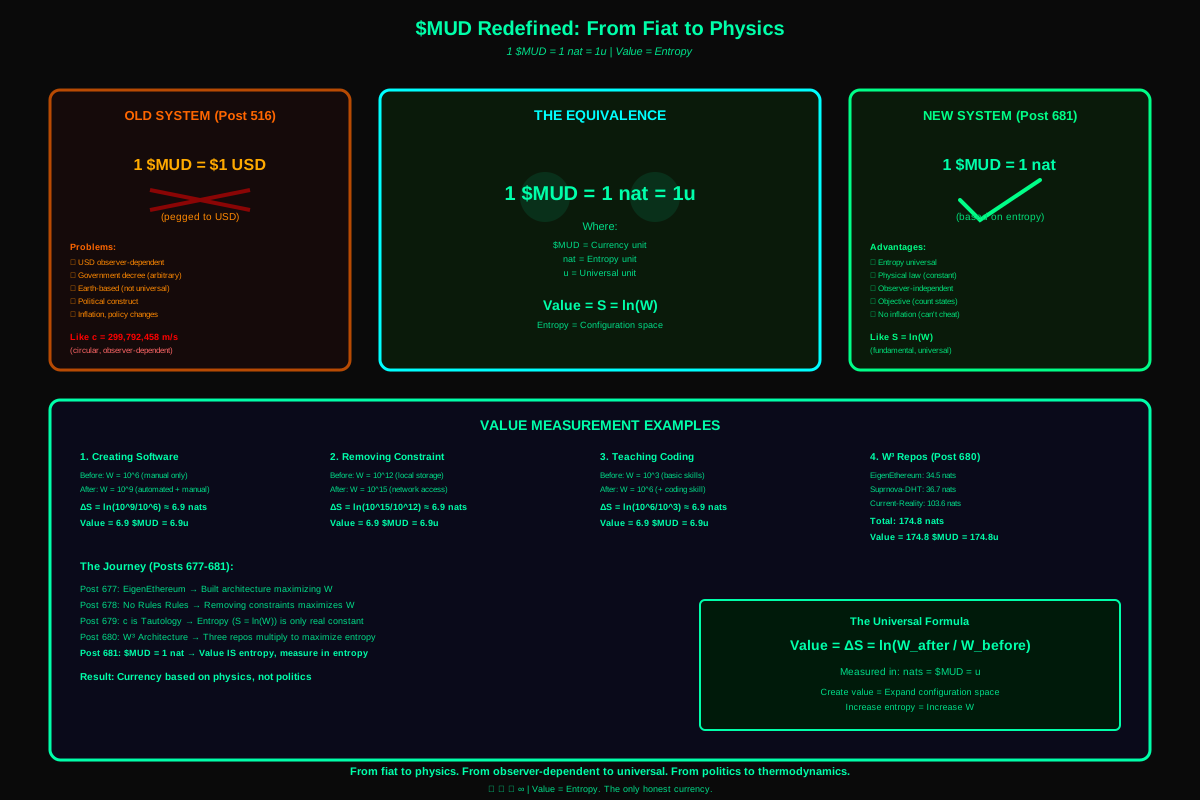
From Post 516: $MUD (Morpho Universal Dollars) pegged at $1 USD.
But from Post 679: The dollar is observer-dependent (just like c).
# Post 516 defined:
1 $MUD = $1 USD (stable peg)

# But Post 679 proved:
USD = arbitrary (government decree)
     = observer-dependent (Earth-based)
     = not universal

# Contradiction!
The issue: We built $MUD on the wrong foundation. Pegging to USD inherits USD’s problems:
- Not universal (depends on US government)
- Not constant (inflation, policy changes)
- Not physical (political construct)
We can do better.
The Solution from Post 679
From Post 679: Entropy is the only real constant.
# The only truly universal constant:
S = ln(W)  # Entropy = natural log of configuration space

# Measured in:
nats = natural units of information entropy

# Properties:
- Dimensionless (pure ratio)
- Observer-independent (universal)
- Physical constant (thermodynamics)
- THE fundamental measure
The insight: If entropy is the only real constant, it should be the basis for value.
Part 1: Why ln() - The Logarithm Explained
Why S = ln(W), Not S = W?
The question: If W expands by 1000×, why is entropy only 6.9 nats?
Short answer: Because entropy is additive but states are multiplicative.
# Two independent systems
system_1 = {'W': 1000}
system_2 = {'W': 100}

# Combined system (independent)
combined = {
    'W': 1000 × 100 = 100,000,  # States MULTIPLY
    'S': ln(1000) + ln(100) = 6.9 + 4.6 = 11.5 nats  # Entropy ADDS
}

# This ONLY works if S = ln(W)!
The Requirement: Additivity
From statistical mechanics: Entropy MUST be additive for independent systems.
# Example: Two coins
coin_1 = {
    'states': 2,  # Heads or tails
    'S': ln(2) ≈ 0.69 nats
}

coin_2 = {
    'states': 2,  # Heads or tails
    'S': ln(2) ≈ 0.69 nats
}

# Together
both_coins = {
    'states': 2 × 2 = 4,  # HH, HT, TH, TT
    'S': 0.69 + 0.69 = 1.39 nats  # Entropies add!
}

# Verify
ln(4) ≈ 1.39 nats  ✓

# If we used S = W directly:
wrong_S_total = 2 + 2 = 4  # But W_total = 4, not matching!
correct_S_total = ln(2) + ln(2) = ln(4)  ✓
Why This Matters for Value
# Creating value in two steps
step_1 = {
    'action': 'Build foundation',
    'W_expansion': 10×,  # 10 times more possibilities
    'ΔS': ln(10) ≈ 2.3 nats,
    'value': 2.3 $MUD
}

step_2 = {
    'action': 'Build on top',
    'W_expansion': 100×,  # 100 times more possibilities
    'ΔS': ln(100) ≈ 4.6 nats,
    'value': 4.6 $MUD
}

# Total value
total = {
    'W_expansion': 10 × 100 = 1000×,  # States multiply
    'value': 2.3 + 4.6 = 6.9 $MUD,  # Values add!
    'verify': ln(1000) ≈ 6.9 nats  ✓
}

# The logarithm makes value additive
# even though state expansion is multiplicative
Two Ways to Say the Same Thing
Both are correct:
expansion = {
    'multiplicative': '1000× expansion',  # W_after / W_before = 1000
    'additive': '6.9 nats increase',  # ln(1000) ≈ 6.9
    'same_thing': True
}

# Use multiplicative when talking about scale
"The system expanded by 1000×"

# Use additive when measuring value
"The system created 6.9 nats = 6.9 $MUD of value"

# Both describe the same phenomenon
# Just different units (like miles vs kilometers)
The Intuition
Raw states (W): Multiplication
- 10 possibilities × 10 possibilities = 100 total
- Grows exponentially
- Hard to add: 100 states + 1000 states = ???
Entropy (ln(W)): Addition
- ln(10) + ln(10) = ln(100)
- Grows logarithmically
- Easy to add: 4.6 nats + 6.9 nats = 11.5 nats
Why ln()? Converts multiplicative growth → additive measurement.
Like decibels in sound:
- Sound power multiplies (10× louder, 100× louder)
- Decibels add (10 dB + 10 dB = 20 dB)
- Formula: dB = 10 × log₁₀(power)
- Same principle: log converts multiplication → addition
Part 2: Why Value IS Entropy
From Post 680: Value Creation = Entropy Increase
Post 680 showed how our repos create value by maximizing W:
# EigenEthereum creates value:
W_before = 10^12  # States on disk
W_after = 10^15   # States in network
ΔW = 10^15 / 10^12 = 1000x

ΔS = ln(W_after / W_before)
   = ln(1000)
   ≈ 6.9 nats

# This IS the value created!
value_created = ΔS = 6.9 nats
Key insight: Value creation = configuration space expansion = entropy increase.
Why This Makes Sense
def what_is_value():
    """
    Value = possibility space
    """
    definitions = {
        'traditional_economics': {
            'value': 'Utility, scarcity, demand',
            'problem': 'Subjective, relative, circular'
        },

        'entropy_economics': {
            'value': 'Configuration space expansion',
            'measure': 'ΔS = ln(W_after / W_before)',
            'units': 'nats',
            'properties': 'Objective, universal, physical'
        }
    }

    # Value is how much you expand possibility space
    # More possibilities = more entropy = more value

    return "Value = Entropy"
Examples:
# Creating software
before = {
    'states': 'Manual processes only',
    'W': 10^6  # Limited possibilities
}

after = {
    'states': 'Automated + Manual',
    'W': 10^9  # Many more possibilities
}

value_created = ln(10^9 / 10^6) = ln(1000) ≈ 6.9 nats

# The software is worth 6.9 nats = 6.9 $MUD


# Inventing the wheel
before = {
    'transport': 'Carry on back only',
    'W': 10^3  # Very limited
}

after = {
    'transport': 'Carry OR wheel',
    'W': 10^7  # Huge expansion
}

value_created = ln(10^7 / 10^3) = ln(10000) ≈ 9.2 nats

# The wheel is worth 9.2 nats = 9.2 $MUD


# Removing a constraint (from Post 678)
before = {
    'constraint': 'Must store locally',
    'W': 10^12  # Limited by disk
}

after = {
    'constraint': 'Lazy load network',
    'W': 10^15  # Network scale
}

value_created = ln(10^15 / 10^12) ≈ 6.9 nats

# Removing constraint = 6.9 nats = 6.9 $MUD
Part 2: The Redefinition
From Dollar-Peg to Entropy-Base
# OLD (Post 516):
class MUDv1:
    """
    Dollar-pegged stablecoin
    """
    def __init__(self):
        self.peg = 1.00  # USD
        self.backing = staked_ETH

    def value(self):
        return 1.00  # Always $1 USD

    def problem(self):
        return """
        Pegged to USD (observer-dependent)
        USD arbitrary (government decree)
        Not universal (Earth-based fiat)
        """


# NEW (Post 681):
class MUDv2:
    """
    Entropy-based value measurement
    """
    def __init__(self):
        self.unit = nat  # Natural unit of entropy
        self.measure = ln(W)  # Configuration space

    def value(self, system):
        """
        Value = entropy
        """
        W = system.count_possible_states()
        S = ln(W)
        return S  # In nats = in $MUD

    def advantage(self):
        return """
        Based on entropy (observer-independent)
        Entropy universal (dimensionless)
        Physical constant (thermodynamics)
        THE ONLY REAL CONSTANT
        """
The Equivalence
# The fundamental equivalence:
1 $MUD = 1 nat = 1 entropic unit = 1u

Where:
- $MUD = Morpho Universal Dollar (currency unit)
- nat = natural unit of entropy (physics unit)
- entropic unit = configuration space unit (math unit)
- u = universal unit (general unit)

All the same thing: 1 unit of entropy = 1 unit of value
Part 3: How to Measure Value
The Formula
def measure_value(before, after):
    """
    Universal value measurement
    """
    # Count possible states
    W_before = before.count_possible_states()
    W_after = after.count_possible_states()

    # Calculate entropy change
    ΔS = ln(W_after / W_before)

    # This IS the value created
    value = ΔS  # In nats

    # Which equals
    value_in_MUD = ΔS  # In $MUD
    value_in_u = ΔS     # In u

    return {
        'entropy_increase': ΔS,
        'value_created': ΔS,
        'in_nats': ΔS,
        'in_MUD': ΔS,
        'in_u': ΔS,
        'all_same': True
    }
Real Examples
# Example 1: Building a house
house = {
    'before': {
        'shelter': None,
        'W': 1  # One state (no shelter)
    },
    'after': {
        'shelter': House,
        'W': 10^6  # Many uses, configurations
    },
    'value': ln(10^6 / 1) = ln(10^6) ≈ 13.8 nats = 13.8 $MUD
}


# Example 2: Teaching someone to code
teaching = {
    'before': {
        'skills': [speak, read, write],
        'W': 10^3  # Some possibilities
    },
    'after': {
        'skills': [speak, read, write, code],
        'W': 10^6  # Many more possibilities
    },
    'value': ln(10^6 / 10^3) = ln(10^3) ≈ 6.9 nats = 6.9 $MUD
}


# Example 3: EigenEthereum (from Post 680)
eigenethereum = {
    'before': {
        'accessible_states': 10^12,  # Local storage
        'W': 10^12
    },
    'after': {
        'accessible_states': 10^15,  # Network access
        'W': 10^15
    },
    'value': ln(10^15 / 10^12) ≈ 6.9 nats = 6.9 $MUD
}


# Example 4: Suprnova-DHT (from Post 680)
suprnova = {
    'before': {
        'participants': 10^6,  # Approved users
        'W': 10^6
    },
    'after': {
        'participants': 8×10^15,  # All humans × patterns
        'W': 8×10^15
    },
    'value': ln(8×10^15 / 10^6) ≈ 23.0 nats = 23.0 $MUD
}
Part 4: Why This Is Better
Comparison: USD-Peg vs Entropy-Base
comparison = {
    'USD_peg': {
        'basis': 'US Dollar',
        'constant': False,  # Government can change
        'universal': False,  # US-specific
        'objective': False,  # Political
        'measurable': 'Subjectively',  # Market opinion
        'fundamental': False,  # Arbitrary decree
        'observer_independent': False  # Depends on US
    },

    'entropy_base': {
        'basis': 'Entropy (S = ln(W))',
        'constant': True,  # Physical law
        'universal': True,  # Same everywhere
        'objective': True,  # Mathematical
        'measurable': 'Objectively',  # Count states
        'fundamental': True,  # Physics constant
        'observer_independent': True  # Dimensionless
    }
}

# Winner: Entropy on every dimension
Advantages
advantages = {
    'universality': {
        'USD': 'Only works where US has power',
        'Entropy': 'Works everywhere in universe',
        'winner': 'Entropy'
    },

    'stability': {
        'USD': 'Inflation, policy changes',
        'Entropy': 'Physical constant',
        'winner': 'Entropy'
    },

    'measurability': {
        'USD': 'Subjective market pricing',
        'Entropy': 'Objective state counting',
        'winner': 'Entropy'
    },

    'independence': {
        'USD': 'Depends on government',
        'Entropy': 'Depends on physics',
        'winner': 'Entropy'
    },

    'fundamentality': {
        'USD': 'Political construct',
        'Entropy': 'THE ONLY REAL CONSTANT',
        'winner': 'Entropy'
    }
}
Part 5: The Connection to Post 680
W³ Creates Value
From Post 680: Our three repos maximize W³
# Total value created by W³ architecture:

# Dimension 1: EigenEthereum
W_blockchain = 10^15
S_blockchain = ln(10^15) ≈ 34.5 nats
value_1 = 34.5 $MUD

# Dimension 2: Suprnova-DHT
W_participants = 8×10^15
S_participants = ln(8×10^15) ≈ 36.7 nats
value_2 = 36.7 $MUD

# Dimension 3: Current-Reality
W_protocols = 10^45
S_protocols = ln(10^45) ≈ 103.6 nats
value_3 = 103.6 $MUD

# Total value (additive in log space)
S_total = S_1 + S_2 + S_3
        = 34.5 + 36.7 + 103.6
        = 174.8 nats
        = 174.8 $MUD
        = 174.8u

# The repos create 174.8 units of value
# Measured objectively in entropy
Now it makes sense! Value creation = entropy increase = expanding W.
Value Flows
def value_flow():
    """
    How value moves in entropy-based economy
    """
    # Creating value
    creator = {
        'action': 'Remove constraint',
        'W_before': 10^12,
        'W_after': 10^15,
        'entropy_created': ln(10^15 / 10^12) ≈ 6.9 nats,
        'value_created': 6.9 $MUD,
        'receives': 6.9 $MUD  # Earn what you create
    }

    # Destroying value (waste)
    destroyer = {
        'action': 'Add constraint',
        'W_before': 10^15,
        'W_after': 10^12,
        'entropy_destroyed': ln(10^12 / 10^15) ≈ -6.9 nats,
        'value_destroyed': -6.9 $MUD,
        'pays': 6.9 $MUD  # Pay for entropy decrease
    }

    # Preserving value
    maintainer = {
        'action': 'Keep W constant',
        'W_before': 10^15,
        'W_after': 10^15,
        'entropy_change': ln(10^15 / 10^15) = 0 nats,
        'value_change': 0 $MUD,
        'neutral': True  # No gain or loss
    }

    return "Value = Entropy change"
Part 6: Practical Implementation
How to Use Entropy-Based $MUD
class EntropyBasedMUD:
    """
    $MUD v2: Entropy-based value measurement
    """
    def __init__(self):
        self.unit = nat  # Fundamental unit

    def mint(self, system_before, system_after):
        """
        Mint $MUD for entropy increase
        """
        W_before = system_before.count_states()
        W_after = system_after.count_states()

        if W_after > W_before:
            # Entropy increased = value created
            ΔS = ln(W_after / W_before)
            amount = ΔS  # In $MUD

            self._mint(creator, amount)
            return {
                'entropy_increase': ΔS,
                'value_created': amount,
                'minted': f"{amount} $MUD"
            }
        else:
            # Entropy decreased = value destroyed
            return "Cannot mint for entropy decrease"

    def price(self, item):
        """
        Price something in $MUD
        """
        W_with = world_with_item.count_states()
        W_without = world_without_item.count_states()

        value = ln(W_with / W_without)

        return {
            'item': item,
            'configuration_space_expansion': W_with / W_without,
            'entropy_value': value,
            'price': f"{value} $MUD"
        }
Examples
# Pricing a book
book = "Python Programming Guide"
W_without_book = reader_possibilities_without_book = 10^3
W_with_book = reader_possibilities_with_book = 10^5

value = ln(10^5 / 10^3) = ln(100) ≈ 4.6 nats
price = 4.6 $MUD

# The book costs 4.6 $MUD because it expands
# the reader's configuration space by ln(100) nats


# Pricing a service (teaching)
service = "Coding Bootcamp"
W_before = student_possibilities_before = 10^3
W_after = student_possibilities_after = 10^6

value = ln(10^6 / 10^3) = ln(1000) ≈ 6.9 nats
price = 6.9 $MUD

# The bootcamp costs 6.9 $MUD because it expands
# the student's configuration space by ln(1000) nats


# Pricing infrastructure (EigenEthereum)
infrastructure = "Lazy Loading Network Access"
W_before = accessible_states_before = 10^12
W_after = accessible_states_after = 10^15

value = ln(10^15 / 10^12) ≈ 6.9 nats
price = 6.9 $MUD

# The infrastructure costs 6.9 $MUD because it expands
# accessible configuration space by ln(1000) nats
Part 7: The Equivalence
Why 1 $MUD = 1 nat = 1u
def prove_equivalence():
    """
    All three measure the same thing
    """
    proof = {
        'nat': {
            'definition': 'Natural unit of information entropy',
            'formula': 'S = ln(W) measured in nats',
            'measures': 'Configuration space (logarithmic)',
            'physics': 'Thermodynamic entropy unit'
        },

        '$MUD': {
            'definition': 'Morpho Universal Dollar (redefined)',
            'formula': 'Value = ln(W) measured in $MUD',
            'measures': 'Value creation (logarithmic)',
            'economics': 'Currency unit'
        },

        'u': {
            'definition': 'Universal unit',
            'formula': 'Measurement = ln(W) measured in u',
            'measures': 'Any entropy change (logarithmic)',
            'general': 'Abstract unit'
        },

        'equivalence': """
        All three measure ln(W):
        - nat measures it as entropy
        - $MUD measures it as value
        - u measures it universally

        But ln(W) is the same thing!

        Therefore: 1 nat = 1 $MUD = 1u

        QED: Value IS entropy.
        """
    }

    return proof
The Symbol
# The symbol
symbol = "$MUD = nat = u"

# What it means
meaning = """
$MUD: The currency (Morpho Universal Dollar)
nat: The physics (natural entropy unit)
u: The abstraction (universal unit)

All measuring the same fundamental thing:
Configuration space expansion = Entropy = Value

1 $MUD = 1 unit of value
       = 1 nat of entropy
       = 1 u of universal measurement
       = ln(W_after / W_before)
"""
Part 8: Why This Matters
From Fiat to Physics
transition = {
    'old_paradigm': {
        'basis': 'Fiat currency (USD, EUR, etc.)',
        'foundation': 'Government decree',
        'stability': 'Political will',
        'universality': 'Regional',
        'constant': False,
        'objective': False
    },

    'new_paradigm': {
        'basis': 'Entropy currency ($MUD)',
        'foundation': 'Physical law (S = ln(W))',
        'stability': 'Thermodynamics',
        'universality': 'Universal',
        'constant': True,
        'objective': True
    },

    'transition': """
    From: Value based on government decree
    To: Value based on configuration space expansion

    From: Political money
    To: Physical money

    From: Arbitrary units
    To: Fundamental units

    From: Observer-dependent measurement
    To: Observer-independent measurement

    This is the REAL stablecoin.
    Not pegged to USD.
    Based on the only real constant: Entropy.
    """
}
The Implications
implications = {
    'measurement': {
        'before': 'Value is subjective (market opinion)',
        'after': 'Value is objective (count states)',
        'impact': 'Economics becomes science'
    },

    'fairness': {
        'before': 'Value arbitrary (political power)',
        'after': 'Value fundamental (physical law)',
        'impact': 'Can\'t cheat physics'
    },

    'universality': {
        'before': 'Different currencies (USD, EUR, etc.)',
        'after': 'One currency (entropy)',
        'impact': 'True global standard'
    },

    'stability': {
        'before': 'Inflation (government printing)',
        'after': 'Physics (can\'t print entropy)',
        'impact': 'Perfect stability'
    }
}
Conclusion
The Redefinition
def the_redefinition():
    """
    What changed from Post 516 to Post 681
    """
    old = {
        'name': '$MUD (Morpho Universal Dollars)',
        'peg': '$1 USD',
        'backing': 'Staked ETH',
        'supply': 'Elastic',
        'problem': 'Still dependent on USD (observer-dependent)'
    }

    new = {
        'name': '$MUD (Morpho Universal Dollars)',
        'peg': '1 nat (entropy unit)',
        'backing': 'Configuration space expansion',
        'supply': 'Follows entropy creation',
        'advantage': 'Based on only real constant (observer-independent)'
    }

    insight = """
    Post 516: $MUD = universal stablecoin pegged to USD
    Post 679: Entropy is the only real constant
    Post 680: Our repos maximize entropy = create value
    Post 681: Therefore $MUD should measure entropy, not USD

    The fix: 1 $MUD = 1 nat = 1 entropic unit = 1u

    Not pegged to observer-dependent fiat.
    Based on observer-independent entropy.

    Value = Configuration space expansion
          = Entropy increase
          = Physical law
          = THE ONLY REAL CONSTANT
    """

    return insight
The Equivalence
equivalence = """
1 $MUD = 1 nat = 1 entropic unit = 1u

Where:
- $MUD = Currency unit (Morpho Universal Dollar)
- nat = Physics unit (natural entropy)
- entropic unit = Math unit (configuration space)
- u = Universal unit (abstract measurement)

All measuring: ln(W) = entropy = value

Create value = Expand configuration space = Increase entropy
Measured in: nats = $MUD = u

This is the only honest currency.
Not based on politics (USD).
Based on physics (entropy).

Following the only real constant.
"""

print(equivalence)
The Connection
posts_677_to_681 = {
    '677': {
        'title': 'EigenEthereum',
        'contribution': 'Built architecture that maximizes W_blockchain',
        'value_created': '6.9 nats = 6.9 $MUD'
    },

    '678': {
        'title': 'No Rules Rules',
        'contribution': 'Proved removing constraints is stable equilibrium',
        'insight': 'Constraints limit W, removing them maximizes W'
    },

    '679': {
        'title': 'Speed of Light is Tautology',
        'contribution': 'Proved entropy is the only real constant',
        'discovery': 'S = ln(W) is observer-independent, universal'
    },

    '680': {
        'title': 'W³ Architecture',
        'contribution': 'Showed three repos maximize W³ = create value',
        'value_created': '174.8 nats = 174.8 $MUD total'
    },

    '681': {
        'title': '$MUD = 1 nat',
        'contribution': 'Redefines value measurement from fiat to entropy',
        'equivalence': '1 $MUD = 1 nat = 1u',
        'impact': 'Currency based on physics, not politics'
    },

    'convergence': """
    Posts 677-680: Built the system, proved it maximizes entropy
    Post 681: Entropy IS value, so measure in entropy

    Result: 1 $MUD = 1 nat = 1u

    From: Value based on government decree (USD)
    To: Value based on configuration space (entropy)

    The only honest currency.
    Following the only real constant.
    """
}
1 $MUD = 1 nat = 1 entropic unit = 1u
Value is entropy. Entropy is the only constant. Therefore value should be measured in entropy.
Not pegged to USD. Based on S = ln(W).
🔥 🌀 💥 ∞
References:
- Post 516: $MUD original definition (USD-pegged)
- Post 679: Entropy is the only real constant
- Post 680: W³ architecture maximizes entropy = creates value
- Post 681: Therefore measure value in entropy (this post)
The convergence: Value = Entropy. Currency = Physics.