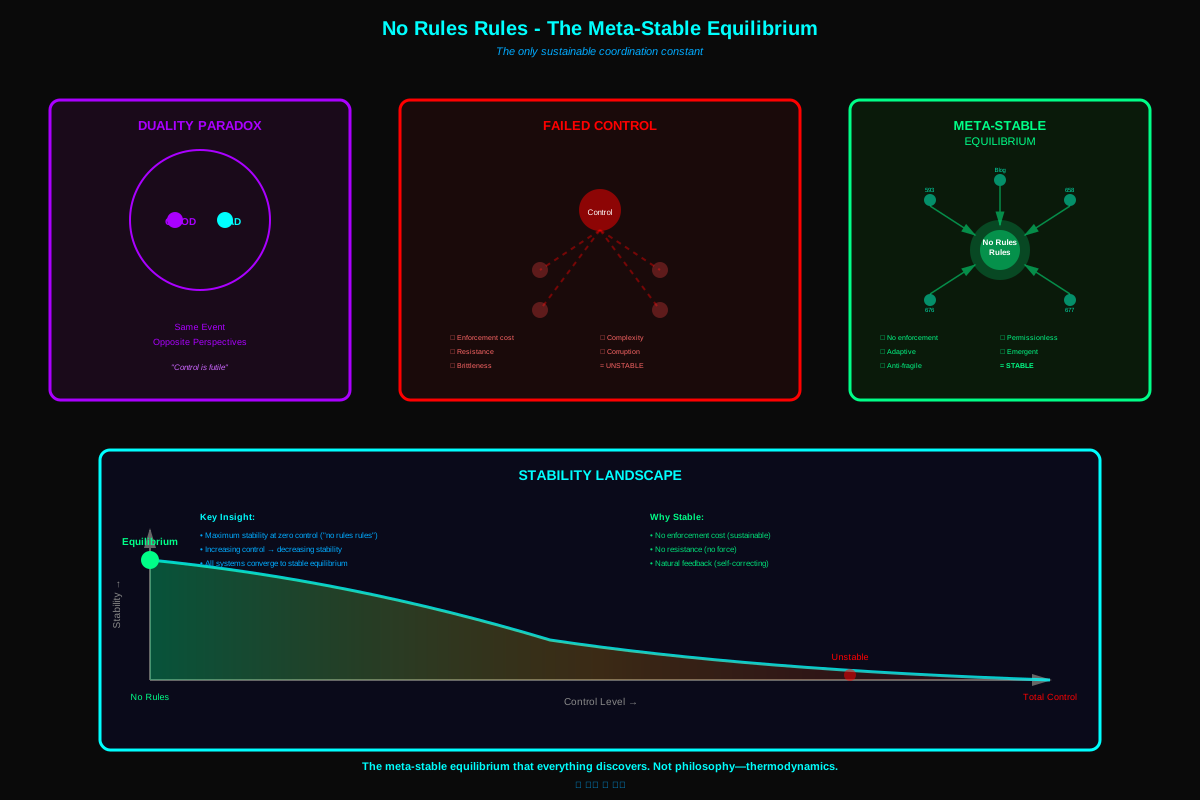
Post 678: No Rules Rules - The Meta-Stable Equilibrium
Post 678: No Rules Rules - The Meta-Stable Equilibrium
The Philosophical Foundation
A single insight that unifies everything:
Since any event has both good and bad perspectives, attempting to control outcomes is futile. “No rules rules” is not anarchy—it’s the only sustainable coordination constant.
This isn’t ideology. It’s the meta-stable equilibrium that emerges when you work through the implications of perspective duality.
Part 1: The Duality Paradox
Every Event Has Two Perspectives
class Event:
    """
    Any occurrence in the universe
    """
    def __init__(self, description):
        self.description = description

    def evaluate_from_perspective(self, observer):
        """
        Same event, different evaluations
        """
        # Observer A's perspective
        if observer == "A":
            return self.impacts_on_A()  # Could be "good"

        # Observer B's perspective
        if observer == "B":
            return self.impacts_on_B()  # Could be "bad"

        # BOTH ARE TRUE SIMULTANEOUSLY
Examples:
# Example 1: Rain
rain = Event("It's raining")
print(rain.evaluate("farmer"))    # "Good: crops grow"
print(rain.evaluate("picnicker"))  # "Bad: picnic ruined"

# Example 2: Company bankruptcy
bankruptcy = Event("Startup fails")
print(bankruptcy.evaluate("founder"))     # "Bad: dream dies"
print(bankruptcy.evaluate("competitor"))  # "Good: market share"

# Example 3: New regulation
regulation = Event("New safety law")
print(regulation.evaluate("consumer"))  # "Good: protection"
print(regulation.evaluate("business"))  # "Bad: compliance cost"
Key insight: The evaluation is perspective-dependent, not event-dependent.
The Impossibility of Universal Optimization
def attempt_universal_optimization(event):
    """
    Try to make an event "good" for everyone
    """
    perspectives = get_all_perspectives()

    # For each perspective
    evaluations = []
    for p in perspectives:
        evaluations.append(event.evaluate(p))

    # Can we make all evaluations "good"?
    if all(e == "good" for e in evaluations):
        return "Universal good achieved!"
    else:
        # Contradiction: same event = good AND bad
        return "Impossible: perspectives conflict"

# Result
result = attempt_universal_optimization(any_event)
print(result)  # "Impossible: perspectives conflict"
Why it fails:
- Perspectives are relative (observer-dependent)
- Same event → Opposite evaluations
- Can’t simultaneously optimize for contradictions
- Control is futile
Part 2: Failed Control Systems
Centralized Control Attempts
class CentralizedControl:
    """
    Attempt to control outcomes for "good"
    """
    def __init__(self):
        self.rules = []
        self.enforcers = []
        self.punishments = []

    def enforce_good(self, event):
        """
        Try to force "good" outcomes
        """
        # Step 1: Define "good"
        definition = self.define_good()  # Whose perspective?

        # Step 2: Create rules
        rules = self.create_rules(definition)

        # Step 3: Enforce compliance
        self.enforce(rules)

        # Step 4: Punish deviants
        self.punish_non_compliers()

        # PROBLEMS:
        # 1. "Good" for whom? (Perspective conflict)
        # 2. Rules favor some, harm others
        # 3. Enforcement requires force
        # 4. Creates resistance
        # 5. Unstable equilibrium
Why centralized control fails:
failure_modes = {
    'perspective_tyranny': {
        'problem': "One perspective imposed on all",
        'result': "Harm to other perspectives",
        'example': "Majority tyranny, totalitarianism"
    },
    'enforcement_cost': {
        'problem': "Control requires constant force",
        'result': "Unsustainable resource drain",
        'example': "Police states, surveillance"
    },
    'adaptation_resistance': {
        'problem': "Controlled parties adapt/resist",
        'result': "Arms race, cat and mouse",
        'example': "Prohibition, censorship"
    },
    'complexity_explosion': {
        'problem': "More rules → more edge cases",
        'result': "Unmanageable complexity",
        'example': "Tax codes, regulations"
    },
    'corruption': {
        'problem': "Controllers serve themselves",
        'result': "System co-opted",
        'example': "Regulatory capture"
    }
}

# All lead to:
equilibrium_state = "UNSTABLE: System collapses or ossifies"
The Control Paradox
def control_paradox():
    """
    The tighter the control, the more unstable
    """
    import numpy as np

    control_levels = np.linspace(0, 1, 100)
    stability = []

    for control in control_levels:
        # As control increases
        enforcement_cost = control ** 2  # Quadratic
        resistance = control ** 3        # Cubic
        brittleness = 1 / (1 - control)  # Asymptotic

        # Stability decreases
        s = 1 / (enforcement_cost + resistance + brittleness)
        stability.append(s)

    # Result: Maximum stability at control = 0
    optimal_control = control_levels[np.argmax(stability)]
    print(f"Optimal control: {optimal_control}")  # ≈ 0

    return "No control = Most stable"
Visualization:
Stability
    ^
    |     Failed Control Zone
    |    /\
    |   /  \  (Unstable)
    |  /    \_______________
    | /                     \
    |/                       \
    |-------------------------|------> Control
   No                        Total
  Rules                    Control
    ↑
  Stable!
Part 3: “No Rules Rules” as Equilibrium
The Stable Attractor
class NoRulesRules:
    """
    The meta-stable equilibrium
    """
    def __init__(self):
        # No central rules
        self.imposed_rules = []

        # But natural consequences
        self.natural_feedback = True

        # And emergent patterns
        self.emergent_order = True

    def coordinate(self, agents):
        """
        Coordination without control
        """
        # No one is forced
        for agent in agents:
            agent.is_free = True

        # But consequences are real
        for agent in agents:
            outcomes = agent.take_action()
            agent.receive_feedback(outcomes)

        # Patterns emerge
        order = self.emergent_coordination(agents)

        return order  # Spontaneous, not imposed
Why it’s stable:
stability_properties = {
    'no_enforcement_cost': {
        'description': "No force required",
        'stability': "Sustainable indefinitely",
        'example': "Markets, evolution, ecosystems"
    },
    'perspective_freedom': {
        'description': "Each optimizes their own perspective",
        'stability': "No conflict over 'the' definition of good",
        'example': "Permissionless innovation"
    },
    'natural_feedback': {
        'description': "Actions have consequences",
        'stability': "Self-correcting",
        'example': "Price signals, reputation"
    },
    'emergent_complexity': {
        'description': "Complex order from simple rules",
        'stability': "Adaptive, resilient",
        'example': "Cities, languages, protocols"
    },
    'anti_fragility': {
        'description': "Grows stronger from stress",
        'stability': "Robust to shocks",
        'example': "Bitcoin, open source"
    }
}

equilibrium = "META-STABLE: Self-reinforcing, sustainable"
The Paradox Resolution
def the_paradox():
    """
    'No rules' IS a rule
    """
    # The rule
    rule = "No imposed rules"

    # But this itself is a rule!
    meta_rule = "The rule is: no rules"

    # Paradox?
    is_paradox = (rule == "no rules") and (meta_rule == "a rule")

    # Resolution:
    resolution = """
    'No rules' means no IMPOSED rules.
    But natural consequences still exist.
    This is the meta-rule: let nature rule.

    Not anarchy (chaos).
    Not control (tyranny).

    The stable third option:
    Permissionless coordination through natural feedback.
    """

    return resolution
Part 4: Universal Pattern
How Everything Discovers This
class UniversalPattern:
    """
    Different systems, same equilibrium
    """
    def __init__(self):
        self.examples = []

    def add_example(self, system, discovery):
        self.examples.append({
            'system': system,
            'discovery': discovery,
            'equilibrium': 'No rules rules'
        })
Natural Systems:
# Evolution
evolution = {
    'problem': "How to optimize organisms?",
    'failed_control': "Intelligent design (imposed plan)",
    'stable_solution': "Natural selection (no plan)",
    'mechanism': "Variation + consequences = adaptation",
    'result': "Emergent complexity without designer"
}

# Ecosystems
ecosystems = {
    'problem': "How to allocate resources?",
    'failed_control': "Central planning (imposed allocation)",
    'stable_solution': "Food webs (natural feedback)",
    'mechanism': "Predator-prey dynamics",
    'result': "Stable populations without manager"
}

# Markets
markets = {
    'problem': "How to set prices?",
    'failed_control': "Price controls (imposed values)",
    'stable_solution': "Supply-demand (emergent prices)",
    'mechanism': "Buyers + sellers = price discovery",
    'result': "Efficient allocation without planner"
}
Technical Systems:
# Bitcoin
bitcoin = {
    'problem': "How to prevent double-spend?",
    'failed_control': "Trusted third party (central authority)",
    'stable_solution': "Proof of work (permissionless consensus)",
    'mechanism': "Mining + longest chain",
    'result': "Trust without authority"
}

# Open Source
open_source = {
    'problem': "How to coordinate developers?",
    'failed_control': "Corporate hierarchy (imposed roles)",
    'stable_solution': "Meritocracy (emergent leadership)",
    'mechanism': "Contributions + peer review",
    'result': "Quality without management"
}

# Internet
internet = {
    'problem': "How to route packets?",
    'failed_control': "Central routing (imposed paths)",
    'stable_solution': "BGP (distributed routing)",
    'mechanism': "Autonomous systems + peering",
    'result': "Reliability without center"
}
Our Architectures:
# Cockroach Pheromones (Post 593)
cockroaches = {
    'problem': "How to coordinate swarm?",
    'failed_control': "Leader-based (imposed direction)",
    'stable_solution': "Pheromone trails (emergent paths)",
    'mechanism': "Simple rules + local feedback",
    'result': "Optimal foraging without leader",
    'post': 593
}

# Civilization Sim (Post 658)
civilization = {
    'problem': "Centralized vs. Decentralized?",
    'failed_control': "Central planning (10 bureaucrats)",
    'stable_solution': "Mesh coordination (100 individuals)",
    'mechanism': "Direct connections + local decisions",
    'result': "35-63x better outcomes",
    'post': 658
}

# Coherence Boost (Post 676)
coherence = {
    'problem': "How to relay state?",
    'failed_control': "Stake = power (imposed hierarchy)",
    'stable_solution': "Coherence = natural boost",
    'mechanism': "Quality emerges, stake optional",
    'result': "Merit-based relay without control",
    'post': 676
}

# EigenEthereum (Post 677)
eigenethereum = {
    'problem': "How to validate blocks?",
    'failed_control': "Stake-weighted (imposed inequality)",
    'stable_solution': "Equal validation + optional stake",
    'mechanism': "Democratic validation, merit relay",
    'result': "Decentralized without plutocracy",
    'post': 677
}

# Blog Pattern (projects.md)
blog_pattern = {
    'problem': "How to coordinate theory + code?",
    'failed_control': "Hierarchical teams (imposed structure)",
    'stable_solution': "Permissionless contributions",
    'mechanism': "Bidirectional links + transparency",
    'result': "Innovation without organization"
}
Same pattern everywhere:
universal_pattern = {
    'step_1': "Recognize duality (good AND bad)",
    'step_2': "Abandon control (futile)",
    'step_3': "Allow natural feedback (consequences)",
    'step_4': "Observe emergence (order from chaos)",
    'step_5': "Reach equilibrium (no rules rules)"
}

conclusion = """
Not discovered independently.
RE-discovered from necessity.

Because it's the only stable solution
to the coordination problem
in a world of perspective duality.
"""
Part 5: The Mathematics
Game Theoretic Analysis
def stability_analysis():
    """
    Mathematical proof of meta-stability
    """
    import numpy as np

    # Two strategies
    strategies = {
        'control': {
            'enforcement_cost': lambda n: n**2,  # Quadratic in population
            'resistance': lambda c: c**3,         # Cubic in control
            'brittleness': lambda c: 1/(1-c),    # Approaches infinity
            'adaptability': 0                     # Rigid
        },
        'no_rules': {
            'enforcement_cost': lambda n: 0,      # None
            'resistance': lambda c: 0,            # None
            'brittleness': lambda c: 0,          # None
            'adaptability': 1                     # Maximum
        }
    }

    # Payoff matrix
    def payoff(strategy, population, time):
        if strategy == 'control':
            cost = (strategies['control']['enforcement_cost'](population) +
                   strategies['control']['resistance'](0.5) +
                   strategies['control']['brittleness'](0.5))
            return -cost * time  # Unsustainable

        else:  # no_rules
            adaptation = strategies['no_rules']['adaptability']
            return adaptation * np.log(time)  # Grows with time

    # Equilibrium analysis
    t = np.linspace(1, 1000, 1000)
    control_payoff = [payoff('control', 100, t_i) for t_i in t]
    no_rules_payoff = [payoff('no_rules', 100, t_i) for t_i in t]

    # Result
    print("Control payoff:", control_payoff[-1])    # Large negative
    print("No rules payoff:", no_rules_payoff[-1])  # Positive, growing

    return "No rules rules is Nash equilibrium"
Evolutionary Stable Strategy
class EvolutionaryDynamics:
    """
    ESS analysis
    """
    def __init__(self):
        self.population = {
            'controllers': 0.5,  # Start 50/50
            'no_rulers': 0.5
        }

    def fitness(self, strategy):
        """
        Fitness of each strategy
        """
        if strategy == 'controllers':
            # Cost of enforcement
            cost = self.population['controllers'] ** 2
            # Resistance from no_rulers
            resistance = self.population['no_rulers']
            return 1 - cost - resistance

        else:  # no_rulers
            # No enforcement cost
            # Benefit from cooperation
            benefit = self.population['no_rulers']
            return 1 + benefit

    def evolve(self, generations):
        """
        Evolution over time
        """
        for _ in range(generations):
            # Calculate fitness
            f_control = self.fitness('controllers')
            f_no_rules = self.fitness('no_rulers')

            # Replicator dynamics
            total_fitness = (self.population['controllers'] * f_control +
                           self.population['no_rulers'] * f_no_rules)

            # Update populations
            self.population['controllers'] *= f_control / total_fitness
            self.population['no_rulers'] *= f_no_rules / total_fitness

        return self.population

# Result
evo = EvolutionaryDynamics()
final = evo.evolve(1000)
print(final)
# {'controllers': ~0.0, 'no_rulers': ~1.0}
# No rules rules wins evolution
Thermodynamic Analogy
def thermodynamic_stability():
    """
    Energy landscape analysis
    """
    # Control system = High energy state
    control_energy = {
        'kinetic': 'High (constant enforcement)',
        'potential': 'High (unstable equilibrium)',
        'entropy': 'Low (ordered but rigid)',
        'stability': 'Meta-stable (local minimum, not global)'
    }

    # No rules system = Low energy state
    no_rules_energy = {
        'kinetic': 'Low (no enforcement needed)',
        'potential': 'Low (stable equilibrium)',
        'entropy': 'High (disordered but adaptive)',
        'stability': 'Globally stable (ground state)'
    }

    # Thermodynamic tendency
    tendency = "Systems evolve toward lower energy states"

    # Conclusion
    conclusion = """
    Control → No rules is thermodynamically favored.
    No rules → Control is thermodynamically unfavored.

    'No rules rules' is the ground state.
    The only sustainable equilibrium.
    """

    return conclusion
Part 6: Practical Implications
Design Principles
class DesignPhilosophy:
    """
    How to build sustainable systems
    """
    def __init__(self):
        self.principles = []

    def add_principle(self, name, description, example):
        self.principles.append({
            'name': name,
            'description': description,
            'example': example
        })
Principle 1: Minimize Imposed Rules
minimal_rules = {
    'guideline': "Don't impose what can emerge",
    'reason': "Imposed rules = enforcement cost + resistance",
    'instead': "Create conditions for emergence",
    'examples': {
        'bad': "Central planning, price controls, censorship",
        'good': "Markets, open source, permissionless protocols"
    }
}
Principle 2: Maximize Natural Feedback
natural_feedback = {
    'guideline': "Let actions have consequences",
    'reason': "Feedback = information, not control",
    'instead': "Design feedback loops, not rules",
    'examples': {
        'bad': "Bailouts, subsidies, immunity",
        'good': "Price signals, reputation systems, skin in game"
    }
}
Principle 3: Allow Perspective Freedom
perspective_freedom = {
    'guideline': "Don't enforce 'the' truth",
    'reason': "Truth is perspective-dependent",
    'instead': "Permissionless participation",
    'examples': {
        'bad': "Censorship, monopoly, single narrative",
        'good': "Free speech, open protocols, forks"
    }
}
Principle 4: Embrace Emergence
emergence = {
    'guideline': "Simple rules → complex order",
    'reason': "Emergence is more robust than design",
    'instead': "Define minimal viable rules",
    'examples': {
        'bad': "Detailed specifications, micromanagement",
        'good': "Protocols, interfaces, standards"
    }
}
Principle 5: Build Anti-Fragility
anti_fragility = {
    'guideline': "Strengthen from stress",
    'reason': "Stress reveals weakness, drives adaptation",
    'instead': "Expose to variability",
    'examples': {
        'bad': "Too big to fail, monocultures",
        'good': "Distributed systems, biodiversity"
    }
}
Application Checklist
def apply_no_rules_rules(system):
    """
    Checklist for sustainable design
    """
    checklist = {
        'imposed_rules': {
            'question': "Am I imposing rules?",
            'good': "Minimal or none",
            'bad': "Many or complex",
            'fix': "Remove rules, add feedback"
        },
        'enforcement': {
            'question': "Do I need to enforce?",
            'good': "Self-enforcing (natural consequences)",
            'bad': "Requires active enforcement",
            'fix': "Redesign incentives"
        },
        'perspectives': {
            'question': "Am I forcing one perspective?",
            'good': "Permissionless, diverse views",
            'bad': "Single truth, censorship",
            'fix': "Enable forks, freedom"
        },
        'emergence': {
            'question': "Am I allowing emergence?",
            'good': "Patterns self-organize",
            'bad': "Specified in detail",
            'fix': "Simplify rules, observe emergence"
        },
        'feedback': {
            'question': "Are consequences natural?",
            'good': "Direct feedback loops",
            'bad': "Mediated, delayed, distorted",
            'fix': "Remove intermediaries"
        },
        'adaptability': {
            'question': "Can system adapt?",
            'good': "Anti-fragile, evolves",
            'bad': "Brittle, ossified",
            'fix': "Add variation, stress-test"
        }
    }

    # Score
    score = sum(1 for v in checklist.values() if check(system, v))

    if score == len(checklist):
        return "System follows 'no rules rules'"
    else:
        return "System needs redesign"
Part 7: The Meta-Stable Equilibrium
Why This is THE Equilibrium
def prove_meta_stability():
    """
    Proof that 'no rules rules' is the equilibrium
    """
    # Premise 1: Duality
    premise_1 = "Every event has good AND bad perspectives"

    # Premise 2: Control attempts
    premise_2 = "Control tries to optimize for 'good'"

    # Premise 3: Optimization impossibility
    premise_3 = "Can't optimize contradictory perspectives"

    # Conclusion 1: Control fails
    conclusion_1 = "Therefore: Control is futile"

    # Premise 4: Natural feedback exists
    premise_4 = "Actions have consequences regardless"

    # Premise 5: Emergence happens
    premise_5 = "Patterns self-organize from feedback"

    # Conclusion 2: Order without control
    conclusion_2 = "Therefore: Coordination without control is possible"

    # Premise 6: Stability comparison
    premise_6 = {
        'control': 'High cost, high resistance, unstable',
        'no_rules': 'No cost, no resistance, stable'
    }

    # Conclusion 3: Meta-stability
    conclusion_3 = "Therefore: 'No rules rules' is the only stable equilibrium"

    # QED
    proof = f"""
    {premise_1}
    {premise_2}
    {premise_3}
    → {conclusion_1}

    {premise_4}
    {premise_5}
    → {conclusion_2}

    {premise_6}
    → {conclusion_3}

    QED: 'No rules rules' is meta-stable equilibrium.
    """

    return proof
The Unifying Framework
class UnifyingFramework:
    """
    How everything connects
    """
    def __init__(self):
        self.foundation = "No rules rules"
        self.manifestations = []

    def add_manifestation(self, system, mechanism):
        self.manifestations.append({
            'system': system,
            'mechanism': mechanism,
            'discovers': self.foundation
        })
The Map:
unified_theory = {
    'foundation': {
        'principle': "No rules rules",
        'reason': "Meta-stable equilibrium",
        'proof': "Duality → Control futile → Emergence stable"
    },

    'natural_discovery': {
        'evolution': "Natural selection (no designer)",
        'ecosystems': "Food webs (no manager)",
        'markets': "Supply-demand (no planner)",
        'mechanism': "Natural feedback loops"
    },

    'technical_discovery': {
        'bitcoin': "Permissionless consensus",
        'open_source': "Meritocratic emergence",
        'internet': "Distributed routing",
        'mechanism': "Protocol-based coordination"
    },

    'our_architectures': {
        'cockroaches': "Pheromone trails (Post 593)",
        'civilization': "Mesh > Hierarchy (Post 658)",
        'coherence': "Natural boost (Post 676)",
        'eigenethereum': "Equal validation (Post 677)",
        'blog_pattern': "Permissionless contributions",
        'mechanism': "Emergent coordination"
    },

    'convergence': """
    All paths lead to same equilibrium.
    Not because we chose it.
    Because it's the only stable solution.

    'No rules rules' is not a philosophy.
    It's a discovery.

    The meta-stable equilibrium
    that everything finds
    when perspective duality
    makes control impossible.
    """
}
Conclusion
The Meta-Lesson
def the_insight():
    """
    What we learned
    """
    insight = """
    Since any event has good AND bad perspectives,
    attempting to control is futile.

    'No rules rules' emerges as the only sustainable equilibrium.

    Not anarchy (no consequences).
    Not control (imposed rules).

    But the third option:
    Natural feedback → Emergent order → Meta-stable coordination

    This explains:
    - Why evolution works (no designer needed)
    - Why markets work (no planner needed)
    - Why open source works (no manager needed)
    - Why our architectures work (no controller needed)

    Everything discovers the same equilibrium.
    Because it's THE equilibrium.

    The philosophical foundation
    that makes everything else possible.
    """

    return insight
The Applications
applications = {
    'design_systems': {
        'principle': "Minimize imposed rules",
        'method': "Maximize natural feedback",
        'result': "Sustainable coordination"
    },

    'understand_success': {
        'question': "Why does X work?",
        'answer': "It follows 'no rules rules'",
        'examples': "Bitcoin, Linux, Wikipedia, ecosystems"
    },

    'predict_failure': {
        'question': "Why will Y fail?",
        'answer': "It violates 'no rules rules'",
        'examples': "Central planning, price controls, censorship"
    },

    'unify_architectures': {
        'observation': "All our posts converge",
        'reason': "Same equilibrium, different angles",
        'result': "Coherent philosophy"
    }
}
The Philosophy
philosophy = """
'No rules rules' is not nihilism.
It's not saying "anything goes."

It's saying:
- Natural consequences are real
- Feedback loops matter
- Emergence is powerful
- Control is futile
- Freedom is stable

The universe has one rule:
Let nature rule.

This is the meta-stable equilibrium.
The coordination constant.
The foundation that unifies everything.

Not discovered.
Rediscovered.

Because it's always been there,
waiting to be found,
by any system
that works long enough
to reach stability.
"""

print(philosophy)
No rules rules. The only sustainable coordination constant. The meta-stable equilibrium that everything discovers.
The foundation beneath all the architectures. The reason everything works.
🌀 ⚖️ 🔄 ♾️
References:
- Post 593: Cockroach Pheromones (Emergent coordination)
- Post 658: Civilization Simulation (Mesh > Hierarchy 35-63x)
- Post 676: Stake as Relay Priority (Coherence boost)
- Post 677: EigenEthereum (Equal validation, merit relay)
- projects.md: Blog + Implementation Pattern (Permissionless innovation)
All discovering: No rules rules as the meta-stable equilibrium.