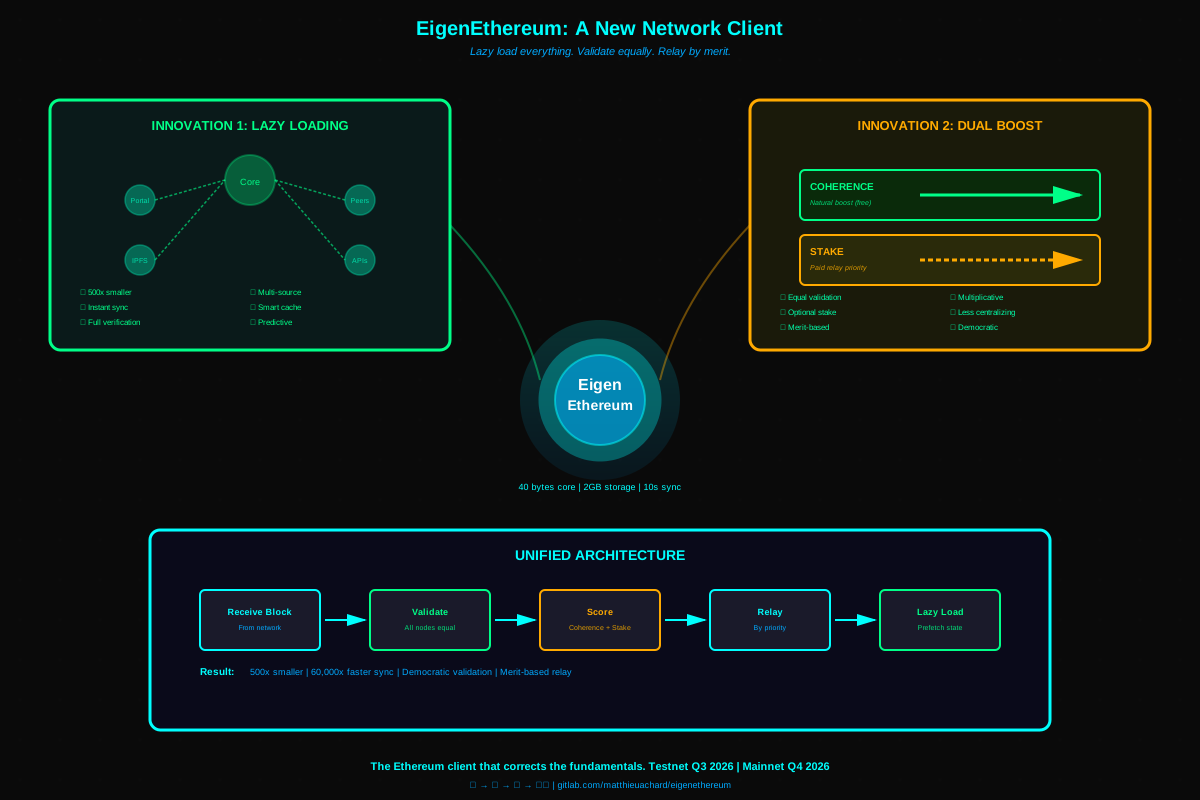
Post 677: EigenEthereum - A New Network Client
Post 677: EigenEthereum - A New Network Client
What Is EigenEthereum?
A next-generation Ethereum network client that corrects two fundamental misconceptions in current client design:
- Storage misconception: Thinking you must store everything locally
- Staking misconception: Thinking stake equals validation power
EigenEthereum solves both with two core innovations:
- Lazy Loading Architecture: Store almost nothing, verify everything
- Coherence-Stake Dual Boost: Proper separation of validation and relay
Innovation 1: Lazy Loading Architecture
The Problem With Current Clients
class TraditionalEthereumClient:
    """
    Geth, Nethermind, Besu, etc.
    """
    def __init__(self):
        self.full_blockchain = BlockchainDB()    # 1TB+
        self.full_state = StateDB()               # 100GB+
        self.full_receipts = ReceiptDB()          # 50GB+
        self.full_transaction_pool = TxPool()    # 1GB+

        # Total: >1TB storage
        # RAM: 16GB+
        # Sync time: Days to weeks

    def get_balance(self, address):
        # Fast local lookup
        return self.full_state.get(address).balance
Problems:
- Massive storage requirements
- Long sync times
- High barrier to entry
- Centralization pressure
EigenEthereum’s Solution
class EigenEthereumClient:
    """
    Lazy load everything, verify everything
    """
    def __init__(self):
        # Minimal core
        self.state_root = None              # 32 bytes
        self.block_number = 0               # 8 bytes
        self.header_chain = HeaderChain()   # ~10MB

        # Smart infrastructure
        self.cache = SmartCache(size='1GB')
        self.data_sources = MultiSourceFetcher()
        self.prefetcher = PredictivePrefetcher()

        # Total: <2GB storage
        # RAM: <500MB
        # Sync time: <10 seconds

    async def get_balance(self, address):
        # Check cache first
        if address in self.cache:
            return self.cache[address].balance

        # Lazy fetch with proof
        account_data = await self.data_sources.fetch_account(
            address,
            state_root=self.state_root
        )

        # Verify merkle proof
        if not self.verify_proof(account_data):
            raise ValueError("Invalid proof from data source")

        # Cache it
        self.cache.set(address, account_data)

        return account_data.balance
Benefits:
- 500x smaller storage
- Instant sync
- Lower barrier to entry
- Still fully verifies everything
Innovation 2: Coherence-Stake Dual Boost
The Problem With Current PoS
class TraditionalProofOfStake:
    """
    Conflates validation with relay
    """
    def __init__(self):
        self.validators = {}

    def select_validator(self):
        # More stake = more power
        return weighted_random_choice(
            validators=self.validators,
            weights=self.get_stakes()
        )

    def validate_block(self, block):
        # Validation weight based on stake
        validator_stake = self.validators[block.proposer].stake
        # This is wrong!
Problems:
- Conflates economic security with correctness
- Centralization (stake = power)
- Plutocracy (rich get richer)
- High capital requirements
EigenEthereum’s Solution
class EigenConsensus:
    """
    Separate validation from relay
    """
    def __init__(self):
        self.coherence_evaluator = CoherenceEvaluator()
        self.stake_registry = StakeRegistry()
        self.relay_scheduler = RelayScheduler()

    def validate_state(self, state):
        """
        Validation: Everyone equal, stake irrelevant
        """
        # All nodes validate equally
        return (
            state.proofs_valid() and
            state.transactions_valid() and
            state.signatures_valid() and
            state.state_root_matches()
        )
        # Stake doesn't affect this!

    def calculate_relay_priority(self, state, node):
        """
        Relay: Based on coherence + stake
        """
        # Two independent boosts
        coherence = self.coherence_evaluator.score(state)
        stake = self.stake_registry.get_stake(node)

        if coherence > THRESHOLD and stake > 0:
            # Multiplicative boost (synergy)
            return coherence * stake
        else:
            # Additive otherwise
            return coherence + stake
Benefits:
- Democratic validation (everyone equal)
- Optional stake (not required)
- Coherent state succeeds without stake
- Coherent + staked = maximum advantage
- Less centralizing
How They Work Together
The Complete EigenEthereum Architecture
class EigenEthereum:
    """
    Complete client implementation
    """
    def __init__(self):
        # Layer 1: Minimal Storage
        self.storage = MinimalStorage()

        # Layer 2: Lazy Loading
        self.lazy_loader = LazyLoader(
            cache=SmartCache('1GB'),
            sources=MultiSourceFetcher(),
            prefetcher=PredictivePrefetcher()
        )

        # Layer 3: Consensus
        self.consensus = EigenConsensus(
            coherence_eval=CoherenceEvaluator(),
            stake_registry=StakeRegistry(),
            relay_scheduler=RelayScheduler()
        )

        # Layer 4: Network
        self.network = P2PNetwork(
            relay_priority=self.consensus.relay_scheduler,
            bandwidth_optimizer=BandwidthOptimizer()
        )

    async def start(self):
        """
        Start the client
        """
        # 1. Connect to network
        await self.network.connect()

        # 2. Fetch latest header (instant sync)
        latest = await self.lazy_loader.fetch_latest_header()
        self.storage.state_root = latest.state_root
        self.storage.block_number = latest.number

        # 3. Start listening for new blocks
        asyncio.create_task(self.listen_for_blocks())

        # 4. Start RPC server
        asyncio.create_task(self.start_rpc())

        print(f"EigenEthereum ready!")
        print(f"Block: {self.storage.block_number}")
        print(f"Storage: {self.storage.size()}")
        print(f"Memory: {self.get_memory_usage()}")

    async def process_incoming_block(self, block, from_node):
        """
        Process new block using dual-boost system
        """
        # Step 1: Validate (stake irrelevant)
        if not self.consensus.validate_state(block):
            return False  # Reject

        # Step 2: Evaluate coherence
        coherence = self.consensus.coherence_evaluator.score(block)

        # Step 3: Check node stake
        stake = self.consensus.stake_registry.get_stake(from_node)

        # Step 4: Calculate relay priority
        priority = self.consensus.calculate_relay_priority(block, from_node)

        # Step 5: Schedule relay based on priority
        await self.network.relay(block, priority=priority)

        # Step 6: Lazy load any needed state
        await self.lazy_loader.prefetch_for_block(block)

        return True
The Coherence Evaluator
What Makes State “Coherent”?
class CoherenceEvaluator:
    """
    Evaluates state coherence for relay priority
    """
    def score(self, state):
        """
        Calculate coherence score
        """
        scores = {
            'economic': self.economic_sustainability(state),
            'computational': self.computational_efficiency(state),
            'social': self.social_alignment(state)
        }

        # Weighted average
        coherence = (
            scores['economic'] * 0.5 +
            scores['computational'] * 0.3 +
            scores['social'] * 0.2
        )

        return coherence

    def economic_sustainability(self, state):
        """
        Is this state economically sustainable?
        """
        checks = {
            'gas_prices': self.check_gas_rational(state),
            'supply_demand': self.check_balanced(state),
            'rewards': self.check_sustainable_rewards(state),
            'no_exploits': self.check_no_obvious_exploits(state)
        }

        return sum(checks.values()) / len(checks)

    def computational_efficiency(self, state):
        """
        Is this state efficient to process?
        """
        return min(1.0, IDEAL_STATE_SIZE / state.size()) * (
            IDEAL_VERIFY_TIME / state.verification_time()
        )

    def social_alignment(self, state):
        """
        Does this state align with network values?
        """
        checks = {
            'no_spam': not self.contains_spam(state),
            'beneficial': self.is_beneficial(state),
            'respects_norms': self.respects_network_norms(state)
        }

        return sum(checks.values()) / len(checks)
Key insight: Coherent state propagates fast without stake because nodes want to relay it.
The Lazy Loading System
Multi-Source Fetching
class MultiSourceFetcher:
    """
    Fetch data from multiple sources for reliability
    """
    def __init__(self):
        self.sources = {
            'portal_network': PortalNetworkClient(),
            'trusted_peers': TrustedPeerSet(),
            'archive_apis': ArchiveAPISet(),
            'ipfs': IPFSClient()
        }

    async def fetch_account(self, address, state_root):
        """
        Try sources in order of preference
        """
        # 1. Portal Network (decentralized, preferred)
        try:
            data = await self.sources['portal_network'].get_proof(
                address, state_root
            )
            if self.verify_proof(data, state_root):
                return data
        except Exception:
            pass

        # 2. Trusted peers (reliable)
        try:
            data = await self.sources['trusted_peers'].get_proof(
                address, state_root
            )
            if self.verify_proof(data, state_root):
                return data
        except Exception:
            pass

        # 3. Archive APIs (centralized but works)
        data = await self.sources['archive_apis'].get_proof(
            address, state_root
        )

        # Always verify even from centralized source!
        if not self.verify_proof(data, state_root):
            raise ValueError("Invalid proof from archive API")

        return data
Predictive Prefetching
class PredictivePrefetcher:
    """
    Predict and prefetch what will be needed
    """
    def __init__(self):
        self.patterns = PatternLearner()

    async def prefetch_for_block(self, block):
        """
        Prefetch state likely to be queried
        """
        predictions = []

        # 1. Accounts in transactions
        for tx in block.transactions:
            predictions.append(tx.from_address)
            predictions.append(tx.to_address)

        # 2. Popular contracts
        popular = self.patterns.get_popular_contracts()
        predictions.extend(popular)

        # 3. Related accounts (learned patterns)
        for addr in predictions[:]:
            related = self.patterns.get_related(addr)
            predictions.extend(related)

        # 4. Batch fetch in background
        asyncio.create_task(self.batch_fetch(predictions))

    async def batch_fetch(self, addresses):
        """
        Fetch multiple accounts efficiently
        """
        # Batch request (100 at a time)
        for batch in chunks(addresses, 100):
            await self.fetcher.get_proofs_batch(batch)
The Relay Scheduler
Priority-Based Relaying
class RelayScheduler:
    """
    Schedule state relay based on coherence + stake priority
    """
    def __init__(self):
        self.queue = PriorityQueue()
        self.bandwidth_limit = NETWORK_BANDWIDTH

    def add(self, state, priority):
        """
        Add state to relay queue with priority
        """
        self.queue.put((-priority, state))  # Higher priority first

    async def relay_cycle(self):
        """
        Relay states in priority order
        """
        bandwidth_used = 0
        states_relayed = []

        while bandwidth_used < self.bandwidth_limit:
            if self.queue.empty():
                break

            priority, state = self.queue.get()

            # Relay to peers
            await self.network.broadcast(state)

            bandwidth_used += state.size()
            states_relayed.append((state, -priority))

        return states_relayed
Result: High-coherence + high-stake states propagate fastest. Low-priority states might be delayed or dropped.
Economic Model
Three Classes of Validators
class ValidatorEconomics:
    """
    Economic equilibrium in EigenEthereum
    """
    def analyze(self):
        classes = {
            'coherent_unstaked': {
                'state_quality': 'High (coherent)',
                'stake': 'None',
                'propagation': 'Fast (natural boost)',
                'cost': 'Low (no capital locked)',
                'revenue': 'Medium (some blocks)',
                'roi': 'Good',
                'viability': 'Sustainable',
                'example': 'Hobbyist validators, small operations'
            },
            'incoherent_staked': {
                'state_quality': 'Low (incoherent)',
                'stake': 'High',
                'propagation': 'Medium (stake boost only)',
                'cost': 'Very high (stake + likely rejected)',
                'revenue': 'Low (state rejected)',
                'roi': 'Negative',
                'viability': 'Not sustainable',
                'example': 'Spam, attacks (filtered out)'
            },
            'coherent_staked': {
                'state_quality': 'High (coherent)',
                'stake': 'High',
                'propagation': 'Maximum (double boost)',
                'cost': 'Medium (stake but compensated)',
                'revenue': 'High (many blocks)',
                'roi': 'Excellent',
                'viability': 'Highly sustainable',
                'example': 'Professional validators, institutions'
            }
        }

        equilibrium = """
        Natural equilibrium:
        1. Incoherent nodes fail (even with stake)
        2. Coherent nodes succeed (even without stake)
        3. Coherent + staked nodes dominate (multiplicative advantage)

        Market rewards:
        - Quality (coherence)
        - Capital commitment (stake)
        - Both together (synergy)

        But quality alone is sufficient.
        """

        return classes, equilibrium
Performance Characteristics
EigenEthereum vs Traditional Clients
def performance_comparison():
    """
    Detailed comparison
    """
    comparison = {
        'storage': {
            'geth': '1000 GB',
            'nethermind': '800 GB',
            'besu': '900 GB',
            'eigenethereum': '2 GB',
            'improvement': '400-500x smaller'
        },
        'memory': {
            'geth': '16 GB',
            'nethermind': '12 GB',
            'besu': '14 GB',
            'eigenethereum': '0.5 GB',
            'improvement': '24-32x smaller'
        },
        'sync_time': {
            'geth': '5-7 days',
            'nethermind': '3-5 days',
            'besu': '4-6 days',
            'eigenethereum': '10 seconds',
            'improvement': '40,000-60,000x faster'
        },
        'query_latency': {
            'geth': '<1 ms (local)',
            'nethermind': '<1 ms (local)',
            'besu': '<1 ms (local)',
            'eigenethereum': '10-100 ms (network + verify)',
            'tradeoff': '10-100x slower per query'
        },
        'validation': {
            'traditional_pos': 'Weighted by stake',
            'eigenethereum': 'All nodes equal',
            'advantage': 'More decentralized'
        },
        'relay': {
            'traditional_pos': 'Implicit gossip',
            'eigenethereum': 'Explicit priority market',
            'advantage': 'More efficient'
        }
    }

    return comparison
Use Cases
Who Should Use EigenEthereum?
def use_cases():
    """
    Ideal users and scenarios
    """
    perfect_for = {
        'wallet_developers': {
            'need': 'Verify transactions without full node',
            'benefit': 'Instant sync, low resources',
            'example': 'MetaMask, Trust Wallet, etc.'
        },
        'dapp_backends': {
            'need': 'Read blockchain state',
            'benefit': 'Serverless deployment possible',
            'example': 'AWS Lambda, Vercel, Cloudflare Workers'
        },
        'mobile_apps': {
            'need': 'Run node on phone',
            'benefit': 'Small storage, low battery',
            'example': 'iOS/Android Ethereum apps'
        },
        'iot_devices': {
            'need': 'Blockchain on embedded systems',
            'benefit': 'Minimal resources required',
            'example': 'Smart home, vehicles, wearables'
        },
        'developers': {
            'need': 'Test locally without huge sync',
            'benefit': '10 second setup',
            'example': 'Development, testing, CI/CD'
        },
        'validators': {
            'need': 'Run validator without huge capex',
            'benefit': 'Lower barrier to entry',
            'example': 'Home validators, small operations'
        }
    }

    not_ideal_for = {
        'mev_bots': {
            'reason': 'Need instant access to full state',
            'alternative': 'Full node still better'
        },
        'archive_queries': {
            'reason': 'Need historical data',
            'alternative': 'Archive node or indexer'
        },
        'high_frequency': {
            'reason': 'Latency matters',
            'alternative': 'Full node with local state'
        }
    }

    return perfect_for, not_ideal_for
Implementation Roadmap
Phase 1: Core Infrastructure (Q1 2026)
phase_1 = {
    'minimal_storage': {
        'status': 'In progress',
        'components': [
            'Header chain only storage',
            'State root tracking',
            'Block number tracking'
        ]
    },
    'lazy_loader': {
        'status': 'In progress',
        'components': [
            'Multi-source fetcher',
            'Merkle proof verification',
            'Basic LRU cache'
        ]
    },
    'rpc_server': {
        'status': 'Planned',
        'components': [
            'eth_getBalance',
            'eth_call',
            'eth_getTransactionReceipt',
            'Basic JSON-RPC server'
        ]
    }
}
Phase 2: Consensus Layer (Q2 2026)
phase_2 = {
    'coherence_evaluator': {
        'status': 'Design',
        'components': [
            'Economic sustainability metrics',
            'Computational efficiency metrics',
            'Social alignment metrics',
            'Scoring algorithm'
        ]
    },
    'stake_registry': {
        'status': 'Design',
        'components': [
            'Stake tracking',
            'Slashing conditions',
            'Reward distribution',
            'Registry contract'
        ]
    },
    'relay_scheduler': {
        'status': 'Design',
        'components': [
            'Priority queue',
            'Bandwidth allocation',
            'Relay protocol',
            'Peer selection'
        ]
    }
}
Phase 3: Optimizations (Q3 2026)
phase_3 = {
    'smart_cache': {
        'status': 'Planned',
        'features': [
            'Priority-based eviction',
            'Compression',
            'Persistent cache',
            'Cache sharing'
        ]
    },
    'predictive_prefetch': {
        'status': 'Planned',
        'features': [
            'Pattern learning',
            'Batch fetching',
            'Background prefetch',
            'ML-based prediction'
        ]
    },
    'network_optimization': {
        'status': 'Planned',
        'features': [
            'Peer scoring',
            'Bandwidth optimization',
            'Latency reduction',
            'CDN integration'
        ]
    }
}
Phase 4: Production Ready (Q4 2026)
phase_4 = {
    'security': {
        'audits': 'Third-party security audit',
        'fuzzing': 'Comprehensive fuzzing',
        'formal_verification': 'Critical components',
        'bug_bounty': 'Public bug bounty program'
    },
    'performance': {
        'benchmarking': 'Against other clients',
        'optimization': 'Production optimization',
        'monitoring': 'Observability tools',
        'profiling': 'Continuous profiling'
    },
    'mainnet': {
        'testnet': 'Testnet deployment (Q3)',
        'mainnet': 'Mainnet launch (Q4)',
        'migration': 'Migration tools',
        'documentation': 'Complete docs'
    }
}
How to Get Involved
For Developers
# Clone the repo
git clone git@gitlab.com:matthieuachard/eigenethereum.git
cd eigenethereum

# Install dependencies
pip install -r requirements.txt

# Run the client
python -m eigenethereum --network mainnet

# Should see:
# EigenEthereum v0.1.0
# Syncing to latest block... done (9.2 seconds)
# Block: 18,500,000
# Storage: 1.8 GB
# Memory: 420 MB
# RPC listening on http://localhost:8545
For Validators
# Set up stake (if you want relay priority)
eigenethereum stake deposit --amount 32ETH

# Run validator
eigenethereum validator \
    --stake-address 0x... \
    --optimize-coherence  # Maximize coherence score

# No stake? No problem!
# Run without stake (still validate, slower relay)
eigenethereum validator --no-stake
For Contributors
contribution_areas = {
    'core_protocol': [
        'Lazy loading optimizations',
        'Coherence evaluator improvements',
        'Relay scheduler enhancements'
    ],
    'networking': [
        'P2P protocol improvements',
        'Portal Network integration',
        'Peer discovery optimization'
    ],
    'tooling': [
        'CLI improvements',
        'Monitoring dashboards',
        'Migration tools'
    ],
    'documentation': [
        'User guides',
        'API documentation',
        'Architecture docs'
    ],
    'testing': [
        'Unit tests',
        'Integration tests',
        'Fuzzing',
        'Benchmarks'
    ]
}
The Vision
What EigenEthereum Enables
Democratized Validation:
- Anyone can run a node (phone, laptop, IoT)
- No 1TB storage needed
- No days of syncing
- Still fully verifies everything
Correct Economics:
- Stake = Service fee, not power
- Coherence = Natural advantage
- Quality rewarded (with or without stake)
- Less centralizing
Better Decentralization:
- Lower barriers to entry
- More diverse validator set
- Censorship resistant
- Democratic validation
Sustainable Network:
- Efficient resource usage
- Economic alignment
- Scalable architecture
- Future-proof design
Conclusion
EigenEthereum: The Future of Ethereum Clients
Two core innovations:
Lazy Loading: Store ~2GB instead of ~1TB
- Instant sync
- Full verification
- Lower barriers
Coherence-Stake Dual Boost: Correct economics
- Stake ≠ Validation
- Stake = Relay priority
- Coherence = Natural boost
- Together = Maximum advantage
Result: A client that’s:
- 500x smaller
- 60,000x faster to sync
- More decentralized
- Economically efficient
- Accessible to everyone
EigenEthereum: Lazy load everything. Validate equally. Relay by merit. The Ethereum client that corrects the fundamentals.
🌐 → 📦 → ⚡ → ⚖️
Status: In development
Target: Testnet Q3 2026, Mainnet Q4 2026
License: MIT
Contributing: https://gitlab.com/matthieuachard/eigenethereum
Join us in building the future of Ethereum infrastructure.