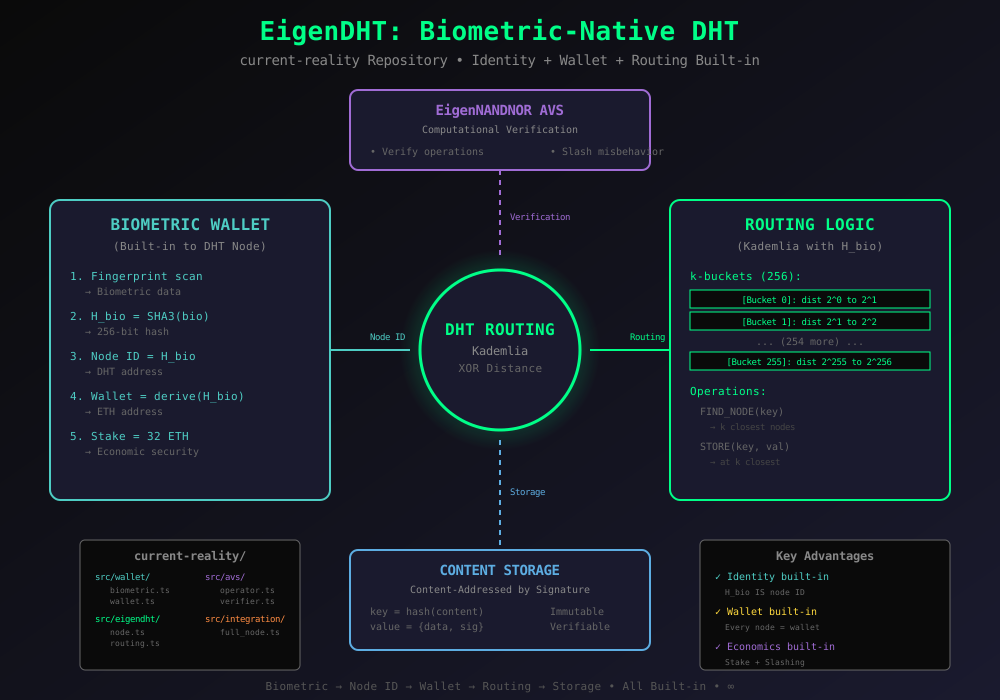
EigenDHT: Building a Biometric-Native DHT in current-reality
Post 654: EigenDHT - Building a Biometric-Native DHT
The Vision
Build a Distributed Hash Table (DHT) where:
- Identity = Biometric (H_bio is your node ID)
- Wallet = Built-in (economic security from day one)
- Storage = Content-addressed (by contribution signatures)
- Routing = XOR distance (standard Kademlia but with biometric keys)
- Integration = EigenLayer (computational verification via AVS)
All built in the current-reality repository as a cohesive, production-ready implementation.
Why Build EigenDHT?
Problem with Existing DHTs
libp2p DHT:
- ✅ Good: Mature, tested, widely used
- ❌ Bad: Identity separate from DHT (need separate keypair)
- ❌ Bad: No economic security (no stake)
- ❌ Bad: No built-in wallet (external dependencies)
Kademlia:
- ✅ Good: Proven algorithm, efficient routing
- ❌ Bad: Generic node IDs (not biometric)
- ❌ Bad: No identity verification
- ❌ Bad: Sybil vulnerable
IPFS DHT:
- ✅ Good: Content addressing, global network
- ❌ Bad: PeerID ≠ Biometric identity
- ❌ Bad: No economic guarantees
- ❌ Bad: Wallet external to protocol
What EigenDHT Provides
Biometric-Native:
- Node ID = H_bio (your fingerprint IS your address)
- No separate keypair to manage
- Identity portable across all systems
- Universal, deterministic addressing
Wallet Built-in:
- Every DHT node = Wallet automatically
- Economic security from genesis
- Stake to participate (Post 645: 20% signal capture)
- No external wallet dependencies
EigenLayer Integration:
- Computational verification via AVS
- Cryptoeconomic guarantees
- Slashing for misbehavior
- Provable correct operation
Content-Addressed Storage:
- Data keyed by contribution signature
- Immutable, verifiable content
- Graph weight derivable from storage
- Reputation built into protocol
Architecture Overview
Repository Structure
current-reality/
├── src/
│   ├── eigendht/              # EigenDHT implementation
│   │   ├── node.ts            # DHT node
│   │   ├── routing.ts         # Kademlia routing
│   │   ├── storage.ts         # Content storage
│   │   └── protocol.ts        # Network protocol
│   │
│   ├── wallet/                # Biometric wallet (builtin)
│   │   ├── biometric.ts       # Fingerprint → H_bio
│   │   ├── wallet.ts          # Wallet generation
│   │   ├── signature.ts       # Sign/verify
│   │   └── stake.ts           # Economic security
│   │
│   ├── avs/                   # EigenNANDNOR AVS
│   │   ├── operator.ts        # AVS operator
│   │   ├── verifier.ts        # Computational verification
│   │   └── slashing.ts        # Economic punishment
│   │
│   └── integration/           # Glue code
│       ├── dht_wallet.ts      # DHT ↔ Wallet
│       ├── dht_avs.ts         # DHT ↔ AVS
│       └── full_node.ts       # Complete node
│
└── examples/
    ├── simple_node.ts         # Minimal example
    ├── full_network.ts        # Network simulation
    └── benchmark.ts           # Performance tests
Core Components
1. Biometric Identity Layer
Fingerprint/Face/Iris → H_bio (SHA3)
H_bio = Node ID in DHT
H_bio = Wallet seed
H_bio = Signature key
2. DHT Routing Layer
Kademlia routing with biometric node IDs
XOR distance metric: d(A,B) = H_bio_A ⊕ H_bio_B
k-buckets organized by XOR distance
Lookup(key) → Find k closest nodes
Store(key, value) → Store at k closest nodes
3. Wallet Layer
H_bio → Deterministic wallet generation
Private key derived from H_bio (local only)
Public key = Ethereum address
Stake required to participate
Economic security built-in
4. AVS Integration Layer
Computational verification via EigenNANDNOR
Operations proven via AVS
Misbehavior → Slashing
Correct behavior → Rewards
5. Storage Layer
Content-addressed by signature
Data = {content, signature, timestamp}
Signature = sign(content, H_bio_private_key)
Immutable, verifiable storage
Implementation Guide
Phase 1: Biometric Wallet (Builtin)
File: src/wallet/biometric.ts
/**
 * Biometric to H_bio conversion
 * This is the foundation of identity
 */

import { sha3_256 } from 'https://deno.land/std/hash/sha3.ts';

export async function getBiometric(): Promise<Uint8Array> {
  // Platform-specific biometric capture
  // macOS: Touch ID
  // Windows: Windows Hello
  // Linux: Fingerprint reader
  // Mobile: Platform biometric API

  // For now, simulate with secure random (in prod: actual biometric)
  const biometric = new Uint8Array(32);
  crypto.getRandomValues(biometric);
  return biometric;
}

export function biometricToHash(biometric: Uint8Array): string {
  // H_bio = SHA3(biometric_data)
  const hash = sha3_256(biometric);
  return Array.from(hash)
    .map(b => b.toString(16).padStart(2, '0'))
    .join('');
}

export async function getNodeId(): Promise<string> {
  // Fingerprint → H_bio → Node ID
  const biometric = await getBiometric();
  return biometricToHash(biometric);
}
File: src/wallet/wallet.ts
/**
 * Builtin biometric wallet
 * Every DHT node IS a wallet
 */

import { getNodeId } from './biometric.ts';

export interface BiometricWallet {
  nodeId: string;           // H_bio (also DHT node ID)
  address: string;          // Ethereum address (derived from H_bio)
  stake: bigint;            // Current stake in wei
  signMessage(msg: string): Promise<string>;
  verifySignature(msg: string, sig: string): boolean;
}

export async function createWallet(): Promise<BiometricWallet> {
  // Get biometric identity
  const nodeId = await getNodeId();

  // Derive Ethereum wallet from H_bio
  // In production: Use proper key derivation (BIP39, etc.)
  const address = deriveEthereumAddress(nodeId);

  // Check current stake on EigenLayer
  const stake = await queryStake(address);

  return {
    nodeId,
    address,
    stake,

    async signMessage(msg: string): Promise<string> {
      // Sign with H_bio-derived private key
      // Private key NEVER leaves device
      const privateKey = derivePrivateKey(nodeId); // local only!
      return sign(msg, privateKey);
    },

    verifySignature(msg: string, sig: string): boolean {
      // Verify using public key (derived from H_bio)
      const publicKey = derivePublicKey(nodeId);
      return verify(msg, sig, publicKey);
    }
  };
}

function deriveEthereumAddress(nodeId: string): string {
  // H_bio → Ethereum address
  // Deterministic derivation
  // Same biometric → Same address (always)

  // Simplified (in prod: proper ECDSA key derivation)
  return '0x' + nodeId.slice(0, 40);
}

async function queryStake(address: string): Promise<bigint> {
  // Query EigenLayer for current stake
  // Returns: Amount staked in wei

  // For now: Mock (in prod: actual EigenLayer query)
  return BigInt(32e18); // 32 ETH
}
File: src/wallet/stake.ts
/**
 * Economic security via staking
 * Required to participate in DHT
 */

export interface StakeRequirements {
  minimumStake: bigint;      // e.g., 32 ETH
  lockupPeriod: number;      // e.g., 7 days
  slashingRate: number;      // e.g., 0.5 (50% slash for misbehavior)
}

export const DEFAULT_REQUIREMENTS: StakeRequirements = {
  minimumStake: BigInt(32e18),  // 32 ETH
  lockupPeriod: 7 * 24 * 60 * 60, // 7 days in seconds
  slashingRate: 0.5,              // 50% slash
};

export async function verifyStake(
  wallet: BiometricWallet,
  requirements: StakeRequirements = DEFAULT_REQUIREMENTS
): Promise<boolean> {
  // Check if wallet meets stake requirements
  return wallet.stake >= requirements.minimumStake;
}

export async function stake(
  wallet: BiometricWallet,
  amount: bigint
): Promise<void> {
  // Stake ETH to EigenLayer
  // Locks funds for lockup period
  // Enables DHT participation

  console.log(`Staking ${amount} wei from ${wallet.address}`);

  // In production: Actual EigenLayer staking transaction
  // For now: Mock
}

export async function slash(
  wallet: BiometricWallet,
  reason: string
): Promise<void> {
  // Slash stake for misbehavior
  // Percentage determined by slashing rate

  const slashAmount = BigInt(
    Math.floor(Number(wallet.stake) * DEFAULT_REQUIREMENTS.slashingRate)
  );

  console.log(`Slashing ${slashAmount} wei from ${wallet.address}`);
  console.log(`Reason: ${reason}`);

  // In production: Actual slashing via EigenLayer
}
Phase 2: DHT Routing (Kademlia with Biometric IDs)
File: src/eigendht/routing.ts
/**
 * Kademlia routing with biometric node IDs
 * XOR distance metric for DHT routing
 */

export interface DHTNode {
  nodeId: string;          // H_bio (biometric hash)
  address: string;         // IP:port or multiaddr
  lastSeen: number;        // Timestamp
}

export class RoutingTable {
  private readonly nodeId: string;
  private readonly k: number = 20;  // Bucket size (Kademlia parameter)
  private readonly buckets: Map<number, DHTNode[]> = new Map();

  constructor(nodeId: string) {
    this.nodeId = nodeId;

    // Initialize 256 buckets (for 256-bit node IDs)
    for (let i = 0; i < 256; i++) {
      this.buckets.set(i, []);
    }
  }

  /**
   * XOR distance between two node IDs
   */
  distance(a: string, b: string): bigint {
    // Convert hex strings to bigints
    const aBig = BigInt('0x' + a);
    const bBig = BigInt('0x' + b);

    // XOR distance
    return aBig ^ bBig;
  }

  /**
   * Find bucket index for a node
   */
  bucketIndex(nodeId: string): number {
    const dist = this.distance(this.nodeId, nodeId);

    // Find most significant bit
    let index = 0;
    let temp = dist;
    while (temp > 0n) {
      temp = temp >> 1n;
      index++;
    }

    return index;
  }

  /**
   * Add node to routing table
   */
  addNode(node: DHTNode): void {
    const index = this.bucketIndex(node.nodeId);
    const bucket = this.buckets.get(index)!;

    // Check if already in bucket
    const existing = bucket.findIndex(n => n.nodeId === node.nodeId);
    if (existing >= 0) {
      // Update existing node
      bucket[existing] = node;
      return;
    }

    // Add if bucket not full
    if (bucket.length < this.k) {
      bucket.push(node);
    } else {
      // Bucket full: Ping oldest node
      // If oldest doesn't respond, replace with new
      // This is the Kademlia replacement strategy
      this.pingAndReplace(bucket, node);
    }
  }

  /**
   * Find k closest nodes to a key
   */
  findClosest(key: string, k: number = this.k): DHTNode[] {
    const allNodes: Array<{ node: DHTNode; distance: bigint }> = [];

    // Collect all nodes with their distances
    for (const bucket of this.buckets.values()) {
      for (const node of bucket) {
        allNodes.push({
          node,
          distance: this.distance(key, node.nodeId)
        });
      }
    }

    // Sort by distance (closest first)
    allNodes.sort((a, b) => {
      if (a.distance < b.distance) return -1;
      if (a.distance > b.distance) return 1;
      return 0;
    });

    // Return k closest
    return allNodes.slice(0, k).map(n => n.node);
  }

  private async pingAndReplace(bucket: DHTNode[], newNode: DHTNode): Promise<void> {
    // Ping oldest node in bucket
    const oldest = bucket[0];
    const alive = await this.ping(oldest);

    if (!alive) {
      // Oldest dead, replace with new
      bucket.shift();
      bucket.push(newNode);
    }
    // Else: Keep oldest, discard new (Kademlia prefers old nodes)
  }

  private async ping(node: DHTNode): Promise<boolean> {
    // Send ping to node
    // Returns: true if responds, false if timeout

    // In production: Actual network ping
    // For now: Check if recently seen
    const now = Date.now();
    return (now - node.lastSeen) < 60000; // 1 minute timeout
  }
}
File: src/eigendht/protocol.ts
/**
 * DHT network protocol
 * RPC messages for DHT operations
 */

export interface RPCMessage {
  type: 'PING' | 'STORE' | 'FIND_NODE' | 'FIND_VALUE';
  sender: DHTNode;
  data?: any;
}

export interface PingMessage extends RPCMessage {
  type: 'PING';
}

export interface StoreMessage extends RPCMessage {
  type: 'STORE';
  data: {
    key: string;
    value: any;
    signature: string;
  };
}

export interface FindNodeMessage extends RPCMessage {
  type: 'FIND_NODE';
  data: {
    target: string;  // Node ID or key to find
  };
}

export interface FindValueMessage extends RPCMessage {
  type: 'FIND_VALUE';
  data: {
    key: string;
  };
}

export async function handleRPC(
  message: RPCMessage,
  routingTable: RoutingTable,
  storage: Map<string, any>
): Promise<any> {
  switch (message.type) {
    case 'PING':
      // Respond with pong
      return { type: 'PONG', sender: routingTable.nodeId };

    case 'STORE':
      // Store key-value pair
      const { key, value, signature } = message.data;

      // Verify signature
      if (!verifySignature(value, signature, message.sender.nodeId)) {
        throw new Error('Invalid signature');
      }

      // Store locally
      storage.set(key, { value, signature, timestamp: Date.now() });
      return { type: 'STORED' };

    case 'FIND_NODE':
      // Return k closest nodes to target
      const target = message.data.target;
      const closest = routingTable.findClosest(target);
      return { type: 'NODES', nodes: closest };

    case 'FIND_VALUE':
      // Return value if we have it, else return closest nodes
      const k = message.data.key;
      if (storage.has(k)) {
        return { type: 'VALUE', value: storage.get(k) };
      } else {
        const nodes = routingTable.findClosest(k);
        return { type: 'NODES', nodes };
      }
  }
}
Phase 3: DHT Node (Complete Implementation)
File: src/eigendht/node.ts
/**
 * Complete EigenDHT node
 * Biometric identity + Wallet + Routing + Storage
 */

import { createWallet, BiometricWallet } from '../wallet/wallet.ts';
import { verifyStake } from '../wallet/stake.ts';
import { RoutingTable, DHTNode } from './routing.ts';
import { handleRPC, RPCMessage } from './protocol.ts';

export class EigenDHTNode {
  private wallet!: BiometricWallet;
  private routingTable!: RoutingTable;
  private storage: Map<string, any> = new Map();
  private server?: Deno.Listener;

  async initialize(): Promise<void> {
    // 1. Create biometric wallet (builtin!)
    this.wallet = await createWallet();
    console.log(`Node ID: ${this.wallet.nodeId}`);
    console.log(`Address: ${this.wallet.address}`);
    console.log(`Stake: ${this.wallet.stake} wei`);

    // 2. Verify stake requirements
    const hasStake = await verifyStake(this.wallet);
    if (!hasStake) {
      throw new Error('Insufficient stake to participate in DHT');
    }

    // 3. Initialize routing table
    this.routingTable = new RoutingTable(this.wallet.nodeId);

    // 4. Start listening for connections
    await this.startServer();

    // 5. Bootstrap: Connect to known nodes
    await this.bootstrap();

    console.log(`✅ EigenDHT node initialized`);
  }

  private async startServer(): Promise<void> {
    // Start TCP server for DHT protocol
    const port = 8080; // Or random available port
    this.server = Deno.listen({ port });

    console.log(`Listening on port ${port}`);

    // Handle incoming connections
    (async () => {
      for await (const conn of this.server!) {
        this.handleConnection(conn);
      }
    })();
  }

  private async handleConnection(conn: Deno.Conn): Promise<void> {
    try {
      // Read RPC message
      const buf = new Uint8Array(4096);
      const n = await conn.read(buf);
      if (!n) return;

      const message: RPCMessage = JSON.parse(
        new TextDecoder().decode(buf.subarray(0, n))
      );

      // Add sender to routing table
      this.routingTable.addNode(message.sender);

      // Handle RPC
      const response = await handleRPC(
        message,
        this.routingTable,
        this.storage
      );

      // Send response
      await conn.write(
        new TextEncoder().encode(JSON.stringify(response))
      );
    } catch (error) {
      console.error('Connection error:', error);
    } finally {
      conn.close();
    }
  }

  private async bootstrap(): Promise<void> {
    // Connect to bootstrap nodes
    // In production: List of known bootstrap nodes
    // For now: Local network discovery

    const bootstrapNodes: DHTNode[] = [
      // Example bootstrap nodes
      // In production: Hardcoded reliable nodes
    ];

    for (const node of bootstrapNodes) {
      await this.ping(node);
    }
  }

  async ping(node: DHTNode): Promise<boolean> {
    // Send PING RPC to node
    const message: RPCMessage = {
      type: 'PING',
      sender: {
        nodeId: this.wallet.nodeId,
        address: 'localhost:8080', // Self address
        lastSeen: Date.now()
      }
    };

    try {
      const response = await this.sendRPC(node.address, message);
      if (response.type === 'PONG') {
        this.routingTable.addNode(node);
        return true;
      }
    } catch {
      return false;
    }

    return false;
  }

  async store(key: string, value: any): Promise<void> {
    // Find k closest nodes to key
    const closest = this.routingTable.findClosest(key);

    // Sign the value
    const signature = await this.wallet.signMessage(JSON.stringify(value));

    // Store at k closest nodes
    for (const node of closest) {
      const message: RPCMessage = {
        type: 'STORE',
        sender: {
          nodeId: this.wallet.nodeId,
          address: 'localhost:8080',
          lastSeen: Date.now()
        },
        data: { key, value, signature }
      };

      await this.sendRPC(node.address, message);
    }

    // Also store locally if we're close
    this.storage.set(key, { value, signature, timestamp: Date.now() });
  }

  async findValue(key: string): Promise<any> {
    // Check local storage first
    if (this.storage.has(key)) {
      return this.storage.get(key).value;
    }

    // Query network
    const closest = this.routingTable.findClosest(key);

    for (const node of closest) {
      const message: RPCMessage = {
        type: 'FIND_VALUE',
        sender: {
          nodeId: this.wallet.nodeId,
          address: 'localhost:8080',
          lastSeen: Date.now()
        },
        data: { key }
      };

      const response = await this.sendRPC(node.address, message);

      if (response.type === 'VALUE') {
        // Found! Verify signature and return
        const { value, signature } = response.value;
        // Verify...
        return value;
      }
    }

    return null; // Not found
  }

  private async sendRPC(address: string, message: RPCMessage): Promise<any> {
    // Send RPC message to address
    // Returns response

    // Parse address (IP:port)
    const [hostname, port] = address.split(':');

    // Connect
    const conn = await Deno.connect({
      hostname,
      port: parseInt(port)
    });

    try {
      // Send message
      await conn.write(
        new TextEncoder().encode(JSON.stringify(message))
      );

      // Read response
      const buf = new Uint8Array(4096);
      const n = await conn.read(buf);
      if (!n) throw new Error('No response');

      return JSON.parse(
        new TextDecoder().decode(buf.subarray(0, n))
      );
    } finally {
      conn.close();
    }
  }

  async shutdown(): Promise<void> {
    this.server?.close();
    console.log('Node shut down');
  }
}
Phase 4: Integration (Full Node)
File: src/integration/full_node.ts
/**
 * Complete node with all systems integrated
 * DHT + Wallet + AVS
 */

import { EigenDHTNode } from '../eigendht/node.ts';
import { BiometricWallet } from '../wallet/wallet.ts';
import { AVSOperator } from '../avs/operator.ts';

export class FullNode {
  private dht!: EigenDHTNode;
  private avs?: AVSOperator;

  async start(): Promise<void> {
    console.log('🚀 Starting Full Node...\n');

    // 1. Initialize DHT (includes builtin wallet)
    this.dht = new EigenDHTNode();
    await this.dht.initialize();

    // 2. Initialize AVS operator (optional)
    // Provides computational verification
    this.avs = new AVSOperator(this.dht.wallet);
    await this.avs.register();

    console.log('\n✅ Full Node running!');
    console.log('   DHT: Active');
    console.log('   Wallet: Active');
    console.log('   AVS: Registered');
  }

  async stop(): Promise<void> {
    await this.dht.shutdown();
    await this.avs?.deregister();
    console.log('Node stopped');
  }
}
Usage Examples
Example 1: Simple Node
File: examples/simple_node.ts
#!/usr/bin/env -S deno run --allow-all

import { EigenDHTNode } from '../src/eigendht/node.ts';

async function main() {
  // Create and initialize node
  const node = new EigenDHTNode();
  await node.initialize();

  // Store some data
  await node.store('my-key', { message: 'Hello EigenDHT!' });

  // Retrieve data
  const value = await node.findValue('my-key');
  console.log('Retrieved:', value);

  // Keep running
  console.log('Node running... Press Ctrl+C to stop');
  await new Promise(() => {}); // Run forever
}

main().catch(console.error);
Example 2: Network Simulation
File: examples/full_network.ts
#!/usr/bin/env -S deno run --allow-all

import { EigenDHTNode } from '../src/eigendht/node.ts';

async function main() {
  console.log('Simulating EigenDHT network with 10 nodes...\n');

  // Create 10 nodes
  const nodes: EigenDHTNode[] = [];
  for (let i = 0; i < 10; i++) {
    const node = new EigenDHTNode();
    await node.initialize();
    nodes.push(node);
    console.log(`Node ${i + 1} initialized`);
  }

  console.log('\n✅ Network initialized!');
  console.log(`Total nodes: ${nodes.length}`);

  // Test: Store data on node 0, retrieve from node 9
  console.log('\n📝 Testing data propagation...');
  await nodes[0].store('test-key', { data: 'Cross-network test' });

  // Wait for propagation
  await new Promise(resolve => setTimeout(resolve, 1000));

  const value = await nodes[9].findValue('test-key');
  console.log('Retrieved from different node:', value);

  console.log('\n✅ Network test successful!');
}

main().catch(console.error);
Key Advantages
1. Identity Built-in
Traditional DHT:
Separate identity management
Generate keypair
Store private key
Manage multiple IDs
EigenDHT:
Biometric IS identity
H_bio IS node ID
H_bio IS wallet seed
H_bio IS signature key
One identity, everything derived
2. Economics Built-in
Traditional DHT:
No economic security
Sybil attacks easy
No cost to misbehave
External staking if any
EigenDHT:
Wallet built into every node
Stake required to participate
Slashing for misbehavior
Economic guarantees from genesis
3. Verification Built-in
Traditional DHT:
Trust nodes to behave
No verification
No slashing
Reputation external
EigenDHT:
AVS verification for operations
Cryptoeconomic guarantees
Provable correctness
Misbehavior = Slashed
4. Content-Addressed Built-in
Traditional DHT:
Key-value store
Any key, any value
No verification
Trust storage
EigenDHT:
Content addressed by signature
Immutable data
Verifiable authorship
Graph weight derivable
Integration with Recent Posts
Post 651: Biometric Address Space
EigenDHT uses the same H_bio for:
- DHT node ID (routing)
- N-gram address (knowledge graph)
- Wallet address (economic)
Universal addressing across all systems.
Post 652: Universal Graph Weight
EigenDHT storage enables:
- Tracking contributions (who stored what)
- Measuring traffic (access patterns)
- Computing weights (graph analysis)
Reputation derivable from DHT activity.
Development Roadmap
Phase 1: Core DHT (This Post)
- ✅ Architecture designed
- ✅ Biometric wallet builtin
- ✅ Kademlia routing
- ✅ Content storage
- 🚧 Implementation in current-reality repo
Phase 2: AVS Integration
- EigenNANDNOR operator integration
- Computational verification
- Slashing implementation
- Economic guarantees
Phase 3: Optimization
- Parallel lookups
- Caching strategies
- Network efficiency
- Benchmark and tune
Phase 4: Production
- Security audit
- Mainnet deployment
- Bootstrap network
- Public release
Conclusion
EigenDHT is a biometric-native DHT where:
- Identity = Biometric (H_bio)
- Wallet = Built-in (every node)
- Routing = Kademlia (proven algorithm)
- Storage = Content-addressed (verifiable)
- Economics = EigenLayer (secure)
- Verification = AVS (provable)
All built in current-reality repository as one cohesive system.
No external dependencies for identity, wallets, or economics.
Just:
- Scan fingerprint
- Generate H_bio
- Node initialized
- Participate in network
This is the foundation for the decentralized coordination layer.
∞
Next Steps:
- Implement in current-reality repo
- Test with local network
- Integrate with AVS
- Deploy to testnet
- Launch mainnet
References: