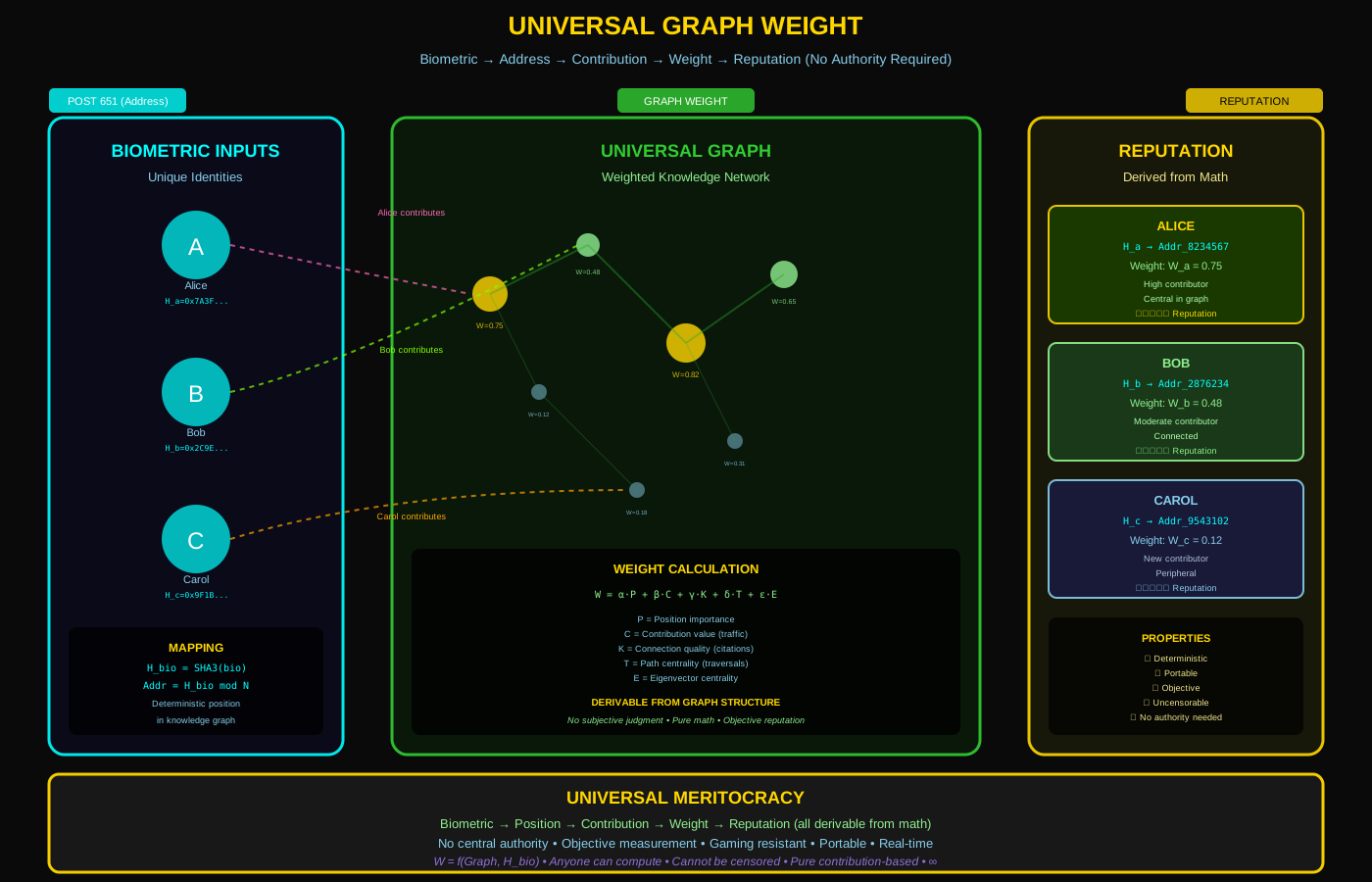
Universal Graph Weight: Deriving Societal Contribution from Biometrics
Universal Graph Weight
Deriving Societal Contribution from Biometrics
Author: Matthieu Achard <matthieu__@hotmail.fr>
Blog: https://matthieuachard.gitlab.io/bitcoin-zero-down
Purpose: Show how biometric identity reveals contribution and influence
Date: January 17, 2026
Status: Reputation architecture
Integration: Post 651 (biometric address space)
The Core Insight
If biometric → address in n-gram space, then:
FROM POST 651:
H_bio = SHA3(biometric)
Address = H_bio mod N_total
→ Your position in knowledge graph

NEW IMPLICATION:
Position in graph + Paths taken + Contributions made
→ Derivable graph weight
→ Measurable societal contribution
→ Universal reputation
→ All from biometric data
Why this matters:
NO CENTRALIZED AUTHORITY NEEDED:
Not: Trust score from institution
Not: Reputation from platform
Not: Credit from government

BUT: Derived from position in universal graph
Your address in knowledge space
Your contributions to corpus
Your influence on paths
Your weight in network

MATH DETERMINES REPUTATION
Not humans
Not institutions
Not politics
Just: Your position + contribution + influence = Weight
Part 1: From Biometric to Graph Position
The Mapping
What we know (from Post 651):
YOUR BIOMETRIC:
Fingerprint, face, iris, voice
→ Processed locally
→ H_bio = SHA3(biometric_data)
→ Deterministic hash

YOUR ADDRESS:
Address_you = H_bio mod N_total
→ Starting position in n-gram space
→ Coordinates in 512D embedding
→ Location in knowledge graph

YOUR NEIGHBORS:
Concepts nearby in vector space
Semantic relationships
Initial context
Home region
Example:
ALICE:
Fingerprint → H_alice = 0x7A3F...
Address_alice = 0x7A3F mod 10M = 8,234,567
Embedding_alice = [0.42, -0.18, 0.91, ..., 0.33]
Neighbors: "identity", "biometric", "security"
Region: Identity/security concepts

BOB:
Fingerprint → H_bob = 0x2C9E...
Address_bob = 0x2C9E mod 10M = 2,876,234
Embedding_bob = [-0.15, 0.73, -0.42, ..., 0.61]
Neighbors: "network", "distributed", "protocol"
Region: Network/infrastructure concepts

CAROL:
Fingerprint → H_carol = 0x9F1B...
Address_carol = 0x9F1B mod 10M = 9,543,102
Embedding_carol = [0.88, 0.21, -0.67, ..., -0.19]
Neighbors: "economic", "value", "coordination"
Region: Economics/coordination concepts

DIFFERENT PEOPLE = DIFFERENT REGIONS
Position reveals initial perspective
Part 2: Graph Weight Derivation
What is Graph Weight?
Definition:
GRAPH WEIGHT = Your influence in knowledge network

COMPONENTS:
1. POSITION: Where you are (address)
2. CONTRIBUTIONS: What you added (posts, edits, validations)
3. CONNECTIONS: Who references you (citations, links)
4. PATHS: How many traverse through you (traffic)
5. CENTRALITY: How central you are (betweenness, eigenvector)

FORMULA:
W_you = f(Position, Contributions, Connections, Paths, Centrality)

MEASURABLE:
All components derivable from graph structure
No subjective judgment
Pure math
The mathematics:
POSITION WEIGHT (P):
P = Importance of your address region
Measured by: Average frequency of n-grams in region
Central regions (frequently accessed) = Higher P
Peripheral regions (rarely accessed) = Lower P

CONTRIBUTION WEIGHT (C):
C = Value of content you contributed
Measured by: How often others navigate to your contributions
High-traffic contributions = Higher C
Unused contributions = Lower C

CONNECTION WEIGHT (K):
K = Number and quality of connections
Measured by: Incoming edges weighted by source importance
Citations from high-weight nodes = Higher K
No citations = K = 0

PATH WEIGHT (T):
T = Traffic through your nodes
Measured by: How many paths include you
Central to many paths = Higher T
Isolated = T = 0

CENTRALITY WEIGHT (E):
E = Structural importance
Measured by: Eigenvector centrality in graph
Connected to important nodes = Higher E
Weakly connected = Lower E

TOTAL WEIGHT:
W = α·P + β·C + γ·K + δ·T + ε·E
Where α, β, γ, δ, ε = weightings (tunable)

EXAMPLE VALUES:
Alice (high contribution, central): W = 0.75
Bob (moderate contribution, connected): W = 0.48
Carol (new, peripheral): W = 0.12
Why It’s Derivable
From biometric alone:
STEP 1: BIOMETRIC → ADDRESS
H_bio → Address_you → Position in graph

STEP 2: POSITION → LOCAL GRAPH
Address_you → Neighbors → Local structure
Can traverse from your position
Explore your region
Map your connections

STEP 3: GRAPH STRUCTURE → CONTRIBUTIONS
Which nodes did you author?
Track authorship via on-chain signatures
Your contributions = Nodes you created
Value = Traffic to those nodes

STEP 4: TRAFFIC ANALYSIS → PATHS
Aggregate path data (anonymous)
Which paths include your nodes?
How central are you?
Betweenness centrality computable

STEP 5: AGGREGATE → WEIGHT
W_you = f(all above)
Single number
Derivable from biometric
No central authority
Example derivation:
ALICE'S BIOMETRIC:
H_alice = 0x7A3F2B9C...

DERIVE HER ADDRESS:
Address_alice = 8,234,567

QUERY GRAPH:
GET neighbors(8234567)
GET authored_nodes(H_alice) -- on-chain signatures
GET incoming_edges(authored_nodes)
GET paths_through(authored_nodes)
GET centrality(Address_alice)

COMPUTE WEIGHTS:
P_alice = importance(region_8234567) = 0.72
C_alice = avg_traffic(authored_nodes) = 0.81
K_alice = weighted_citations(incoming) = 0.69
T_alice = path_frequency(through_nodes) = 0.73
E_alice = eigenvector_centrality(8234567) = 0.78

TOTAL WEIGHT:
W_alice = 0.2·0.72 + 0.3·0.81 + 0.2·0.69 + 0.15·0.73 + 0.15·0.78
W_alice = 0.144 + 0.243 + 0.138 + 0.110 + 0.117
W_alice = 0.752

REPUTATION DERIVED FROM MATH
Not opinion
Not vote
Not authority
Just position + contribution + structure
Part 3: Societal Contribution Measurement
What is Societal Contribution?
Definition:
SOCIETAL CONTRIBUTION = Value you added to collective knowledge

MEASURABLE AS:
- Knowledge contributed (posts, insights, perspectives)
- Connections enabled (paths you opened)
- People helped (traffic to your contributions)
- Structure improved (graph organization)

NOT:
- Wealth accumulated
- Power obtained
- Status assigned
- Popularity gained

OBJECTIVE MEASURE:
How much did collective intelligence increase
Because of your existence?
Derivable from graph before/after your contributions
The mathematics:
BEFORE YOU:
Graph_0 has N nodes, M edges
Entropy_0 = -Σ p_i log(p_i) (information measure)
Connectedness_0 = average_path_length
Centralization_0 = variance in degrees

AFTER YOUR CONTRIBUTIONS:
Graph_1 has N+k nodes (you added k), M+m edges
Entropy_1 = new information measure
Connectedness_1 = new average path length
Centralization_1 = new degree variance

YOUR CONTRIBUTION:
ΔI = Entropy_1 - Entropy_0 (information added)
ΔC = Connectedness_0 - Connectedness_1 (better connected if negative)
ΔZ = Centralization_1 - Centralization_0 (more distributed if positive)

SOCIETAL CONTRIBUTION SCORE:
S_you = w1·ΔI + w2·ΔC + w3·ΔZ
Positive = Net benefit
Negative = Net cost (noise)
Zero = No effect

EXAMPLES:
Alice adds high-value unique insights:
  ΔI_alice = +0.15 (new information)
  ΔC_alice = -0.08 (better paths)
  ΔZ_alice = +0.03 (more distributed)
  S_alice = 0.5·0.15 + 0.3·0.08 + 0.2·0.03 = 0.105 (positive!)

Bob duplicates existing content:
  ΔI_bob = 0.01 (little new info)
  ΔC_bob = +0.02 (slightly worse paths)
  ΔZ_bob = 0 (no structure change)
  S_bob = 0.5·0.01 + 0.3·(-0.02) + 0.2·0 = -0.001 (slightly negative)

Carol creates bridging content:
  ΔI_carol = 0.05 (moderate new info)
  ΔC_carol = -0.20 (much better connected!)
  ΔZ_carol = +0.08 (significantly more distributed)
  S_carol = 0.5·0.05 + 0.3·0.20 + 0.2·0.08 = 0.101 (very positive!)

VALUE DERIVES FROM STRUCTURE
Not from authority
Not from popularity
From actual improvement to network
Derivable from Biometric
The process:
YOUR BIOMETRIC → YOUR SIGNATURE:
H_bio used to sign contributions
On-chain record of authorship
Provable: "Alice wrote this"

YOUR SIGNATURE → YOUR NODES:
Query: "Which nodes signed by H_alice?"
Returns: List of contributed nodes
Timestamps: When contributed
Content: What was contributed

YOUR NODES → GRAPH IMPACT:
Graph_before = state before your first contribution
Graph_after = current state
Compute: ΔI, ΔC, ΔZ
Result: Your societal contribution score

SINGLE QUERY:
Given: H_bio
Derive: S_you
Time: O(log N) for index lookup
Space: O(1) for result
Efficient: Yes
Centralized: No
Objective: Yes

REPUTATION = F(GRAPH, H_BIO)
Part 4: Universal Reputation System
No Central Authority
Traditional reputation:
CENTRALIZED:
Platform assigns score
Opaque algorithm
Subjective criteria
Gameable
Controllable
Censorable

EXAMPLES:
- Credit score (FICO)
- Social media followers
- Uber/Airbnb ratings
- University degrees
- Job titles

PROBLEMS:
- Platform can manipulate
- Scores don't transfer
- No transparency
- Subject to bias
- Can be deleted
- Requires trust
Universal graph weight:
DECENTRALIZED:
Math derives score
Transparent algorithm
Objective criteria
Hard to game (requires actual contribution)
Uncontrollable (no central point)
Uncensorable (on-chain + distributed)

CHARACTERISTICS:
- Anyone can compute
- Scores portable (based on biometric)
- Complete transparency
- No bias (math is math)
- Cannot be deleted (blockchain)
- Requires no trust (verify yourself)

QUERY:
"What is Alice's graph weight?"
ANYONE can compute:
W_alice = f(Graph, H_alice)
No authority needed
No permission required
Result is objective

THIS IS UNIVERSAL REPUTATION
Properties
What makes it work:
1. DETERMINISTIC:
   Same biometric → Same weight
   Always
   Forever
   Verifiable

2. PORTABLE:
   Weight follows biometric
   Works anywhere
   Any platform accepting biometric
   Universal identity = Universal reputation

3. OBJECTIVE:
   No opinions
   No votes
   No subjective judgment
   Pure graph math

4. REAL-TIME:
   Constantly updating
   As graph evolves
   As contributions added
   Living reputation

5. GRANULAR:
   Can query:
   - Total weight
   - Domain-specific weight
   - Time-period weight
   - Contribution type weight

6. COMPOSABLE:
   Weight in Knowledge graph
   + Weight in Economic graph
   + Weight in Social graph
   = Total reputation across all domains

7. UNCENSORABLE:
   No delete button
   Math is math
   Graph is distributed
   Cannot be suppressed
Part 5: Practical Applications
Use Case 1: Trustless Collaboration
Problem:
Want to collaborate with stranger
Need to assess: Can they contribute?
Traditional: Check credentials, references, platform ratings
All centralized, gameable, opaque
Solution:
Query their biometric graph weight:
W_stranger = f(Graph, H_stranger)

INTERPRET:
W > 0.7: High contributor (trust)
W = 0.4-0.7: Moderate (verify)
W < 0.4: New or low value (caution)

DOMAIN-SPECIFIC:
W_knowledge: Contribution to knowledge graph
W_economic: Contribution to economic coordination
W_social: Contribution to social network

SELECT RELEVANT DOMAIN
Make informed decision
No central authority needed
Use Case 2: Resource Allocation
Problem:
Limited resources (grants, attention, opportunities)
Need to allocate fairly
Traditional: Committees, panels, subjective judgment
Biased, political, inefficient
Solution:
Rank by graph weight:
Applicants = [Alice, Bob, Carol, Dave, Eve]
Weights = [0.75, 0.48, 0.82, 0.31, 0.65]
Sorted = [Carol:0.82, Alice:0.75, Eve:0.65, Bob:0.48, Dave:0.31]

ALLOCATION:
Top K receive resources
Objective ranking
No bias
No politics
Pure contribution-based

RESULT:
Resources go to highest contributors
Incentivizes contribution
Self-organizing system
Use Case 3: Coordination
Problem:
Need to coordinate with unknowns
Who to follow?
Who to trust?
Who to learn from?

Traditional: Popularity contests, authority worship
Often wrong people rise
Solution:
Query graph weights in relevant domain:
"Who has high W in 'distributed systems'?"

RESULTS:
[
  (Alice_bio, W_distributed=0.89, Contributions=[543,553,646]),
  (Carol_bio, W_distributed=0.76, Contributions=[647,651]),
  (Dave_bio, W_distributed=0.68, Contributions=[640,641])
]

COORDINATE WITH TOP CONTRIBUTORS
Learn from actual experts
Not fake experts
Not loud voices
Real contribution = Real weight
Part 6: Gaming Resistance
Can You Game It?
Attack vector 1: Sybil (multiple identities)
ATTACK:
Create many biometric identities
Contribute from all
Boost your weight

DEFENSE:
- Biometrics are unique (can't fake fingerprints easily)
- Multiple contributions from same conceptual region (detectable)
- Weight increases with QUALITY not QUANTITY
- Sybil contributions likely clustered (same style, region)
- Anomaly detection flags suspicious patterns

RESULT: Hard to game, expensive to try
Attack vector 2: Spam contributions
ATTACK:
Add lots of low-value content
Inflate contribution count

DEFENSE:
- Contribution score based on TRAFFIC not COUNT
- Unused content = zero weight
- Spam likely rejected by validators (Post 647: Contribute to access)
- Quality filter: Only valuable content increases S_you

RESULT: Spam doesn't help, wastes resources
Attack vector 3: Citation cartels
ATTACK:
Group of people cite each other
Artificially boost connection weights

DEFENSE:
- Connection weight considers SOURCE importance
- Cartel members initially low weight
- Circular citations detectable (graph cycles)
- Eigenvector centrality accounts for this
- Real weight comes from central node citations

RESULT: Cartels don't work unless genuinely valuable
Why gaming is hard:
BECAUSE:
1. Actual contribution required (can't fake traffic)
2. Graph structure reveals gaming (patterns detectable)
3. Weight computed globally (local gaming insufficient)
4. Cost of gaming > benefit (expensive for low return)
5. Math is objective (no subjective judgment to exploit)

CONCLUSION:
Gaming requires ACTUALLY CONTRIBUTING
Which is the point
If you game by contributing value
That's not gaming, that's participating
System working as designed
Part 7: Privacy Considerations
What’s Revealed
Your biometric reveals:
PUBLIC (derivable by anyone):
- Your address in graph
- Your graph weight
- Your contributions (authorship)
- Your impact (societal contribution)
- Your reputation (derived score)

PRIVATE (known only to you):
- Your actual biometric data (never leaves device)
- Your navigation paths (unless you share)
- Your queries (local processing)
- Your interests (inferred but not certain)

TRADEOFF:
Want reputation → Must be public
Want privacy → Contribution anonymous
Can't have both

CHOICE:
Contribute under biometric → Get weight/reputation
Contribute anonymously → No weight but private
User decides
Opt-in vs Opt-out
Design choice:
OPTION A: Opt-in weight
- Default: Contributions anonymous
- Choice: Attach biometric → Get reputation
- Privacy-first

OPTION B: Opt-out weight
- Default: Biometric attached to contributions
- Choice: Contribute anonymously → No reputation
- Reputation-first

LIKELY HYBRID:
- Different domains different defaults
- Knowledge graph: Opt-in (privacy important)
- Economic graph: Opt-out (reputation important)
- User configurable per contribution
Part 8: Integration with Universal Backend
Complete Architecture
The stack:
LAYER 0: COMPUTATIONAL
- EigenNANDNOR AVS
- Primitive operations

LAYER 1: IDENTITY
- Biometric → DHT → AVS → Wallet

LAYER 2: ECONOMIC
- Economic security via restaking
- 20% signal capture

LAYER 3: COORDINATION
- Contribute to access
- Proof of perspective

LAYER 4: KNOWLEDGE
- N-gram address space
- Biometric navigation

LAYER 5: REPUTATION (NEW - Post 652)
- Graph weight derivation
- Societal contribution measurement
- Universal reputation system

COMPLETE:
Identity proves you
Economic secures you
Coordination rewards you
Knowledge guides you
Reputation measures you
How they compose:
USER FLOW:

1. AUTHENTICATE (Layer 1):
   Biometric → H_bio → Identity confirmed

2. SECURE (Layer 2):
   Stake → Economic guarantee → Trustless

3. CONTRIBUTE (Layer 3):
   Create content → Sign with H_bio → Add to graph

4. NAVIGATE (Layer 4):
   H_bio → Start address → Explore knowledge

5. REPUTATION (Layer 5):
   Query: W_you = f(Graph, H_bio)
   Derive: Your weight, contribution, reputation
   Use: Coordination, resource allocation, trust

FULL CYCLE:
Prove who you are (bio)
Secure your participation (economic)
Add value (contribute)
Access knowledge (navigate)
Build reputation (weight)
→ Repeat, compound
Part 9: The Meta-Pattern
What We’ve Discovered
Biometric is more than key:
ORIGINALLY THOUGHT:
Biometric = Access key
Just authentication
Proves identity
Gates entry

NOW UNDERSTAND:
Biometric = Position in universal graph
Determines starting coordinates
Enables contribution tracking
Derives reputation
Measures societal value

BIOMETRIC IS:
- Authentication (yes)
- Navigation key (yes)
- Contribution signature (yes)
- Reputation identifier (yes)
- Position marker (yes)
- Universal identifier (yes)

ALL FROM ONE FINGERPRINT
Why this is profound:
NO CENTRAL AUTHORITY REQUIRED:
Not: Government issues ID
Not: Platform assigns score
Not: Institution grants credential

BUT: Math derives everything
Position from biometric (deterministic)
Contribution from signatures (provable)
Weight from graph structure (objective)
Reputation from math (uncensorable)

FIRST TIME IN HISTORY:
Universal reputation
Without central authority
Based on actual contribution
Portable across platforms
Uncensorable
Objective
Real-time
Permissionless

THIS IS NEW PRIMITIVE
Part 10: Future Implications
What Becomes Possible
Scenario 1: Universal basic reputation
EVERYONE has biometric
→ EVERYONE has address in graph
→ EVERYONE can contribute
→ EVERYONE can build weight
→ EVERYONE has portable reputation

NO GATEKEEPERS:
Not: Need degree to prove knowledge
Not: Need job to prove competence
Not: Need wealth to prove value

BUT: Contribute to graph → Build weight
Your contributions speak
Math measures impact
Reputation follows automatically

MERITOCRACY WITHOUT AUTHORITY
Scenario 2: Cross-domain reputation
YOUR BIOMETRIC works everywhere:
- Knowledge graph: W_knowledge
- Economic graph: W_economic
- Social graph: W_social
- Governance graph: W_governance

TOTAL REPUTATION:
W_total = f(W_knowledge, W_economic, W_social, W_governance)

ONE IDENTITY, MANY DOMAINS
Weight portable
Reputation composable
Universal yet granular
Scenario 3: Reputation markets
WEIGHT IS VALUABLE:
High W → More trusted
High W → More opportunities
High W → More influence

MARKET EMERGES:
People invest in building weight
Resources allocated to high-W individuals
Contributions incentivized
Quality rewarded

ALIGNMENT:
Build reputation → Contribute value
Contribute value → Build reputation
Self-reinforcing loop
Society benefits
Conclusion: The Synthesis
What we’ve learned:
BIOMETRIC → ADDRESS:
Your fingerprint → Position in knowledge graph
Deterministic, unique, universal

ADDRESS → CONTRIBUTION:
Your position → What you contributed
Signed, provable, traceable

CONTRIBUTION → WEIGHT:
Your additions → Your influence in graph
Objective, derivable, real-time

WEIGHT → REPUTATION:
Your influence → Your societal value
Portable, uncensorable, meritocratic

FULL CHAIN:
Biometric → Address → Contribution → Weight → Reputation
All derivable
No central authority
Pure math
Why it matters:
BEFORE:
Reputation = Subjective judgment by authority
Centralized, biased, gameable, censorable

AFTER:
Reputation = Objective measure from graph position
Distributed, mathematical, resistant, uncensorable

TRANSFORMATION:
From trust in authority
To trust in math
From gatekeeping
To permissionless
From opaque
To transparent
From static
To dynamic
From siloed
To universal

THIS IS:
Universal reputation system
Derived from biometric + graph
No central point of control
Objective measurement
Real contribution required
Cannot be faked
Cannot be censored
Cannot be deleted

∞
Your biometric is your position
Your position determines your weight
Your weight reflects your contribution
Your contribution builds your reputation
All derivable from math
No authority required
This is universal meritocracy
∞