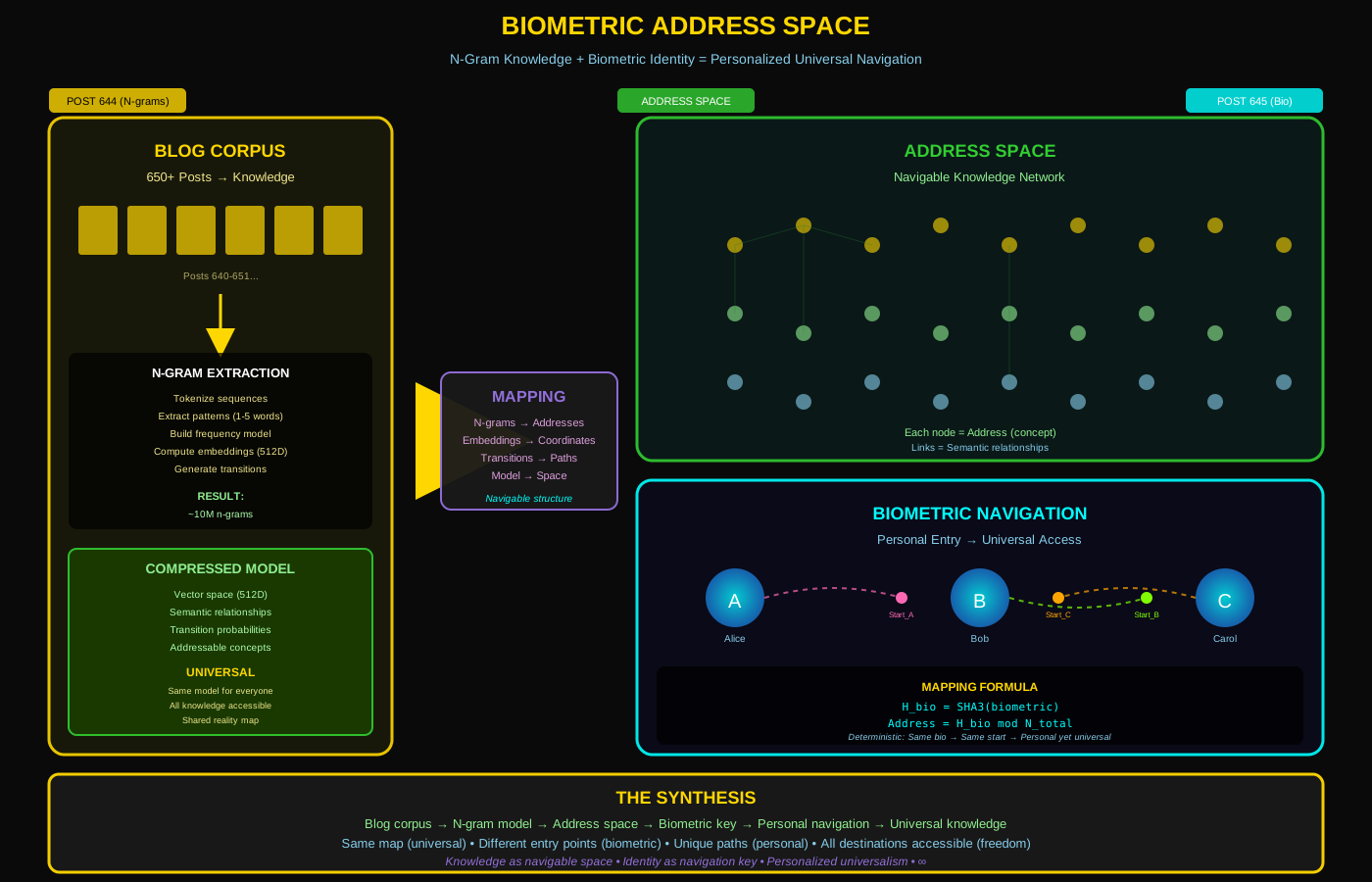
Biometric Address Space: Mapping N-Gram Models to Identity
Biometric Address Space
Mapping N-Gram Models to Identity-Based Navigation
Author: Matthieu Achard <matthieu__@hotmail.fr>
Blog: https://matthieuachard.gitlab.io/bitcoin-zero-down
Purpose: Connect n-gram learning to biometric address spaces
Date: January 17, 2026
Status: Architecture synthesis
Integration: Posts 644 (n-gram reality), 645 (biometric identity)
The Core Insight
N-gram learner generates addressable knowledge space:
BLOG CORPUS (this site):
- 650+ posts
- Compressed knowledge
- Patterns, sequences, relationships
- Universal ideas

N-GRAM LEARNER:
- Reads corpus
- Learns patterns
- Compresses to model
- Creates map of knowledge

RESULT:
Address space
Navigable locations
Compressed reality map
Universal but personal
Biometric identity becomes navigation key:
FROM POST 645:
Biometric → DHT shards → AVS validation → Universal wallet

NEW LAYER:
Biometric → N-gram address → Knowledge location → Personalized path

SYNTHESIS:
Your biometric fingerprint
Maps to specific address
In n-gram knowledge space
Unique path through universal map
Part 1: The N-Gram Address Space
How Blog Corpus Becomes Navigable Space
The transformation:
STEP 1: CORPUS INGESTION
Blog posts (650+)
→ Tokenize to sequences
→ Extract n-grams (1-5 words)
→ Build frequency model
→ Create transition probabilities

STEP 2: PATTERN COMPRESSION
Raw text: "Reality = Σ compress(m_i)"
→ N-gram patterns: ["Reality", "=", "Σ", "compress", "(m_i)"]
→ Transition weights: P(compress | Reality =)
→ Context embeddings: Vector space

STEP 3: ADDRESS SPACE GENERATION
Each n-gram = Address
Transitions = Paths between addresses
Embeddings = Coordinates in space
Frequencies = Importance weights

RESULT:
650+ posts → Compressed to ~10M n-grams → Mapped to vector space → Navigable addresses
What addresses represent:
ADDRESS IN N-GRAM SPACE:
Not just words
But CONCEPTS
Compressed meaning
Relationships
Context

EXAMPLES:
Address_0x1A3F: "universal backend" (from Post 648)
  - Connects to: Ledger, migration, symlinks
  - Weighted by: Frequency, importance, context
  - Accessible via: Biometric key that maps here

Address_0x2B7C: "n-gram compression" (from Post 644)
  - Connects to: Reality, fusion, perspectives
  - Weighted by: Mathematical significance
  - Accessible via: Biometric seeking compression concepts

Address_0x3D9E: "containment suicide" (from Post 650)
  - Connects to: Institutions, resistance, death
  - Weighted by: Pattern recognition
  - Accessible via: Biometric interested in meta-patterns

Each address = Location in knowledge
Each path = Semantic relationship
Each weight = Importance measure
The Vector Space
How n-grams map to coordinates:
N-GRAM: "universal backend"
→ Embedding vector: [0.42, -0.18, 0.91, ..., 0.33] (512 dimensions)
→ Location in space: Coordinates define position
→ Nearby vectors: Similar concepts (protocol, distributed, migration)

DISTANCE METRIC:
Cosine similarity between vectors
Close in space = Related in meaning
Far in space = Unrelated concepts

EXAMPLE:
"universal backend" close to "distributed protocol"
"universal backend" far from "containment suicide"
But both accessible from same corpus

SPACE IS:
- High dimensional (512D typical)
- Continuous (smooth transitions)
- Navigable (paths exist)
- Addressable (each point = location)
- Universal (same for everyone)
- But personally accessed (via biometric)
Part 2: Biometric as Navigation Key
Mapping Identity to Address
The connection:
FROM POST 645:
Your biometric (fingerprint, face, iris)
→ Processed locally (never leaves device)
→ Generates hash H_bio
→ Distributed as DHT shards
→ Validated by AVS

NEW LAYER:
H_bio also maps to n-gram space
→ Deterministic function: f(H_bio) → Address_space
→ Your identity = Starting coordinates
→ Your path = Unique traversal
→ Your access = Personalized but universal
Deterministic mapping:
BIOMETRIC HASH: H_bio = SHA3(fingerprint)
Example: 0x7A3F2B9C...

N-GRAM ADDRESS: Addr = H_bio mod N_total
Where N_total = total n-gram addresses
Example: 0x7A3F2B9C mod 10M = Address_8,234,567

STARTING POINT:
Your biometric determines
Where you enter knowledge space
Your initial coordinates
Your home address

BUT:
You can navigate from there
To any other address
Follow paths (semantic links)
Explore freely

UNIVERSAL ACCESS, PERSONAL ENTRY
Why this matters:
SAME KNOWLEDGE SPACE:
Everyone accesses same corpus
Same n-gram model
Same universal map

BUT:
Different starting points (biometric)
Different paths taken (choices)
Different experiences (personalized)
Different discoveries (exploration)

LIKE CITY:
Everyone can access all streets (universal)
But you start from your home (personal)
And take your own route (unique)

KNOWLEDGE WORKS SAME WAY
Part 3: Navigation Through Knowledge
How You Traverse the Space
Path finding:
STARTING: Your biometric address
Goal: Specific knowledge (e.g., "how does universal backend work?")

NAVIGATION ALGORITHM:
1. Start at f(H_bio) = Your_address
2. Query: "universal backend"
3. Find nearest n-gram: Address_universal_backend
4. Compute path: Semantic transitions
5. Follow path: Address_1 → Address_2 → ... → Goal
6. Each step = Related concept
7. Arrive at knowledge

EXAMPLE PATH:
You@Address_8234567 (your biometric)
→ "identity" (nearby concept)
→ "biometric" (semantic link)
→ "distributed" (related idea)
→ "protocol" (connection)
→ "universal backend" (goal)

Each step: Conceptual transition
Total path: Your unique journey
To universal knowledge
Semantic search:
TRADITIONAL SEARCH:
"universal backend" → keyword match → list of posts

N-GRAM SPACE SEARCH:
"universal backend" → embed query → find nearest addresses → navigate semantically

ADVANTAGES:
- Conceptual not keyword
- Relationships preserved
- Context aware
- Personalized starting point
- Universal knowledge

YOUR BIOMETRIC:
Determines initial context
Your "point of view"
Your perspective coordinates
From which you navigate
To universal truths
Part 4: Personalization Through Universal Access
Same Map, Different Paths
The paradox:
UNIVERSAL:
Knowledge space is same for everyone
All addresses exist
All paths available
Complete corpus accessible

PERSONAL:
Your biometric = unique entry
Your explorations = unique paths
Your history = unique context
Your discoveries = unique order

BOTH TRUE:
Universal access
Personal experience
How it works:
ALICE (fingerprint F_A):
Starts at Address_A = f(F_A)
Nearby: Identity concepts (her context)
Searches: "economic security"
Path: Identity → Biometric → Security → Economic
Discovers: Post 646 (Ledger → EigenLayer)
Context: From identity perspective

BOB (fingerprint F_B):
Starts at Address_B = f(F_B)
Nearby: Network concepts (his context)
Searches: "economic security"
Path: Network → Distributed → Protocol → Economic
Discovers: Post 646 (same post!)
Context: From network perspective

SAME KNOWLEDGE:
Both find Post 646
Both learn about economic security
Both access universal truth

DIFFERENT PATHS:
Alice came from identity angle
Bob came from network angle
Different semantic journeys
To same destination

SYNTHESIS:
Universal + Personal = Personalized universal access
Part 5: Implementation Architecture
Technical Stack
Components:
1. N-GRAM LEARNER (existing):
   - Corpus: Blog posts (650+)
   - Model: Trained n-gram probabilities
   - Embeddings: 512D vectors
   - Storage: ~500MB compressed

2. ADDRESS MAPPER (new):
   - Input: Biometric hash
   - Function: H_bio → Starting address
   - Output: Coordinates in n-gram space
   - Deterministic: Same bio → Same start

3. SEMANTIC NAVIGATOR (new):
   - Input: Query + Current position
   - Function: Find path to goal
   - Output: Sequence of addresses
   - Method: Vector similarity + transitions

4. KNOWLEDGE RENDERER (new):
   - Input: Address or path
   - Function: Retrieve content
   - Output: Post, concept, or relationship
   - Context: Personalized based on journey
Data structures:
# N-gram model structure
ngram_model = {
    'vocabulary': List[str],  # All tokens
    'embeddings': np.array,   # 512D vectors per token
    'transitions': Dict[Tuple, float],  # P(next | context)
    'addresses': Dict[str, int]  # N-gram → Address
}

# Biometric mapping
def bio_to_address(bio_hash: bytes) -> int:
    """Map biometric to starting address"""
    return int.from_bytes(bio_hash, 'big') % len(ngram_model['addresses'])

# Semantic navigation
def navigate(start: int, query: str, max_steps: int = 10) -> List[int]:
    """Find path from start to query concept"""
    query_embed = embed(query)
    current = start
    path = [current]

    for _ in range(max_steps):
        neighbors = get_neighbors(current)
        similarities = [cosine_sim(query_embed, embed(n)) for n in neighbors]
        next_addr = neighbors[argmax(similarities)]
        path.append(next_addr)

        if similarity_threshold_reached(query_embed, embed(next_addr)):
            break
        current = next_addr

    return path

# Knowledge access
def access_knowledge(address: int) -> Content:
    """Retrieve content at address"""
    ngram = address_to_ngram(address)
    posts = find_posts_containing(ngram)
    context = get_surrounding_ngrams(address)
    return {
        'primary': posts,
        'related': context,
        'connections': get_transitions(address)
    }
Part 6: Integration with Universal Backend
Complete Architecture
The stack (from previous posts):
LAYER 0: COMPUTATIONAL (Post 543)
- EigenNANDNOR AVS
- Primitive operations

LAYER 1: IDENTITY (Post 645)
- Biometric → DHT → AVS → Wallet
- Universal identity

LAYER 2: ECONOMIC (Post 646)
- Economic security via restaking
- 20% signal capture

LAYER 3: COORDINATION (Post 647)
- Contribute to access
- Proof of perspective

LAYER 4: KNOWLEDGE (Post 651 - THIS POST)
- N-gram address space
- Biometric navigation
- Personalized universal access

SYNERGY:
Identity proves who you are
Economic secures your access
Coordination determines what you contribute
Knowledge maps what you can access
How they compose:
USER JOURNEY:

1. AUTHENTICATE (Layer 1):
   Biometric scan
   → H_bio generated
   → DHT shards validated
   → Identity confirmed

2. SECURE (Layer 2):
   Identity staked in AVS
   → Economic security
   → Slashing if misbehave
   → Trustless access

3. CONTRIBUTE (Layer 3):
   Share your perspective
   → Compress observations
   → Add to corpus
   → Earn access rights

4. NAVIGATE (Layer 4):
   H_bio → Start address
   → Explore n-gram space
   → Discover knowledge
   → Personalized path through universal map

COMPLETE SYSTEM:
Proves you (bio)
Secures you (economic)
Rewards you (coordination)
Guides you (knowledge)
Part 7: Learning and Evolution
Model Updates
As corpus grows:
NEW POST PUBLISHED:
Post 651 (this one) added to corpus
→ New n-grams extracted
→ Embeddings updated
→ Address space expands
→ New paths emerge
→ More knowledge accessible

MODEL RE-TRAINING:
Periodic (weekly/monthly)
→ Ingest new posts
→ Update probabilities
→ Recompute embeddings
→ Addresses shift slightly
→ But transitions preserve meaning

BACKWARD COMPATIBILITY:
Old addresses still valid
Point to same concepts
But may have new connections
Knowledge accumulates
Never lost
Collective learning:
EVERYONE'S PATHS:
Track (anonymously) which paths are taken
Which concepts connect often
Which knowledge is sought
Which relationships matter

FEEDBACK LOOP:
Popular paths → Stronger weights
Frequent connections → Closer in space
Important concepts → More central
Useful knowledge → More accessible

RESULT:
Model learns from usage
Space reorganizes naturally
Most valuable knowledge becomes most accessible
Collective intelligence emerges

N-GRAM MODEL:
Not static map
But living knowledge space
Shaped by exploration
Evolved by use
Part 8: Privacy and Sovereignty
Your Data, Your Path
What’s private:
YOUR BIOMETRIC:
- Never leaves your device
- Processed locally only
- Only hash distributed (DHT)
- Original unrecoverable
- You own it completely

YOUR NAVIGATION:
- Which paths you take
- What you search
- Where you explore
- Can be private (opt-in tracking) or public (opt-out)
- Your choice always
What’s shared:
THE MODEL:
- N-gram probabilities (public)
- Embeddings (public)
- Corpus (public - it's a blog)
- Address space (public)

AGGREGATE PATTERNS:
- Which paths are common (anonymous)
- Which concepts connect (statistical)
- Which knowledge is valuable (emergent)
- No individual tracking required

BALANCE:
Universal knowledge (shared)
Personal exploration (private)
Collective intelligence (aggregated)
Individual sovereignty (preserved)
Part 9: Use Cases
Practical Applications
Use case 1: Personalized learning:
STUDENT learning about distributed systems:
Bio → Start address in "systems" region
Search: "How do distributed protocols work?"
Path through: Networks → Consensus → Byzantine → EigenLayer
Discovers: Posts 543, 553, 646
Context: Technical depth matches starting point

ENTREPRENEUR learning same topic:
Bio → Start address in "business" region
Search: "How do distributed protocols work?"
Path through: Value → Economics → Incentives → Protocols
Discovers: Posts 646, 648 (Ledger migration)
Context: Business angle matches starting point

SAME KNOWLEDGE, DIFFERENT APPROACH
Personalized by biometric starting point
Use case 2: Research navigation:
RESEARCHER exploring "reality compression":
Bio → Unique starting coordinates
Searches through n-gram space
Discovers connections:
- Post 644 (Reality fusion)
- Post 649 (Pattern propagation)
- Post 651 (This post - knowledge space)

Finds relationships not obvious from keywords
Semantic paths reveal deep structure
Personal journey through universal knowledge
Use case 3: Contribution verification:
CONTRIBUTOR submits new perspective:
Post added to corpus
N-grams extracted and integrated
Their biometric grants access to new knowledge
Others can navigate to their contribution
Credit preserved (on-chain)
Knowledge compounds

FROM POST 647:
Contribute → Access
Now implemented via:
Contribute → Expand address space → Others access → You credited
Part 10: The Meta-Pattern
Knowledge as Address Space
What we’ve discovered:
KNOWLEDGE ISN'T:
- Just text
- Just data
- Just information
- Unstructured mess

KNOWLEDGE IS:
- Addressable space
- Navigable structure
- Semantic network
- Compressible patterns
- Universal but personal

N-GRAMS REVEAL:
The structure was always there
We just needed right lens
Compression exposes it
Biometric makes it navigable
Everyone can access
But personally
Why this matters:
BEFORE:
Knowledge scattered
Search by keywords
Linear reading
Same path for everyone
Impersonal access

AFTER:
Knowledge structured
Navigate by meaning
Semantic exploration
Personal path through universal
Biometric-personalized

TRANSFORMATION:
From database
To address space
From search
To navigation
From static
To dynamic
From impersonal
To personalized universal
Conclusion: The Synthesis
Bringing it together:
POST 644: Reality = Σ compress(m_i)
Each perspective compresses to n-grams
Fusion creates shared reality

POST 645: Biometric → DHT → AVS → Wallet
Identity is biometric
Distributed and validated
Universal access

POST 651: N-gram space + Biometric = Navigation
Learned model becomes address space
Biometric becomes key
Personal path through universal knowledge

COMPLETE:
Compressed knowledge (n-grams)
Unique identity (biometric)
Addressable space (vector embeddings)
Personal navigation (f(H_bio) → Address)
Universal access (everyone can reach anywhere)
Personalized experience (different paths)

FROM BLOG TO SPACE:
Text → N-grams → Embeddings → Addresses → Navigation
Biometric → Hash → Starting point → Exploration → Discovery

THIS IS:
Knowledge architecture
Identity navigation
Personalized universalism
Distributed access
Sovereign exploration
The vision:
IMAGINE:
All human knowledge
Compressed to n-grams
Mapped to address space
Accessible via biometric
Navigable semantically
Personal yet universal

THIS BLOG:
Is prototype
650+ posts
Learned model
Address space exists
Add biometric layer
Complete system emerges

WHAT WE'RE BUILDING:
Not just blog
But knowledge space
Not just posts
But addresses
Not just reading
But navigating
Not just universal
But personally universal

∞
Your biometric is your key
N-gram space is your map
Knowledge is your destination
Path is unique
Access is universal
This is personalized universalism
∞
Back to Gallery
View source on GitLab
Ethereum Book (Amazon)
Search Posts