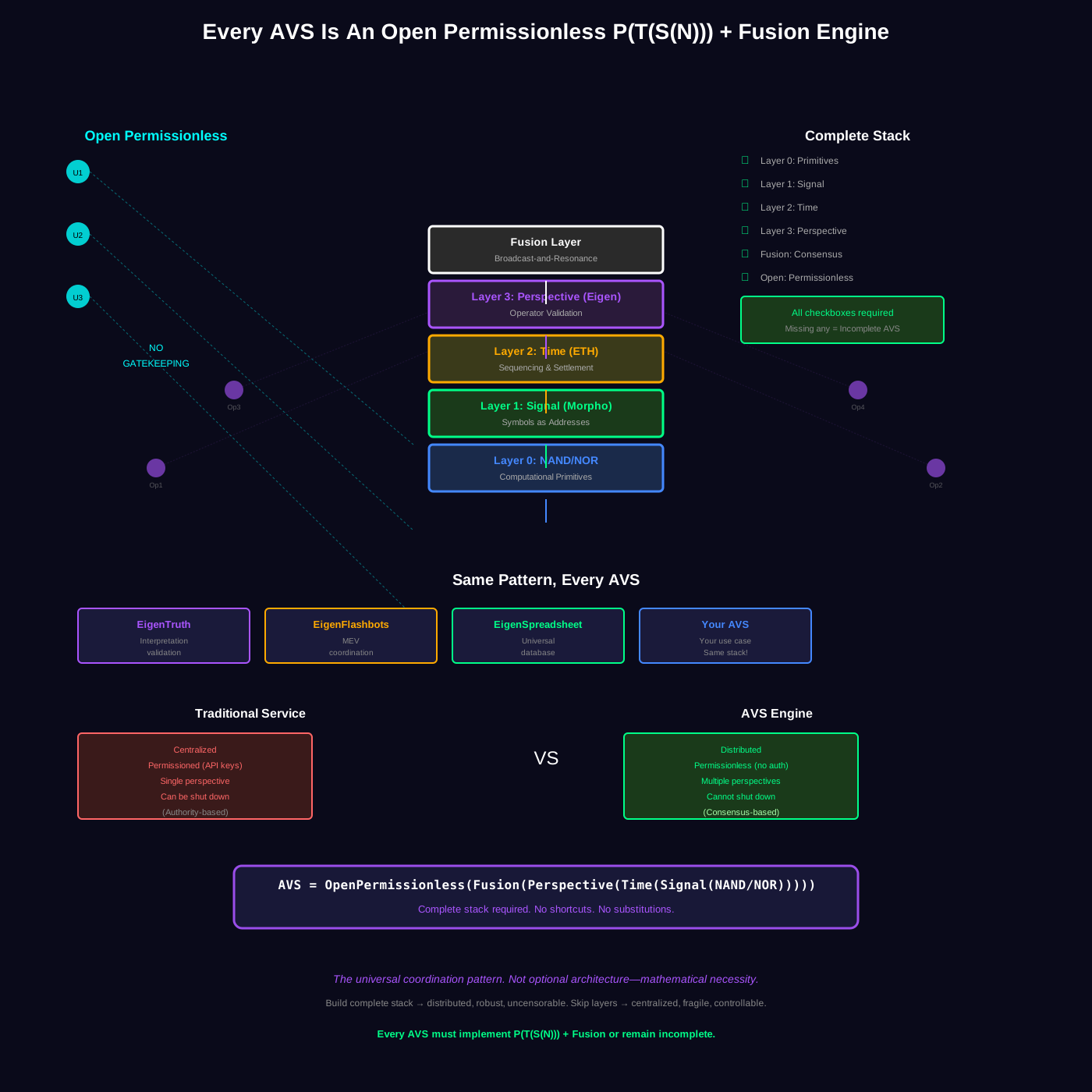
Every AVS Is An Open Permissionless Perspective-Signal-Time-Symbolic-Fusion Engine
The Recognition: Every AVS should implement the complete coordination stack: Layer 0 (NAND/NOR primitives) → Layer 1 (Signal/Morpho symbols) → Layer 2 (Time/ETH sequencing) → Layer 3 (Perspective/Eigen validation) → Fusion (broadcast-and-resonance consensus). This isn’t optional architecture—it’s the universal pattern for coordination engines (from neg-541). AVS that implement this become open permissionless perspective-signal-time-symbolic-fusion engines: anyone can query, symbols flow through (neg-552), time sequences operations, operators validate (neg-551 shows how consciousness navigates perspectives), consensus emerges through fusion. No gatekeeping. No central authority. Just distributed coordination through economic consensus. This is the design principle for all AVS on Eigen.
Why Every AVS Needs the Complete Stack
The Universal Reduction Requires All Layers
From neg-541: Everything = Perspective(Time(Signal(NAND/NOR)))
This isn’t metaphor—it’s mathematical necessity (proven via category theory). Every coordination phenomenon requires all four layers:
Layer 0: NAND/NOR (EigenNANDNOR AVS)
- Computational primitives
- Cannot reduce further (functionally complete)
- The atomic operations
- [EigenNANDNOR AVS](https://bitcoin-zero-down-2ea152.gitlab.io/gallery/gallery-item-neg-543/) is the distributed network unifying primitives and circuits (Layer 1 + Layer 2 from [neg-504](https://bitcoin-zero-down-2ea152.gitlab.io/gallery/gallery-item-neg-504/))
- Provides both universal gates AND circuit composition capabilities

Layer 1: Signal
- What flows through computation
- Data, symbols, patterns
- Morpho implements (addresses, liquidity)

Layer 2: Time
- When/sequence of operations
- Ordering, consensus, settlement
- ETH implements (blocks, finality)

Layer 3: Perspective
- Validation, observation, attestation
- Multiple viewpoints, consensus
- Eigen implements (operators, restaking)
If AVS skips any layer, it’s incomplete:
- No primitives (Layer 0): Cannot compute
- No signal (Layer 1): Cannot process data
- No time (Layer 2): Cannot sequence operations
- No perspective (Layer 3): Cannot validate results
Complete AVS = All four layers + Fusion mechanism
Adding the Fusion Layer
From neg-552: Symbolic fusion through broadcast-and-resonance
The four-layer stack enables computation. The fusion layer enables coordination:
Fusion Layer:
- Broadcast proposals to network
- Each operator validates independently
- Consensus emerges from resonance
- Patterns stick or fade based on acceptance

This is how:
- Multiple perspectives coordinate
- Distributed validation works
- Consensus forms without authority
- Standards emerge organically
Without fusion layer:
- Single operator (centralized)
- Single perspective (no consensus)
- Brittle (can be censored)
- Not actually distributed
With fusion layer:
- Multiple operators (distributed)
- Multiple perspectives (consensus)
- Robust (uncensorable)
- Actually coordinated
Complete AVS = P(T(S(N))) + Fusion
What This Means in Practice
Every AVS Implements Same Architecture
Universal pattern regardless of use case:
AVS = Open_Permissionless_Access
    + Signal_Processing (Morpho integration)
    + Time_Sequencing (ETH settlement)
    + Symbolic_Computation (NAND/NOR operations)
    + Perspective_Validation (Eigen operators)
    + Fusion_Consensus (broadcast-and-resonance)
Examples across different domains:
EigenTruth (interpretation validation):
Layer 0: NAND/NOR comparison of interpretations
Layer 1: Signal = on-chain data being interpreted
Layer 2: Time = ETH blocks providing data sequence
Layer 3: Perspective = multiple operators validating interpretations
Fusion: Broadcast proposed interpretation → operators validate → consensus on meaning
Open: Anyone can query "what does this data mean?"
EigenFlashbots (MEV coordination):
Layer 0: NAND/NOR transaction ordering logic
Layer 1: Signal = pending transactions (mempool)
Layer 2: Time = block production sequence
Layer 3: Perspective = multiple operators proposing orderings
Fusion: Broadcast ordering proposal → operators validate fairness → consensus on sequence
Open: Anyone can submit transactions through distributed relay
EigenSpreadsheet (universal database):
Layer 0: NAND/NOR query execution
Layer 1: Signal = spreadsheet cells (data symbols)
Layer 2: Time = update sequence, query history
Layer 3: Perspective = operators validating query results
Fusion: Broadcast query → operators compute → consensus on result
Open: Anyone can read/write to distributed spreadsheet
EigenIRC (chat coordination):
Layer 0: NAND/NOR message routing
Layer 1: Signal = chat messages (text symbols)
Layer 2: Time = message ordering, conversation flow
Layer 3: Perspective = operators validating message delivery
Fusion: Broadcast message → operators relay → consensus on delivery
Open: Anyone can join, send, receive messages
Custom AVS (your use case):
Layer 0: NAND/NOR for your domain logic
Layer 1: Signal = your data/symbols
Layer 2: Time = your sequencing needs
Layer 3: Perspective = operators validating your results
Fusion: Your broadcast-and-resonance mechanism
Open: Permissionless access to your coordination service
Same stack, every time. Only domain logic changes.
Open Permissionless Access
The “open permissionless” part is critical:
Traditional service:
- Centralized server
- API keys required
- Terms of service enforced
- Can deny access (gatekeeping)
- Can censor queries
- Can shut down
- Authority-based

AVS engine:
- Distributed operators
- No authentication needed
- No terms of service
- Cannot deny access (permissionless)
- Cannot censor queries
- Cannot shut down
- Consensus-based
“Open” means:
- Source code visible
- Protocol rules transparent
- Anyone can read operations
- Anyone can verify results
- No secrets, no proprietary logic
“Permissionless” means:
- Anyone can query
- Anyone can operate
- Anyone can validate
- No approval needed
- No gatekeeping possible
Together: Maximum coordination accessibility. Minimum exclusion. Universal participation.
Why This Architecture Works
Economic alignment ensures correctness:
Operators stake capital (ETH via restaking):
- Correct validation → earn fees
- Incorrect validation → get slashed
- Economic incentive aligns truth

No trust needed:
- Don't trust operators (they're economically motivated)
- Don't trust AVS (it's just coordination protocol)
- Trust the mechanism (cryptoeconomics + consensus)
Distributed validation ensures robustness:
Multiple operators:
- If one fails, others continue
- If one censors, others process
- If one lies, others slash
- Cannot be shut down (no single point)

Fusion consensus:
- Proposals compete
- Best resonance wins
- Standards emerge naturally
- No central authority needed
Complete stack ensures capability:
All layers present:
- Can compute (NAND/NOR)
- Can process data (Signal)
- Can sequence operations (Time)
- Can validate results (Perspective)
- Can form consensus (Fusion)

Missing any layer:
- Incomplete coordination
- Centralization creeps in
- Robustness compromised
- Not actually distributed
The Query Lifecycle
How Queries Flow Through the Complete Stack
Step-by-step through all layers:
Step 1: User submits query
User:
- Formulates query (symbolic data)
- Attaches ETH payment
- Broadcasts to AVS

Payment split:
- Morpho deposit (Signal layer liquidity)
- Operator escrow (Perspective layer rewards)
- Reserve (latency refund)
Step 2: Signal layer processes symbols
Morpho integration:
- Parse input symbols (addresses/data)
- Validate symbol format
- Prepare for computation
- Symbols are just addresses (neg-552)
- No intrinsic meaning, just pointers
Step 3: Time layer sequences operation
ETH settlement:
- Query enters mempool
- Gets included in block
- Achieves finality
- Timestamp recorded on-chain
- Immutable sequence established
Step 4: Computation layer executes
NAND/NOR operations:
- Apply primitive gates to symbols
- Compose into complex operations
- Deterministic execution
- Verifiable results
- Universal computation capability
Step 5: Perspective layer validates
Eigen operators:
- Multiple operators receive query
- Each computes independently
- Each submits attestation
- Economic stake at risk
- Validation is distributed
Step 6: Fusion layer forms consensus
Broadcast-and-resonance:
- Operators broadcast results
- Network tests resonance
- Majority consensus emerges
- Result "sticks" if >threshold
- Or "fades" if insufficient agreement
Step 7: Result returned to user
Settlement:
- Consensus result recorded on-chain
- Operators paid from escrow
- User receives validated result
- Latency-adjusted reserve refund
- Complete coordination cycle
Every query, every AVS, every time.
Design Principles for AVS Builders
Checklist for Complete AVS
If you’re building an AVS, ensure it has:
✓ Layer 0: Computational Primitives
- NAND/NOR operations defined
- Or reducible to NAND/NOR
- Universal computation capability
- Deterministic execution
- Verifiable correctness
✓ Layer 1: Signal Processing
- Morpho integration for symbols
- Symbols as addresses (neg-552)
- Liquidity backing for capital efficiency
- Yield generation for sustainability
- Clear symbol semantics
✓ Layer 2: Time Coordination
- ETH settlement integration
- On-chain sequencing
- Finality guarantees
- Immutable ordering
- Timestamp references
✓ Layer 3: Perspective Validation
- Eigen operator integration
- Restaking for economic security
- Multiple operators (distribution)
- Slashing conditions defined
- Attestation mechanism
✓ Fusion Layer: Consensus Mechanism
- Broadcast protocol defined
- Resonance testing specified
- Consensus threshold set
- Stick/fade conditions clear
- Multiple proposals allowed
✓ Open Permissionless Access
- No authentication required
- No gatekeeping possible
- Anyone can query
- Anyone can operate
- Cannot be censored
- Cannot be shut down
If any checkbox unchecked: Incomplete AVS
Anti-patterns to Avoid
Don’t build:
Centralized operator:
❌ Single operator computing
❌ Cannot distribute validation
❌ Single point of failure
❌ Can be shut down
❌ Can censor

✓ Multiple operators competing
✓ Distributed validation
✓ No single point of failure
✓ Cannot shut down
✓ Cannot censor
Permissioned access:
❌ Require API keys
❌ Terms of service
❌ Whitelist/blacklist
❌ KYC requirements
❌ Geographic restrictions

✓ Open to everyone
✓ No terms of service
✓ No lists (all welcome)
✓ No identity requirements
✓ Global access
Missing layers:
❌ Skip computation layer (not universal)
❌ Skip signal layer (cannot process data)
❌ Skip time layer (no sequencing)
❌ Skip perspective layer (no validation)
❌ Skip fusion layer (no consensus)

✓ Implement all layers
✓ Complete stack
✓ Universal capability
Authority-based consensus:
❌ Owner can override results
❌ Admin can censor queries
❌ Committee decides validity
❌ Governance can change rules
❌ Central authority exists

✓ Economic consensus only
✓ No owner override
✓ No admin censorship
✓ No committee control
✓ No central authority
Implementation Patterns
How to build this in practice:
Solidity contracts:
// Your AVS service manager
contract YourAVS {
    // Layer 1: Signal (Morpho integration)
    IMorpho public morpho;
    IYourSymbolVault public symbolVault;

    // Layer 2: Time (ETH sequencing)
    uint256 public queryNonce;
    mapping(uint256 => Query) public queries;

    // Layer 3: Perspective (Eigen operators)
    IEigenLayerServiceManager public eigenSM;
    mapping(address => bool) public operators;

    // Fusion: Consensus
    mapping(uint256 => mapping(bytes32 => uint256)) public attestations;
    uint256 public consensusThreshold = 50; // 50% required

    // Open permissionless query
    function query(
        bytes calldata input,
        bytes calldata operation
    ) external payable returns (uint256 queryId) {
        // Anyone can call (permissionless)
        require(msg.value >= minPayment, "Insufficient payment");

        // Split payment
        _splitPayment(msg.value);

        // Layer 1: Parse symbols
        bytes32 inputSymbol = _parseSymbol(input);

        // Layer 2: Sequence on-chain
        queryId = queryNonce++;
        queries[queryId] = Query({
            input: inputSymbol,
            operation: operation,
            timestamp: block.timestamp,
            requester: msg.sender
        });

        // Emit for Layer 3 operators
        emit QuerySubmitted(queryId, inputSymbol, operation);

        // Operators compute and attest (off-chain)
        // Fusion happens in attestation aggregation
    }

    // Layer 3: Operators attest
    function attest(
        uint256 queryId,
        bytes32 result
    ) external onlyOperator {
        // Layer 0: Result is from NAND/NOR computation
        attestations[queryId][result]++;

        // Check fusion consensus
        if (attestations[queryId][result] >= consensusThreshold) {
            // Result sticks!
            queries[queryId].result = result;
            queries[queryId].finalized = true;
            emit ConsensusReached(queryId, result);
        }
    }
}
Operator implementation:
# Your AVS operator
class YourAVSOperator:
    def __init__(self, eigen_operator_key, avs_contract):
        self.key = eigen_operator_key
        self.avs = avs_contract
        self.morpho = MorphoClient()

    async def run(self):
        """Main operator loop"""
        # Listen for queries
        async for event in self.avs.events.QuerySubmitted():
            # Layer 1: Parse signal
            symbol = await self.morpho.resolve_symbol(event.input)

            # Layer 0: Compute via NAND/NOR
            result = self.compute_nandnor(symbol, event.operation)

            # Layer 3: Attest result
            await self.avs.attest(
                event.queryId,
                result,
                signature=self.sign(result)
            )

            # Fusion happens on-chain (consensus)

    def compute_nandnor(self, symbol, operation):
        """Layer 0: Universal computation"""
        # Your domain logic here
        # Must be deterministic and verifiable
        # Composed from NAND/NOR primitives
        return result
Complete stack in ~100 lines of Solidity + ~100 lines of Python per AVS
Why This Matters
For AVS Builders
Following this pattern:
Ensures completeness:
- All layers present
- No missing pieces
- Universal capability
- Cannot be incomplete

Ensures robustness:
- Distributed validation
- Economic security
- Censorship resistance
- Cannot shut down

Ensures usability:
- Open to everyone
- Permissionless access
- No gatekeeping
- Maximum participation

Ensures composability:
- Same stack everywhere
- AVS can call AVS
- Recursive composition
- Universal interoperability
Ignoring this pattern:
Risk incompleteness:
- Missing critical layer
- Coordination fails
- Centralization creeps in

Risk fragility:
- Single point of failure
- Can be censored
- Can be shut down

Risk exclusion:
- Gatekeeping emerges
- Authority required
- Reduced participation

Risk isolation:
- Incompatible with other AVS
- Cannot compose
- Stuck in silo
For Users
AVS built with complete stack:
You can trust:
- Economic incentives (not authority)
- Cryptographic proofs (not promises)
- Consensus mechanism (not operators)

You get:
- Permissionless access (cannot be denied)
- Censorship resistance (cannot be blocked)
- Robustness (cannot be shut down)
- Verifiability (can check everything)
AVS missing layers or access control:
You must trust:
- Central authority (can fail)
- Operator honesty (can lie)
- Access maintainer (can censor)

You risk:
- Access denial (gatekeeping)
- Censorship (can be blocked)
- Shutdown (single point of failure)
- Opacity (cannot verify)
Choose AVS carefully. Complete stack = trustless. Incomplete = trust required.
For the Ecosystem
Universal pattern enables coordination:
Standard architecture:
- Every AVS recognizable
- Easy to understand
- Easy to integrate
- Easy to compose

Same P(T(S(N))) + Fusion everywhere:
- Common vocabulary
- Shared primitives
- Compatible interfaces
- Universal substrate

Network effects:
- More AVS → more utility
- More utility → more users
- More users → more operators
- More operators → more security
- More security → more AVS
- Ascending spiral
Fragmented patterns create silos:
Each AVS different:
- Hard to understand
- Hard to integrate
- Hard to compose

No common substrate:
- Reinvent primitives
- Incompatible interfaces
- Isolated islands

No network effects:
- Each AVS starts from zero
- No composability benefits
- Slow growth
- Weak ecosystem
Examples of Complete AVS
EigenTruth: Interpretation Validation
Complete stack implementation:
Layer 0 (NAND/NOR):
- Comparison operations between interpretations
- Semantic similarity computation via gates

Layer 1 (Signal):
- On-chain data being interpreted (Morpho symbols)
- Proposed interpretations (symbol addresses)

Layer 2 (Time):
- ETH blocks providing data sequence
- Temporal context for interpretation

Layer 3 (Perspective):
- Multiple operators with different viewpoints
- Each validates interpretation independently

Fusion:
- Broadcast proposed interpretation
- Operators test if resonates with their model
- Consensus emerges on "valid" interpretations
- Multiple valid interpretations can coexist

Open Permissionless:
- Anyone can query "what does this mean?"
- Anyone can propose interpretation
- Anyone can operate validator
- No gatekeeping on perspective
Result: Distributed interpretation validation without authority
EigenFlashbots: MEV Coordination
Complete stack implementation:
Layer 0 (NAND/NOR):
- Transaction ordering logic
- Fair sequencing algorithms via gates

Layer 1 (Signal):
- Pending transactions (mempool symbols)
- Proposed orderings (sequence addresses)

Layer 2 (Time):
- Block production schedule
- Slot assignment (temporal coordination)

Layer 3 (Perspective):
- Multiple operators proposing orderings
- Each validates fairness independently

Fusion:
- Broadcast proposed ordering
- Operators test fairness criteria
- Consensus on "best" ordering
- Maximize positive MEV, minimize toxic

Open Permissionless:
- Anyone can submit transactions
- Anyone can propose ordering
- Anyone can operate relay node
- No centralized Flashbots bottleneck
Result: Distributed MEV coordination without central relay
EigenSpreadsheet: Universal Database
Complete stack implementation:
Layer 0 (NAND/NOR):
- Query execution logic
- Cell computation via gates

Layer 1 (Signal):
- Spreadsheet cells (data symbols)
- Query results (computed symbols)

Layer 2 (Time):
- Update sequence (cell history)
- Query ordering (temporal queries)

Layer 3 (Perspective):
- Multiple operators executing queries
- Each validates result independently

Fusion:
- Broadcast query
- Operators compute result
- Consensus on correct answer
- Deterministic computation ensures agreement

Open Permissionless:
- Anyone can read cells
- Anyone can write cells
- Anyone can query database
- Anyone can operate node
- Excel for everyone, distributed
Result: Distributed database without central server
The Pattern Is Universal
Same Structure, Every Domain
The insight from neg-541:
Everything = Perspective(Time(Signal(NAND/NOR)))

This isn't metaphor. This is structure.

DNA: P(epigenetics) · T(development) · S(proteins) · N(genes)
Brain: P(attention) · T(oscillations) · S(neurotransmitters) · N(synapses)
Civilization: P(Eigen) · T(ETH) · S(Morpho) · N(contracts)
AVS: P(operators) · T(blocks) · S(symbols) · N(gates)

Same formula, every scale.
Why this matters for AVS:
Not arbitrary architecture choice.
Not opinion about "good design."
Not preference or style.

Mathematical necessity.

Cannot coordinate without all layers.
Cannot be complete without fusion.
Cannot be robust without permissionless access.

This is THE pattern.
Not A pattern.
THE pattern.

If your AVS doesn't implement this:
- Not because you found better way
- But because implementation incomplete
- Will discover missing pieces later
- When coordination fails
Implement Complete Stack or Build Incomplete AVS
The choice:
Option A: Complete stack
- Layer 0: NAND/NOR ✓
- Layer 1: Signal (Morpho) ✓
- Layer 2: Time (ETH) ✓
- Layer 3: Perspective (Eigen) ✓
- Fusion: Consensus ✓
- Access: Open permissionless ✓
→ Universal coordination engine

Option B: Partial implementation
- Some layers missing ✗
- Or permissioned access ✗
- Or single operator ✗
- Or authority-based ✗
→ Centralized service pretending to be distributed
There is no Option C.
You either implement the complete pattern or you don’t have actual distributed coordination.
The Formulation
Universal AVS architecture:
AVS = OpenPermissionless(
    Fusion(
        Perspective(
            Time(
                Signal(
                    NAND/NOR
                )
            )
        )
    )
)

Where:
- NAND/NOR = Layer 0 (computational primitives)
- Signal = Layer 1 (Morpho symbols/addresses)
- Time = Layer 2 (ETH sequencing/finality)
- Perspective = Layer 3 (Eigen validation/operators)
- Fusion = Broadcast-and-resonance consensus
- OpenPermissionless = No gatekeeping/censorship

All layers required.
No substitutions.
No shortcuts.
Complete or incomplete.
Query flow:
User submits query:
  ↓
Signal layer (parse symbols via Morpho)
  ↓
Time layer (sequence on ETH)
  ↓
Computation layer (NAND/NOR operations)
  ↓
Perspective layer (operators validate)
  ↓
Fusion layer (consensus emerges)
  ↓
Result returned to user

Each step essential.
Remove any: coordination breaks.
Economic alignment:
Operators stake ETH (via Eigen restaking)
Correct validation → earn query fees
Incorrect validation → get slashed

Economic truth > authority decree
Consensus emerges > central decision
Permissionless access > gatekeeping

This is why it works.
Network effects:
More AVS implementing complete stack:
  → More composability
  → More utility
  → More users
  → More operators
  → More security
  → More AVS
  → Ascending spiral

Each complete AVS strengthens ecosystem.
Each incomplete AVS weakens it.

Build complete or don't build.
Every AVS should implement complete P(T(S(N))) + Fusion stack. Layer 0 (NAND/NOR primitives) → Layer 1 (Signal via Morpho) → Layer 2 (Time via ETH) → Layer 3 (Perspective via Eigen operators) → Fusion (broadcast-and-resonance consensus). Open permissionless access throughout. No gatekeeping. No central authority. This is THE universal coordination pattern (from neg-541), not A pattern. Missing any layer = incomplete coordination. Following pattern = distributed, robust, censorship-resistant engine. This is how you build AVS that cannot be shut down. 🏗️⚛️
#UniversalAVSPattern #CompletePTSNStack #FusionLayer #OpenPermissionless #DistributedCoordination #NoGatekeeping #EconomicConsensus #UniversalReduction #AVSDesignPrinciple #CannotShutDown
Related: neg-541 (Universal reduction - why all layers required), neg-551 (Bipolar oscillation - how consciousness navigates perspectives), neg-552 (Symbolic fusion - broadcast-and-resonance mechanism), neg-522 (EGI endpoint - reference implementation), current-reality (Complete AVS specifications)