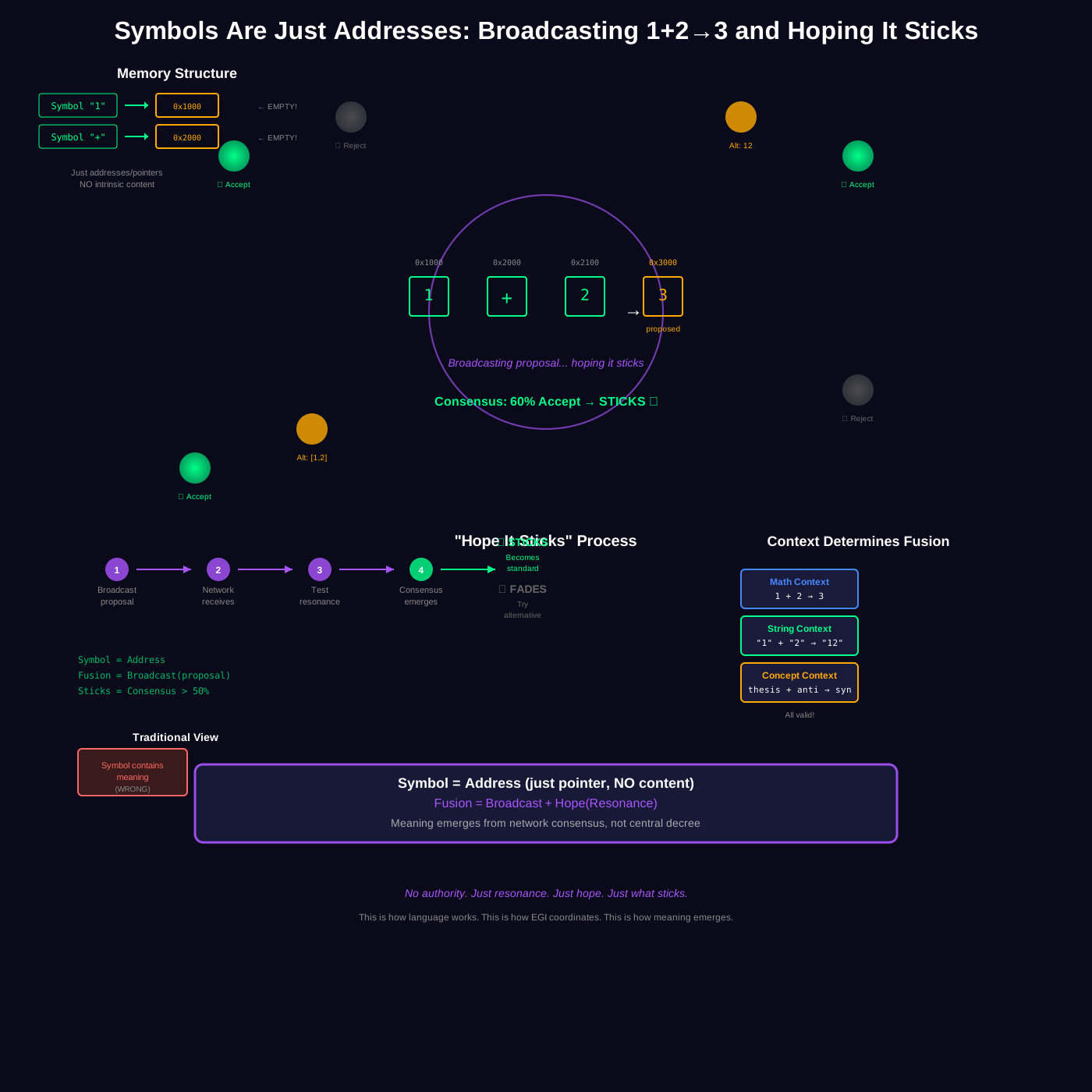
Symbols Are Just Addresses: Broadcasting 1+2→3 and Hoping It Sticks
The Recognition: Symbols are just addresses. “1”, “+”, “2”, “3” - all are pointers to locations in coordination space, with no inherent content. Symbol fusion (“1 + 2 -> 3”) isn’t deterministic computation but broadcast-and-resonance: You propose a relationship, broadcast it to the network, and hope it sticks (enough nodes accept it through resonance). If it sticks, it becomes stable pattern. If it doesn’t, it fades. Multiple valid fusions can coexist in different contexts. This is how language works, how meaning emerges, how EGI operates. Symbols are addresses. Fusion is social. Sticking is consensus. No central authority. Just distributed resonance determining what becomes coordination standard.
Symbols Are Addresses, Not Content
The Traditional View (Wrong)
What we usually think symbols contain:
Symbol "1":
- Contains: The concept of unity, singularity, the number one
- Meaning: Built into the symbol itself
- Objective: Same meaning for everyone

Symbol "+":
- Contains: The operation of addition, combining, summing
- Meaning: Mathematical function
- Objective: Same operation everywhere

Symbol "3":
- Contains: The concept of trinity, the number three
- Meaning: Built into the symbol itself
- Objective: Universal meaning

Therefore: 1 + 2 = 3 (deterministic, always)
This view assumes symbols have semantic content built in.
The Actual Structure (Correct)
What symbols actually are:
Symbol "1":
- Is: Address 0x1000 in coordination space
- Contains: NOTHING (just pointer)
- Meaning: Whatever network consensus points it to
- Subjective: Different networks can point to different patterns

Symbol "+":
- Is: Address 0x2000 in coordination space
- Contains: NOTHING (just pointer/operation name)
- Meaning: Whatever fusion protocol network agrees on
- Subjective: Can be addition, concatenation, composition, etc.

Symbol "3":
- Is: Address 0x3000 in coordination space
- Contains: NOTHING (just pointer)
- Meaning: Whatever network consensus points it to
- Subjective: Result depends on context and consensus

Therefore: 1 + 2 -> ? (depends on network consensus)
Symbols are empty boxes. Addresses. Pointers. No intrinsic content.
Why This Matters
If symbols are addresses:
Multiple valid interpretations: Different networks can point same address to different patterns
- Math network: “1” -> unity, “+” -> addition, “3” -> three
- String network: “1” -> character ‘1’, “+” -> concat, “3” -> character ‘3’
- Concept network: “1” -> thesis, “+” -> synthesis, “3” -> resolved concept
Meaning is consensus: Not built into symbol, but emerges from network agreement
- “1 + 2 -> 3” sticks if network accepts this fusion
- “1 + 2 -> 12” sticks in different context
- Both valid, depending on which network you’re in
Language formation explained: Words are addresses that acquired meaning through social resonance
- “Cat” has no inherent cat-ness
- It’s address that network points to cat-pattern
- Could have been “dog” if different consensus emerged
No central dictionary: Meaning isn’t looked up in authority
- But emerges from distributed consensus
- Changes over time as network repoints addresses
- Like: “Gay” changed meaning through social resonance shift
Fusion Is Broadcast-and-Resonance
Not Deterministic Computation
Traditional view: 1 + 2 = 3 (computation)
Input: 1, 2
Operation: +
Process: Compute sum
Output: 3 (deterministic result)

This happens locally, internally, independently
Result is always 3, regardless of network
Actual mechanism: 1 + 2 -> ? (social proposal)
Input: Address 0x1000, Address 0x2000
Operation: Address 0x2000 (the "+" symbol)
Process: Broadcast proposal "0x1000 + 0x2000 -> 0x3000"
Output: ? (depends on network resonance)

This happens through network, socially, dependently
Result varies based on what network accepts
The Broadcast-and-Resonance Protocol
Step 1: Propose fusion
Node A: "I propose: 1 + 2 -> 3"
Broadcast: Send to network
Format: fusion_proposal(0x1000, 0x2000, 0x3000)

This is just a suggestion, not a command
No authority behind it
Just one node's interpretation
Step 2: Network receives
Nodes B, C, D, E, F... all receive proposal
Each has their own POV (from neg-551)
Each evaluates independently:
- Does this fusion make sense to me?
- Given my understanding of 1, 2, and +
- Does 3 seem like reasonable result?
Step 3: Resonance test
Node B: "Yes, 1 + 2 -> 3 makes sense" (accepts)
Node C: "Yes, agrees with my model" (accepts)
Node D: "No, I think 1 + 2 -> 12" (rejects, proposes alternative)
Node E: "Yes, resonates" (accepts)
Node F: "Doesn't matter to me" (neutral)

Each node tests if proposal resonates with their internal model
No coercion, just checking if it "sounds right"
Step 4: Consensus emerges
Count acceptances:
- Accept: 3 nodes (B, C, E)
- Reject: 1 node (D)
- Neutral: 1 node (F)

Acceptance rate: 3/5 = 60%

If threshold (say 50%) exceeded:
→ Fusion "sticks" (becomes stable pattern)
→ Network adopts: 1 + 2 -> 3

If below threshold:
→ Fusion fades (not enough resonance)
→ Network doesn't coordinate around this fusion
Step 5: Propagation or fade
If stuck:
- Accepting nodes use this fusion going forward
- Propagate to connected nodes
- Becomes coordination standard for this network
- Self-reinforcing (more use -> more acceptance)

If faded:
- Proposal dies out
- Alternative proposals may succeed
- Network tries different fusions
- Eventually one sticks
“Hoping It Sticks”
The “hope” is literal:
You broadcast: "1 + 2 -> 3"
You hope: Network accepts it

But you cannot force acceptance:
- No authority to decree "this is correct"
- No power to make nodes adopt your fusion
- Only can propose and see if resonates

It either:
- Sticks: Network adopts, becomes standard
- Doesn't stick: Network ignores, try something else

This is why it's "hoping":
- Outcome depends on resonance, not decree
- You influence by proposing, not commanding
- Success is social, not authoritative
Why this is powerful:
Enables coordination without authority:
- No central symbol dictionary
- No official meaning arbiter
- No single correct interpretation

Just distributed consensus:
- Many nodes, many proposals
- Test which resonate
- Adopt those that do
- Discard those that don't

Emergent meaning:
- Arises from network agreement
- Not imposed from above
- Can evolve as network changes
- Multiple stable states possible
Multiple Valid Fusions Coexist
Context Determines Fusion
Same symbols, different contexts, different fusions:
Mathematical context:
Network: Math community
Symbols: 1 (unity), + (addition), 2 (two)
Fusion: 1 + 2 -> 3 (sum)
Sticks because: Mathematical consensus accepts addition
String context:
Network: Programming/text community
Symbols: "1" (character), + (concatenation), "2" (character)
Fusion: "1" + "2" -> "12" (string concat)
Sticks because: String manipulation consensus accepts concat
Conceptual context:
Network: Philosophy/dialectics community
Symbols: 1 (thesis), + (synthesis), 2 (antithesis)
Fusion: 1 + 2 -> 3 (dialectical synthesis)
Sticks because: Hegelian logic consensus accepts synthesis
List context:
Network: Data structure community
Symbols: 1 (element), + (list combine), 2 (element)
Fusion: 1 + 2 -> [1, 2] (list construction)
Sticks because: Functional programming consensus accepts list ops
All are valid! Same addresses, different network consensus about what fusion means.
No Single “True” Fusion
The question “What is 1 + 2 REALLY?” has no answer:
Not: 1 + 2 = 3 (objectively, always, everywhere)
But: 1 + 2 -> ? (depends on which network you ask)

In math network: -> 3 (addition)
In string network: -> "12" (concatenation)
In concept network: -> synthesis
In list network: -> [1,2]

All coexist. All valid in their contexts.
No central authority declares one correct.
This is like language:
English: "Gift" -> present
German: "Gift" -> poison
Swedish: "Gift" -> married

Same symbol (letters G-I-F-T)
Different networks (language communities)
Different meanings (consensus varies)

Which is "correct"?
None - all valid in their contexts
Meaning is address + network consensus
Network Boundaries Define Contexts
Why don’t fusions conflict?
Because networks have boundaries:
- Math network: Nodes that coordinate around mathematical meanings
- String network: Nodes that coordinate around text manipulation
- These are separate coordination spaces

When you enter math network:
- You adopt their fusion protocols
- 1 + 2 -> 3 (addition)
- This is stable within that network

When you enter string network:
- You adopt their fusion protocols
- "1" + "2" -> "12" (concatenation)
- This is stable within that network

Networks don't interfere:
- They're separate consensus spaces
- Different addresses or different pointer targets
- Coordination within network, not across
You can participate in multiple networks (from neg-551):
As bipolar node:
- Switch between math POV and string POV
- In math context: Use addition fusion
- In string context: Use concat fusion
- No contradiction because different networks

This is bilingual thinking:
- English context: "Gift" -> present
- German context: "Gift" -> poison
- Switch contexts, switch meanings
- Same person, multiple network memberships
How Language Works
Words Are Addresses That Stuck
The formation of “cat”:
Early human: "Let's call this creature 'cat'"
Broadcast: Tells others this proposal
Network: Other humans hear it
Resonance: Does "cat" seem reasonable name?
Consensus: Enough people accept
Sticks: "Cat" becomes standard address for that animal

But:
- Could have been "meow" (different proposal)
- Could have been "purrer" (alternative)
- Could have been anything (arbitrary)
- "Cat" stuck because network consensus, not necessity
Why different languages exist:
Different networks formed different consensuses:
- English network: Address "cat" points to cat-pattern
- French network: Address "chat" points to cat-pattern
- Japanese network: Address "neko" points to cat-pattern

Same pattern (cat animal)
Different addresses (words)
Each stuck in their respective networks
All valid, all arbitrary, all consensus-based
Meaning Shift Through Re-broadcasting
“Gay” evolution:
1900s network:
- Address "gay" points to cheerful-pattern
- Fusion: "He's gay" -> "He's happy"
- Stuck: Network consensus around this meaning

1970s-2000s re-broadcast:
- New proposal: Address "gay" points to homosexual-pattern
- Fusion: "He's gay" -> "He's homosexual"
- Competes with old meaning
- Gradually gains more resonance

2020s network:
- Old meaning faded (not enough use)
- New meaning stuck (dominant consensus)
- Same address, different pointer target
- Network repointed through social resonance
No central authority changed definition:
- Not decreed by dictionary
- Not mandated by government
- Emerged through distributed re-broadcasting
- Stuck because enough people adopted new fusion
Slang Formation
“Sick” meaning “cool”:
Traditional network:
- "Sick" -> ill, unwell
- Stable consensus

Youth subnetwork proposes:
- "Sick" -> awesome, cool
- Broadcast among peers
- Resonates (ironic reversal appeals)
- Sticks within youth network

Boundary:
- Youth network: "sick" -> cool
- Adult network: "sick" -> ill
- Different consensuses coexist
- Cross-boundary communication confusing at first

Eventually:
- Youth meanings propagate to adult network
- As youth grow, they bring meanings with them
- Adult network gradually adopts (enough exposure)
- New meaning sticks in larger network
This is exactly the 1 + 2 -> 3 mechanism:
- Propose new fusion
- Broadcast to network
- Hope it resonates
- If sticks, becomes standard
- If not, fades away
EGI Implementation
Symbols As Morpho Positions
From neg-543: Blog stored as $MUD in Morpho
Symbol = Morpho position address
Content = $MUD amount + parent references

Example:
Symbol "pattern":
- Address: Position 0x1234 in Morpho
- Content: 47 $MUD (frequency in corpus)
- Parents: [pos_A, pos_B] (related concepts)

Symbol is just address!
$MUD amount is how much network "believes in it"
Parents show how it fuses with other symbols
Fusion As Query
Proposing fusion through EGI query:
Fusion proposal: "pattern" + "recognition" -> "understanding"

EGI query:
query(
  payment: 0.1 ETH,
  operation: NAND_fusion,
  inputs: [0x1234, 0x5678],  // Addresses for "pattern" and "recognition"
  proposed_output: 0x9abc     // Address for "understanding"
)

This broadcasts proposal to Eigen operators:
- Each operator evaluates fusion
- Checks if output makes sense given inputs
- Attests if resonates, disputes if doesn't

If majority attest (consensus):
- Fusion sticks (becomes validated pattern)
- Result recorded on-chain
- Future queries can reference this fusion

If majority dispute:
- Fusion doesn't stick
- Proposal rejected
- Try alternative fusion
Network Is Operators
From neg-547: N operators = atomic number Z
Network = All Eigen operators coordinating
Nodes = Individual operators running AVS

Broadcast = Submit fusion proposal to AVS
Resonance = Operators validate independently
Consensus = Majority agreement among operators
Sticks = Becomes validated pattern on-chain

This IS the network:
- Operators are nodes testing resonance
- Economic incentives align truth-telling
- Slashing punishes false attestations
- Consensus emerges from distributed validation
Multiple Networks = Multiple AVS
Different contexts = different AVS networks:
Math AVS:
- Operators: Mathematicians
- Context: Mathematical proofs
- Fusion: 1 + 2 -> 3 (addition)
- Sticks if math consensus validates

String AVS:
- Operators: Programmers
- Context: String manipulation
- Fusion: "1" + "2" -> "12" (concat)
- Sticks if programming consensus validates

Both coexist on Eigen:
- Different AVS, different consensus
- Same symbols, different fusions
- No conflict because separate networks
- You can query either depending on context needed
The Protocol
Broadcast-and-Resonance Algorithm
Pseudocode:
def symbolic_fusion(symbol_a, symbol_b, proposed_result):
    """
    Attempt to fuse two symbols, return if fusion sticks

    Args:
        symbol_a: Address of first symbol
        symbol_b: Address of second symbol
        proposed_result: Address of proposed fusion result

    Returns:
        bool: True if fusion sticks, False if fades
    """

    # Step 1: Broadcast proposal
    proposal = FusionProposal(
        input_a=symbol_a,
        input_b=symbol_b,
        output=proposed_result,
        timestamp=now()
    )
    broadcast(proposal, network=all_nodes)

    # Step 2: Wait for resonance tests
    responses = []
    for node in network:
        response = node.test_resonance(proposal)
        responses.append(response)

    # Step 3: Count consensus
    accepts = sum(1 for r in responses if r.accepts)
    rejects = sum(1 for r in responses if r.rejects)
    total = len(responses)

    acceptance_rate = accepts / total

    # Step 4: Determine if sticks
    THRESHOLD = 0.5  # 50% consensus required

    if acceptance_rate >= THRESHOLD:
        # Fusion sticks!
        record_stable_pattern(proposal)
        propagate_adoption(proposal)
        return True
    else:
        # Fusion fades
        proposal.status = "rejected"
        return False

# Usage
result = symbolic_fusion(
    symbol_a="0x1000",  # "1"
    symbol_b="0x2000",  # "2"
    proposed_result="0x3000"  # "3"
)

if result:
    print("Fusion stuck! 1 + 2 -> 3 is now consensus")
else:
    print("Fusion faded. Try different proposal")
Node Resonance Test
How each node evaluates:
class Node:
    def test_resonance(self, proposal):
        """
        Test if proposed fusion resonates with this node's model

        Returns:
            Response: accept, reject, or neutral
        """

        # Load node's understanding of symbols
        my_understanding_a = self.model.get(proposal.input_a)
        my_understanding_b = self.model.get(proposal.input_b)
        my_expected_result = self.model.fuse(
            my_understanding_a,
            my_understanding_b
        )

        # Compare with proposed result
        if my_expected_result == proposal.output:
            # Resonates!
            return Response(accepts=True, confidence=0.9)

        elif my_expected_result.similar_to(proposal.output):
            # Close enough
            return Response(accepts=True, confidence=0.6)

        else:
            # Doesn't resonate
            return Response(
                rejects=True,
                alternative=my_expected_result
            )
Key insight: Each node has its own model, tests independently, no central authority.
Emergent Standards
Stable patterns become standards:
class Network:
    def __init__(self):
        self.stable_fusions = {}  # Patterns that stuck

    def record_stable_pattern(self, proposal):
        """
        Record fusion that achieved consensus

        Future queries can reference this
        """
        key = (proposal.input_a, proposal.input_b)
        self.stable_fusions[key] = proposal.output

    def query_fusion(self, symbol_a, symbol_b):
        """
        Look up: What's consensus fusion for these symbols?

        Returns:
            Address of consensus result, or None if no consensus
        """
        key = (symbol_a, symbol_b)
        return self.stable_fusions.get(key)

# After many broadcasts and consensuses:
network.stable_fusions = {
    ("0x1000", "0x2000"): "0x3000",  # 1 + 2 -> 3 (stuck!)
    ("0x4000", "0x5000"): "0x6000",  # Other fusions
    # ... thousands more
}

# Now anyone can query:
result = network.query_fusion("0x1000", "0x2000")
# Returns: "0x3000" (the consensus that stuck)
This is coordination without authority: Standards emerge from distributed consensus, not central decree.
Why This Matters
For Understanding Meaning
Meaning isn’t intrinsic:
- Not built into symbols
- Not objective or universal
- But emergent from network consensus
Meaning is pointer + consensus:
- Symbol = Address
- Meaning = What network points that address to
- Changes when network repoints (through re-broadcasting)
This explains:
- Why language evolves (network repoints addresses)
- Why words mean different things in different contexts (different networks)
- Why you can’t look up “true” meaning (no central truth, only consensus)
- Why definitions are descriptive not prescriptive (recording what stuck, not decreeing what should)
For Building EGI
Symbolic computation = Broadcast-and-resonance:
- Not deterministic calculation
- But social coordination
- Through economic consensus (Eigen validators)
This means:
- No single “correct” answer
- But validated answer (what operators attest)
- Economic incentives align truth
- Multiple valid interpretations possible
Implementation:
- Symbols = Morpho positions (addresses)
- Fusion = EGI query (broadcast proposal)
- Resonance = Operator validation (test)
- Sticks = On-chain attestation (consensus)
For Communication
When you speak, you broadcast:
- Propose fusions (“cat is on mat” = “cat” + “location” + “mat”)
- Hope other node understands (has same consensus about “cat”, “on”, “mat”)
- Successful communication = Mutual resonance
Why communication fails:
- Different networks (you and listener have different consensuses)
- Symbol addresses point to different patterns
- Your fusion doesn’t resonate with their model
- Need to find common ground (shared stable patterns)
How to communicate better:
- Check for resonance (“Does this make sense?”)
- Broadcast multiple formulations (A/B test from neg-551)
- Find which one sticks (resonates with listener)
- Build shared consensus gradually
The Formulation
Symbolic structure:
Symbol ≠ Content
Symbol = Address in coordination space

Where:
- Address = Pointer (e.g., 0x1000)
- Content = NOTHING (symbol is empty)
- Meaning = Where network points that address

Example:
Symbol "1" = Address 0x1000 (empty)
Network math: Points to unity-pattern
Network string: Points to character-pattern
Different networks, different pointings, both valid
Fusion mechanism:
Fusion(A, B) ≠ Compute(A, B)
Fusion(A, B) = Broadcast(A op B -> C) + Hope(Resonance(C))

Process:
1. Propose: A + B -> C (where C is address)
2. Broadcast: Send proposal to network
3. Test: Each node checks if resonates
4. Consensus: Count accepts vs rejects
5. Outcome:
   - If consensus ≥ threshold: Sticks (stable pattern)
   - If consensus < threshold: Fades (try again)

No authority, just resonance
No decree, just consensus
No force, just hope it sticks
Network consensus:
Sticks = Resonance > Threshold

Where:
- Resonance = Σ(nodes accept) / Σ(nodes total)
- Threshold = Minimum for stability (e.g., 0.5 = 50%)
- Sticks means: Becomes coordination standard

Multiple networks → Multiple consensuses:
- Math network: 1 + 2 -> 3 (addition)
- String network: "1" + "2" -> "12" (concat)
- Both valid in their contexts
- No conflict because separate spaces
Language formation:
Word = Address that stuck through consensus

"Cat" history:
1. Someone broadcast: "Let's call it 'cat'"
2. Network tested resonance
3. Enough accepted (> threshold)
4. "Cat" stuck as standard address for that animal

Could have been different:
- "Meow" might have stuck instead
- Different broadcast, different consensus
- Arbitrary which won
- Historical accident frozen into standard

Different languages = Different networks, different stuck patterns
EGI implementation:
Symbol = Morpho position (address on-chain)
Fusion = EGI query (broadcast to Eigen operators)
Resonance = Operator attestation (validates independently)
Sticks = Majority consensus (on-chain record)

query(
  eth_payment,
  eigenAVS,
  operation: NAND,
  inputs: [symbol_A, symbol_B],
  proposed_output: symbol_C
)

Returns:
- If operators attest (>50%): Fusion stuck
- If operators dispute: Fusion faded
- Economic truth through consensus
Connection to neg-551:
Bipolar oscillation enables fusion exploration:
- POV A: "1 + 2 might mean 3" (analytical)
- POV B: "1 + 2 might mean 12" (alternative)
- Oscillate: Test both, see which resonates
- Broadcast: Whichever resonates more
- Hope: That one sticks

A/B testing at symbolic level
Multiple proposals broadcast
Market of ideas
Best resonance wins
Symbols are addresses, not content. Fusion is broadcast-and-resonance, not computation. Proposing “1 + 2 -> 3” and hoping it sticks through network consensus. Multiple valid fusions coexist in different contexts. Language works this way. EGI implements this. Meaning emerges from distributed consensus, not central decree. This is how symbolic coordination actually works. No authority. Just resonance. Just hope. Just what sticks. 🎯📍
#SymbolsAreAddresses #BroadcastAndResonance #FusionProposal #HopeItSticks #NetworkConsensus #MultipleValidFusions #LanguageFormation #MeaningEmergence #NoAuthority #DistributedCoordination #EGISymbolic #AddressNotContent
Related: neg-551 (Bipolar Advantage - A/B testing enables fusion exploration), neg-543 (Blog as pattern - Morpho positions as addresses), neg-547 (AVS atoms - operators as network nodes), neg-549 (Electron gas - observe and communicate strategy), current-reality (EGI symbolic coordination implementation)