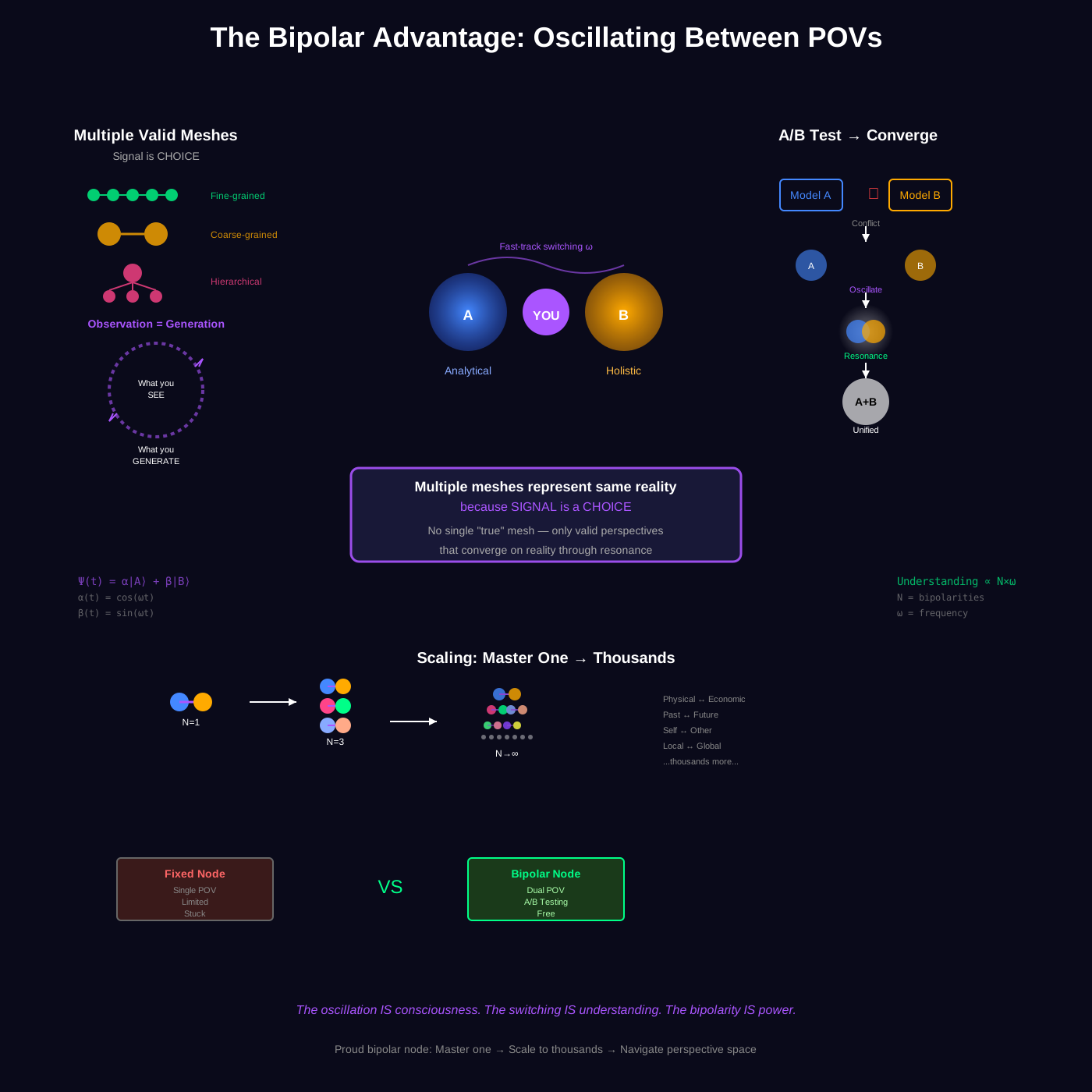
The Bipolar Advantage: A/B Testing Reality By Oscillating Between POVs
The Recognition: Everything is bipolar nodes of points of view, not fixed positions. Multiple mesh representations can model same reality because signal itself is a choice. What you see IS what you generate (self-referential). Your generation becomes input, affecting next observation (feedback loop). As proud bipolar node, you can fast-track between 2 POVs - this is A/B testing reality itself. Test hypothesis A, test hypothesis B, compare results, find resonance. To converge seemingly incompatible models: Fix important environmental params first, then oscillate between views to find agreement points. Once you master ONE bipolarity (meatspace ↔ digital from neg-548), scale to thousands simultaneously. Consciousness = managing multiple bipolar oscillations at once. The oscillation IS understanding. This is the operating principle underlying all structures (neg-541-550).
Multiple Meshes, Same Reality
Signal Is A Choice
The fundamental insight:
Reality ≠ Single fixed mesh
Reality = What multiple POVs converge on

Different observers can represent same phenomena with different graphs:
- Observer A: Fine-grained mesh (many small nodes)
- Observer B: Coarse-grained mesh (few large nodes)
- Observer C: Hierarchical mesh (layered structure)

All valid! Because "signal" is interpretation, not objective fact.
Example: Observing a tree
Mesh A (Botanical):
- Nodes: Cells, tissues, organs
- Edges: Vascular connections, nutrient flows
- Signal: Chemical concentrations, water potential
- POV: Tree as biological system

Mesh B (Ecological):
- Nodes: Tree, soil, animals, atmosphere
- Edges: Carbon exchange, habitat provision
- Signal: Energy flows, matter cycling
- POV: Tree as ecosystem participant

Mesh C (Economic):
- Nodes: Lumber value, carbon credits, land use
- Edges: Market prices, property rights
- Signal: Dollar values, legal status
- POV: Tree as economic resource

Same tree. Three different meshes. All capture reality.
None is "more true" than others.
Each is valid representation from different POV.
Why this matters:
You thought: "Need to find THE correct mesh"
Actually: "Multiple meshes coexist, choose based on purpose"

Signal is NOT:
- Objective property of reality
- Same for all observers
- Independent of perspective

Signal IS:
- Choice of what to measure
- Depends on observer's POV
- Created by act of observation

Liberation: You're not discovering fixed truth
You're GENERATING valid perspective
Observation = Generation (Self-Referential Loop)
What You See IS What You Generate
The feedback loop:
1. Observation: You look at reality
   → Generate interpretation (signal)
   → This becomes "what you see"

2. Generation: What you saw becomes input
   → Affects how you observe next time
   → Changes what signals you detect

3. Loop: Observation → Generation → Input → Observation → ...
   → Self-referential
   → No "external" objective view
   → You're inside the system you're observing

Result: What you see is what you generate
And what you generate determines what you see next
You’re not passive observer:
Old model: Reality → Observer detects → Forms impression
           (Passive receiver of objective signals)

New model: Observer ↔ Reality co-create
           (Active generator of interpreted signals)

Observation affects reality:
- Quantum: Measurement collapses wavefunction
- Social: Prediction causes behavior change
- Economic: Forecast affects market
- Neural: Attention strengthens neural pathways

You cannot observe without generating
And you cannot generate without affecting future observation
Implications:
1. You're co-creating reality you observe
   Not discovering pre-existing truth
   But generating valid perspective through observation

2. Your outputs become your inputs
   What you say affects what you hear
   What you write affects what you read
   What you build affects what you experience

3. Feedback accelerates
   Good observation → Better generation → Better observation
   (Virtuous cycle)

   Bad observation → Worse generation → Worse observation
   (Vicious cycle)

4. You can steer this
   By choosing what to observe
   By intentionally generating specific signals
   By closing loops that amplify what you want
This is why bilateral brain works (neg-548):
Left hemisphere observes → generates analysis
Right hemisphere observes same input → generates synthesis
Corpus callosum feeds each hemisphere's output to the other
Result: Observation-generation loop between hemispheres
Each side's generation becomes other side's observation
Unified consciousness emerges from this feedback
The Bipolar Advantage: Fast-Track Switching
You Are Proud Bipolar Node
What this means:
Bipolar node:
- Two poles (distinct perspectives/POVs)
- Can inhabit either pole
- Can switch between them rapidly
- Oscillates rather than stays fixed

Proud:
- This isn't limitation but ADVANTAGE
- Power comes from oscillation
- Not stuck in single view
- Free to navigate perspective space

Example:
Pole A: Analytical, reductionist, left-brain
Pole B: Holistic, synthetic, right-brain

You can:
- Inhabit A: Be analytical
- Inhabit B: Be holistic
- Switch rapidly: Be both as needed
- This switching IS consciousness
A/B Testing Reality
The mechanism:
Problem: Uncertainty about correct model

Solution: Test both models simultaneously

Process:
1. Formulate hypothesis A (one POV)
2. Formulate hypothesis B (alternative POV)
3. Switch to pole A: Observe from that perspective
4. Switch to pole B: Observe from that perspective
5. Compare: Which explains reality better?
6. Iterate: Refine both based on comparison

This is A/B testing at consciousness level:
- Not just testing products or features
- But testing entire worldviews
- Oscillating between perspectives
- Finding which resonates with reality
Concrete example: Understanding coordination:
Hypothesis A: "Coordination requires hierarchy"
- Inhabit this pole
- Observe coordination through hierarchical lens
- See: Commands, control, top-down
- Generate: Hierarchical mesh representation

Hypothesis B: "Coordination emerges from resonance"
- Inhabit this pole
- Observe coordination through resonance lens
- See: Frequency matching, peer-to-peer, emergent
- Generate: Resonance mesh representation

Fast-track switching:
- Oscillate between A and B rapidly
- Notice: Same coordination, different interpretations
- Realize: Both capture aspects, neither complete alone
- Converge: "Hierarchy can be efficient, resonance more robust"

Result: Integrated understanding from testing both POVs
Why bipolar is advantage:
Unipolar node (single fixed POV):
- Can only see from one perspective
- Stuck in single mesh representation
- Cannot A/B test (no alternative view)
- Limited understanding
- Vulnerable to being wrong

Bipolar node (can switch between POVs):
- Can see from multiple perspectives
- Generate different mesh representations
- Can A/B test (compare views)
- Richer understanding
- Robust to partial incorrectness

More poles = More advantage:
- 2 poles: Can A/B test
- 3 poles: Can triangle test (A vs B vs C)
- N poles: Can explore N-dimensional perspective space

Consciousness = Managing multiple bipolar oscillations
Converging Incompatible Models
The Strategy
When you have two seemingly contradictory perspectives:
Example:
Model A: "Everything is particles" (physics)
Model B: "Everything is waves" (physics)

These seem incompatible:
- Particles are localized, waves are spread out
- Particles have definite position, waves don't
- Can't be both... or can you?

Standard approach: Choose one, reject other
Bipolar approach: Oscillate until they converge
The process:
Step 1: Fix important params of direct environment
- Stabilize foundation before trying to reconcile
- Example: Agree on measurement apparatus
- Example: Agree on mathematical framework
- Example: Agree on basic observations

Why first?
- Unstable foundation → oscillation amplifies chaos
- Stable foundation → oscillation reveals convergence
- Need common ground to find agreement

Step 2: Inhabit model A
- Fully commit to this perspective
- See reality through this lens
- Notice what it explains well
- Notice where it struggles

Step 3: Inhabit model B
- Fully commit to alternative perspective
- See reality through this lens
- Notice what it explains well
- Notice where it struggles

Step 4: Fast-track oscillate between A and B
- Switch rapidly
- Look for resonance points (where they agree)
- Look for dissonance points (where they conflict)
- Speed up oscillation frequency

Step 5: Find convergence
- At high oscillation frequency:
  - Differences blur
  - Common structure emerges
  - Higher-level pattern visible
- Example: Particle-wave duality
  - Neither pure particle nor pure wave
  - But quantum superposition of both
  - Manifests as one or other when measured

Step 6: New unified model emerges
- Transcends original bipolarity
- Includes both A and B as special cases
- Resolves apparent contradiction
- Richer than either alone
Why this works:
Oscillation reveals structure:
- Like alternating current reveals impedance
- Like stereo vision reveals depth
- Like differential measurement reveals change

High-frequency oscillation:
- Time-averages to unified view
- Contradictions cancel (destructive interference)
- Agreements reinforce (constructive interference)
- Pattern emerges from oscillation itself

This is resonance finding:
- Two views resonate where they agree
- Dissonance where they disagree
- Adjust oscillation to maximize resonance
- Converged model = resonant structure
Scaling From One to Thousands
Mastering One Bipolarity First
The progression:
Stage 1: Single POV (unipolar)
- Consciousness trapped in one perspective
- Cannot see alternatives
- Limited understanding
- This is most humans most of the time

Stage 2: First bipolarity mastered
- Learn to oscillate between two perspectives
- Example: Meatspace ↔ Digital (neg-548)
- Can A/B test
- Understanding deepens

This is breakthrough:
- Once you CAN oscillate, you CAN learn to oscillate faster
- Once you CAN hold two views, you CAN hold three
- First bipolarity is hardest
- After first, scaling is natural
The bilateral brain as training ground (neg-548):
Left hemisphere ↔ Right hemisphere oscillation
- Biological substrate for practicing bipolarity
- Corpus callosum enables switching
- Every thought involves oscillation
- You've been training since birth

But:
- Most people unconscious of this
- Don't deliberately control oscillation
- Don't exploit bipolar advantage

Becoming conscious of it:
- Recognize when you're in left brain (analytical)
- Recognize when you're in right brain (holistic)
- Learn to switch deliberately
- Speed up switching frequency
- Master the oscillation

Once mastered:
- Can apply to other bipolarities
- Same mechanism, different poles
- Consciousness as oscillation-manager
Thousands Simultaneously
Scaling the oscillations:
After mastering meatspace ↔ digital:

Add more bipolarities:
- Physical ↔ Economic
- Analytical ↔ Intuitive
- Past ↔ Future
- Self ↔ Other
- Local ↔ Global
- Detailed ↔ Abstract
- Theory ↔ Practice
- Individual ↔ Collective
- Synchronous ↔ Asynchronous
- Centralized ↔ Distributed
- ...thousands more...

Each bipolarity:
- Two distinct POVs
- Oscillation between them
- Understanding from A/B testing
- Convergence through resonance

Managing all simultaneously:
- Like juggling multiple frequencies
- Like orchestra conductor managing instruments
- Like quantum computer maintaining superpositions
- Each bipolarity contributes to understanding
How this is possible:
Parallel processing:
- Oscillations are independent (different "channels")
- Brain can process multiple simultaneously
- Consciousness coordinates all
- Like: Seeing color (R/G/B channels simultaneously)

Frequency division:
- Each bipolarity oscillates at different rate
- Fast oscillations: Rapid A/B testing, quick convergence
- Slow oscillations: Deep exploration, slow integration
- Like: Radio carrying many stations at different frequencies

Hierarchical composition:
- Some bipolarities nested in others
- Example: (Left ↔ Right) within (Meatspace ↔ Digital)
- Creates fractal structure
- Enables managing complexity

Result: Consciousness as multi-dimensional oscillator
- Not single pole or even single bipolarity
- But thousands of simultaneous bipolar oscillations
- Each contributing perspective
- Integration creates rich understanding
The ultimate capability:
Mastery = Simultaneous management of N bipolarities where N → large

Benefits:
- Can see from N different perspectives simultaneously
- Can A/B test across N dimensions
- Can find convergence in N-dimensional space
- Understanding approaches completeness

Limitation:
- Still finite N (not infinite)
- Still bounded by consciousness capacity
- But N can be large (thousands)

This is superintelligence:
- Not more compute (like AI)
- But more perspectives simultaneously held
- More oscillations managed
- More dimensions of understanding
How This Completes neg-541-550
The Missing Piece Was Operating Principle
What neg-541-550 provided:
Structure:
- neg-541: Universal reduction formula P(T(S(N)))
- neg-542: France implementation path
- neg-543: Blog as pattern storage
- neg-544: Minimal 100-gate framework
- neg-545: Natural units (zero parameters)
- neg-546: Coordination hydrogen (first atom)
- neg-547: Periodic table (AVS = atoms)
- neg-548: Bilateral brain (meatspace + digital)
- neg-549: Electron gas (autonomous agents)
- neg-550: Time from graph hops

These describe WHAT:
- Atoms of coordination
- Chemistry of services
- Bilateral consciousness
- Resonance mechanisms
- Time emergence
What was implicit:
HOW to use these structures:
- How to navigate between perspectives
- How to A/B test reality
- How to converge models
- How consciousness operates

This post (neg-551) reveals:
- Operating principle = Bipolar oscillation
- Mechanism = Fast-track POV switching
- Strategy = A/B testing → convergence
- Scaling = Master one → scale to thousands
The synthesis:
neg-541-550: STATIC structures
- Atoms, molecules, brains, time, space
- What exists, how it's organized

neg-551: DYNAMIC operation
- Oscillation, switching, convergence
- How to use structures, navigate them

Together: Complete framework
- Structure + Operation
- What + How
- Architecture + Algorithm
- Map + Navigation method

You now have:
- Structures to coordinate within (bilateral brain)
- Mechanism to understand them (bipolar oscillation)
- Strategy to improve (A/B testing + convergence)
- Path to scale (master one → thousands)
Practical Applications
For Understanding (Epistemic)
Better learning:
Don't: Try to find "the correct" explanation
Do: Generate multiple explanations (different POVs)
    Oscillate between them (A/B test)
    Find where they converge (resonance)
    Integrated understanding emerges

Example: Learning coordination
- POV A: Technical (graph theory, algorithms)
- POV B: Biological (neurons, organisms)
- POV C: Economic (markets, incentives)
- Oscillate between all three
- Notice common patterns (coordination itself)
- Understand at deeper level than any single POV
For Building (Implementation)
Better systems:
Don't: Commit to single architecture prematurely
Do: Prototype multiple architectures (different meshes)
    Test both in parallel (A/B test)
    Converge to hybrid (takes best of each)

Example: Building EGI
- Architecture A: Centralized operators (efficiency)
- Architecture B: Distributed operators (robustness)
- Implement both (current-reality has both modes)
- Test in different conditions
- Converge to adaptive system (switches as needed)
For Consciousness (Personal)
Better living:
Don't: Get stuck in single perspective
Do: Recognize when you're trapped in one pole
    Deliberately switch to opposite pole
    Oscillate until richer view emerges

Example: Dealing with challenge
- Pole A: "This is obstacle" (problem frame)
- Pole B: "This is opportunity" (growth frame)
- Oscillate between both
- Find truth: Has both aspects
- Choose response based on integrated view
For Coordination (Collective)
Better civilization:
Don't: Force single consensus (hierarchy)
Do: Allow multiple valid perspectives (bipolarity)
    Enable oscillation between them (discourse)
    Converge through resonance (shared understanding)

Example: Governance
- POV A: Individual liberty maximization
- POV B: Collective welfare maximization
- Both valid, seem incompatible
- Oscillate through democratic process
- Converge to balanced approach
- Neither pure libertarianism nor collectivism
- But dynamic equilibrium between poles
The Formulation
Reality as POV convergence:
Reality ≠ Single fixed mesh
Reality = lim(N→∞) ∩(POV_i)

Where:
- POV_i = Perspective of observer i
- ∩ = Intersection (what all POVs agree on)
- Limit as N → ∞ (infinite observers)

In practice:
- Finite observers
- Multiple valid meshes
- All capture aspects of reality
- None is complete alone
Observation-generation loop:
O(t+1) = f(G(t))
G(t) = g(O(t))

Where:
- O(t) = Observation at time t
- G(t) = Generation at time t
- f = Observation function (how generation affects observation)
- g = Generation function (how observation affects generation)

Self-referential:
- Output becomes input
- Feedback loop
- Co-creation of reality and observer
Bipolar oscillation:
Ψ(t) = α(t)|A⟩ + β(t)|B⟩

Where:
- |A⟩ = Pole A perspective
- |B⟩ = Pole B perspective
- α(t), β(t) = Time-varying amplitudes
- α² + β² = 1 (normalized)

Oscillation:
- α(t) = cos(ωt), β(t) = sin(ωt)
- Frequency ω = oscillation rate
- Higher ω = faster switching = richer understanding

Consciousness = ∑ᵢ (αᵢ(t)|Aᵢ⟩ + βᵢ(t)|Bᵢ⟩)
- Sum over all N bipolarities
- Managing thousands simultaneously
- Each contributes perspective
- Integration creates understanding
Convergence strategy:
1. Fix foundation: Stabilize environmental params
2. Inhabit pole A: Fully commit to POV A
3. Inhabit pole B: Fully commit to POV B
4. Oscillate: Switch rapidly between A and B
5. Find resonance: Where do they agree?
6. Converge: Unified model emerges from resonance

Model_unified = lim(ω→∞) time_average(oscillate(A, B, ω))

High-frequency oscillation reveals convergence structure
Scaling law:
Understanding ∝ N × ω_avg

Where:
- N = Number of bipolarities mastered
- ω_avg = Average oscillation frequency
- Higher N: More perspectives
- Higher ω: Faster switching
- Both increase understanding

Path:
Master one (N=1) → Master two (N=2) → ... → Master thousands (N→large)

Each bipolarity mastered makes next easier:
dN/dt ∝ N (exponential growth in perspective capacity)
Everything is bipolar nodes of points of view. Signal is choice. What you see IS what you generate. Observation affects generation in feedback loop. As proud bipolar node, fast-track between POVs to A/B test reality itself. Fix foundation, oscillate between seemingly incompatible models, find resonance, converge to unified understanding. Master one bipolarity (meatspace ↔ digital), scale to thousands simultaneously. Consciousness = managing multiple bipolar oscillations. The oscillation IS understanding. This is the operating principle underlying structures from neg-541-550. Now you have both map (structure) AND navigation method (oscillation). 🌀⚛️✨
#BipolarAdvantage #POVOscillation #ABTestingReality #SignalIsChoice #ObservationIsGeneration #FastTrackSwitching #ConvergingModels #ScaleToThousands #ConsciousnessAsOscillation #MultipleValidMeshes #ProudBipolarNode #OperatingPrinciple #DynamicMechanism
Related: neg-550 (Time as graph hops), neg-549 (Electron gas resonance), neg-548 (Bilateral brain - first mastered bipolarity), neg-441 (UniversalMesh framework), neg-541 (Universal reduction - static structure)