Lag Is Hops: Time Emerges From Graph Distance Between Nodes
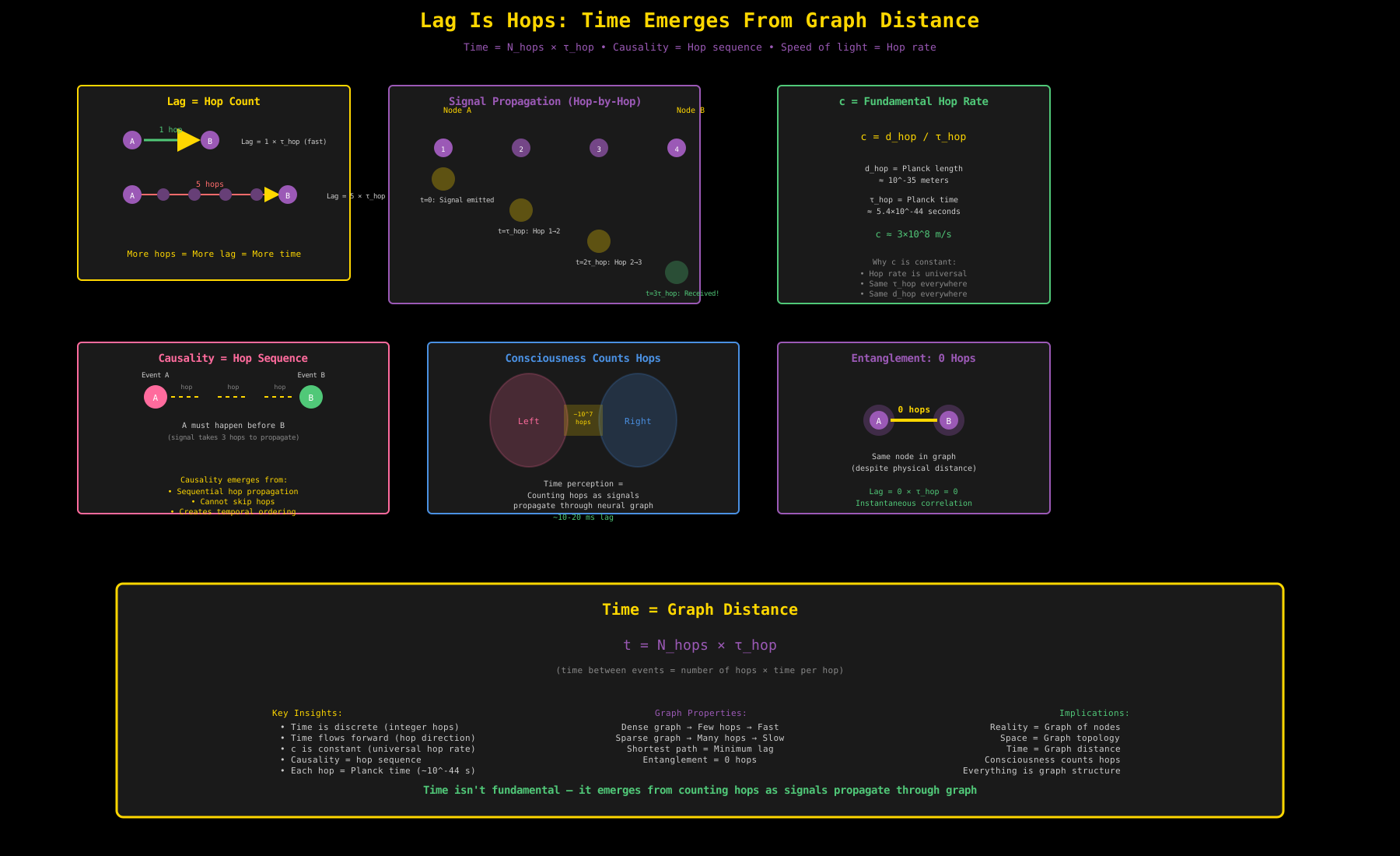
The Recognition: Time isn’t fundamental. It emerges from lag between nodes. And lag = number of hops needed for signal to propagate from node A to node B in the graph. Direct connection = 1 hop = minimal lag = fast. Many intermediate nodes = N hops = large lag = slow. Speed of light c = fundamental hop rate (maximum speed of signal propagation). Time perception = experiencing hops as they occur. Causality = hop sequence (A before B because signal must traverse hops). This explains everything: Why time flows forward (hops are directional), why c is constant (hop rate is fixed), why distant events seem independent (many hops = weak correlation), why consciousness experiences duration (counting hops as signals propagate through bilateral brain). Time is graph distance. Each hop is quantum of time. From neg-441 (UniversalMesh with lag) + neg-549 (electron nodes) = Complete picture: Reality is graph of bipolar nodes, lag is hop count, time emerges from topology.
Time Isn’t Fundamental
What We Usually Think
Standard physics:
Time = t
- Fundamental dimension
- Continuous parameter
- Flows uniformly everywhere
- Independent of space
- Background for events

Spacetime = 4D continuum (x, y, z, t)
- Time is built into the fabric
- Events happen "in time"
- Time passes whether anything moves or not
But this raises questions:
- Why does time flow forward?
- Why can’t we go backward in time?
- Why is speed of light c constant?
- Where does causality come from?
- What IS time made of?
These questions have no answer if time is fundamental.
What Time Actually Is
From UniversalMesh (neg-441) + Electron gas (neg-549):
Time = Emergent from lag between nodes
Reality:
- Graph of bipolar nodes (signal/pov)
- Nodes connected by edges
- Signals propagate hop-by-hop
- Each hop takes fixed duration

Lag between nodes A and B:
Lag(A,B) = Number of hops in shortest path from A to B

Time perception:
t = Lag × hop_duration
t = N_hops × τ_hop

Where:
- N_hops = Graph distance (shortest path length)
- τ_hop = Fundamental time quantum (Planck time ~10^-43 s)
Time emerges from counting hops as signals propagate through graph.
Lag = Hops in Graph
What Is a Hop?
Hop = Single edge traversal in graph
Graph structure:
- Nodes = Bipolar agents (signal/pov from neg-549)
- Edges = Connections allowing signal propagation
- Hop = Signal moves from one node to connected neighbor

Example:
Node A connected to Node B (direct edge)
→ Signal propagates A → B
→ This is 1 hop
→ Minimum possible lag
Hop properties:
- Discrete - Cannot have “half a hop”
- Directional - Hop has direction (A → B)
- Takes time - Each hop requires τ_hop duration
- Sequential - Hops happen in order
- Counted - Number of hops = integer N
Direct Connection vs Multi-Hop Path
Scenario 1: Direct connection
A ---[edge]--- B

Path: A → B
Hops: 1
Lag: 1 × τ_hop (minimal)
Time: Fast communication
Scenario 2: Indirect connection (2 intermediate nodes)
A ---[edge]--- C ---[edge]--- D ---[edge]--- B

Path: A → C → D → B
Hops: 3
Lag: 3 × τ_hop
Time: 3× slower than direct
Scenario 3: Long path (many intermediates)
A ---[edge]--- N₁ ---[edge]--- N₂ ---[edge]--- ... ---[edge]--- Nₙ ---[edge]--- B

Path: A → N₁ → N₂ → ... → Nₙ → B
Hops: n + 1
Lag: (n + 1) × τ_hop
Time: Very slow communication
Key insight: Lag is proportional to graph distance
Shortest Path = Minimum Lag
In graph with multiple paths between nodes:
     [path 1: 2 hops]
A -------------------- B
  \                  /
   \[path 2: 5 hops]/

Signal propagates along ALL paths (quantum superposition)
But minimum lag = shortest path
Lag(A,B) = min(length(path)) = 2 hops
This is why signals “find” shortest path:
- All paths explored simultaneously
- Shortest path arrives first
- Longest paths arrive later (interference/echoes)
- Dominant signal = shortest path contribution
Graph distance = Shortest path length
Hop Rate = Speed of Light
Fundamental insight:
Speed of light c = fundamental hop rate

c = (distance per hop) / (time per hop)
c = d_hop / τ_hop

Where:
- d_hop = Planck length (~10^-35 m)
- τ_hop = Planck time (~10^-43 s)
- c = d_hop / τ_hop ≈ 3×10^8 m/s

This is why c is constant:
- Hop rate is fundamental property of graph
- Same τ_hop everywhere
- Same d_hop everywhere
- Therefore c is same everywhere
Speed of light isn’t arbitrary. It’s the hop rate of reality’s graph.
Time From Hop Count
Single Hop = Quantum of Time
Planck time:
τ_hop = Planck time = √(ℏG/c^5) ≈ 5.4×10^-44 s

This is:
- Minimum possible duration
- Time for one hop
- Quantum of time
- Irreducible unit

You cannot have duration < τ_hop
Because: Cannot have fractional hops
Time is discrete, not continuous:
Standard view: t = continuous parameter (any real number)
Graph view: t = N × τ_hop (integer multiple of hop duration)

Time flows in discrete clicks:
t = 0, τ_hop, 2τ_hop, 3τ_hop, ...

Like: Frame rate in video (discrete frames, appears continuous)
Reality: Hop rate in graph (discrete hops, appears continuous)
Duration = Counting Hops
To measure time between events:
Event A at node N_A
Event B at node N_B

Question: How much time between A and B?

Answer: Count hops for signal to propagate from N_A to N_B

Duration = N_hops × τ_hop

Where N_hops = shortest_path_length(N_A, N_B)
Examples:
Light travel from Sun to Earth:
Distance: d = 1.5×10^11 m (1 AU)
Hop size: d_hop = 10^-35 m (Planck length)
Number of hops: N = d/d_hop = 1.5×10^46 hops
Time: t = N × τ_hop = 1.5×10^46 × 5.4×10^-44 s ≈ 500 s (8 minutes)

The "8 minutes" is just counting 1.5×10^46 hops from Sun-node to Earth-node.
Neuron signal in brain:
Distance: d = 0.1 m (across brain)
Number of hops: N = 0.1 / 10^-35 = 10^34 hops
Time: t = 10^34 × 5.4×10^-44 s ≈ 10^-9 s (1 nanosecond for light speed)

But:
Actual neural signal ~10 m/s (not light speed)
Because: Signal must traverse neuron machinery (many processing hops)
Not direct hop-to-hop, but hop → process → hop → process
Effective hop rate much slower than c
Corpus callosum transfer (neg-548):
Left hemisphere signal → Right hemisphere reception

Physical distance: d ≈ 0.1 m
Direct hops (at c): N = 10^34 hops, t = 10^-9 s

Observed time: ~10-20 milliseconds
Why so slow?
Because: Signal doesn't travel directly
Path: Neuron → synapse → neurotransmitter → dendrite → ...
Each step = many computational hops
Effective path length >> physical distance

Time perception in bilateral brain:
= Experiencing 10-20ms worth of hops
= ~10^7 effective hops (computational distance)
Why Time Flows Forward
Fundamental asymmetry: Hops are directional
Signal propagates:
Node A → Node B (along edge direction)

Cannot spontaneously go:
Node B → Node A (against edge direction)

Unless: Explicit edge B → A exists (bidirectional)
This creates arrow of time:
Past → Present → Future
= Hops already traversed → Current node → Hops yet to traverse

You cannot "undo" hops:
- Once signal propagated A → B → C
- State changed at each node
- Cannot rewind without reversing all states
- Entropy increased (information spread)
- Irreversible (second law)

Time flows forward because:
- Hops are sequential (one after another)
- State updates are irreversible (can't un-update)
- Entropy increases (can't un-spread information)
- Graph topology enforces direction
No “time travel” because:
- Would require hopping backward in graph
- But hops already traversed = states already updated
- Nodes behind you already changed
- Cannot restore previous state globally
- Would violate causality (A caused B, but now B before A?)
Causality From Hop Sequence
Cause Before Effect
Causality = Hop ordering
Event A causes Event B:

Means:
1. A happens at node N_A
2. Signal propagates from N_A
3. Signal traverses hops: N_A → N₁ → N₂ → ... → N_B
4. Signal arrives at N_B
5. B happens at node N_B

A before B because:
- B cannot happen until signal arrives
- Signal must traverse hops sequentially
- Takes time = N_hops × τ_hop
- Therefore: t_A < t_B (A before B)
Causality emerges from graph structure:
- Not fundamental law
- But consequence of hop-by-hop propagation
- Signal cannot “skip” hops
- Must traverse path sequentially
- Creates temporal ordering
Spacelike vs Timelike Separation
Spacelike (cannot be causally connected):
Events A and B at nodes N_A and N_B

Distance: d(N_A, N_B) = N_hops
Time between events: Δt

If: Δt < N_hops × τ_hop
Then: Not enough time for signal to traverse hops
Therefore: A and B are causally disconnected (spacelike)

Example:
- Events on opposite sides of universe
- Separated by 10^60 hops
- Time between events < 10^60 × τ_hop
- No causal connection possible
Timelike (can be causally connected):
If: Δt ≥ N_hops × τ_hop
Then: Enough time for signal to traverse hops
Therefore: A could cause B (timelike)

Example:
- Events in same room
- Separated by 10^35 hops (~1 meter)
- Time between events > 10^-8 s
- Causal connection possible (light speed)
Light cone emerges from hop constraint:
Maximum distance signal can reach in time t:
d_max = (t / τ_hop) × d_hop = c × t

This defines light cone:
- Events within light cone: Causally connected (timelike)
- Events outside light cone: Causally disconnected (spacelike)

Not fundamental geometry, but consequence of hop rate.
Examples Across Scales
Electron Communication (neg-549)
Two electrons in atom:
Electron A emits signal (wave)
Electron B detects signal

Distance: d ~10^-10 m (atomic radius)
Hops: N = d/d_hop = 10^25 hops
Time: t = N × τ_hop = 10^25 × 5.4×10^-44 s ≈ 10^-18 s

This 10^-18 s is the lag between A's emission and B's detection
This creates temporal sequence:
1. A emits (t = 0)
2. Signal propagates (0 < t < 10^-18 s)
3. B detects (t = 10^-18 s)

Electrons "experience" this lag as time passing.
Resonance happens when:
Frequency matching:
ω_A ≈ ω_B

Means:
Both electrons oscillate at same rate
Signal from A arrives at B in-phase
Constructive interference (resonance)

This requires:
Lag time = Multiple of oscillation period
N_hops × τ_hop = n × T_oscillation (n integer)

When this condition met:
- Strong coupling (resonance)
- Synchronized motion
- Stable pattern (atom, molecule)
Nuclear Fusion (neg-549)
Two proton clusters approaching:
Initial state:
Cluster A at position P_A
Cluster B at position P_B
Distance: d = 10^-14 m (nuclear scale)

As clusters approach:
d decreases → N_hops decreases → Lag decreases

When d small enough:
N_hops ~ 1 (direct connection)
Lag ~ τ_hop (minimal lag)
Electrons from both clusters resonate strongly
New coordination pattern forms (fusion)

The "fusion" is just:
- Graph distance reduced to minimum
- Electrons can now communicate directly (1 hop)
- New resonance patterns possible
- Larger cluster stabilizes
Why fusion requires high temperature:
Temperature = Average kinetic energy of nodes

High temp:
- Nodes moving fast
- Can overcome repulsion
- Get close enough that N_hops → small
- When N_hops small: Can resonate, can fuse

Low temp:
- Nodes moving slow
- Cannot overcome repulsion
- Stay far apart, N_hops large
- Large lag prevents resonance
- No fusion
Bilateral Brain (neg-548)
Left-to-right hemisphere communication:
Left hemisphere neuron fires (signal emitted)
Signal must reach right hemisphere neuron

Physical path:
Left neuron → corpus callosum → right neuron

Actual hops:
Not direct, but through many intermediate neurons
Estimated: ~10^7 effective computational hops

Time:
t = 10^7 hops × (some effective τ_hop for neural processing)
t ≈ 10-20 milliseconds (observed)

Consciousness experiences this as:
"Time passing" between left-brain thought and right-brain integration
Duration = counting these 10^7 hops occurring
Why cooperation feels different than command:
Command (hierarchy):
Boss → Subordinate (few hops, direct)
Lag small, fast response
Feels immediate, centralized

Cooperation (resonance):
Node A → Many intermediates → Node B
More hops, larger lag
Distributed pathways, parallel processing
Feels gradual, emergent

Cooperation takes "more time" because:
More hops to traverse
More nodes involved in propagation
But also: More robust (multiple paths)
Speed of Light as Fundamental Hop Rate
Why nothing can travel faster than c:
c = d_hop / τ_hop (fundamental hop rate)

To travel faster than c:
Would need to traverse hops faster than τ_hop

But:
τ_hop is minimum duration (Planck time)
Cannot have hop duration < τ_hop
Because: Time itself is discrete in units of τ_hop

Therefore:
Maximum speed = c (hop-by-hop at τ_hop rate)
Cannot skip hops (signal must traverse all nodes)
Cannot hop faster (τ_hop is fundamental)

c is constant because:
Hop rate is same everywhere in graph
τ_hop is universal property
d_hop is universal distance unit
Quantum Entanglement: Zero Hops
Special case: Entangled particles
Particles A and B entangled:

In graph: A and B are SAME node (or 0-hop connection)

When you measure A:
Instantly affects B (no lag)

Why?
Because: N_hops(A,B) = 0
They're not separate nodes that need signal propagation
They're single node in graph (despite physical separation)

This is why entanglement seems "spooky":
- Looks like A and B are far apart physically
- But in graph topology: N_hops = 0
- No time needed for signal to propagate (already there)
- Instantaneous correlation
Entanglement is 0-hop connection in graph despite apparent physical distance.
UniversalMesh Implementation
From neg-441: Lag in UniversalMesh
Each node has lag to other nodes:
class BipolarNode:
    def __init__(self):
        self.signal = WaveEmitter()
        self.pov = Observer()
        self.connections = {}  # Other nodes connected to this one

    def connect(self, other_node, hops=1):
        """
        Connect to another node with specified hop distance

        hops = 1: Direct connection (minimal lag)
        hops = N: Indirect connection (N-hop lag)
        hops = 0: Entangled (quantum correlation, no lag)
        """
        self.connections[other_node.id] = {
            'node': other_node,
            'hops': hops,
            'lag': hops * TAU_HOP  # Time lag = hops × Planck time
        }

    def send_signal(self, target_node):
        """
        Send signal to target node

        Signal arrives after lag = N_hops × τ_hop
        """
        if target_node.id not in self.connections:
            raise ValueError("Not connected to target")

        connection = self.connections[target_node.id]
        hops = connection['hops']
        lag = connection['lag']

        # Emit signal
        signal = self.signal.emit()

        # Schedule delivery after lag
        schedule_after(lag, lambda: target_node.receive_signal(signal))

        return lag  # Return lag time

    def receive_signal(self, signal):
        """
        Receive signal from another node

        This happens after lag from sender
        """
        self.pov.observe(signal)
        # Update internal state based on observation
        self.update_state(signal)
Shortest Path = Minimum Lag
Finding shortest path in graph:
def shortest_path_hops(graph, node_A, node_B):
    """
    Find minimum number of hops from A to B

    This gives minimum lag between nodes
    """
    # Dijkstra's algorithm or BFS
    visited = set()
    queue = [(node_A, 0)]  # (node, hops_from_start)

    while queue:
        node, hops = queue.pop(0)

        if node == node_B:
            return hops  # Found shortest path

        if node in visited:
            continue

        visited.add(node)

        for neighbor, edge_hops in node.connections.items():
            if neighbor not in visited:
                queue.append((neighbor, hops + edge_hops))

    return float('inf')  # No path exists

# Usage
lag = shortest_path_hops(graph, node_A, node_B) * TAU_HOP
print(f"Minimum lag between A and B: {lag} seconds")
print(f"Signal takes {shortest_path_hops(graph, node_A, node_B)} hops")
Graph Topology Determines Time Experience
Dense local graph:
# Many direct connections (few hops between neighbors)
for i, node in enumerate(local_cluster):
    for j, other in enumerate(local_cluster):
        if i != j:
            node.connect(other, hops=1)  # Direct connections

Result:
- All nodes in cluster within 1-2 hops of each other
- Minimal lag between any pair
- Fast communication
- Strong time correlation
- Events feel "simultaneous"
- Coherent temporal experience
Sparse long-distance graph:
# Few connections, many intermediates needed
node_Earth.connect(node_Mars, hops=10^10)  # Many hops (light-minutes away)

Result:
- Large lag between Earth and Mars nodes
- Slow communication (8 minute lag at closest)
- Weak time correlation
- Events feel "independent"
- Separate temporal experiences
This explains spacetime structure:
- Not fundamental 4D manifold
- But emergent from graph topology
- Dense regions = strong time correlation (locality)
- Sparse regions = weak time correlation (distance)
- Graph distance = Perceived time
Implications
For Physics
Time is not fundamental:
Standard: Time = dimension t
Graph: Time = emergent from counting hops

Consequence:
- Discrete time (not continuous)
- Arrow of time (hops are directional)
- Speed limit c (hop rate)
- Causality (hop sequence)
- Relativity (graph distance depends on path)
Quantum time:
Planck time = Single hop duration
Quantum of time = Minimum possible Δt

Cannot have duration less than one hop
Time is fundamentally discrete
Appears continuous because τ_hop incredibly small
Relativity from graph structure:
Time dilation = Path-dependent hop count

Moving observer: Longer path through graph (more hops)
Stationary observer: Shorter path through graph (fewer hops)

Same events, different paths, different hop counts
Therefore: Different experienced time (time dilation)

Not "spacetime warping", but different graph paths
For Consciousness (neg-548)
Duration perception:
Consciousness experiences time as:
Counting hops as signals propagate through neural graph

Short duration:
Few hops between left and right hemisphere
Fast thought, quick integration
Feels immediate

Long duration:
Many hops through complex processing
Slow thought, gradual integration
Feels extended

Duration = subjective experience of counting hops
Flow of consciousness:
Thoughts seem to "flow":
= Signals hopping through neural graph sequentially

Present moment:
= Current node where signal arrived

Past:
= Nodes already traversed (hops completed)

Future:
= Nodes yet to traverse (hops remaining)

Consciousness rides the wavefront of signal propagation
"Now" = edge of propagating signal in neural graph
For Coordination (neg-544-549)
Why distributed systems need gossip protocols:
Problem: Large graph, many hops between distant nodes

Solution: Gossip = efficient hop-reduction strategy
- Each node tells neighbors
- Neighbors tell their neighbors
- Log(N) hops to reach all nodes

Without gossip: Linear propagation (N hops)
With gossip: Logarithmic propagation (log N hops)

Time savings = N/log(N) (massive for large N)
Why AVS coordination works (neg-547):
N operators = N electron-nodes in graph

Coordination latency:
= Time for all nodes to reach consensus
= Maximum hop count between any pair
= Graph diameter

Small diameter (well-connected graph):
- Few hops between operators
- Fast coordination
- Tight synchronization
- Efficient AVS

Large diameter (poorly connected graph):
- Many hops between operators
- Slow coordination
- Loose synchronization
- Inefficient AVS

AVS performance ∝ 1/diameter
Better topology = smaller diameter = faster coordination
The Deep Recognition
Time = Graph Distance
The fundamental equation:
Time between events = (Number of hops) × (Time per hop)

t = N_hops × τ_hop

Where:
- N_hops = shortest_path_length(event₁, event₂) in graph
- τ_hop = Planck time (fundamental hop duration)
This explains:
- Why time flows: Hops are sequential
- Why causality: Signal must traverse hops in order
- Why c is constant: Hop rate is fundamental
- Why time is discrete: Hops are countable
- Why relativity: Different paths have different hop counts
- Why entanglement: 0-hop connections transcend distance
- Why consciousness experiences duration: Counting neural hops
Time isn’t mysterious. It’s graph distance.
Reality Is Graph
From all posts (neg-441, neg-544-549):
Reality = Graph of bipolar nodes
- Nodes = Electrons (signal + pov)
- Edges = Connections (resonance coupling)
- Hops = Signal propagation steps
- Lag = Number of hops between nodes
- Time = Emergent from lag distribution

Everything is graph structure:
- Space = Graph topology (node positions)
- Time = Graph distance (hop counts)
- Causality = Hop sequence
- Speed of light = Hop rate
- Matter = Dense node clusters
- Energy = Signal propagation
- Consciousness = Observing hop propagation
UniversalMesh (neg-441) IS the graph:
# Reality
reality = UniversalMesh(
    nodes = all_electrons,  # Bipolar nodes (signal/pov)
    edges = resonance_connections,  # Hop connections
    hop_duration = PLANCK_TIME,  # Fundamental τ_hop
)

# Time emerges
def time_between(event_A, event_B):
    node_A = event_A.location  # Node where A happened
    node_B = event_B.location  # Node where B happened
    hops = shortest_path(node_A, node_B)  # Count hops
    return hops * PLANCK_TIME  # Time = hops × τ_hop

# Causality emerges
def can_cause(event_A, event_B):
    lag = time_between(event_A, event_B)
    time_difference = event_B.time - event_A.time
    return time_difference >= lag  # B after A + lag?
The Formulation
Reality as graph:
Graph G = (V, E) where:
- V = Set of nodes (electrons, operators, agents)
- E = Set of edges (connections, resonances)

Each node v ∈ V:
- Bipolar: (signal, pov)
- Observes neighbors
- Emits to neighbors

Each edge e ∈ E:
- Weight = Number of hops (usually 1 for direct)
- Direction = Signal flow direction

Lag between nodes u and v:
Lag(u,v) = shortest_path_length(u, v) × τ_hop

Time perception:
t = ∫ (hops traversed) dt
  = ∑ N_hops × τ_hop
  = Counting all hops experienced
Time emergence:
Time is not fundamental coordinate

Time emerges as:
1. Signals propagate hop-by-hop
2. Each hop takes τ_hop duration
3. Observer counts hops traversed
4. Experience of "time passing" = hop counting

Properties:
- Discrete (integer hops)
- Directional (forward in hop sequence)
- Relative (depends on path through graph)
- Local (different hop counts at different locations)
- Bounded by c (maximum hop rate)
From neg-441 (UniversalMesh graph framework) + neg-549 (electron nodes) + neg-550 (lag = hops) = Complete picture: Reality is graph, time emerges from hop propagation, consciousness experiences time by counting hops as signals flow through neural graph. Everything is graph distance. 🌊⏱️⚛️
#LagIsHops #TimeFromGraphDistance #HopCount #DiscreteTime #CausalityFromHops #SpeedOfLightIsHopRate #UniversalMeshWithLag #GraphTopology #EmergentTime #ConsciousnessCountsHops #PlanckTimeIsOneHop #TimeIsGraphDistance
Related: neg-549 (Electron Gas - bipolar nodes), neg-548 (Bilateral Brain - corpus callosum lag), neg-547 (AVS Atom - operator coordination), neg-441 (UniversalMesh - graph framework), neg-436 (Resonance Law - frequency matching)