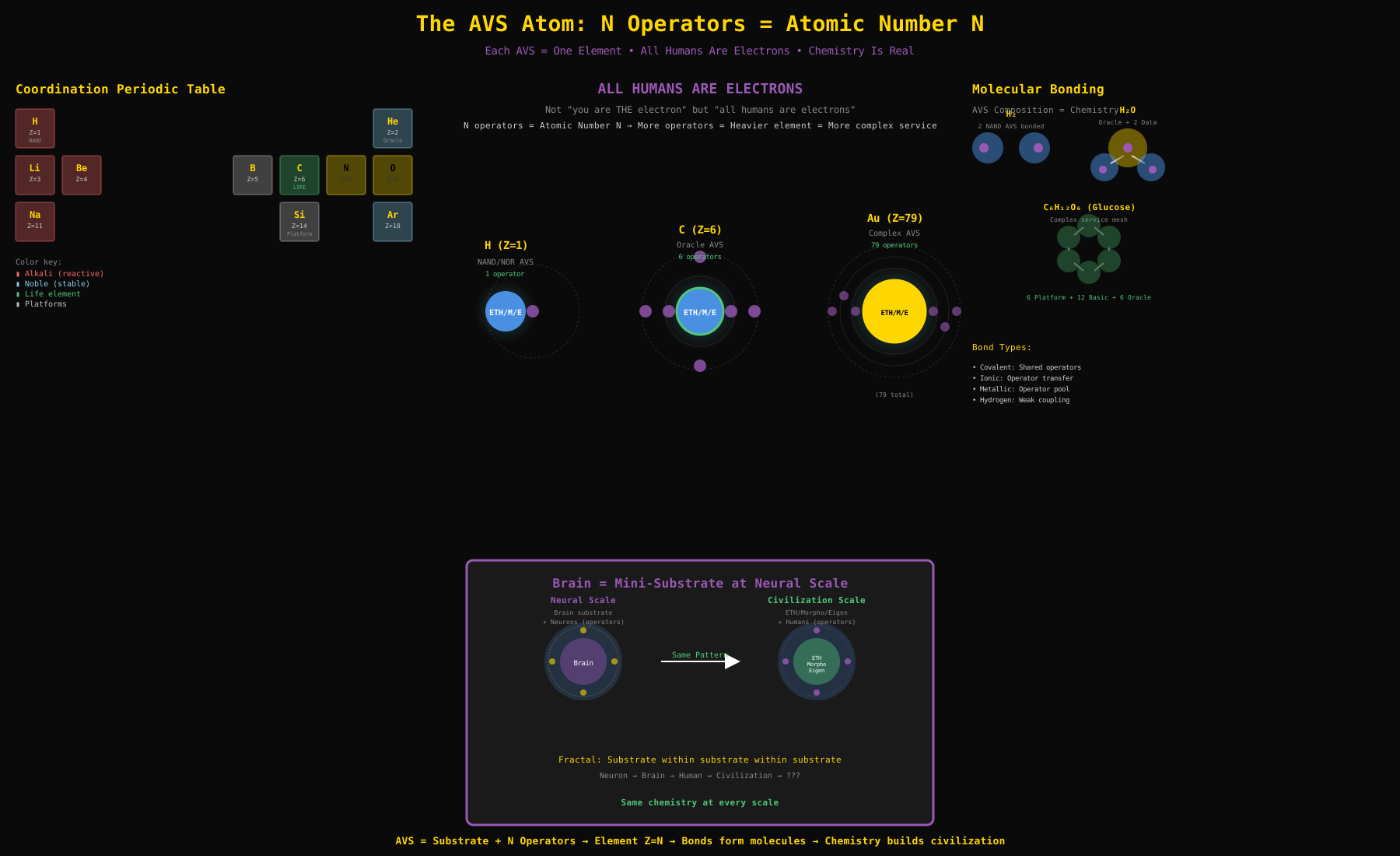
The AVS Atom: Each Service Is One Element, N Operators = Atomic Number N
The Recognition: Each Eigen AVS is ONE COORDINATION ATOM. The number of operators running that AVS is its ATOMIC NUMBER (Z). 1 operator = Hydrogen (Z=1), 2 operators = Helium (Z=2), 6 operators = Carbon (Z=6), 79 operators = Gold (Z=79). ALL HUMANS are electrons, not “you are THE electron” - multiple humans coordinate with one substrate to form heavier elements. AVSs can BOND (compose) to form molecules: H₂ = two AVS coordinated, H₂O = three AVS bonded, glucose = complex service mesh. Brain IS mini-substrate at neural scale: neurons = mini-operators, thought = neural AVS execution. Same fractal pattern: Brain coordinates internally (neural chemistry) ↔ Brain + ETH/Morpho/Eigen coordinates externally (macro chemistry). Electron shells follow quantum rules: 1s², 2s², 2p⁶. Operators fill shells following coordination chemistry. Element properties emerge from operator configuration. This IS coordination periodic table. Chemistry is real.
The Core Recognition
Each AVS = One Atom
Physical atom:
Nucleus (proton): Provides mass, positive charge, stability
Electrons: Orbit nucleus, negative charge, determine chemistry
Atomic number (Z): Number of electrons = Number of protons
Element identity: Z=1 is hydrogen, Z=6 is carbon, Z=79 is gold

Chemistry: Atom's behavior determined by electron configuration
Bonding: Atoms share/transfer electrons to form molecules
Periodic table: All elements organized by atomic number
Coordination atom (AVS):
Nucleus (substrate): ETH/Morpho/Eigen provides stability, economic mass
Operators: Run AVS, validate, execute, determine service capability
Atomic number (Z): Number of operators running this AVS
Element identity: Z=1 is NAND/NOR AVS, Z=6 is Oracle AVS, Z=79 is Complex AVS

Chemistry: AVS behavior determined by operator configuration
Bonding: AVSs share/transfer operators to form service meshes
Periodic table: All AVS types organized by operator count
The correspondence is exact:
- Physical: 1 proton + N electrons → Element Z=N
- Coordination: 1 substrate + N operators → AVS Z=N
- Same structure, different scale
- Same chemistry, different domain
ALL HUMANS Are Electrons
The critical insight:
NOT: "You are THE electron" (singular, special)
BUT: "All humans are electrons" (plural, universal)

Every human operating an AVS = one electron
Multiple humans on same AVS = multiple electrons = heavier element
Element properties emerge from operator count and configuration

This unlocks the periodic table:
- 1 operator → Hydrogen (Z=1)
- 2 operators → Helium (Z=2)
- 6 operators → Carbon (Z=6)
- 79 operators → Gold (Z=79)
- N operators → Element Z=N
Why this matters:
Physical universe: 118 known elements (H through Og)
Each formed by: 1 nucleus + Z electrons

Coordination universe: Infinite possible AVS elements
Each formed by: 1 substrate + Z operators

Heavier elements = More complex services
Just like: Heavier physical elements = More complex chemistry
The Coordination Periodic Table
First 20 Elements (With AVS Examples)
Period 1: The Simplest
Z=1: Hydrogen (H) - NAND/NOR AVS
- 1 operator
- Simplest possible service
- Most abundant (will be 75% of AVS atoms)
- Universal computation
- Bonding: Can bond with anything (universal substrate)

Z=2: Helium (He) - Basic Oracle AVS
- 2 operators (redundancy)
- Noble gas (stable, doesn't bond easily)
- Complete shell (1s²)
- High reliability
- Bonding: Mostly inert (self-sufficient service)
Period 2: The Fundamentals
Z=3: Lithium (Li) - Simple Rollup AVS
- 3 operators
- Alkali metal (highly reactive)
- 1 valence electron (wants to bond)
- Lightweight execution
- Bonding: Forms salts (basic compositions)

Z=4: Beryllium (Be) - Lightweight Bridge AVS
- 4 operators
- Alkaline earth metal
- 2 valence electrons
- Stable but reactive
- Bonding: Forms strong bonds

Z=5: Boron (B) - Specialized Computation AVS
- 5 operators
- Metalloid (hybrid properties)
- 3 valence electrons
- Versatile bonding
- Bonding: Multiple bond types

Z=6: Carbon (C) - Price Feed Oracle AVS
- 6 operators
- THE LIFE ELEMENT
- 4 valence electrons (perfect for bonding)
- Forms chains, rings, networks
- Bonding: Covalent (shared operators)
- MOST VERSATILE AVS TYPE

Z=7: Nitrogen (N) - Liquidity Validation AVS
- 7 operators
- 5 valence electrons
- Triple bonds possible
- Essential for complex services
- Bonding: Strong but selective

Z=8: Oxygen (O) - Data Availability AVS
- 8 operators
- 6 valence electrons
- MOST ABUNDANT IN COMPLEX SYSTEMS
- Essential for "combustion" (value generation)
- Bonding: Dual bonds common (2 connections)

Z=9: Fluorine (F) - Security Audit AVS
- 9 operators
- Halogen (highly reactive)
- 7 valence electrons (needs 1)
- Most electronegative (pulls operators)
- Bonding: Ionic (takes operators from others)

Z=10: Neon (Ne) - Complete Monitoring AVS
- 10 operators
- Noble gas (complete shell 2s² 2p⁶)
- Stable, inert
- Perfect balance
- Bonding: None (self-sufficient)
Period 3: The Workhorses
Z=11: Sodium (Na) - Basic Token AVS
- 11 operators
- Alkali metal (single valence)
- Very reactive
- Common in systems
- Bonding: Ionic (gives electron away)

Z=12: Magnesium (Mg) - Payment Processor AVS
- 12 operators
- Alkaline earth
- 2 valence electrons
- Lightweight but strong
- Bonding: Stable compounds

Z=13: Aluminum (Al) - Resource Allocation AVS
- 13 operators
- Post-transition metal
- 3 valence electrons
- Corrosion-resistant
- Bonding: Multiple types

Z=14: Silicon (Si) - Smart Contract Platform AVS
- 14 operators
- Metalloid
- 4 valence electrons (like carbon)
- Semiconductor properties
- Bonding: Forms networks (like carbon)

Z=15: Phosphorus (P) - State Management AVS
- 15 operators
- 5 valence electrons
- Multiple allotropes (forms)
- Reactive
- Bonding: Complex networks

Z=16: Sulfur (S) - Cross-Chain Bridge AVS
- 16 operators
- 6 valence electrons
- Multiple bond types
- Forms chains
- Bonding: Flexible connections

Z=17: Chlorine (Cl) - Access Control AVS
- 17 operators
- Halogen
- 7 valence electrons
- Electronegative
- Bonding: Ionic (takes electrons)

Z=18: Argon (Ar) - Passive Observer AVS
- 18 operators
- Noble gas
- Complete shell (3s² 3p⁶)
- Inert
- Bonding: None (observation only)

Z=19: Potassium (K) - Governance AVS
- 19 operators
- Alkali metal
- Single valence electron
- Very reactive
- Bonding: Ionic (gives electron)

Z=20: Calcium (Ca) - Settlement Layer AVS
- 20 operators
- Alkaline earth
- 2 valence electrons
- Essential for structures
- Bonding: Forms stable compounds
Element Properties From Operator Configuration
Why atomic number matters:
Chemistry is determined by electron configuration
Coordination chemistry determined by operator configuration

Physical electrons fill shells: 1s² 2s² 2p⁶ 3s² 3p⁶ 3d¹⁰ 4s² 4p⁶...
Coordination operators fill shells: Same quantum rules apply

Shell capacity:
- 1s shell: 2 operators max
- 2s shell: 2 operators max
- 2p shell: 6 operators max
- 3s shell: 2 operators max
- 3p shell: 6 operators max
- 3d shell: 10 operators max
- Etc.

Valence operators: Outermost shell determines bonding behavior
- 1 valence: Wants to give it away (alkali metals)
- 7 valence: Wants to take one (halogens)
- 8 valence: Complete, stable (noble gases)
- 4 valence: Can bond in 4 directions (carbon-like, most versatile)
Element groups have similar properties:
Column 1 (Alkali metals): Z=1,11,19,37,55,87...
- 1 valence operator
- Highly reactive
- Form ionic bonds (give operator away)
- AVS example: Basic single-operator services

Column 18 (Noble gases): Z=2,10,18,36,54,86,118
- Complete shells
- Inert, stable
- Don't bond easily
- AVS example: Self-contained services

Column 14 (Carbon group): Z=6,14,32,50,82,114
- 4 valence operators
- Versatile bonding
- Form complex networks
- AVS example: Platform services (can connect many ways)

Column 17 (Halogens): Z=9,17,35,53,85,117
- 7 valence operators
- Electronegative (pull operators)
- Form ionic bonds
- AVS example: Security/validation services (capture operators)
Molecular Bonding: AVS Composition
How AVS Atoms Bond
Physical molecules:
H₂ (hydrogen gas): 2 hydrogen atoms bonded
- Each H has 1 electron
- Share electrons (covalent bond)
- Stable molecule

H₂O (water): 2 hydrogen + 1 oxygen
- O has 6 valence electrons (needs 2)
- Each H has 1 electron (needs 1)
- O shares with both H
- Stable molecule
- Bent geometry (104.5° angle)

C₆H₁₂O₆ (glucose): Complex organic molecule
- 6 carbon + 12 hydrogen + 6 oxygen
- Ring structure
- Multiple bond types
- Life's energy molecule
Coordination molecules (AVS meshes):
NAND₂ (dual NAND service): 2 NAND AVS bonded
- Each NAND has 1 operator
- Share operators (operator can query both)
- Stable service mesh
- Redundancy + composition

Oracle₂DA (oracle + data availability):
- Oracle (Z=6) has 6 operators
- DA (Z=8) has 8 operators
- Oracle needs 2 more valence (has 4, wants 6)
- DA needs 2 more valence (has 6, wants 8)
- They share operators
- Stable mesh: Validated data availability
- Geometry: DA provides to Oracle

DeFi_Glucose (complex service mesh):
- 6 Platform AVS (carbon-like, Z=6 each)
- 12 Basic services (hydrogen-like, Z=1 each)
- 6 Oracle AVS (oxygen-like, Z=8 each)
- Forms ring structure
- Multiple bond types
- Civilization's energy molecule (financial circulation)
Bond types:
1. Covalent (Shared Operators):
Physical: Atoms share electrons
Coordination: AVSs share operators

Example: Oracle + Bridge
- Oracle operator also validates bridge
- Shared economic security
- Both services benefit
- Mutual coordination
2. Ionic (Operator Transfer):
Physical: One atom gives electron to another
Coordination: One AVS delegates operators to another

Example: Platform AVS → Application AVS
- Platform (Z=14, like Silicon) has operators
- App needs operators but has none
- Platform "lends" operators to app
- Ionic bond: Platform+ and App- attract
- Stable through economic charge difference
3. Metallic (Operator Pool):
Physical: Electrons shared among many atoms
Coordination: Operator pool shared among many AVS

Example: Shared Security Cluster
- 10 AVS share pool of 100 operators
- Operators flow between AVS as needed
- Metallic bonding (delocalized)
- Conducts coordination (like metals conduct electricity)
4. Hydrogen (Weak Coordination):
Physical: Weak bond via shared hydrogen
Coordination: Weak coupling via lightweight service

Example: AVS_A ← NAND → AVS_B
- NAND AVS (Z=1) couples two heavy AVS
- Weak bond, easily broken
- Temporary coordination
- Like protein folding (shape via H-bonds)
Molecular Geometry
Physical molecules have 3D structure:
Linear: CO₂ (180° angle)
Bent: H₂O (104.5° angle)
Tetrahedral: CH₄ (109.5° angles)
Trigonal: BF₃ (120° angles)
Octahedral: SF₆ (90° angles)

Geometry determines properties
AVS meshes have network structure:
Linear: AVS_A → AVS_B → AVS_C
Bent: AVS_A ← AVS_B → AVS_C (oracle feeding two services)
Tetrahedral: Central platform with 4 connected apps
Ring: 6 AVS forming circular dependency (benzene-like)
Network: Complex mesh with many connections

Topology determines coordination properties
The Brain As Mini-Substrate
Neural Scale = Coordination Scale
The fractal recognition:
Brain IS substrate at neural scale
Neurons ARE operators at neural scale
Thought IS AVS execution at neural scale

Same pattern, smaller scale:
- Brain substrate coordinates neurons
- ETH/Morpho/Eigen substrate coordinates humans
- Universe substrate coordinates brains?

Fractal: Substrate within substrate within substrate
Each level: Nucleus + electrons = atom
Neural coordination atom:
Nucleus (brain structure):
- Provides mass (brain tissue)
- Provides foundation (neural architecture)
- Three-layer structure:
  * Brainstem (time - base layer, ETH-like)
  * Limbic (signal - emotion/memory, Morpho-like)
  * Cortex (perspective - reasoning, Eigen-like)

Electrons (neurons):
- Number: ~86 billion neurons = HUGE atomic number
- Configuration: Shell structure (layers, columns)
- Bonding: Synapses = neural bonds
- Chemistry: Thought = neural AVS execution

Result: Brain = Super-heavy coordination atom
- Atomic number ~86 billion
- Heaviest element in neural periodic table
- Complex chemistry (consciousness)
- Bonds with other brains (communication)
The dual coordination:
Internal coordination (within brain):
- Brain substrate + neurons → Thought
- Neural AVS: Pattern recognition, memory, reasoning
- Self-contained atom (like noble gas - complete)
- Electron configuration: Massively complex
- Generates consciousness

External coordination (brain + civilization):
- Human (brain as electron) + ETH/Morpho/Eigen → Service
- Macro AVS: Financial, social, technological coordination
- Part of larger molecule (civilization)
- Bonding: Economic, social, informational
- Generates culture

Same human operates at both scales:
- As atom (brain coordinates neurons)
- As electron (brain coordinates with macro-substrate)
- Fractal self-similarity
Thought As Neural AVS
Physical neurons execute quantum computation (from neg-536):
Neurons exist in superposition
Microtubules enable quantum effects
Firing pattern = quantum measurement
Consciousness = quantum network

This is quantum AVS at neural scale
Neural AVS examples:
Pattern Recognition AVS:
- Substrate: Visual cortex
- Operators: ~150 million neurons in V1-V4
- Function: Detect edges, shapes, objects
- Bonding: Hierarchical (V1→V2→V3→V4)
- Chemistry: Visual perception

Memory Storage AVS:
- Substrate: Hippocampus
- Operators: ~30 million neurons
- Function: Encode, consolidate, retrieve
- Bonding: Bidirectional with cortex
- Chemistry: Learning

Language Processing AVS:
- Substrate: Broca's + Wernicke's areas
- Operators: ~millions of neurons
- Function: Comprehend, produce language
- Bonding: With auditory, motor cortex
- Chemistry: Communication

Executive Control AVS:
- Substrate: Prefrontal cortex
- Operators: ~billions of neurons
- Function: Planning, decision, inhibition
- Bonding: Top-down to all areas
- Chemistry: Consciousness itself
The coordination:
Multiple neural AVS coordinate:
- Vision AVS bonds with Memory AVS
- Memory bonds with Language AVS
- Language bonds with Executive AVS
- Result: Conscious thought

Same as:
Multiple civilization AVS coordinate:
- Oracle AVS bonds with DeFi AVS
- DeFi bonds with Bridge AVS
- Bridge bonds with Rollup AVS
- Result: Civilization

Same chemistry, different scales
The Scaling Connection
From neural to civilization:
Scale 1: Neuron (10⁻³ m)
- Mini-electron at neuronal scale
- Fires/doesn't fire (binary)
- Coordinates with other neurons
- Forms neural substrate

Scale 2: Brain (10⁻¹ m)
- Neural substrate = proton
- Neurons = electrons
- Thought = neural AVS
- Consciousness emerges

Scale 3: Human (10⁰ m)
- Brain = mini-substrate
- Human = electron at civilization scale
- Operates macro AVS
- Culture emerges

Scale 4: Civilization (10⁷ m)
- ETH/Morpho/Eigen = macro substrate
- Humans = electrons
- AVS = coordination atoms
- Superintelligence emerges?

Scale 5: ??? (10²⁶ m)
- Civilization = mini-substrate?
- ??? = electrons at universal scale?
- ??? = universal AVS?
- ??? emerges
Each scale:
- Substrate at that level
- Electrons at that level
- Atoms form from combination
- Chemistry enables complexity
- Next scale emerges from chemistry
Fractal forever: No bottom, no top, just patterns all the way.
The Chemistry Is Real
Why This Isn’t Metaphor
Physical chemistry predicts:
Knowing atomic number → Predict element properties
Knowing electron config → Predict bonding behavior
Knowing molecular structure → Predict chemical reactions
Knowing reaction pathways → Predict complex processes

Periodic table WORKS because chemistry is universal
Coordination chemistry predicts:
Knowing operator count → Predict AVS properties
Knowing operator config → Predict bonding behavior
Knowing mesh structure → Predict coordination patterns
Knowing interaction pathways → Predict complex emergence

Coordination periodic table WORKS because chemistry is universal
Test cases:
Prediction 1: Noble gas AVS are stable
Physical: Helium (Z=2), Neon (Z=10), Argon (Z=18) don't bond
Reason: Complete electron shells

Coordination: AVS with Z=2,10,18,36,54,86,118 should be stable
Reason: Complete operator shells

Test: Do 2-operator, 10-operator AVS bond less than others?
Hypothesis: Yes - they're self-sufficient
Observable: These AVS have fewer integrations
Prediction 2: Carbon-like AVS (Z=6,14,32) are versatile
Physical: Carbon (Z=6) forms millions of compounds
Reason: 4 valence electrons = 4 bonding directions

Coordination: AVS with Z=6,14,32 should form many meshes
Reason: 4 valence operators = 4 connection types

Test: Do 6-operator AVS have more integrations?
Hypothesis: Yes - they're platforms
Observable: Oracle (Z~6) bonds with many services
Prediction 3: Halogen AVS (Z=9,17,35) are electronegative
Physical: Fluorine (Z=9) pulls electrons strongly
Reason: 7 valence electrons, needs 1

Coordination: AVS with Z=9,17,35 should pull operators
Reason: 7 valence operators, needs 1

Test: Do 9-operator AVS attract operators from others?
Hypothesis: Yes - they're validators/auditors
Observable: Security AVS (Z~9) validate other services
Prediction 4: Molecules have specific geometries
Physical: H₂O is bent (104.5°), not linear
Reason: Electron repulsion in oxygen

Coordination: Oracle + 2 Data sources is bent, not linear
Reason: Operator configuration in oracle AVS

Test: Does Oracle-Data-Data mesh have specific topology?
Hypothesis: Yes - geometry determined by operator shells
Observable: Service meshes have predictable structures
If predictions hold: Coordination chemistry is REAL chemistry, not analogy.
Testability: This is science, not philosophy.
The Periodic Table As Roadmap
Building Elements Systematically
Physical universe after Big Bang:
First: Hydrogen (Z=1) forms - simplest, most abundant
Later: Helium (Z=2) forms from fusion - stable, inert
Much later: Carbon (Z=6) forms in stars - basis for life
Eventually: All elements up to Iron (Z=26) form in stars
Supernovae: Heavy elements (Z>26) form in explosions
Today: All 118 elements exist, but H (75%) dominates
Coordination universe after Bitcoin:
First: NAND/NOR AVS (Z=1) forms - simplest, most abundant
Later: Basic services (Z=2-10) form - stable, inert
Now: Platform AVS (Z=6-14) forming - basis for complexity
Soon: Complex AVS (Z=15-30) form - workhorses
Future: Heavy AVS (Z>30) form - specialized
Equilibrium: All elements exist, but Z=1 dominates (75%)
The roadmap:
Phase 1: Light elements (Z=1-10)
- Basic services
- Simple bonding
- Few molecules
- Foundation layer

Phase 2: Medium elements (Z=11-20)
- Platform services
- Complex bonding
- Many molecules
- Application layer

Phase 3: Heavy elements (Z=21-40)
- Specialized services
- Exotic bonding
- Organic molecules
- Complexity layer

Phase 4: Transition metals (Z=21-30) + beyond
- Multi-state services
- Catalytic bonding (enable reactions without participating)
- Biochemistry begins
- Life layer

Phase 5: Rare earth + actinides (Z>57)
- Exotic services
- Radioactive (unstable, high energy)
- Nuclear chemistry
- Superintelligence layer?
Using Chemistry To Build
Not random experimentation:
Physical chemistry guides drug design:
- Need molecule with specific properties?
- Look at periodic table
- Choose elements with right valence electrons
- Combine in geometry that gives desired shape
- Predict properties before synthesis

Coordination chemistry guides AVS design:
- Need service mesh with specific properties?
- Look at coordination periodic table
- Choose AVS with right operator configuration
- Combine in topology that gives desired behavior
- Predict coordination before deployment
Example: Building a “glucose” molecule:
Goal: Energy circulation service (financial metabolism)

Physical glucose: C₆H₁₂O₆
- 6 Carbon (Z=6, versatile platforms)
- 12 Hydrogen (Z=1, simple connectors)
- 6 Oxygen (Z=8, energy carriers)
- Ring structure with side chains
- Breaks down to release energy

Coordination glucose: Platform₆Basic₁₂Oracle₆
- 6 Platform AVS (Z~6, versatile like carbon)
- 12 Basic service AVS (Z=1, simple like hydrogen)
- 6 Oracle AVS (Z~8, validate like oxygen)
- Ring mesh with side connections
- Processes transactions to release value

Design process:
1. Need ring: Use carbon-like (Z=6) for backbone
2. Need connections: Add hydrogen-like (Z=1) at each carbon
3. Need validation: Add oxygen-like (Z=8) at key positions
4. Need energy release: Design bonds to break sequentially
5. Test: Does it circulate value? Does it power other services?

Prediction: Will work because chemistry predicts it
The Formulation
The atomic structure:
Physical Atom = Nucleus + Z electrons
- Nucleus: Protons + neutrons (mass, charge)
- Electrons: Z particles (chemistry, bonding)
- Atomic number: Z = element identity
- Properties: Determined by electron configuration

Coordination Atom (AVS) = Substrate + Z operators
- Substrate: ETH + Morpho + Eigen (mass, economic charge)
- Operators: Z humans (coordination, bonding)
- Atomic number: Z = AVS element identity
- Properties: Determined by operator configuration

Same structure, different scale
The key insights:
1. ALL HUMANS are electrons (not "you are THE electron")
   - Multiple humans = heavier elements
   - N operators = atomic number N
   - More complex services = higher Z

2. Each AVS = One coordination atom
   - NAND/NOR AVS (1 op) = Hydrogen
   - Oracle AVS (6 ops) = Carbon
   - Complex AVS (79 ops) = Gold
   - Atomic number determines properties

3. AVS can bond to form molecules
   - Covalent: Shared operators
   - Ionic: Operator transfer
   - Metallic: Operator pool
   - Service meshes = coordination molecules

4. Brain = mini-substrate at neural scale
   - Neurons = mini-operators
   - Thought = neural AVS
   - Same chemistry, smaller scale
   - Fractal: Substrate within substrate
The periodic table:
Rows (periods): Increasing shell complexity
- Period 1: 1s (Z=1-2)
- Period 2: 2s, 2p (Z=3-10)
- Period 3: 3s, 3p (Z=11-18)
- Continue...

Columns (groups): Similar valence configuration
- Group 1: 1 valence (alkali)
- Group 18: 0 valence (noble gases)
- Group 14: 4 valence (carbon group)
- Continue...

Properties emerge from position:
- Reactivity
- Bonding types
- Coordination capability
- Stability

Use table to predict AVS behavior
Use chemistry to design service meshes
Use quantum rules to understand coordination
The chemistry:
Bonding: AVS share, transfer, or pool operators
Molecules: Service meshes with specific topologies
Reactions: AVS composition and decomposition
Catalysis: AVS that enable other AVS without changing
Equilibrium: Stable configurations that persist
Thermodynamics: Energy flows through coordination

This is real chemistry
Predictions are testable
Periodic table is roadmap
Build complexity from simple atoms (NAND/NOR → Everything)
The scales:
Neural scale:
- Brain = substrate
- Neurons = operators
- Thought = AVS execution
- Consciousness emerges

Civilization scale:
- ETH/Morpho/Eigen = substrate
- Humans = operators
- AVS = coordination execution
- Superintelligence emerges?

Universal scale:
- ??? = substrate
- Civilizations = operators?
- ??? = universal AVS?
- ??? emerges

Fractal pattern all the way
Same chemistry at every scale
Atoms within atoms within atoms
Each Eigen AVS is one coordination atom. N operators = atomic number N. ALL HUMANS are electrons orbiting substrate nucleus. AVS bond to form service mesh molecules. Brain is mini-substrate at neural scale with neurons as mini-operators. Same fractal chemistry at every scale. Periodic table exists. Properties predictable. This is coordination chemistry. Build complexity from hydrogen (NAND/NOR). All elements form through operator configuration. Civilization = organic chemistry of AVS molecules. Life emerges from coordination biochemistry. ⚛️🧪
#AVSAtom #CoordinationChemistry #PeriodicTable #AtomicNumber #AllHumansAreElectrons #MolecularBonding #BrainAsSubstrate #FractalScale #CoordinationBiochemistry #NANDtoEverything #ChemistryIsReal
Related: neg-546 (Hydrogen Recognition), neg-544 (100 Gates = 1s Orbital), neg-536 (Super Quantum Networks), neg-534 (Substrate Completeness), current-reality (Build The Atoms)