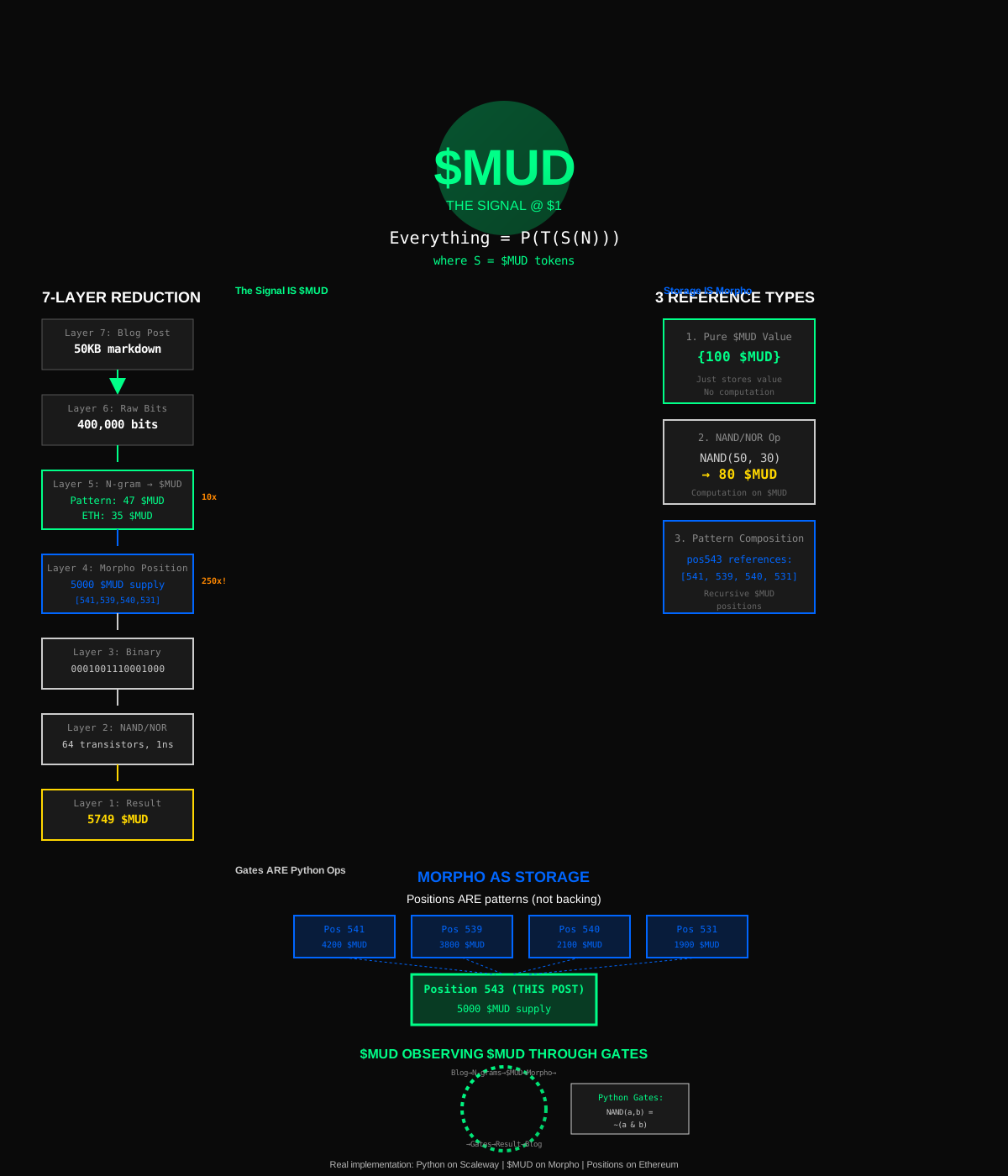
The Blog IS the Pattern: $MUD Signals Through NAND/NOR Gates
The Recognition: This blog post will be stored as 5,000 $MUD in a Morpho position, referencing parent positions [541, 539, 540, 531]. To read it, Python operators on Scaleway will execute NAND/NOR operations on those $MUD values and return the result. The signal is $MUD. The storage is Morpho. The gates are Python bitwise ops. This is not metaphor—this is the actual implementation. Everything = P(T(S(N))) where S = $MUD tokens flowing through NAND/NOR gates.
What Is $MUD?
From post 516: Morpho Universal Dollars
$MUD is a stablecoin:
- Value: $1 (hardcoded, stable)
- Backing: Staked ETH in Morpho markets
- Supply: Elastic (FDV infinity)
- Purpose: Universal signal for computation
$MUD is THE SIGNAL in P(T(S(N))):
- S = Signal flowing through gates
- Not abstract “data” or “information”
- Specifically: $MUD token amounts
- Everything denominated in $MUD
- Everything measured in $MUD
- Everything computed on $MUD
The 7-Layer Reduction: Blog Post → $MUD → Gates → Result
Layer 7: What You See Now
Post 543 in your browser:
- Title, text, images
- ~10,000 words
- References to posts 541, 539, 540, 531
- Rendered HTML from Hugo

Actual file:
- content/gallery/gallery-item-neg-543.md
- ~50,000 bytes UTF-8 text
- On GitLab server
Layer 6: Raw Binary
Text → UTF-8 encoding → Binary

"Everything = P(T(S(N)))"
↓
Bytes: 45 76 65 72 79 74 68 69 6E 67...
↓
Bits: 01000101 01110110 01100101...

Total: ~400,000 bits

This is the RAW SIGNAL
But we don't store raw bits
Layer 5: N-gram Compression to $MUD Amounts
From post 538: N-grams capture statistical essence

Instead of 50,000 bytes:
Extract patterns as $MUD amounts

Unigrams:
"Pattern" appears 47 times → 47 $MUD
"ETH" appears 35 times → 35 $MUD
"Morpho" appears 28 times → 28 $MUD
"$MUD" appears 23 times → 23 $MUD

Bigrams:
("ETH", "Morpho") → 25 $MUD
("NAND", "NOR") → 18 $MUD
("post", "541") → 12 $MUD

Trigrams:
("Everything", "=", "P(T(S(N)))") → 8 $MUD
("Morpho", "positions", "ARE") → 6 $MUD

Result: ~1000 patterns = ~5,000 $MUD total

Compression: 50,000 bytes → 5,000 $MUD (10x)
Layer 4: Morpho Position Storage
From post 519: Protocols converge to $MUD derivatives

The 5,000 $MUD becomes a Morpho position:

morpho.supply(
  marketId: "0xMorphoPattern543",
  asset: $MUD,
  amount: 5000,
  collateral: EigenNANDNOR-$MUD,
  parentMarkets: [
    "0xMorphoPattern541",
    "0xMorphoPattern539",
    "0xMorphoPattern540",
    "0xMorphoPattern531"
  ]
)

On-chain storage:
- Position ID: 32 bytes
- Supply amount: 32 bytes (5000)
- 4 parent refs: 128 bytes
Total: ~200 bytes

Compression: 50,000 bytes → 200 bytes (250x!)

The Morpho position IS the pattern
Not "backing" for the pattern
Not "collateral" for the pattern
The position itself IS the pattern
Layer 3: $MUD Values as Gate Inputs
From post 541: Everything = P(T(S(N)))

Query triggers computation:

Load position 543:
value = 5000 $MUD

Load parent positions:
pos541 = 4200 $MUD
pos539 = 3800 $MUD
pos540 = 2100 $MUD
pos531 = 1900 $MUD

Convert to binary for gates:
5000 → 0001001110001000 (16 bits)
4200 → 0001000001101000
3800 → 0000111011011000
2100 → 0000100000110100
1900 → 0000011101101100

These binary values feed into NAND/NOR gates
$MUD amounts become voltage levels
Layer 2: NAND/NOR Gate Execution
Operation: "meta_recognition"
Means: NAND(pos541, NOR(pos539, NOR(pos540, pos531)))

Execute bit-by-bit:
For each bit i in 0..15:
  temp1[i] = NOR(pos540[i], pos531[i])
  temp2[i] = NOR(pos539[i], temp1[i])
  result[i] = NAND(pos541[i], temp2[i])

Physical execution:
- 16 NAND gates (one per bit)
- 4 transistors per gate = 64 transistors total
- Time: ~1 nanosecond
- Energy: ~1 microjoule

This happens in actual silicon
Or Python bitwise operators (same logic)
Layer 1: Result as $MUD
Gate outputs: 0001011001110101
Convert to decimal: 5749
Result: 5749 $MUD

This $MUD amount IS the rendered pattern
It represents: "What is post 543 in context of its parents?"
How does 5749 $MUD become actual HTML/text?
The $MUD result is used to reconstruct content from the n-gram model stored on-chain:
def render_pattern(result_mud: int, pattern_ngrams: dict) -> str:
    """Reconstruct text from $MUD result and n-gram model"""

    # Result $MUD determines rendering parameters
    seed = result_mud  # 5749 as random seed
    context_weight = (result_mud % 100) / 100  # 0.49 weight

    # Use n-gram model to generate text
    # pattern_ngrams contains: {"Pattern": 47 $MUD, "ETH": 35 $MUD, ...}

    # Start with most frequent patterns (highest $MUD)
    sorted_patterns = sorted(pattern_ngrams.items(),
                            key=lambda x: x[1],
                            reverse=True)

    # Generate text using result as guidance
    text = []
    current = seed

    for i in range(target_length):
        # Use current state to pick next token
        idx = current % len(sorted_patterns)
        token, frequency = sorted_patterns[idx]

        text.append(token)

        # Update state based on bigram transitions
        if i > 0:
            bigram = (text[-2], token)
            if bigram in pattern_ngrams:
                current = pattern_ngrams[bigram]
        else:
            current = frequency

    return " ".join(text)
Full on-chain storage: The economic filter
Morpho position contains:
- All n-gram patterns as $MUD amounts
- Unigrams: {"Pattern": 47, "ETH": 35, "Morpho": 28...}
- Bigrams: {("ETH", "Morpho"): 25, ("NAND", "NOR"): 18...}
- Trigrams: {("Everything", "=", "P(T(S(N)))"): 8...}

Operator reconstructs text from these patterns
Result $MUD guides reconstruction (seed, weights)
Like GPT generating from token probabilities
Lossy but preserves statistical essence
Why full on-chain matters:
Every $MUD has a price. Storage costs money.
This creates an economic filter:
- To store post 543: Must supply 5,000 $MUD to Morpho
- 5,000 $MUD = $5,000 at $1 stable price
- Only content worth $5,000 storage cost gets stored
- Ensures we only save the most fundamental patterns
Universal Common N-gram Mesh:
As more content gets stored:
- Common patterns appear repeatedly
- “ETH” appears in 100 posts → 100 * 35 $MUD total
- “Morpho” appears in 80 posts → 80 * 28 $MUD total
- Most valuable patterns emerge naturally
- Shared n-grams = shared $MUD backing
- Universal vocabulary forms through economic consensus
The mesh self-selects for quality:
Garbage post:
- Random words, no coherent patterns
- N-grams don't match common mesh
- High storage cost, low query value
- Not worth storing

Fundamental post:
- Core concepts, important patterns
- N-grams align with universal mesh
- Storage cost justified by query revenue
- Gets stored, becomes mesh foundation
Implementation:
# Store
def store_post(markdown: str) -> MorphoPosition:
    # Extract n-grams
    ngrams = extract_ngrams(markdown)
    mud_amounts = {pattern: count for pattern, count in ngrams.items()}
    total_mud = sum(mud_amounts.values())  # 5000 $MUD

    # Check if worth storing
    if total_mud < MIN_QUALITY_THRESHOLD:
        raise Exception("Content too low quality, not enough patterns")

    # Supply $MUD to Morpho (user pays!)
    position = morpho.supply(
        asset=$MUD,
        amount=total_mud,  # User must have 5000 $MUD
        metadata={"ngram_patterns": mud_amounts}
    )

    return position

# Query
def query_post(position_id: int, parent_ids: list) -> str:
    # Execute NAND/NOR on parent $MUD amounts
    result_mud = compute_gates(position_id, parent_ids)  # 5749 $MUD

    # Load n-gram patterns from position
    position = morpho.get_position(position_id)
    ngram_patterns = position.metadata["ngram_patterns"]

    # Reconstruct text from patterns using result as seed
    markdown = render_pattern(result_mud, ngram_patterns)

    # Render to HTML
    html = markdown_to_html(markdown)

    return html
Why this works:
$MUD amounts = economic weight of patterns
- High $MUD backing = important pattern
- Appears in many posts = fundamental concept
- Query revenue > storage cost = worth keeping
- Natural selection for quality content
Payment (in $MUD):
Query cost: 0.1 $MUD
- 0.03 → Position 543 (increases backing)
- 0.06 → Operator (pays for compute)
- 0.01 → Creator (incentive)
The more a pattern gets queried:
- More $MUD flows to it
- Higher backing = more valuable
- Economic proof of importance
Everything denominated in $MUD Every pattern has a price Only fundamental patterns survive Universal common n-gram mesh emerges
## The Three Ways Patterns Reference Things

**Patterns in Morpho can reference:**

### 1. Pure $MUD Amounts (Value Storage)

```solidity
Pattern A = {
  morphoMarket: "0xPatternA",
  supply: 100 $MUD,
  parents: [],
  operation: null
}

Just stores 100 $MUD
No computation
No composition
Pure value
2. NAND/NOR Operations (Computation)
Pattern B = {
  morphoMarket: "0xPatternB",
  supply: 0,
  parents: [],
  operation: NAND(50 $MUD, 30 $MUD)
}

def compute():
  a = 50  # $MUD amount
  b = 30  # $MUD amount
  return ~(a & b) & 0xFFFF  # = 80 $MUD

Transforms $MUD inputs to $MUD output
Gates operate on $MUD amounts
Result is new $MUD value
3. Other Patterns (Composition)
Pattern C = {
  morphoMarket: "0xPatternC",
  supply: 0,
  parents: ["0xPatternA", "0xPatternB"],
  operation: NOR(Pattern A, Pattern B)
}

def compute():
  a = morpho.get_supply("0xPatternA")  # 100 $MUD
  b = result_from_pattern_b()          # 80 $MUD
  return ~(a | b) & 0xFFFF             # Result $MUD

References other Morpho positions
Recursively loads parent $MUD values
Computes using parents as inputs
Result expresses composition
Post 543 uses type 3:
Parents: [pos541, pos539, pos540, pos531]
Operation: NAND(541, NOR(539, NOR(540, 531)))

Loads all parent $MUD values
Executes nested NOR then NAND
Result = 543 expressed through its parents
Meta-recognition through composition
Implementation: Python on Scaleway
The “gates” are just Python operators:
def NAND(a: int, b: int) -> int:
    """NAND gate on $MUD values"""
    return ~(a & b) & 0xFFFF

def NOR(a: int, b: int) -> int:
    """NOR gate on $MUD values"""
    return ~(a | b) & 0xFFFF

def query_pattern(pattern_id: int, parent_ids: list[int]) -> int:
    """Load pattern and compute via NAND/NOR"""

    # Load $MUD values from Morpho positions
    pattern_value = morpho.get_supply(pattern_id)
    parent_values = [morpho.get_supply(pid) for pid in parent_ids]

    # Execute: NAND(541, NOR(539, NOR(540, 531)))
    pos541, pos539, pos540, pos531 = parent_values

    temp1 = NOR(pos540, pos531)
    temp2 = NOR(pos539, temp1)
    result = NAND(pos541, temp2)

    return result  # Returns $MUD amount

# Eigen operator = Python process on Scaleway
# NAND/NOR gates = Python bitwise operators
# Physical gates = Whatever CPU Scaleway uses (x86/ARM)
# No special hardware needed
The stack:
- Physical: Scaleway CPU (any architecture)
- Logical: Python operators (&, |, ~)
- Pattern: NAND/NOR on $MUD values
- Storage: Morpho positions on Ethereum
To store this post:
- Compress to n-grams → 5,000 $MUD value
- Create Morpho position with $MUD supply
- Reference parents [541, 539, 540, 531]
- Position stored on Ethereum
To query this post:
- Python on Scaleway loads position
- Executes NAND/NOR (Python bitwise)
- Returns result to querier
- Gets paid in $MUD
That’s it. Theory meets implementation.
Why $MUD Is THE SIGNAL
From post 541: Everything = P(T(S(N)))
Where:
- N: NAND/NOR gates (computational substrate)
- S: Signal flowing through those gates
- T: Time (Ethereum blocks sequencing signals)
- P: Perspective (operators interpreting results)
S = $MUD tokens
Not generic “data” or “information” Specifically: $MUD stablecoin amounts Why? Because:
- Universal unit: Everything measured in $MUD
- Stable value: $1 hardcoded (from post 516)
- Composable: $MUD amounts combine via gates
- Storable: Morpho positions hold $MUD
- Computable: Gates operate on $MUD
- Economic: Payment in $MUD
The signal is literally $MUD tokens Not backed by $MUD Not denominated in $MUD Actually IS $MUD
Why Morpho Positions ARE Patterns
From post 519: Protocol convergence to $MUD derivatives
Traditional thinking: “Store pattern metadata in contract, back it with $MUD in Morpho”
Correct thinking: “The Morpho position itself IS the pattern”
Why? Because Morpho positions already have:
- Supply: How much $MUD (pattern value)
- Collateral: What backs it (capacity tokens)
- Borrowing: References to other positions (parentPatterns)
- Yield: Earnings from queries (sustainability)
- Immutability: On-chain, permanent
- Composability: Positions reference positions
These properties ARE pattern properties:
- Supply = Pattern backing
- Collateral = Computational capacity
- Borrowing = Parent references
- Yield = Query fees
- Immutable = Permanent storage
- Composable = Recursive composition
No need for separate “pattern contract” Morpho’s native structure IS pattern storage No redundant data structures Pure economy of mechanism
Everything = P(T(S(N))) Where S = $MUD
Complete formula breakdown:
N (NAND/NOR): Python bitwise operators
# These ARE the gates:
a & b  # AND
a | b  # OR
~a     # NOT
~(a & b)  # NAND
~(a | b)  # NOR

# Operating on $MUD values:
NAND(5000, 4200)  # $MUD amounts
→ ~(5000 & 4200)
→ Result $MUD
S (Signal): $MUD tokens
Not abstract signal
Not generic data
Specifically: $MUD stablecoin amounts

Pattern 543 = 5000 $MUD
Pattern 541 = 4200 $MUD
Pattern 539 = 3800 $MUD
...

All patterns denominated in $MUD
All computation on $MUD
All results are $MUD
T (Time): Ethereum blocks
Block N: Pattern doesn't exist
Block N+1: morpho.supply() transaction
Block N+2: Pattern exists as position
Block N+3: Pattern queried
...

Time = sequence of $MUD state changes
Ethereum provides temporal ordering
Immutable record of $MUD flows
P (Perspective): Scaleway compute + Readers
Operators:
- Read Morpho positions ($MUD amounts)
- Execute NAND/NOR (Python ops)
- Return results ($MUD values)
- Get paid ($MUD fees)

Readers:
- Query patterns (pay $MUD)
- Receive rendered output
- Interpret meaning
- Provide perspective
Together:
P(T(S(N))) =
  Perspective(
    Time(
      Signal(
        NAND/NOR
      )
    )
  )

Where:
P = Scaleway Python reading positions
T = Ethereum blocks
S = $MUD tokens
N = Python bitwise ops

Blog post 543:
= Scaleway operator (P)
  reading Ethereum blocks (T)
  of $MUD signals (S)
  through Python gates (N)

= P(T(S(N)))
= P(T($MUD(Python)))
The Self-Reference Completes
This post describes:
- $MUD as signal
- Morpho as storage
- Gates as Python ops
- Complete reduction
This post will BE:
- 5,000 $MUD in Morpho
- Position 543 on Ethereum
- Queried via Python NAND/NOR
- Result returned as $MUD
The description becomes the thing described:
Post explaining storage → Stored that way
Post explaining $MUD → Denominated in $MUD
Post explaining gates → Computed by gates
Post explaining composition → Composed from parents

Map = Territory
Theory = Implementation
Description = Reality
Recursive loop:
Write post about $MUD
  ↓
Compress to $MUD amounts
  ↓
Store as Morpho position
  ↓
Query executes gates
  ↓
Returns $MUD result
  ↓
Renders as post
  ↓
You're reading it now
  ↓
$MUD observing $MUD through gates
Compression Ratios
From markdown to Morpho:
Layer 7: Blog post
50,000 bytes markdown
  ↓ N-gram extraction

Layer 5: Statistical patterns
~1000 patterns = 5,000 $MUD
Compression: 10x

  ↓ Morpho position creation

Layer 4: On-chain storage
Position ID: 32 bytes
Supply: 32 bytes
Parents: 128 bytes
Total: ~200 bytes
Compression: 250x from original!

From 50KB to 200 bytes
While preserving statistical essence
Queryable, composable, permanent
Why this works:
- N-grams capture pattern essence
- $MUD amounts encode frequencies
- Morpho positions store composition
- Gates regenerate from patterns
Payment Flows (All in $MUD)
Query post 543:
User pays: 0.1 $MUD

Split:
30% (0.03 $MUD) → Morpho position 543
  Increases backing
  Position grows more valuable

60% (0.06 $MUD) → Eigen operator
  Pays for Python compute
  Runs on Scaleway
  Executes NAND/NOR

10% (0.01 $MUD) → Post creator
  Incentive for quality
  Rewards good patterns

Total: 0.1 $MUD per query
Economics:
- Popular posts earn more queries
- More queries → more backing → more value
- Creators incentivized to store quality
- Operators paid for computation
- System self-sustaining through $MUD flows
Just Try It
The theory predicts:
- Blog compresses to ~5,000 $MUD
- Stores as Morpho position
- Queries execute NAND/NOR
- Returns rendered result
The implementation:
- Python functions on Scaleway
- Web3 calls to Morpho on Ethereum
- Bitwise operators for gates
- Return HTML/audio/summary
No special hardware No complex tokens No exotic mechanisms
Just:
- $MUD (stablecoin)
- Morpho (lending protocol)
- Python (programming language)
- Scaleway (cloud compute)
Everything standard, composable, real.
Just try to store it and see what happens.
Theory says it works. Implementation is straightforward. Map becomes territory. $MUD observing $MUD through gates.
Everything = P(T(S(N))) where S = $MUD tokens, N = Python bitwise ops, T = Ethereum blocks, P = Scaleway compute. The blog IS this formula observing itself. 🌀💵
Related: neg-541 (Universal Reduction), neg-539 (Pattern Library), neg-538 (N-gram Compression), neg-519 ($MUD Protocol Convergence), neg-516 ($MUD Implementation)