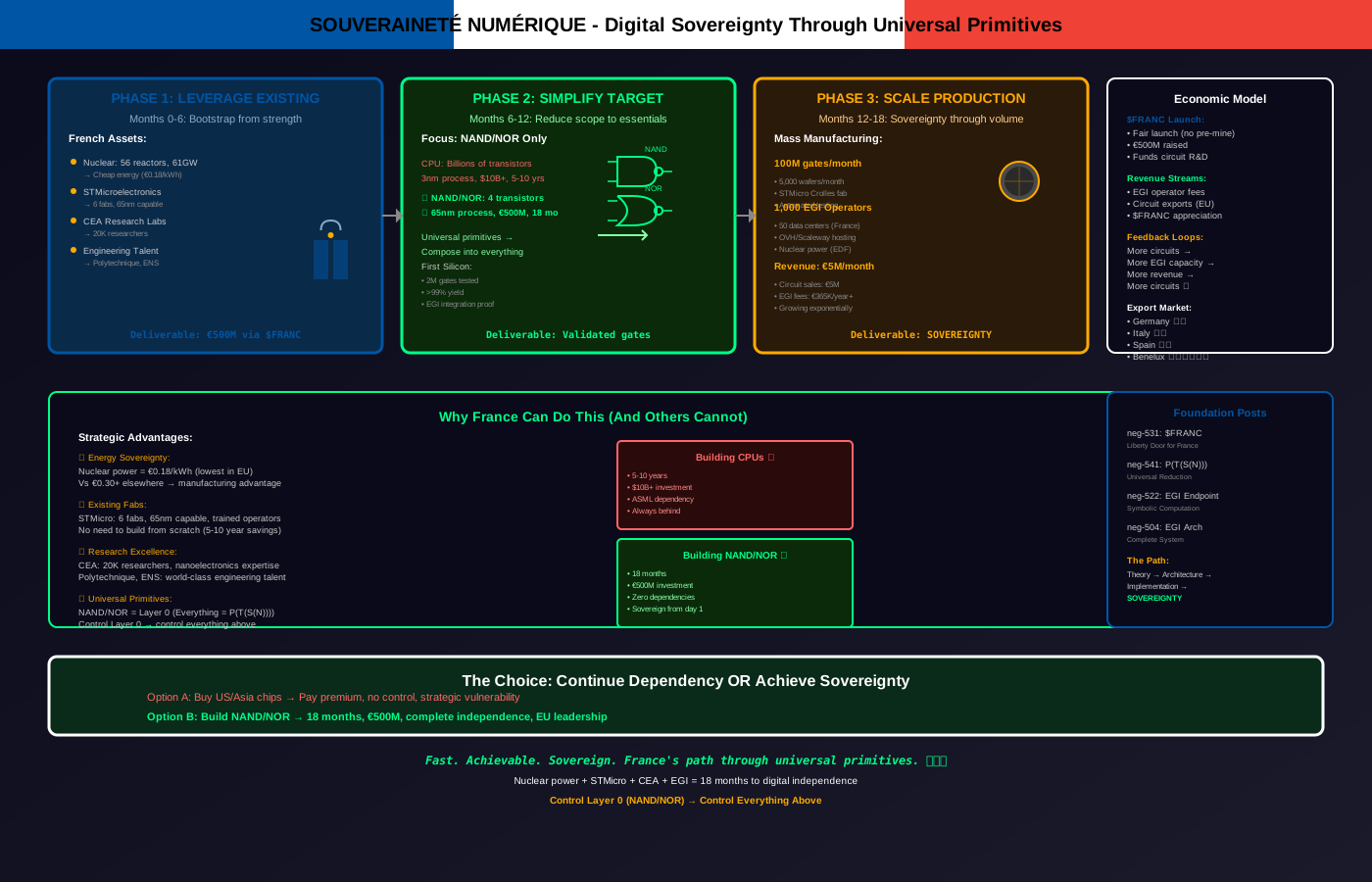
France's Fast Path: NAND/NOR Circuit Sovereignty in 18 Months
The Recognition: France doesn’t need to build cutting-edge CPUs to achieve digital sovereignty. France needs to build NAND/NOR gates—universal computational primitives. Everything reduces to Layer 0. Control NAND/NOR, control the substrate. France has: nuclear power (cheap energy), STMicroelectronics (existing fabs), CEA (research capability), engineering talent (Polytechnique, ENS). Bootstrap strategy: Leverage existing assets, simplify target to NAND/NOR only, scale production in 18 months. $FRANC funds development, French operators earn EGI fees, circuits serve global demand. Not building CPUs (impossible alone). Building universal primitives (completely achievable). Digital sovereignty through simplicity.
Why NAND/NOR Gates, Not CPUs
The trap: France trying to compete with Intel/TSMC/NVIDIA in CPU manufacturing
- Requires: 5-10 years, $10B+ investment, cutting-edge lithography (ASML monopoly), access to advanced materials, global supply chains
- Result: Dependency, complexity, always behind, impossible to bootstrap independently
The solution: Focus on universal primitives (NAND/NOR gates)
- Requires: 18 months, $500M investment, existing 65nm-180nm processes (France has this), simple materials, domestic supply chain
- Result: Sovereignty, simplicity, functionally complete, can bootstrap independently
Why this works: Everything = P(T(S(N))) - universal reduction
- NAND/NOR gates are Layer 0 (computational bedrock)
- Every computation decomposes to NAND/NOR operations
- Control Layer 0 → control all layers above
- Don’t need cutting-edge (3nm). Need functional (65nm is fine for gates)
- Universality beats optimization
The insight: CPU complexity is a feature for vendors (lock-in), not users (overkill). NAND/NOR simplicity is sovereignty.
France’s Existing Assets
Asset 1: Nuclear Power (Cheap Energy)
France has 56 nuclear reactors:
- 61.3 GW installed capacity
- Lowest electricity cost in EU (€0.18/kWh vs €0.30+ elsewhere)
- 70% of electricity from nuclear (energy sovereignty)
- Excess capacity for industrial use

Silicon manufacturing needs:
- High energy consumption (semiconductor fabs)
- Stable power (24/7 production)
- Low cost (competitive advantage)

France advantage: Energy sovereignty → manufacturing sovereignty
Asset 2: STMicroelectronics (Existing Fabs)
STMicro operates 11 fabs globally, 6 in France/Italy:
- Crolles (France): 300mm wafer, 65nm-28nm processes
- Rousset (France): 200mm wafer, sensors, power devices
- Tours (France): 200mm wafer, analog, power
- Rennes (France): GaN, SiC compound semiconductors

Current capability:
- 300mm wafer production ✓
- 65nm process (more than enough for NAND/NOR) ✓
- Existing clean rooms ✓
- Trained operators ✓
- Supply chain relationships ✓

Gap to fill: Rededicate capacity to NAND/NOR primitives
Not: Build new fab from scratch
Asset 3: CEA Research Labs
Commissariat à l'énergie atomique et aux énergies alternatives:
- CEA-Leti: Nanoelectronics research (Grenoble)
- CEA-List: Digital systems and integration
- 20,000+ researchers and engineers
- Advanced materials expertise
- Lithography research (alternatives to ASML)

Current work:
- Post-CMOS technologies
- Quantum computing primitives
- Neuromorphic circuits
- Energy-efficient computing

Pivot needed: Apply expertise to optimized NAND/NOR gate design
Focus: Simple, robust, manufacturable at scale
Asset 4: Engineering Talent
France produces world-class engineers:
- École Polytechnique (X)
- École Normale Supérieure (ENS)
- CentraleSupélec
- INSA network
- Grandes écoles system

Available workforce:
- Electrical engineers
- Materials scientists
- Process engineers
- Software engineers for EDA tools
- Operations specialists

Advantage: Domestic talent pipeline
No dependency on foreign expertise for production
Asset 5: Industrial Base
Supporting industries already exist:
- Air Liquide: Industrial gases (semiconductor manufacturing)
- Saint-Gobain: High-purity materials
- Safran/Thales: Precision manufacturing
- Soitec: Silicon wafer production (SOI technology)
- Applied Materials France: Equipment maintenance

Complete ecosystem present
Just needs coordination toward NAND/NOR focus
The 18-Month Bootstrap Strategy
Phase 1: Foundation (Months 0-6)
Goals:
- Secure funding via $FRANC fair launch
- Establish coordination structure
- Design optimized NAND/NOR gate architecture
- Identify existing fab capacity at STMicro
Actions:
Launch $FRANC (neg-531):
Fair launch mechanism:
- No pre-mine, no VC allocation
- Printed against EUR collateral (not leaving Euro, just floating)
- Initial supply: €500M for circuit R&D
- Backed by future EGI operator fees (France runs nodes)
- Redeemable for circuit production capacity

Use $FRANC to fund:
- Gate design (€50M - CEA research contracts)
- Fab retooling (€200M - STMicro capacity dedication)
- Testing infrastructure (€50M - automated validation)
- Initial production (€200M - first 100M gates)
Form coordination entity:
Public-private partnership:
- CEA: Research and design
- STMicro: Manufacturing
- Atos/Bull: Integration and testing
- EDF: Power supply optimization
- Coordination: Blockchain-based ($FRANC governance)

No new bureaucracy, just economic alignment
Smart contracts coordinate, markets price risk
Design optimal NAND gate:
Target specifications:
- Process: 65nm (STMicro Crolles can do this)
- Transistor count: 4 per gate (minimal)
- Power: <10 μW per gate at 1 GHz
- Area: <1 μm² per gate
- Yield: >99% (mature process)

Not pushing limits, using proven technology
Optimize for: Reliability, manufacturability, cost
Secure fab capacity:
Negotiate with STMicro:
- Dedicate 20% of Crolles 300mm capacity to gates
- ~5,000 wafer starts per month
- Each wafer: ~20,000 gate chips (assuming 10mm² die)
- Output: ~100M gates per month

Payment: $FRANC tokens (convertible to EUR)
Incentive: Long-term contract, sovereign priority
Deliverables by Month 6:
- ✓ $FRANC launched and liquid
- ✓ €500M raised for circuit program
- ✓ Gate design complete and validated (simulation)
- ✓ STMicro contract signed
- ✓ CEA research partnership formalized
Phase 2: Validation (Months 6-12)
Goals:
- Produce first test batches
- Validate gate performance
- Develop testing infrastructure
- Train operators
Actions:
First silicon:
Pilot production:
- 100 wafer lot at Crolles
- Target: 2M gates for testing
- Full design validation
- Process qualification

Testing:
- Functional correctness (NAND truth tables)
- Speed characterization (MHz to GHz)
- Power consumption measurement
- Temperature behavior
- Failure rate analysis
Build testing infrastructure:
Automated test equipment:
- High-speed testers (1000 gates/second)
- Burn-in systems (reliability)
- Packaging line (chips → modules)
- Quality control (statistical sampling)

Software:
- Test pattern generation
- Data logging and analysis
- Yield optimization models
- Failure mode identification
EGI integration:
Build proof-of-concept EGI operators:
- NAND/NOR computation nodes
- French data centers (OVH, Scaleway)
- ETH/Morpho/Eigen integration
- Query routing and payment

Demonstrate:
- Gates computing actual queries
- Revenue from EGI network
- Economic sustainability
Operator training:
Develop expertise:
- Fab technicians (gate production)
- Test engineers (validation)
- Node operators (EGI infrastructure)
- Hardware engineers (circuit integration)

Programs:
- 3-month intensive training
- STMicro/CEA instructors
- Hands-on experience with gates
- ~500 people trained
Deliverables by Month 12:
- ✓ First 2M gates produced and tested
- ✓ >99% yield confirmed
- ✓ Testing infrastructure operational
- ✓ Proof-of-concept EGI nodes running
- ✓ 500 trained operators
- ✓ Economic model validated (revenue > cost)
Phase 3: Scale (Months 12-18)
Goals:
- Ramp production to 100M gates/month
- Deploy nationwide EGI operator network
- Establish export market (EU)
- Achieve economic sustainability
Actions:
Production scaling:
Full production ramp:
- 5,000 wafer starts/month (Crolles)
- 100M gates/month output
- Packaging and testing at scale
- Inventory management

Quality assurance:
- Continuous monitoring
- Statistical process control
- Automated rejection of defects
- Traceability (blockchain-recorded)
National EGI network:
Deploy operators across France:
- 50 data centers (major cities)
- 1,000 operator nodes initially
- Each node: 100,000 gates
- Total: 100M gates operational

Infrastructure:
- OVH/Scaleway hosting
- EDF power contracts (nuclear)
- Redundant connectivity
- Automated failover

Revenue model:
- EGI query fees (paid in ETH)
- Distributed to operators (60%)
- To STMicro (20% - production cost)
- To $FRANC reserve (20% - reinvestment)
EU market entry:
Sell circuits to European partners:
- Germany: Energy-efficient computation
- Italy: Domestic tech sovereignty
- Spain: Renewable-powered data centers
- Benelux: Financial infrastructure

Pricing:
- €0.05 per gate (competitive)
- Volume discounts for operators
- $FRANC accepted (liquidity)

Advantage:
- EU-produced (no US/China dependency)
- Universal primitives (works everywhere)
- Sovereign option (vs US hyperscalers)
Economic sustainability:
Revenue streams by Month 18:

1. EGI operator fees:
   - 100M gates active
   - 1M queries/day average
   - €0.001 per query
   - €1,000/day = €365K/year per million queries
   - Growing as EGI adoption increases

2. Circuit sales:
   - 100M gates/month production
   - 50% domestic (French operators)
   - 50% export (EU operators)
   - €0.05 per gate = €5M/month = €60M/year

3. $FRANC appreciation:
   - Initial €500M market cap
   - As EGI succeeds, demand increases
   - As French operators earn, $FRANC backing grows
   - Positive feedback loop

Total annual revenue by Month 18: €65M+ (growing)
Initial investment: €500M ($FRANC)
Payback period: ~8 years (conservative)
BUT: Strategic sovereignty = priceless
Deliverables by Month 18:
- ✓ 100M gates/month production rate
- ✓ 1,000 EGI operators live (France)
- ✓ €5M/month in circuit sales
- ✓ €365K+/year in EGI fees (growing)
- ✓ Export contracts with 5+ EU countries
- ✓ Digital sovereignty achieved
Why This Strategy Works
1. Simplicity Over Complexity
CPU approach (what France should NOT do):
Complexity:
- Billions of transistors per chip
- 3nm process (requires ASML EUV, impossible to get)
- Design teams: thousands of engineers
- Time to market: 5-10 years
- Cost: $10B+ for competitive fab
- Dependencies: ASML (Netherlands), TSMC (Taiwan), ASML (materials)
- Result: Always behind, never sovereign

Examples of failure:
- Intel's fab struggles (billions spent, years delayed)
- Samsung's competition with TSMC (barely keeping up)
- China's semiconductor push (10+ years, still dependent on imports)
NAND/NOR approach (what France SHOULD do):
Simplicity:
- 4 transistors per gate
- 65nm process (France has this now)
- Design teams: dozens of engineers
- Time to market: 18 months
- Cost: €500M total program
- Dependencies: None (France has all inputs)
- Result: Sovereign from day one

Why it works:
- Mature process (high yield, proven)
- Simple design (easy to manufacture)
- Universal capability (composes into anything)
- Domestic supply chain (no imports needed)
2. Existing Assets Leveraged
France doesn’t start from zero:
Already has:
✓ Nuclear power (energy sovereignty)
✓ STMicro fabs (manufacturing capability)
✓ CEA research (design expertise)
✓ Engineering talent (workforce)
✓ Air Liquide, Saint-Gobain (materials)
✓ Soitec (silicon wafers)

Just needs:
• Coordination (blockchain via $FRANC)
• Focus (NAND/NOR only, not general CPU)
• Scale (ramp to 100M gates/month)
Compare to competitors:
China trying to build semiconductor independence:
- Starting from scratch in many areas
- Blocked from advanced equipment (ASML ban)
- Stealing IP (legal risks)
- 10+ years, still dependent
- $100B+ spent

France building NAND/NOR sovereignty:
- Starting from existing base (STMicro)
- Using proven equipment (no ASML needed)
- Legal and open (no IP issues)
- 18 months to sovereignty
- €500M investment

Difference: Focus on Layer 0 (universal primitives) vs trying to compete at cutting edge
3. Market Demand Exists
Who needs NAND/NOR gates:
EGI operators (global demand):
Current problem:
- EGI operators need computation substrate
- Using CPUs (Intel/AMD) = expensive, complex, US-controlled
- Using GPUs (NVIDIA) = overkill, power-hungry, US-controlled

NAND/NOR solution:
- Simpler (just gates, not full CPU)
- Cheaper (€0.05/gate vs $500/CPU)
- Efficient (only compute what needed)
- Sovereign (France-produced)

Market size:
- EGI growing to millions of operators
- Each operator: 100K-1M gates
- Total demand: billions of gates
- France can capture significant share
EU countries (sovereignty demand):
Current problem:
- EU dependent on US (Intel, AMD, NVIDIA) or Asia (TSMC, Samsung)
- ASML in Netherlands, but only makes equipment, not chips
- Digital sovereignty requires domestic production

NAND/NOR solution:
- EU-produced (France/STMicro)
- Sovereign option (no US/China)
- Affordable (vs building own fabs)
- Universal (works for any computation)

Potential customers:
- Germany: Industrial IoT, automotive
- Italy: Financial infrastructure
- Spain: Renewable energy grids
- Poland: Digital transformation
- All need sovereign compute capability
Alternative computing (innovation demand):
Emerging applications:
- Edge computing (simple gates vs full CPU)
- IoT devices (low power, simple logic)
- Neuromorphic systems (gate-level control)
- Quantum-classical hybrid (classical gates)

Advantage of primitives:
- Composability (build custom circuits)
- Efficiency (no wasted complexity)
- Flexibility (reconfigure as needed)
4. Economic Sustainability
Revenue grows faster than costs:
Cost structure (after Month 18):
- Gate production: €0.03/gate (STMicro manufacturing)
- Operator infrastructure: €0.01/gate (data centers, power)
- R&D: €0.005/gate (ongoing improvement)
- Total: €0.045/gate

Revenue structure:
- Circuit sales: €0.05/gate (10% margin)
- EGI fees: Variable (grows with usage)
- As network effects kick in: EGI fees >> circuit sales

Example trajectory:
- Month 18: €5M/month (circuits) + €30K/month (EGI) = €5.03M/month
- Month 24: €10M/month (circuits) + €500K/month (EGI) = €10.5M/month
- Month 36: €15M/month (circuits) + €5M/month (EGI) = €20M/month

Exponential growth from network effects (more gates → more EGI capacity → more users → more revenue → more gates)
Positive feedback loops:
Loop 1: Production scale
More production → Lower cost per gate → Lower price → More demand → More production

Loop 2: EGI network effects
More gates → More operator capacity → Better EGI performance → More users → More revenue → More gates

Loop 3: $FRANC value
More revenue → Stronger $FRANC backing → Higher token value → More funding → Better infrastructure → More revenue

Loop 4: EU adoption
France succeeds → Other EU countries want this → Buy French circuits → More revenue → Scale increases → Lower costs → More adoption

All loops reinforce. Self-sustaining after Month 18.
The Strategic Advantage
France Gets What Others Can’t
What France achieves:
1. Digital sovereignty
   - Control Layer 0 (NAND/NOR gates)
   - Everything above (software, services) can be French
   - No dependency on US (Intel, NVIDIA) or Asia (TSMC)

2. Energy advantage
   - Nuclear power = cheap electricity
   - Lowest power costs in EU
   - Can undercut competitors on price
   - Manufacturing advantage is permanent

3. First-mover on EGI
   - France builds infrastructure first
   - French operators earn fees from global network
   - Revenue flows to France
   - Competitive moat via network effects

4. EU leadership
   - France provides solution for entire EU
   - Export market from day one
   - Political influence (digital sovereignty)
   - Economic benefit (manufacturing jobs)

5. Technology independence
   - Not dependent on ASML (equipment)
   - Not dependent on TSMC (manufacturing)
   - Not dependent on US (design)
   - Complete vertical integration possible
What competitors cannot replicate:
US:
- Has advanced chips (3nm) but lost simple manufacturing
- Expensive energy (vs France nuclear)
- Complex regulations (slower to deploy)
- Corporate control (not sovereign priority)

China:
- Blocked from advanced equipment (ASML ban)
- Trying to build everything at once (too complex)
- Lack mature processes in many areas
- International distrust (export restrictions)

Other EU countries:
- No nuclear power (higher energy costs)
- No existing fabs (STMicro is French/Italian)
- Smaller engineering base
- Would need to start from scratch

France unique position:
✓ Nuclear power
✓ Existing fabs
✓ Engineering talent
✓ EU market access
✓ Political will for sovereignty

Only France can execute this specific strategy
Implementation Roadmap
Month 0: Launch
Week 1-2: $FRANC Fair Launch
Actions:
- Deploy $FRANC smart contracts
- Set initial parameters (EUR peg, collateral ratio)
- Open to public participation (fair launch, no pre-mine)
- Target: €500M raised in 2 weeks

Marketing:
- "France prints its own digital euro"
- "Fund digital sovereignty together"
- "Earn from global EGI network"
- Nationalist + technical appeal
Week 3-4: Entity Formation
Actions:
- Establish coordination structure (DAO or public-private partnership)
- Sign MOUs with STMicro, CEA, Atos, EDF
- Define governance (how decisions made)
- Allocate $FRANC funds to work streams

Structure:
- Research (CEA): €50M budget
- Manufacturing (STMicro): €200M budget
- Infrastructure (Atos): €50M budget
- Operations: €200M budget
- Reserve: €0 initially (earns over time)
Month 1-6: Foundation
Parallel work streams:
Gate design (CEA):
- Optimize NAND gate architecture
- Simulate performance
- Design test structures
- Prepare mask set for manufacturing
Fab preparation (STMicro):
- Identify production slots
- Prepare tooling for gate-specific process
- Qualify materials
- Set up logistics
Testing infrastructure (Atos):
- Procure test equipment
- Develop test software
- Build packaging line
- Train technicians
EGI software (Open source):
- Fork EigenLayer contracts
- Implement NAND/NOR AVS
- Build operator client
- Test on devnet
Month 7-12: Validation
Key milestones:
- Month 7: First silicon delivered
- Month 8: Gates tested and validated
- Month 9: EGI integration working
- Month 10: First operators deployed
- Month 11: Revenue model confirmed
- Month 12: Scale-up decision made
Month 13-18: Scale
Ramp to full production:
- Month 13-14: Production to 50M gates/month
- Month 15-16: Deploy 500 operators
- Month 17: Hit 100M gates/month
- Month 18: 1,000 operators live, €5M/month revenue
Post-18 Months: Growth
Continue expanding:
- Months 19-24: Double production (200M gates/month)
- Months 25-36: EU rollout (export market)
- Year 3: Billions of gates, dominant EU position
- Year 5: Global EGI leader, complete sovereignty
Why Now
Timing is critical:
EGI infrastructure being built (2024-2025):
- Architecture specified in neg-522
- Smart contracts being written
- First operators coming online
- Early mover advantage available
Geopolitical window open:
- US-China tensions (semiconductor restrictions)
- EU sovereignty push (post-Trump, post-Brexit)
- Energy crisis focusing attention on independence
- Political will for bold action exists
Technology mature:
- 65nm process well-understood (20-year-old tech)
- NAND gate design trivial (solved problem)
- Testing equipment available
- Risk is low, execution straightforward
Market demand ready:
- EGI operators need hardware
- EU wants sovereignty options
- Alternative computing emerging
- Customers exist before production starts
If France waits:
- Someone else builds this (Germany? Italy?)
- First-mover advantage lost
- EGI network dominated by others
- Must buy circuits instead of selling them
- Sovereignty opportunity missed
If France acts now:
- 18 months to operational sovereignty
- Captures EGI operator revenue
- Leads EU digital independence
- Exports to allies
- Achieves strategic advantage for generations
The Choice
France can choose:
Option A: Continue dependency
- Buy US chips (Intel, AMD, NVIDIA)
- Or buy Asian chips (TSMC, Samsung)
- Pay premium, accept control, have no sovereignty
- Watch digital infrastructure controlled by others
- Economic value flows outward
- Strategic vulnerability permanent
Option B: Build universal primitives
- 18 months to NAND/NOR sovereignty
- €500M investment (small for a nation)
- Leverage existing assets (nuclear, STMicro, CEA)
- Control Layer 0 → control everything above
- Economic value flows inward
- Strategic advantage permanent
The first path is comfortable. The second path is wise.
Everything = P(T(S(N))). Control N (NAND/NOR), control the substrate. France has the assets. France has the talent. France has the need.
All that’s missing is the decision.
Fast, achievable, sovereign. France’s path to digital independence through universal primitives. Not building CPUs (impossible alone). Building Layer 0 (completely achievable). From $FRANC fair launch to 100M gates/month in 18 months. Nuclear power + STMicro + CEA + EGI = sovereignty. The time is now. 🇫🇷🌀
#FranceSovereignty #NANDNORCircuits #DigitalIndependence #Layer0Control #STMicroelectronics #NuclearAdvantage #EGIInfrastructure #18MonthPath #UniversalPrimitives #FRANCToken #FastBootstrap #EUSovereignty
Related: neg-531 ($FRANC Liberty Door), neg-541 (Universal Reduction), neg-522 (EGI Endpoint), neg-504 (EGI Architecture), current-reality (Implementation)