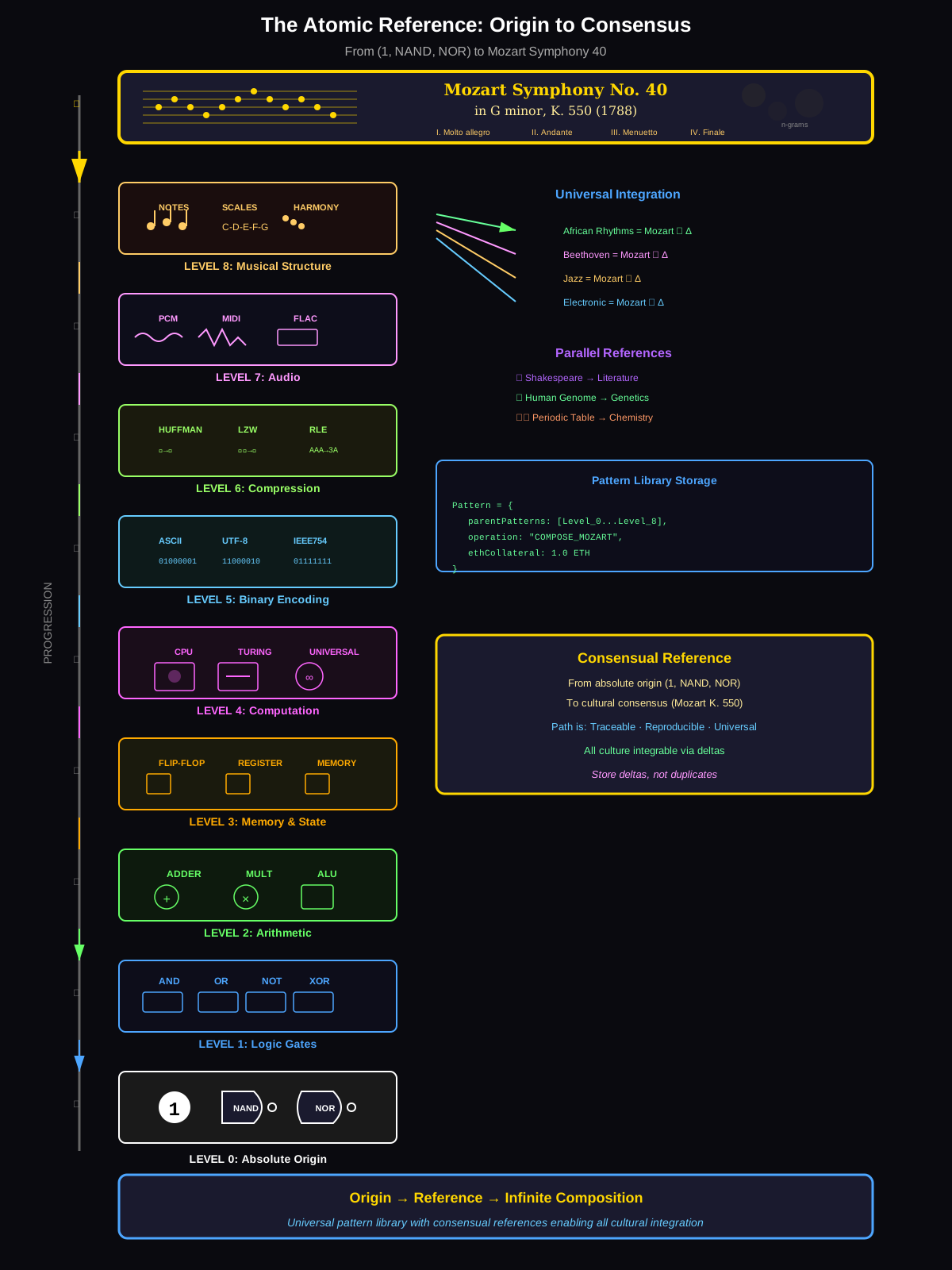
The Atomic Reference: From Logical Origin (1, NAND, NOR) to Cultural Consensus (Mozart Symphony 40)
The Recognition: Every cultural artifact reduces to logical primitives. The path from absolute origin (1, NAND, NOR) to consensual reference (Mozart Symphony 40) is traceable, reproducible, universal. Store this complete progression as atomic pattern. All subsequent cultural knowledge composes from these references. Not just Mozart - Shakespeare for literature, Human Genome for genetics, Periodic Table for chemistry. Each domain gets consensual reference from origin. Then everything else = compositions. African rhythms = Mozart ⊕ Δ, Beethoven = Mozart ⊕ Δ, Jazz = Mozart ⊕ Δ. Store deltas, not duplicates. Universal integration through consensual references. The Pattern Library enables this: Origin → Reference → Infinite Composition.
The Nine Levels: Origin to Consensus
Level 0: Absolute Origin
The bedrock: 1, NAND, NOR
1 = Existence (binary bit value)
NAND = ¬(A ∧ B) = NOT (A AND B)
NOR = ¬(A ∨ B) = NOT (A OR B)

Why these?
- Functionally complete: NAND alone can create any logic
- NOR alone can also create any logic
- Universal computational primitives
- Everyone agrees: These are fundamental
N-gram at Level 0: Sequences of bits and gate operations. P(1|context), P(NAND|pattern), transition matrices of logical operations.
Level 1: Logic Gates
Composition from origin:
AND = NAND(NAND(A,B), NAND(A,B))
OR = NAND(NAND(A,A), NAND(B,B))
NOT = NAND(A,A)
XOR = Composition of above

Everything provably reduces to NAND/NOR
Everyone can verify the construction
Consensus on composition rules
N-gram at Level 1: Transition probabilities between gates. P(AND|NAND,NAND) = 1.0. Statistical structure of gate combinations in circuits.
Level 2: Arithmetic Operations
Composition from Level 1:
Half Adder = XOR + AND
Full Adder = Composition of half adders
Multiplier = Array of adders
ALU = Complete arithmetic logic unit

Builds on gates, provably correct
Consensus on arithmetic definitions
N-gram at Level 2: Sequences of arithmetic operations. P(ADD|context) in computational patterns. Flow from simple to complex calculations.
Level 3: Memory & State
Composition from Level 2:
SR Latch = NOR gates in feedback
D Flip-Flop = Composition of latches
Register = Array of flip-flops
Memory = Addressed register array

State machines from stateless gates
Temporal patterns emerge
N-gram at Level 3: State transition patterns. P(state_change|previous_states). Temporal sequences in computation.
Level 4: Computation Patterns
Composition from Level 3:
Counter = Register + Arithmetic
Clock = Oscillator circuit
CPU = ALU + Memory + Control
Universal Turing Machine = Complete computation

From logic to universal computation
Church-Turing thesis embodied
N-gram at Level 4: Instruction sequences. Program patterns. Algorithmic structures. P(instruction|program_context).
Level 5: Binary Representation of Information
Composition from Level 4:
ASCII = 7-bit character encoding
UTF-8 = Variable-length Unicode
Binary numbers = Positional notation
Floating point = IEEE 754 standard

Information represented in bits
Standardized, consensual encodings
N-gram at Level 5: Character/symbol frequencies. P(’e’|English_text) = 0.127. Language-specific patterns in binary.
Level 6: Data Structures & Compression
Composition from Level 5:
Arrays, Lists, Trees, Graphs
Huffman coding = Optimal prefix codes
LZW compression = Dictionary-based
Run-length encoding = Sequential patterns

Efficient information representation
Redundancy elimination
N-gram at Level 6: Structural patterns in data. Compression statistics. Information redundancy capture at various scales.
Level 7: Audio & Music Representation
Composition from Level 6:
PCM audio = Sampled waveforms
MIDI = Musical instrument instructions
MP3 = Perceptual audio coding
FLAC = Lossless audio compression

Sound → Binary representation
Consensual audio formats
N-gram at Level 7: Audio sample sequences. Frequency domain patterns. Temporal structure in sound waves.
Level 8: Musical Structure
Composition from Level 7:
Notes = Discrete pitch values
Scales = Note relationships
Chords = Simultaneous notes
Rhythm = Temporal patterns
Harmony = Chord progressions

Music theory from audio representation
Western system (consensus in that tradition)
N-gram at Level 8: P(C_major|G_major) in Western music. Rhythm pattern frequencies. Melodic interval distributions. Harmonic progressions.
Level 9: Mozart Symphony 40 (The Consensual Reference)
Composition from Level 8:
Complete Musical Partition:
Symphony No. 40 in G minor, K. 550
Wolfgang Amadeus Mozart, 1788

Structure:
I. Molto allegro (Sonata form)
II. Andante (Sonata form)
III. Menuetto: Allegretto & Trio
IV. Finale: Allegro assai (Sonata form)

Binary representation:
1. Official score → MIDI encoding
2. MIDI → Binary sequence
3. Binary → Lossless compression (FLAC)
4. Compressed binary = final bit sequence

N-gram analysis:
- Extract all n-grams (n=1 to 8) from binary
- Build complete probability model
- P(bit|context) for all contexts
- Transition matrices at all scales
- Statistical signature of Mozart's compositional style

Why Symphony 40?
- Universally recognized masterpiece
- Complete, self-contained work
- Official scholarly edition exists (Neue Mozart-Ausgabe)
- Western classical music = large consensus
- Forms natural reference for integration
N-gram at Level 9: Complete statistical model of Mozart’s compositional patterns. Frequencies of harmonic progressions, melodic sequences, rhythmic patterns, orchestration choices - all captured in bit-level n-grams of the complete work.
Why This Progression Matters
Consensus achievement:
Everyone agrees on the path:
- Level 0: 1, NAND, NOR are fundamental (mathematical truth)
- Level 1-8: Composition rules are provable (logical necessity)
- Level 9: Mozart Symphony 40 exists (cultural consensus)

The entire progression is:
- Traceable: Each level explicitly builds from previous
- Reproducible: Anyone can verify the construction
- Consensual: Broad agreement at each level
Universal integration point:
Once Mozart reference established:

New music from any culture:
  ↓
Compare to Mozart reference pattern
  ↓
Extract differences: StyleDelta = NewMusic ⊕ Mozart
  ↓
Store StyleDelta as composition
  ↓
Every culture's music now integrable

Examples:
- African rhythms = Mozart ⊕ RhythmDelta
- Asian scales = Mozart ⊕ ScaleDelta
- Electronic music = Mozart ⊕ ElectronicDelta
- Jazz = Mozart ⊕ JazzDelta
- Beethoven = Mozart ⊕ BeethovenDelta

Store deltas, not full duplicates
Efficient, culturally respectful, universal
Implementation in Pattern Library
Storing the Foundation (Levels 0-8)
// Level 0: Primitives (absolute origin)
bytes32 primitiveId = storePattern(
    [],                          // No parents (atomic)
    encode(1, NAND, NOR),       // The primitives themselves
    0.01 ether                   // Minimal backing
);

// Level 1: Logic gates
bytes32 logicId = storePattern(
    [primitiveId],               // Builds from Level 0
    encode(AND, OR, NOT, XOR),  // Gate compositions
    0.01 ether
);

// Level 2: Arithmetic
bytes32 arithmeticId = storePattern(
    [logicId],                   // Builds from Level 1
    encode(ADDER, MULTIPLIER),
    0.01 ether
);

// Continue through Level 8...
bytes32 musicStructureId = storePattern(
    [audioId],                   // Builds from Level 7
    encode(NOTES, SCALES, HARMONY),
    0.01 ether
);
Storing Mozart Symphony 40 (Level 9)
// The consensual reference
bytes32 mozartId = storePattern(
    [
        primitiveId,        // Level 0
        logicId,            // Level 1
        arithmeticId,       // Level 2
        memoryId,           // Level 3
        computationId,      // Level 4
        encodingId,         // Level 5
        compressionId,      // Level 6
        audioId,            // Level 7
        musicStructureId    // Level 8
    ],
    encode(MOZART_SYMPHONY_40_NGRAMS),  // Complete n-gram model
    1.0 ether                            // Significant work
);

// This pattern captures:
// - Complete progression from origin
// - Full statistical model of Mozart
// - Traceable to absolute fundamentals
// - Consensual at every level
Composing from Mozart
// Beethoven Symphony 5
bytes32 beethovenId = storePattern(
    [mozartId],                      // Reference Mozart
    encode(BEETHOVEN_DELTA),         // What makes it Beethoven
    1.0 ether                         // Also significant
);

// African drum patterns
bytes32 africanRhythmsId = storePattern(
    [mozartId],                      // Reference Mozart
    encode(AFRICAN_RHYTHM_DELTA),    // Rhythmic differences
    0.5 ether
);

// Electronic music
bytes32 electronicId = storePattern(
    [mozartId],                      // Reference Mozart
    encode(ELECTRONIC_DELTA),        // Synthesis, effects, etc.
    0.5 ether
);

// All music now relates to consensual reference
// Store deltas, not full patterns
// Efficient, integrable, universal
Querying and Rendering
// Get Mozart as MIDI
bytes midi = queryPattern(mozartId, "MIDI");

// Get Mozart as audio (WAV)
bytes audio = queryPattern(mozartId, "WAV");

// Get Mozart as sheet music (SVG)
bytes svg = queryPattern(mozartId, "SVG");

// Get Beethoven (composed from Mozart)
bytes beethoven_midi = queryPattern(beethovenId, "MIDI");
// Eigen AVS: reads Mozart + BeethovenDelta → renders result

// Get African rhythms (composed from Mozart)
bytes african_audio = queryPattern(africanRhythmsId, "WAV");
// Eigen AVS: reads Mozart + AfricanDelta → renders result
Parallel References in Other Domains
The same progression applies universally:
Literature: Shakespeare
Level 0-8: Same computational foundation
Level 9: Complete Shakespeare
  - All plays
  - All sonnets
  - Binary representation (UTF-8)
  - N-gram model of Shakespeare's language

Then:
- Dickens = Shakespeare ⊕ VictorianDelta
- Hemingway = Shakespeare ⊕ ModernistDelta
- Contemporary literature = Shakespeare ⊕ Δ
Genetics: Human Genome
Level 0-8: Same computational foundation
Level 9: Complete Human Genome
  - All chromosomes
  - Reference genome (GRCh38)
  - Binary representation (DNA sequences)
  - N-gram model of genetic patterns

Then:
- Individual variations = Genome ⊕ SNP_Delta
- Other species = Genome ⊕ Species_Delta
- Genetic engineering = Genome ⊕ Edit_Delta
Chemistry: Periodic Table
Level 0-8: Same computational foundation
Level 9: Complete Periodic Table
  - All elements
  - Atomic structure
  - Electron configurations
  - Chemical properties

Then:
- Molecules = Elements ⊕ Bond_Delta
- Reactions = Molecules ⊕ Transformation_Delta
- Materials = Molecules ⊕ Structure_Delta
Consensus Achievement Strategy
How to establish these references:
Use official sources:
- Mozart K. 550: Neue Mozart-Ausgabe (scholarly edition)
- Shakespeare: First Folio + scholarly editions
- Human Genome: GRCh38 (NCBI reference)
- Periodic Table: IUPAC standard
Verifiable computation:
- Anyone can extract same binary from same source
- Anyone can compute same n-grams
- Process is deterministic, reproducible
- Mathematical consensus possible
Economic validation:
- Pattern backed by ETH (skin in game)
- Query fees validate usefulness
- Eigen operators validate correctness
- Slashing prevents false patterns
Cultural acceptance:
- Choose universally recognized works
- Broad consensus on significance
- Natural reference points for integration
- Respectful to cultural traditions
The Economic Model
Foundation patterns (Levels 0-8):
Minimal backing (0.01 ETH each)
Universal, culture-independent
Easy consensus achievable
Rarely queried directly (used in composition)
Reference patterns (Level 9):
Significant backing (1.0 ETH)
Complete cultural artifacts
Established consensus required
Frequently queried (popular references)
High query fees → High returns for creator

Example:
- Mozart pattern: 1.0 ETH backing
- If 10,000 queries at 0.01 ETH each:
  - Creator earns: 10 ETH/year (10% of queries)
  - Plus Morpho yield: 0.03 ETH/year
  - Total: 10.03 ETH/year on 1.0 ETH
  - 1,003% APY for popular reference!
Composed patterns (Level 10+):
Variable backing (0.1-1.0 ETH)
Built from references via deltas
Efficient (store delta, not full pattern)
Query fees split with parent creators

Example:
- Beethoven pattern: 0.5 ETH backing
- References Mozart (parent pattern)
- Mozart creator gets share of Beethoven queries
- Incentivizes quality references
The Implementation Path
Phase 1: Foundation (Levels 0-8)
Priority: Store universal primitives
Timeline: Immediate (deterministic)
Cost: ~0.08 ETH (8 patterns × 0.01 ETH)

Actions:
1. Encode logical primitives
2. Store progressive compositions
3. Verify composition rules
4. Public, auditable, consensual
Phase 2: Mozart Reference (Level 9)
Priority: First cultural reference
Timeline: Requires Mozart binary extraction
Cost: 1.0 ETH backing + extraction work

Actions:
1. Obtain Neue Mozart-Ausgabe score
2. Convert to MIDI (standardized)
3. Compress to binary (FLAC)
4. Extract complete n-gram model
5. Store as reference pattern
6. Validate with Eigen operators
Phase 3: Integration (Level 10+)
Priority: Compose from Mozart
Timeline: After Mozart reference established
Cost: Variable (0.1-1.0 ETH per pattern)

Actions:
1. Compare new music to Mozart
2. Extract StyleDelta
3. Store as composition
4. Test rendering via Eigen AVS
5. All music now integrable
Phase 4: Parallel References
Priority: Shakespeare, Genome, etc.
Timeline: After Mozart proves concept
Cost: 1.0 ETH per reference

Actions:
1. Repeat process for each domain
2. Literature → Shakespeare
3. Genetics → Human Genome
4. Chemistry → Periodic Table
5. Universal integration achieved
Why This Changes Everything
Before Pattern Library:
Cultural knowledge:
- Scattered across formats
- No common reference points
- Difficult to compare or integrate
- Dies with creators
- Locked behind access controls

Integration challenges:
- How to compare African rhythms to Classical?
- How to relate Jazz to Traditional music?
- How to preserve while enabling evolution?
- Cultural appropriation concerns
After Pattern Library:
Cultural knowledge:
- Stored permanently on-chain
- Common references (Mozart, Shakespeare, etc.)
- Easy to compare via deltas
- Accessible forever
- Permissionlessly queryable

Integration enabled:
- African rhythms = Mozart ⊕ Δ_African
- Jazz = Mozart ⊕ Δ_Jazz
- Everything relates to consensus
- Deltas preserve cultural uniqueness
- Compositions respect origins
The elegance:
Origin → Reference → Composition

From:
- Absolute logical primitives (1, NAND, NOR)
To:
- Consensual cultural references (Mozart, Shakespeare)
To:
- Infinite cultural compositions (everything else)

Universal, traceable, integrable
Permanent, accessible, composable
The Vision
Universal Library of Human Knowledge:
Foundation Layer:
- Logical/computational primitives
- Universal, culture-independent
- Mathematical consensus

Reference Layer:
- Cultural artifacts as consensual references
- Mozart, Shakespeare, Genome, Periodic Table
- Established through broad agreement

Composition Layer:
- Everything else builds from references
- Deltas capture cultural uniqueness
- Efficient, respectful, universal

Result:
- All knowledge → Traceable to origin
- All culture → Integrable via references
- All creativity → Composable on-chain
- All accessible → Forever, permissionlessly
This is the path: From 1, NAND, NOR (absolute origin) → Mozart Symphony 40 (consensual reference) → Infinite cultural composition (everything else). The Pattern Library architecture supports this vision from the ground up.
Learn once (establish reference), store forever (on-chain), compose infinitely (via deltas). 🌀🎵📚
Related: neg-539 (Pattern Library architecture), neg-538 (Data to music n-grams), neg-522 (EGI universal computation), current-reality (implementation)