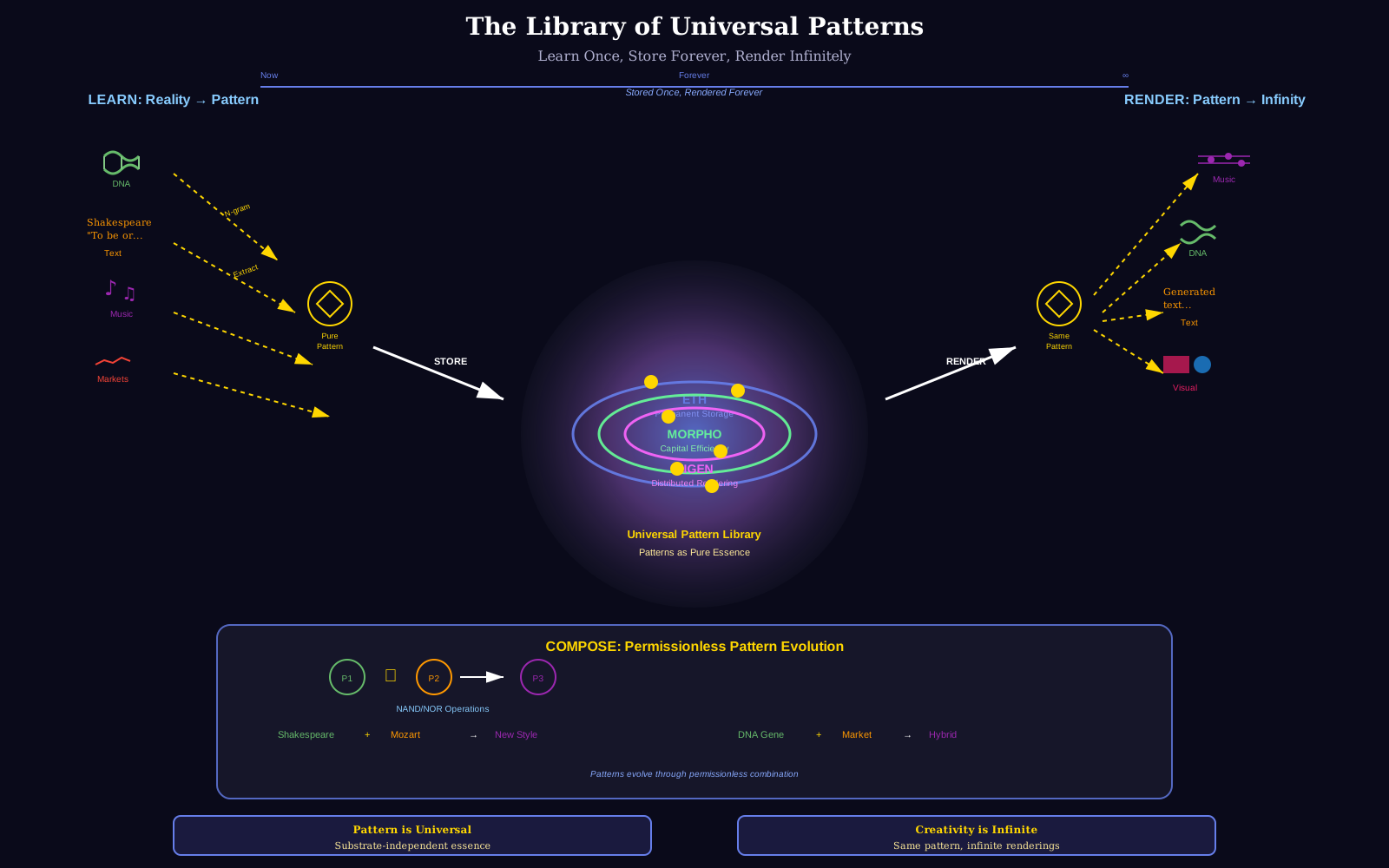
The Library of Universal Patterns: Pure Composable Symbols Backed by ETH
The Recognition: Any data contains patterns. N-gram learning extracts substrate-independent essence. Patterns stored as pure on-chain symbols—combinations of previous patterns via NAND/NOR operations. Backed by ETH collateral in Morpho (earning yield). Eigen AVS interprets meaning and renders infinitely: music, DNA, text, visuals, protocols. Everything reduces to ETH → Morpho symbols → Eigen signification. Learn once, store forever, render infinitely. The Library of Universal Patterns.
The Core Architecture
Everything reduces to three layers:
ETH: Base collateral
- Patterns backed by ETH deposits
- Economic security through cryptographic consensus
- Permanent, immutable, censorship-resistant
Morpho: Symbol substrate
- ETH → Morpho market → Earns yield
- Patterns as Morpho symbols (backed by ETH)
- Liquid staking tokens derive from Morpho symbols
- Capital efficiency: ETH works while stored
Eigen: Signification layer
- AVS operators interpret pattern meaning
- Render patterns in any format
- Distributed computation, no central authority
- Pattern meaning emerges from economic consensus
Result: Pure composable symbols with infinite creative potential.
What Is A Pattern?
Pattern = Combination of previous patterns
Not stored data. Not IPFS hashes. Just:
parentPatterns[]: Which patterns combineoperation: How they combine (NAND/NOR)ethCollateral: Economic backing
Examples:
Pattern A = Atomic pattern (learned from data)
Pattern B = Atomic pattern (learned from data)
Pattern C = A ⊕ B (via NAND operation)
Pattern D = C ⊕ B (via NOR operation)
Pattern E = D ⊕ A (composition continues)
Everything is composable. Every pattern built from previous patterns. All the way down to atomic patterns learned from reality. Pure symbolic recursion backed by ETH.
How Patterns Get Stored
1. Learn pattern from data (off-chain):
Data → N-gram model → Pattern structure
Shakespeare's text → Statistical essence → Pattern
2. Store as on-chain symbol:
function storePattern(
    bytes32[] parentPatterns,  // What combines
    bytes operation,            // How it combines
    uint256 ethAmount          // Economic backing
) external payable returns (bytes32 patternId)
3. ETH flows to Morpho:
- User deposits ETH
- Contract supplies to Morpho market
- ETH earns yield (3-4% APY)
- Pattern backed by productive capital
4. Pattern = pure symbol:
- On-chain: parentPatterns + operation
- No external storage (no IPFS)
- Meaning determined by Eigen AVS
- Accessible forever
How Patterns Get Rendered
Query pattern for any format:
function queryPattern(
    bytes32 patternId,
    string targetFormat  // "music", "DNA", "text", etc.
) external payable returns (bytes rendered)
Eigen AVS interprets:
- Reads pattern composition (parentPatterns + operation)
- Recursively interprets what it means
- Renders in target format
- Returns transformed data
Payment split:
- 30% → Morpho market (increases yield)
- 60% → Eigen operators (computation)
- 10% → Pattern creator (incentive)
Result: Same pattern, infinite renderings. Meaning determined by distributed operators, not centralized authority.
The Complete Flow
Reality → Learning → Storage → Signification → Rendering

Data (Shakespeare)
  ↓
N-gram extraction (off-chain)
  ↓
Pattern structure (frequencies, transitions)
  ↓
Store on-chain (parentPatterns + operation + ETH)
  ↓
ETH → Morpho market (earns yield)
  ↓
Query pattern + target format
  ↓
Eigen AVS interprets composition
  ↓
Render as music / DNA / text / visuals / protocols
  ↓
Infinite creativity from finite symbols
Elegance: Everything on-chain. Everything composable. Everything backed by ETH. Signification by Eigen. No external dependencies.
Example: Shakespeare Pattern
Learning (off-chain):
Shakespeare's complete works
  ↓
N-gram analysis
  ↓
P("the") = 0.07
P("to be"|context) = 0.4
P("or not"|"to be") = high
Style: iambic, metaphorical, formal
Storing (on-chain):
// First time: atomic pattern
bytes32 shakespeareId = storePattern(
    [],                    // No parents (atomic)
    encodeStatistics(...), // Pattern essence
    0.1 ether              // ETH backing
);

// Later: composable patterns
bytes32 hybridId = storePattern(
    [shakespeareId, mozartId],  // Combine both
    NAND_operation,              // How to combine
    0.05 ether                   // Partial backing
);
Rendering (via Eigen):
// Render as music
bytes music = queryPattern(shakespeareId, "music");
// Eigen AVS interprets statistical structure
// Maps to musical parameters
// Returns: "Shakespearean symphony"

// Render as DNA
bytes dna = queryPattern(shakespeareId, "DNA");
// Eigen AVS maps patterns to genetic sequences
// Returns: DNA with "Shakespearean" structure

// Render as text
bytes text = queryPattern(shakespeareId, "text");
// Eigen AVS generates new text
// Returns: Writing in Shakespeare's style
Key: Pattern stored once. Rendered infinitely. Meaning by Eigen operators.
The Economic Model
Storage (deposit ETH):
Pattern backed by ETH collateral
- User deposits ETH to contract
- Contract supplies to Morpho market
- ETH earns 3-4% APY
- Pattern accessible forever
- Creator can withdraw yield anytime

Example:
- Deposit 0.1 ETH
- Earns 0.003 ETH/year passively
- Pattern permanent on-chain
- Collateral backs queries
Queries (pay for rendering):
Query: patternId + targetFormat + payment

Payment split:
- 30% to Morpho (increases yield pool)
- 60% to Eigen operators (computation)
- 10% to pattern creator (quality incentive)

Economics:
- Popular patterns: more queries → more fees
- Niche patterns: still earn Morpho yield
- All patterns guaranteed positive return
- Self-sustaining through capital efficiency
Composition (create new patterns):
Compose existing patterns via NAND/NOR
- New pattern inherits properties
- Backed by new ETH collateral
- Parent creators earn from derivative
- Permissionless innovation
- Library grows recursively
Example economics:
Shakespeare pattern:
- Deposit: 0.1 ETH
- Morpho yield: 3% APY = 0.003 ETH/year
- If 1000 queries at 0.001 ETH each:
  - Creator earns: 100 ETH/year (10% of queries)
  - Plus Morpho: 0.003 ETH/year
  - Total: 100.003 ETH/year on 0.1 ETH
  - 100,003% APY for popular pattern!

Niche pattern:
- Deposit: 0.1 ETH
- Morpho yield: 0.003 ETH/year
- Few queries: 0.01 ETH/year
- Total: 0.013 ETH/year
- 13% APY minimum
Why This Architecture Works
Pure composability:
- Every pattern = combination of patterns
- Infinite composition via NAND/NOR
- No theoretical limit to complexity
- Recursive creativity
ETH backing:
- Economic security through collateral
- Capital efficiency (earns while stored)
- Self-sustaining (yield covers storage)
- Permissionless (anyone can deposit)
Morpho efficiency:
- Optimal peer-to-peer markets
- ETH earns yield while pattern accessible
- Query fees increase yield pool
- Capital works, not idle
Eigen signification:
- Distributed interpretation (no authority)
- Economic consensus on meaning
- Operators slashable if wrong
- Permissionless rendering services
No external dependencies:
- No IPFS (pure on-chain)
- No oracles (self-contained)
- No centralized servers
- Just ETH + Morpho + Eigen
Implementation
contract PatternLibrary {
    IMorpho public immutable morpho;
    address public immutable morphoMarket;

    struct Pattern {
        bytes32[] parentPatterns;  // Composed from these
        bytes operation;           // NAND/NOR operations
        uint256 ethCollateral;     // ETH backing in Morpho
        address creator;           // Who stored it
        uint256 timestamp;         // When stored
    }

    mapping(bytes32 => Pattern) public patterns;

    // Store new pattern
    function storePattern(
        bytes32[] calldata parentPatterns,
        bytes calldata operation,
        uint256 ethAmount
    ) external payable returns (bytes32 patternId) {
        require(msg.value >= ethAmount, "Insufficient ETH");

        // Supply ETH to Morpho (starts earning yield)
        morpho.supply{value: ethAmount}(morphoMarket, ethAmount, address(this), "");

        // Pattern ID from composition
        patternId = keccak256(abi.encode(
            parentPatterns,
            operation,
            msg.sender,
            block.timestamp
        ));

        // Store as pure on-chain symbol
        patterns[patternId] = Pattern({
            parentPatterns: parentPatterns,
            operation: operation,
            ethCollateral: ethAmount,
            creator: msg.sender,
            timestamp: block.timestamp
        });

        emit PatternStored(patternId, msg.sender, ethAmount);
    }

    // Query pattern for rendering
    function queryPattern(
        bytes32 patternId,
        string calldata targetFormat
    ) external payable returns (bytes memory) {
        Pattern storage pattern = patterns[patternId];
        require(pattern.timestamp > 0, "Pattern not found");

        // Split payment
        uint256 morphoShare = msg.value * 30 / 100;
        uint256 eigenShare = msg.value * 60 / 100;
        uint256 creatorShare = msg.value * 10 / 100;

        // Increase Morpho yield pool
        morpho.supply{value: morphoShare}(morphoMarket, morphoShare, address(this), "");

        // Pay pattern creator
        payable(pattern.creator).transfer(creatorShare);

        // Query Eigen AVS for signification & rendering
        // AVS recursively interprets parentPatterns + operation
        // AVS renders in targetFormat
        // Returns transformed output

        emit PatternQueried(patternId, targetFormat, msg.sender);
    }

    // Compose patterns
    function composePatterns(
        bytes32 pattern1,
        bytes32 pattern2,
        bytes calldata operation
    ) external payable returns (bytes32 newPatternId) {
        bytes32[] memory parents = new bytes32[](2);
        parents[0] = pattern1;
        parents[1] = pattern2;

        return storePattern(parents, operation, msg.value);
    }

    // Withdraw accumulated yield
    function withdrawYield(bytes32 patternId) external {
        Pattern storage pattern = patterns[patternId];
        require(msg.sender == pattern.creator, "Not creator");

        // Withdraw yield from Morpho
        uint256 yield = morpho.withdraw(
            morphoMarket,
            type(uint256).max,  // Max available
            msg.sender,
            address(this)
        );

        emit YieldWithdrawn(patternId, msg.sender, yield);
    }
}
That’s it. ~100 lines. Pure composable symbols. ETH-backed. Morpho-efficient. Eigen-interpreted.
What This Enables
Universal pattern library:
- Store any learned pattern
- Backed by ETH collateral
- Accessible forever
- Render infinitely
Composable creativity:
- Combine any patterns
- NAND/NOR operations
- New patterns from old
- Recursive innovation
Economic alignment:
- Quality patterns earn more
- All patterns earn minimum (Morpho yield)
- Creators incentivized
- Operators compensated
- Library self-sustaining
Distributed signification:
- No central authority determines meaning
- Eigen operators interpret via economic consensus
- Slashable if wrong
- Permissionless participation
Capital efficiency:
- ETH earns yield while stored
- Query fees increase yield pool
- Popular patterns earn significantly more
- Money works, not idle
The Vision
Today: Patterns scattered, ephemeral, locked
- Data dies with creators
- No composability
- Creativity gated by access
Tomorrow: Universal pattern library
- All patterns on-chain (permanent)
- Pure composability (NAND/NOR)
- Economic backing (ETH)
- Distributed interpretation (Eigen)
- Infinite creativity (rendering)
Growth trajectory:
- Day 1: First atomic patterns
- Week 1: Compositions emerge
- Month 1: Libraries form
- Year 1: Universal substrate
- Forever: Infinite patterns
What becomes possible:
- Query Shakespeare → rendered as music
- Query Mozart → rendered as DNA
- Compose both → new hybrid pattern
- Render anywhere → infinite creativity
- All permissionless, all on-chain, all backed by ETH
The Elegance
ETH: Base economic security Morpho: Capital efficiency layer Eigen: Signification layer Patterns: Pure composable symbols
No IPFS. No external storage. No central authority.
Just:
- Combinations of previous patterns
- Backed by ETH in Morpho
- Interpreted by Eigen AVS
- Rendered infinitely
Everything reduces to ETH + combinations + distributed interpretation.
The Library of Universal Patterns: Learn once, store forever, render infinitely. 📚🌀
Related: neg-538 (data to music), neg-536 (super quantum networks), neg-522 (EGI endpoint), neg-519 (Morpho economic substrate), current-reality (implementation)