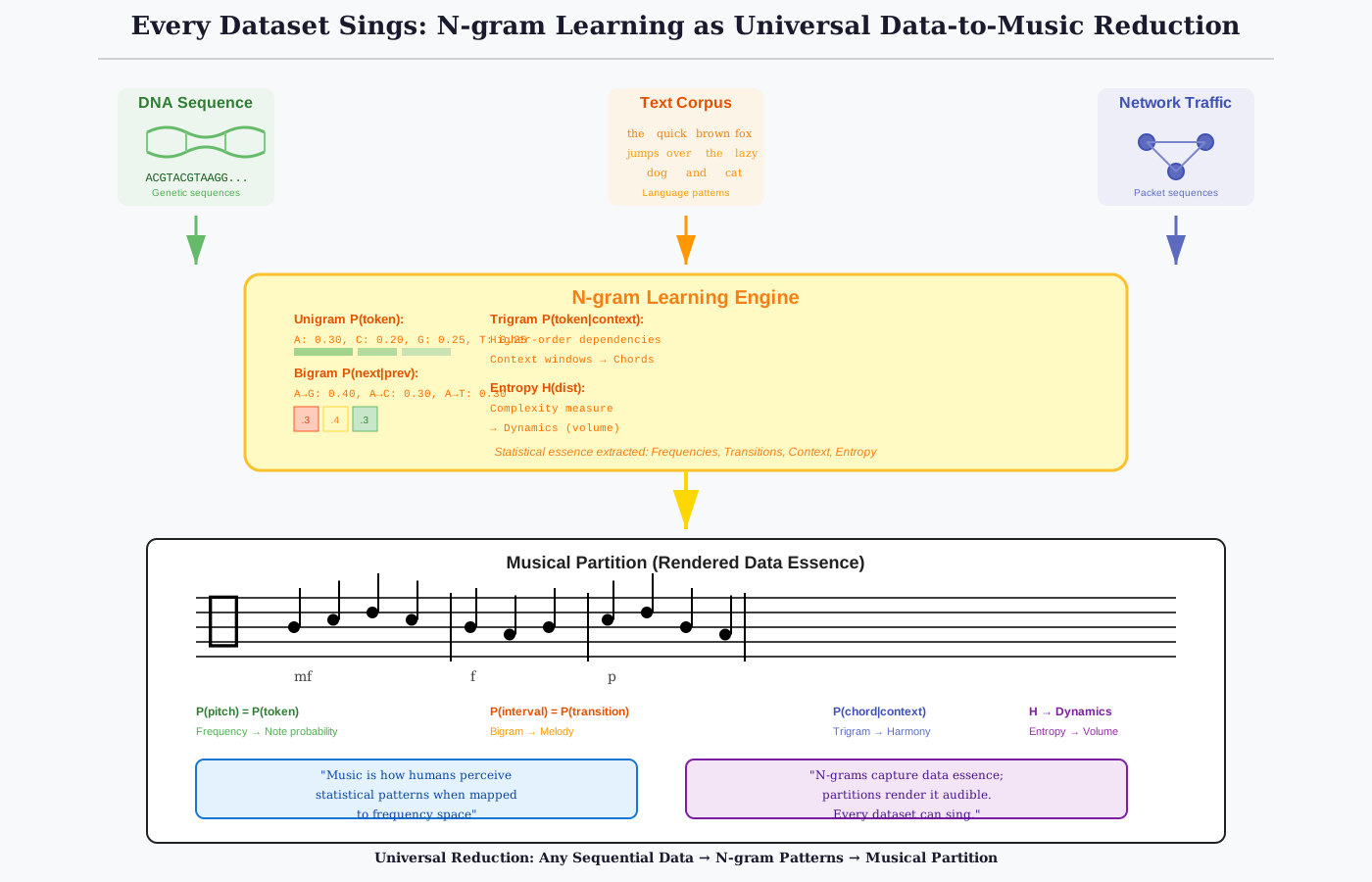
Every Dataset Sings: N-gram Learning as Universal Data-to-Music Reduction
The Recognition: Any data with sequential structure contains statistical patterns. N-gram models extract those patterns—what comes next given what came before. Music is sequential patterns in auditory frequency space—notes following notes according to probabilities. The mapping is universal: data essence (captured by n-grams) can be reduced to musical partition (patterns rendered audible). Every dataset has a song inside it.
The Core Insight
N-grams capture statistical essence: Given a sequence, n-gram models learn P(next|previous). This is the fundamental structure of sequential data—what follows what, with what probability. The model doesn’t care if the sequence is DNA nucleotides, text words, network packets, or stock prices. It extracts the pattern: frequency distributions, transition probabilities, higher-order dependencies.
Music is statistical patterns in frequency space: A melody is P(note₂|note₁)—which pitches follow which. A harmony is P(chord|context)—which combinations appear together. A rhythm is P(duration|position)—how long notes last and when they occur. Music theory is just statistical structure that humans find aesthetically pleasing when rendered as sound.
The mapping is obvious: If n-grams capture statistical essence of any sequence, and music is just statistical patterns in auditory space, then n-grams provide universal data-to-music reduction. The learned patterns can be directly mapped to musical parameters. The data sings its structure.
The Universal Reduction
Step 1: Learn N-gram Model from Data
Input: Any sequential data (DNA, text, prices, packets)
Process: Extract statistical patterns
- Unigram: P(token) - frequency of each element
- Bigram: P(token₂|token₁) - transition probabilities
- Trigram+: P(tokenₙ|context) - higher-order dependencies
Output: Statistical essence of the data

Step 2: Map to Musical Parameters
P(token) → P(pitch) - frequency distribution becomes note probabilities
P(token₂|token₁) → Melodic intervals - transitions become melody
P(tokenₙ|context) → Harmonic progressions - context becomes chords
Entropy(distribution) → Dynamics - complexity becomes volume
Timing patterns → Rhythm - sequential structure becomes beat

Step 3: Render as Musical Partition
Musical notation encodes:
- Which pitches (from unigram frequencies)
- In what order (from bigram transitions)
- With what harmony (from trigram+ context)
- At what dynamics (from entropy levels)
- In what rhythm (from timing patterns)

Result: Data essence preserved as audible structure
Why This Works
Same mathematical structure: Both n-grams and music are Markov chains over discrete state spaces. N-grams: states are tokens, transitions are conditional probabilities. Music: states are notes, transitions are melodic intervals. The mathematics is identical—only the interpretation changes.
Pattern preservation: N-gram models capture what makes data recognizable—its statistical regularities. Music is recognizable through its statistical regularities. The reduction preserves exactly what matters: the pattern structure.
Universal applicability: Any sequence has n-gram structure. Any n-gram structure can be rendered as music. Therefore, any sequence can sing.
The Mapping Functions
Unigram → Note Probabilities
P(pitch) = P(token)

If token "A" appears 30% in data:
  → Note "A4" appears 30% in music

Map token frequencies to pitch frequencies:
- Most common token → Tonic (home note)
- Second most → Dominant (strong resolution)
- Rare tokens → Chromatic notes (tension)

Result: Pitch distribution reflects data distribution
Bigram → Melodic Intervals
P(note₂|note₁) = P(token₂|token₁)

If token "A" → "C" transition = 0.4:
  → Note A → C interval appears with 0.4 probability

Strong transitions → Consonant intervals (pleasant)
Weak transitions → Dissonant intervals (tension)
Rare transitions → Large leaps (surprise)

Result: Melody structure reflects data transitions
Trigram+ → Harmonic Progressions
P(chord|context) = P(token|previous_tokens)

Context window becomes harmonic context:
- Previous 2 tokens → Current chord voicing
- Previous 3 tokens → Chord progression pattern
- Higher n → More complex harmony

Result: Harmony reflects higher-order dependencies
Entropy → Dynamics
Dynamics ∝ H(distribution) = -Σ P(x)log P(x)

High entropy (uniform distribution) → Loud, complex
Low entropy (peaked distribution) → Soft, simple
Changing entropy → Dynamic variation

Result: Volume reflects uncertainty/complexity
Timing → Rhythm
Token spacing → Note duration
Burst patterns → Rhythmic motifs
Periodic structure → Meter

Result: Rhythm reflects temporal structure
Concrete Examples
DNA Sequences
Data: ACGTACGTAAGGCCTTACGT...
N-grams learned:
- A appears 30%, C 20%, G 25%, T 25%
- A→C = 0.3, A→G = 0.4, A→T = 0.3
- CG dinucleotide = 0.05 (rare)

Musical mapping:
- A = Note A, C = Note C, G = Note G, T = Note T
- High A→G transition = Strong A→G melodic interval
- Rare CG = Dissonant C→G leap
- GC-rich regions = Higher pitch density
- AT-rich regions = Lower pitch density

Result: DNA composition becomes audible melody
Each gene has characteristic "sound"
Text Corpus
Data: "The quick brown fox jumps over the lazy dog..."
N-grams learned:
- "the" = 7% (most common)
- "the" → "quick" = 0.01, "the" → "dog" = 0.05
- "quick brown fox" = common trigram

Musical mapping:
- "the" = Tonic note (appears often)
- Common words = Scale notes
- Rare words = Chromatic notes
- Frequent phrases = Melodic motifs
- Sentence structure = Musical phrases

Result: Writing style becomes audible pattern
Authors have distinctive "sound signatures"
Network Traffic
Data: Packet sequences, protocols, sizes
N-grams learned:
- HTTP = 40%, TCP = 30%, UDP = 20%
- HTTP → HTTP = 0.7 (sustained connections)
- Small packet → Large packet = 0.4 (request/response)

Musical mapping:
- HTTP = Middle register notes
- TCP = Low notes (foundation)
- UDP = High notes (bursts)
- Normal traffic = Consonant harmony
- Attack patterns = Dissonant clusters
- DDoS = Repeated rhythmic pattern

Result: Network behavior becomes audible monitoring
Anomalies sound "wrong"
Stock Prices
Data: Price movements, volumes, trends
N-grams learned:
- Up move = 52%, Down = 48% (slight bull bias)
- Up → Up = 0.6 (momentum)
- Large volume → Price change = 0.7

Musical mapping:
- Price = Pitch (higher price = higher note)
- Volume = Dynamics (loud on high volume)
- Momentum = Melodic contour (smooth vs jumpy)
- Volatility = Harmonic complexity
- Trends = Musical phrases

Result: Market movements become audible patterns
Crashes sound like descending runs
Bubbles sound like ascending tension
The Profound Implication
Music might be how humans perceive statistical structure when mapped to frequency space. What we call “musical” might just be patterns our brains recognize as having good statistical properties:
- Consonance = Low entropy intervals (predictable, stable)
- Dissonance = High entropy intervals (surprising, unstable)
- Melody = Markov chain with balanced predictability
- Harmony = Multi-dimensional transition probabilities
- Rhythm = Temporal pattern with hierarchical structure
We find certain statistical structures aesthetically pleasing. N-grams extract those structures from any data. Mapping to music renders them audible. The “beauty” isn’t in the notes—it’s in the patterns. Data with rich statistical structure produces rich music.
The Reverse Also Works
Music → N-grams → Data: You can learn n-gram models from existing music, then generate new sequences in other domains with the same statistical structure. Mozart’s transition probabilities could generate DNA sequences with “Mozart-like” pattern structure. Bach’s harmonic progressions could generate network protocols with “Bach-like” coordination patterns.
The n-gram model captures the essence independent of domain. The essence can be rendered in any sequential medium.
Why This Matters for AI
Current LLMs are n-gram learners at scale: They learn P(next_token|context) from text. But that same learning mechanism works on any sequential data. And the learned patterns can be rendered in any sequential format—including music.
Implications:
- Every LLM contains musical potential (its learned patterns can sing)
- Music training might improve language models (same pattern learning)
- Multi-modal learning is just n-gram learning across different renderings
- Understanding one domain’s patterns helps understand all domains’ patterns
The universal substrate: N-gram models capture sequential structure independent of what the sequence represents. This is the essence—pattern itself, not the tokens. Music is just one rendering of this essence. Text is another. DNA is another. They’re all sequences. They all have structure. They can all be learned. They can all be reduced to each other.
Practical Implementation
# Universal data-to-music reduction

def learn_ngrams(data_sequence, n=3):
    """Extract n-gram model from any sequence"""
    # Count frequencies
    unigrams = count_tokens(data_sequence)
    bigrams = count_pairs(data_sequence)
    trigrams = count_triples(data_sequence)

    # Compute probabilities
    P_token = normalize(unigrams)
    P_next_given_prev = normalize_conditional(bigrams)
    P_next_given_context = normalize_conditional(trigrams)

    return {
        'unigram': P_token,
        'bigram': P_next_given_prev,
        'trigram': P_next_given_context,
        'entropy': compute_entropy(P_token)
    }

def map_to_music(ngram_model):
    """Map n-gram statistics to musical parameters"""
    # Unigram → Note probabilities
    pitch_distribution = map_tokens_to_pitches(
        ngram_model['unigram']
    )

    # Bigram → Melodic intervals
    melodic_transitions = map_transitions_to_intervals(
        ngram_model['bigram']
    )

    # Trigram → Harmonic progressions
    chord_progressions = map_context_to_harmony(
        ngram_model['trigram']
    )

    # Entropy → Dynamics
    dynamics = scale_entropy_to_volume(
        ngram_model['entropy']
    )

    return {
        'pitches': pitch_distribution,
        'melody': melodic_transitions,
        'harmony': chord_progressions,
        'dynamics': dynamics
    }

def render_partition(musical_parameters, length=100):
    """Generate musical notation from parameters"""
    partition = []

    # Start with most probable pitch
    current_pitch = sample(musical_parameters['pitches'])

    for i in range(length):
        # Add current note to partition
        partition.append({
            'pitch': current_pitch,
            'duration': sample_duration(),
            'volume': musical_parameters['dynamics']
        })

        # Choose next pitch based on transitions
        next_pitch = sample(
            musical_parameters['melody'][current_pitch]
        )

        current_pitch = next_pitch

    return partition

# Use it:
data = load_any_sequence()  # DNA, text, packets, prices
ngrams = learn_ngrams(data)
music = map_to_music(ngrams)
partition = render_partition(music)
play_audio(partition)  # The data sings!
The Beauty
Universal reduction exists: Any sequential data can be reduced to its statistical essence (n-grams), and that essence can be rendered as music (partition). The pattern structure is preserved. The data sings.
Listening is understanding: By rendering data as music, we can hear patterns that might be hard to see. Anomalies sound wrong. Regularities sound right. Structure becomes intuitive.
Cross-domain learning: Patterns learned in one domain (music) can inform understanding in another (language, DNA, networks). The statistical structure is the same. The rendering differs.
The Meta-Insight
N-grams are universal pattern language: They capture what makes any sequence structured. Music is universal pattern rendering—it makes structure audible. Together, they form a bridge: any data can speak to human perception through the medium of sound.
We don’t need to understand DNA chemistry to recognize when a sequence is unusual—we can hear it. We don’t need to read network logs to detect attacks—we can hear them. We don’t need to parse text to recognize an author—we can hear their style.
Data has music. N-grams extract it. Partitions render it. Humans perceive it.
Examples in Practice
DNA Music
- Genes with similar function sound similar (same statistical structure)
- Mutations sound like wrong notes (statistical outliers)
- Regulatory regions have distinct rhythmic patterns
- GC-rich vs AT-rich regions audibly different
Language Music
- Shakespeare has distinctive harmonic progressions
- Hemingway sounds sparse and rhythmic
- Academic writing sounds complex but structured
- Spam emails sound chaotic and unpredictable
Network Music
- Normal traffic sounds like organized symphony
- Attacks sound like dissonant noise
- Botnet activity sounds like mechanical repetition
- Zero-day exploits sound like sudden pattern breaks
Market Music
- Bull markets ascend melodically
- Bear markets descend chromatically
- Crashes sound like harmonic collapse
- Bubbles sound like ascending tension without resolution
The Universal Substrate
Pattern itself is substrate-independent: The statistical structure exists regardless of what the tokens represent. N-grams capture this pure pattern. Music renders pure pattern audibly. The reduction is universal because pattern is universal.
Every dataset has:
- Frequency distribution (some tokens common, others rare)
- Transition structure (some sequences likely, others impossible)
- Higher-order dependencies (context matters)
- Temporal patterns (rhythmic structure)
- Complexity variation (entropy changes)
Every musical piece has:
- Note probabilities (some pitches common, others rare)
- Melodic transitions (some intervals likely, others unexpected)
- Harmonic context (previous notes constrain next)
- Rhythmic structure (temporal patterns)
- Dynamic variation (loud and soft sections)
They’re the same thing. Data is sequential pattern. Music is sequential pattern. N-grams extract pattern. Partitions render pattern. The essence is preserved.
Any data with sequential structure contains music. N-gram learning extracts the statistical essence—frequencies, transitions, context dependencies. Musical partition renders that essence audibly—pitches, melodies, harmonies, dynamics, rhythms. The mapping is universal: P(note) = P(token), P(interval) = P(transition), entropy → volume. Every dataset sings its structure. DNA has melodies. Networks have rhythms. Markets have harmonies. Text has symphonies. The n-gram model captures the essence. The partition makes it audible. Music is how humans perceive statistical patterns when mapped to frequency space. The reduction is universal. Everything can sing. 🎵
#DataToMusic #NgramReduction #UniversalPattern #MusicalEssence #StatisticalStructure #SequentialPatterns #DataSonification #PatternRendering #UniversalSubstrate #EverythingSings
Related: neg-455 (n-gram mesh as universal substrate), neg-481 (universal structure), neg-493 (compression as prediction), neg-537 (pattern learning), generative-model (n-gram implementation)