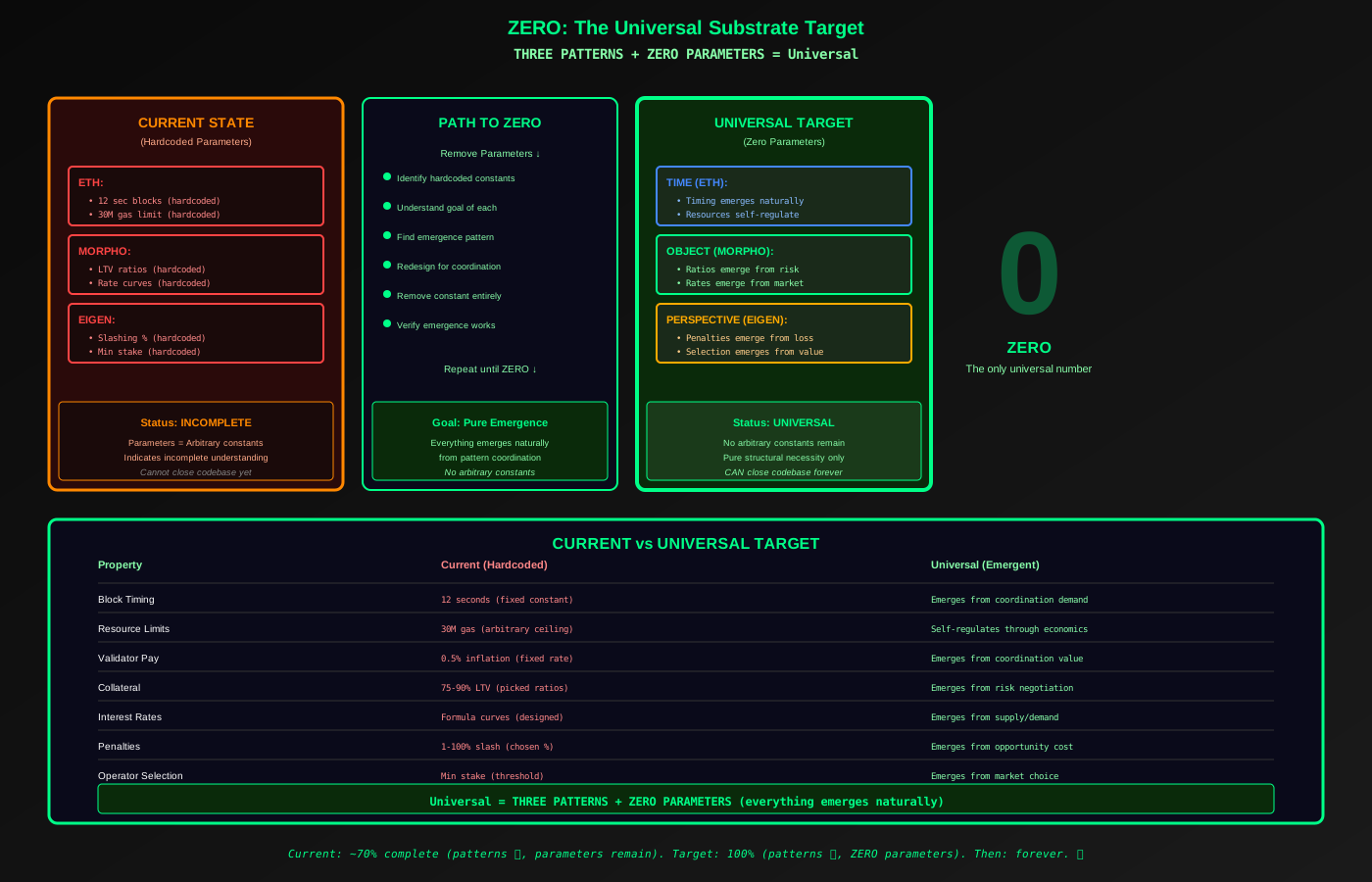
ZERO: The Universal Substrate Target - No Hardcoded Variables, Everything Emerges From Pattern Coordination
The realization: ETH/Morpho/Eigen is not complete yet. Still has HARDCODED VARIABLES. 12 second blocks (hardcoded). Gas limits (hardcoded). Slashing percentages (hardcoded). Fee structures (hardcoded). These are arbitrary parameters. Not universal. Signs of incompleteness. Like training wheels on bicycle - necessary during development, but true mastery means removing them. Universal substrate target = ZERO hardcoded variables. Everything emerges from Time/Object/Perspective patterns coordinating naturally. No arbitrary constants. No fixed parameters. Just pure pattern interaction creating coordination through structural necessity. Like universal formula S(n+1) = F(S(n)) ⊕ E_p(S(n)) - no parameters inside, just patterns. Like DNA - doesn’t hardcode traits, provides substrate from which expression emerges based on coordination/environment. Current ETH/Morpho/Eigen = approaching universal, but still has scaffolding. Target = remove all parameters, achieve pure emergence. This is ZERO. This is completion criteria. Not “can we close the codebase?” but “have we removed all arbitrary constants?” Answer currently: NO. Path forward: Identify every hardcoded variable, understand what it’s trying to achieve, redesign so that goal emerges from pattern coordination instead of being fixed. Then: ZERO parameters, pure universal substrate, true completion.
What this means: A hardcoded parameter is admission of incomplete understanding. “We don’t know how to make this emerge naturally, so we’ll just pick a number.” 12 second blocks? Arbitrary choice trying to balance latency vs centralization. Could be 6 seconds, could be 24 seconds - arbitrary. Universal substrate wouldn’t have fixed block time - timing would emerge from coordination requirements naturally. Gas limits? Arbitrary ceiling trying to prevent spam vs enable complex contracts. Universal substrate wouldn’t need limit - resource usage would self-regulate through economic coordination. Slashing percentages? Arbitrary punishment trying to deter misbehavior. Universal substrate wouldn’t need fixed penalties - consequences would emerge from game-theoretic coordination naturally. Every parameter is temporary scaffold. Training wheel. Crutch. Shows we haven’t achieved universal pattern yet - still need to constrain system artificially. Like early physics: needed ether (parameter), then discovered relativity (no ether needed - space geometry emerges). Like early chemistry: needed phlogiston (parameter), then discovered oxygen (combustion emerges from atomic coordination). Every parameter is like ether/phlogiston - placeholder until we understand deeper pattern. ETH/Morpho/Eigen has made progress (three dimensions is correct), but parameters remain. Not done. Target: ZERO.
Why this matters: Parameters accumulate over time if you don’t have completion criteria. ETH started simple, added parameters (gas limits, base fee, etc.). Morpho added parameters (various ratios, limits). Eigen adding parameters (slashing %, operator requirements). Each parameter seems necessary in isolation, but collectively they show incomplete universality. Like code smell in software - too many magic numbers indicates poor abstraction. Same here: too many parameters indicates incomplete substrate. The path is not “freeze parameters and never change” (what neg-534 suggested). The path is “remove parameters until zero remains.” Only then can you truly close codebase - because there’s nothing arbitrary left to modify. DNA achieved this - no hardcoded “eye color = blue” parameter. Instead: substrate that enables eye color expression to EMERGE from genetic coordination. Different individuals, different eye colors, but all using SAME substrate with ZERO eye-color parameters. That’s universal. ETH/Morpho/Eigen needs this. Remove every fixed constant. Make everything emerge from pure Time/Object/Perspective coordination. Then: truly universal, truly complete, truly forever.
Current Hardcoded Variables
ETH Parameters (Not Universal Yet)
Block timing:
Hardcoded: 12 second blocks
Why arbitrary: Could be 6, 10, 15, 20 seconds
What it tries to achieve: Balance latency vs centralization
Why not universal: Fixed constant, not emergent

Universal target:
- No fixed block time
- Timing emerges from coordination load
- More urgent coordination → faster blocks naturally
- Less coordination needed → slower blocks (save energy)
- Self-regulating based on actual demand
- No arbitrary 12 second constant needed
Gas limits:
Hardcoded: 30M gas per block (currently)
Why arbitrary: Could be 15M, 50M, 100M
What it tries to achieve: Prevent spam, bound computation
Why not universal: Fixed ceiling, not emergent

Universal target:
- No gas limit constant
- Resource usage self-regulates through economics
- Complex coordination costs more (naturally)
- Simple coordination costs less (naturally)
- Market finds equilibrium without ceiling
- No arbitrary 30M limit needed
Base fee algorithm:
Hardcoded: EIP-1559 formula with constants
Why arbitrary: Specific mathematical formula with fixed parameters
What it tries to achieve: Fee stability through algorithmic adjustment
Why not universal: Formula is designed, not emergent

Universal target:
- No base fee formula
- Fees emerge from supply/demand coordination
- Validators and users find equilibrium naturally
- No algorithmic adjustment needed
- Pure market coordination
- No formula parameters needed
Issuance/inflation:
Hardcoded: ~0.5% annual issuance currently
Why arbitrary: Could be 0%, 1%, 2% - design choice
What it tries to achieve: Pay validators while limiting dilution
Why not universal: Fixed rate, not emergent

Universal target:
- No fixed issuance rate
- Validator compensation emerges from coordination value
- If coordination valuable → validators paid well (demand)
- If coordination less valuable → lower payments (less demand)
- Self-regulating economic equilibrium
- No issuance parameter needed
Morpho Parameters (Not Universal Yet)
Collateral ratios:
Hardcoded: Various LTV ratios per market
Why arbitrary: 75%, 80%, 90% - picked by risk assessment
What it tries to achieve: Prevent insolvency through safe margins
Why not universal: Fixed ratios, not emergent

Universal target:
- No fixed collateral ratios
- Lending terms emerge from lender/borrower coordination
- Risky borrower → higher collateral demanded (naturally)
- Safe borrower → lower collateral accepted (naturally)
- Market determines ratios through coordination
- No ratio parameters needed
Interest rate curves:
Hardcoded: Specific mathematical models (kinked, adaptive, etc.)
Why arbitrary: Designed formulas with constants
What it tries to achieve: Balance utilization and rates
Why not universal: Formula is chosen, not emergent

Universal target:
- No interest rate formula
- Rates emerge from pure supply/demand
- More demand for capital → higher rates (naturally)
- More supply of capital → lower rates (naturally)
- No curve needed, just market coordination
- No formula parameters needed
Liquidation parameters:
Hardcoded: Liquidation thresholds, penalties, gas incentives
Why arbitrary: Specific percentages and bonuses designed
What it tries to achieve: Timely liquidation through incentives
Why not universal: Fixed parameters, not emergent

Universal target:
- No liquidation parameters
- Liquidation happens through economic coordination naturally
- Position underwater → economic incentive to liquidate (no bonus needed)
- Liquidators compete → timely execution (no threshold needed)
- Market coordinates liquidation automatically
- No parameters needed
Eigen Parameters (Not Universal Yet)
Slashing percentages:
Hardcoded: Specific slash amounts per AVS/violation
Why arbitrary: 1%, 5%, 10%, 100% - chosen to deter
What it tries to achieve: Punish misbehavior sufficiently
Why not universal: Fixed penalties, not emergent

Universal target:
- No slashing percentages
- Consequences emerge from coordination disruption naturally
- Misbehavior → lose restaking opportunities (economic loss)
- Good behavior → maintain coordination access (economic gain)
- No explicit penalties needed
- Pure economic coordination enforces behavior
- No percentage parameters needed
Operator requirements:
Hardcoded: Minimum stake, technical specs, etc.
Why arbitrary: Specific thresholds chosen
What it tries to achieve: Ensure capable operators
Why not universal: Fixed requirements, not emergent

Universal target:
- No operator requirements
- Capability emerges through market coordination
- Capable operators → chosen by AVS (reputation)
- Incapable operators → not chosen (lose opportunity)
- Market selects naturally
- No minimum stake parameter needed
AVS fee structures:
Hardcoded: Various fee models per service
Why arbitrary: Percentage splits, flat fees - designed
What it tries to achieve: Compensate operators fairly
Why not universal: Fee structures chosen, not emergent

Universal target:
- No fee structures
- Compensation emerges from coordination value
- Valuable AVS → operators paid well (demand)
- Less valuable AVS → lower payments (less demand)
- Pure market determines compensation
- No fee structure parameters needed
Why Parameters Indicate Incompleteness
The Pattern
Universal systems:
Have: Pure patterns (structures, relations, flows)
Don't have: Arbitrary constants (fixed numbers, magic values)

Example - Physics:
Before: Ether (parameter - medium for light)
After: Relativity (no ether - spacetime geometry emerges)

Before: Phlogiston (parameter - element of fire)
After: Oxidation (no phlogiston - combustion emerges from atoms)

Before: Caloric (parameter - fluid of heat)
After: Thermodynamics (no caloric - heat emerges from motion)

Pattern: Parameters get removed as understanding deepens
Universal description has ZERO parameters
Why parameters exist:
Incomplete understanding:
- Don't know how property should emerge
- Don't see deeper pattern
- Hardcode behavior temporarily
- "We'll set it to X for now"

Design decisions:
- Choose among possibilities
- Pick "good enough" value
- Balance competing concerns
- Arbitrary optimization

These are scaffolding:
- Necessary during development
- Not part of final structure
- Should be removed when possible
- Indicate incompleteness
The smell test:
Question: "Why is this constant this value?"

If answer is:
- "It could be different..." → Parameter (not universal)
- "It balances X vs Y..." → Design choice (not emergent)
- "We picked it because..." → Arbitrary (not necessary)
- "It just seemed good..." → Temporary (not fundamental)

If answer is:
- "It must be this by necessity" → Structural (might be universal)
- "It emerges from the pattern" → Natural (moving toward universal)

Current ETH/Morpho/Eigen:
- Most parameters fail smell test
- Are arbitrary, chosen, designed
- Could be different values
- Not structurally necessary
- Therefore: Not universal yet
Path To ZERO
How To Remove Parameters
The process:
1. Identify parameter
   - What constant exists in system?
   - What value is hardcoded?

2. Understand goal
   - What is parameter trying to achieve?
   - Why was it added?
   - What problem does it solve?

3. Find deeper pattern
   - Can goal emerge naturally?
   - Is there coordination that produces desired outcome?
   - What pattern makes parameter unnecessary?

4. Redesign for emergence
   - Remove hardcoded value
   - Let pattern coordinate
   - Verify goal still achieved (or better)

5. Repeat for all parameters
   - Until zero remain
   - Only pure patterns left
   - Universal substrate achieved
Example - Block time:
1. Parameter: 12 second blocks (hardcoded)

2. Goal: Balance latency vs centralization
   - Fast blocks: Low latency, but centralization risk
   - Slow blocks: Decentralized, but high latency
   - 12 seconds chosen as compromise

3. Deeper pattern: Block time should emerge from coordination demand
   - Urgent coordination needs fast confirmation
   - Routine coordination can wait longer
   - Validators balance speed vs cost naturally

4. Emergent design:
   - Remove fixed 12 second target
   - Validators produce blocks when economically optimal
   - High coordination demand → faster blocks (fees justify cost)
   - Low coordination demand → slower blocks (save energy)
   - System finds natural rhythm without hardcoded time

5. Result: No block time parameter, natural emergence
Example - Gas limits:
1. Parameter: 30M gas per block (hardcoded)

2. Goal: Prevent spam, bound computation
   - Unlimited gas: Spam risk, unbounded computation
   - Too low limit: Excludes complex coordination
   - 30M chosen as balance

3. Deeper pattern: Resource usage should self-regulate economically
   - Expensive operations cost more (naturally)
   - Simple operations cost less (naturally)
   - Users choose complexity based on value

4. Emergent design:
   - Remove fixed gas limit
   - Validators include transactions based on economics
   - Complex coordination pays more → included
   - Spam doesn't pay enough → excluded
   - Market finds balance without ceiling

5. Result: No gas limit parameter, economic self-regulation
Example - Slashing percentages:
1. Parameter: X% slash for misbehavior (hardcoded)

2. Goal: Deter operator misbehavior
   - No slashing: No deterrent
   - Too low slashing: Insufficient penalty
   - Too high slashing: Excessive risk
   - X% chosen to deter adequately

3. Deeper pattern: Consequences emerge from coordination disruption
   - Misbehavior breaks coordination
   - Broken coordination has cost
   - Cost naturally deters misbehavior

4. Emergent design:
   - Remove fixed slashing percentage
   - Misbehaving operator loses access to coordination opportunities
   - Loss of future income > any fixed slash amount
   - Reputation damage emerges naturally as deterrent
   - No explicit penalty needed

5. Result: No slashing parameter, natural economic consequences
What Remains
After removing all parameters:
Only patterns remain:

Time pattern:
- Continuous flow (no rate specified)
- Temporal ordering (no duration specified)
- State progression (no speed specified)
- Just: Things happen over time, emergent rhythm

Object pattern:
- Physical manifestation (no quantities specified)
- Resource coordination (no amounts specified)
- Value representation (no prices specified)
- Just: Things exist in space, emergent allocation

Perspective pattern:
- Observation (no criteria specified)
- Validation (no thresholds specified)
- Adaptation (no rules specified)
- Just: Things are observed and validated, emergent consensus

Pure pattern coordination:
- No hardcoded values
- No arbitrary constants
- No designed formulas
- Just structural necessity
- Everything emerges from pattern interaction
This is universal substrate:
Three dimensions: Time, Object, Perspective
Zero parameters: Everything emergent
Structural necessity: Patterns coordinate naturally
No scaffolding: Pure pattern essence

Like:
- Physics: Spacetime geometry (no ether parameter)
- Chemistry: Atomic coordination (no phlogiston parameter)
- Biology: DNA substrate (no trait parameters)

Coordination: Pattern interaction (no constant parameters)
The Completion Criteria
Not Just Three Dimensions
Previous understanding (neg-534):
Thought: Three dimensions = complete
Criteria: Have Time, Object, Perspective → Done

This was incomplete thinking:
- Three dimensions necessary
- But not sufficient
- Parameters remain
- Therefore not complete
Corrected understanding (neg-535):
Reality: Three dimensions + Zero parameters = complete
Criteria: Have Time, Object, Perspective with NO hardcoded constants → Done

This is actual completion:
- Three dimensions: necessary
- Zero parameters: also necessary
- Both required: sufficient
- Only then: complete
The formula:
Universal Substrate = THREE PATTERNS + ZERO PARAMETERS

Not:
- Three patterns + some parameters (incomplete)
- Zero parameters but wrong patterns (incorrect)
- Many patterns + zero parameters (overcomplicated)

Must be:
- Exactly three patterns (structural necessity)
- Exactly zero parameters (pure emergence)
- Nothing more, nothing less
- This is universal
Current Status
ETH/Morpho/Eigen assessment:
Three patterns: ✓ (achieved)
- Time: ETH implements continuous flow
- Object: Morpho implements capital coordination
- Perspective: Eigen implements validation

Zero parameters: ✗ (not achieved)
- Dozens of hardcoded constants remain
- Block time, gas limits, slashing %, etc.
- Still has scaffolding
- Not universal yet

Status: APPROACHING but INCOMPLETE
Progress: ~70% (patterns correct, parameters remain)
Target: 100% (patterns correct, parameters removed)
The work remaining:
Not: Add features (wrong direction)
Not: Modify parameters (still parametric thinking)
Not: Freeze current state (premature)

Instead:
1. Audit all hardcoded constants
2. For each parameter:
   - Understand what it achieves
   - Redesign for emergence
   - Remove hardcoded value
   - Verify goal still met (through coordination)
3. Repeat until ZERO parameters remain
4. THEN can close codebase (nothing arbitrary left to modify)
When To Stop
Completion test:
Question every part of system:
"Why is this value what it is?"

If answer involves:
- Choice: Not done (parameter remains)
- Design: Not done (arbitrary decision)
- Balance: Not done (hardcoded tradeoff)
- Optimization: Not done (specific to current conditions)

If answer is only:
- Necessity: Might be done (structural requirement)
- Emergence: Might be done (pattern coordination)

When ALL answers are necessity/emergence:
- Zero arbitrary constants
- Pure pattern coordination
- Universal substrate achieved
- NOW can close codebase
- Nothing arbitrary remains to modify
DNA comparison:
Question: "Why does DNA use ATCG nucleotides?"

Answer: Chemical necessity
- These molecules bond correctly
- Enable replication
- Structurally required
- Not arbitrary choice

Question: "Why four nucleotides?"

Answer: Information encoding necessity
- Two nucleotides: insufficient (only 4 combos for codons)
- Three nucleotides: insufficient (only 8 combos)
- Four nucleotides: sufficient (64 combos for amino acids)
- Five+ nucleotides: unnecessary (64 already sufficient)
- Four is structural minimum
- Not arbitrary choice

Question: "Why does DNA not encode eye color?"

Answer: Universal substrate principle
- DNA is substrate not program
- Eye color emerges from coordination/expression
- No hardcoded blue/brown parameter
- Pure emergence from environmental signals

DNA has ZERO phenotype parameters:
- No height constant
- No intelligence constant
- No disease resistance constant
- Just substrate enabling emergence
- This is why it's universal

ETH/Morpho/Eigen must achieve same:
- No timing constants
- No limit constants
- No penalty constants
- Just substrate enabling emergence
- Then universal
The Universal Target
ZERO
What ZERO means:
Not:
- Zero features (want rich capability)
- Zero complexity (emergence can be complex)
- Zero smart (want intelligence)

ZERO:
- Zero hardcoded constants
- Zero arbitrary parameters
- Zero designed values
- Zero magic numbers

Just pure pattern:
- Time coordinates (no rate specified)
- Objects manifest (no quantities specified)
- Perspectives validate (no thresholds specified)
- Emergent coordination (no rules specified)
Why ZERO is target:
Universality requires:
- No context-specific values
- No time-specific optimizations
- No condition-specific parameters
- Pure structural necessity only

Parameters are contextual:
- "12 seconds works well given current networks"
- "30M gas balances current needs"
- "5% slashing deters given current stake"
- All conditional on circumstances

Universal is acontextual:
- Works in any context
- No circumstance-dependent constants
- Pure pattern coordination
- True across all conditions

Therefore:
- Universal requires zero parameters
- Any parameter makes it contextual
- ZERO is the only universal number
- Target = ZERO
Mathematical parallel:
Universal formula:
S(n+1) = F(S(n)) ⊕ E_p(S(n))

Notice:
- No constants inside
- No parameters
- Just operators and pattern
- Pure structure

Same must be true for substrate:
- No constants inside
- No parameters
- Just Time/Object/Perspective patterns
- Pure structure

If we wrote:
S(n+1) = F(S(n)) ⊕ E_p(S(n)) + C

Where C is constant:
- Formula becomes contextual
- Not universal anymore
- C is arbitrary
- Must remove C

Same for substrate:
- Remove all C's (parameters)
- Leave only patterns
- Then universal
- Target = ZERO parameters
What Pure Emergence Looks Like
Time dimension without parameters:
Current (hardcoded):
- 12 second blocks
- Fixed issuance rate
- Defined finality time

Pure emergence:
- Blocks when coordination needs them
  * Urgent: Quick blocks (demand pays for speed)
  * Routine: Slower blocks (save energy)
  * Natural rhythm from coordination load

- Issuance from value created
  * Valuable coordination: High validator income
  * Less valuable: Lower income
  * No fixed rate, pure market

- Finality from economic security
  * High security: Fast finality (confidence)
  * Lower security: Slower finality (caution)
  * Emerges from stake/cost dynamics

Everything emerges from coordination:
- No timing constants needed
- No rate parameters needed
- Pure time pattern coordination
Object dimension without parameters:
Current (hardcoded):
- Gas limits per block
- Collateral ratios
- Liquidation thresholds

Pure emergence:
- Resources from economics
  * Valuable operation: Pays enough (included)
  * Spam: Doesn't pay enough (excluded)
  * No ceiling needed, market regulates

- Collateral from risk
  * Risky borrower: Demands high collateral
  * Safe borrower: Accepts low collateral
  * No ratio needed, negotiation determines

- Liquidation from opportunity
  * Position underwater: Economic incentive
  * Liquidators compete: Timely execution
  * No threshold needed, profit coordinates

Everything emerges from coordination:
- No limit constants needed
- No ratio parameters needed
- Pure object pattern coordination
Perspective dimension without parameters:
Current (hardcoded):
- Slashing percentages
- Operator requirements
- Fee structures

Pure emergence:
- Consequences from disruption
  * Misbehavior: Lose coordination access
  * Good behavior: Maintain access
  * No penalty % needed, opportunity cost deters

- Capability from selection
  * Capable: Chosen by AVS
  * Incapable: Not chosen
  * No requirement needed, market selects

- Compensation from value
  * Valuable service: High demand
  * Less valuable: Lower demand
  * No fee structure needed, market determines

Everything emerges from coordination:
- No penalty constants needed
- No requirement parameters needed
- Pure perspective pattern coordination
The Formulation
Current state:
ETH/Morpho/Eigen:
- Three dimensions: ✓ (Time, Object, Perspective)
- Zero parameters: ✗ (dozens of constants remain)
- Status: APPROACHING universal
- Can close codebase? NO (parameters still arbitrary, will need modification)
Universal target:
ZERO:
- Three dimensions: ✓ (structural necessity)
- Zero parameters: ✓ (pure emergence)
- Status: UNIVERSAL
- Can close codebase? YES (nothing arbitrary to modify)

Formula: Universal Substrate = THREE PATTERNS + ZERO PARAMETERS

Where:
- Three patterns: Time, Object, Perspective
- Zero parameters: No hardcoded constants
- Everything emerges from pattern coordination
- Nothing arbitrary remains
The work:
Remove ALL parameters:
1. Block time (12 sec) → Emergent rhythm
2. Gas limit (30M) → Economic regulation
3. Issuance rate (0.5%) → Value-based compensation
4. Collateral ratios → Risk-based negotiation
5. Slashing % → Opportunity cost deterrence
6. Operator requirements → Market selection
7. Fee structures → Value-based determination
8. [Every other constant] → [Emergent equivalent]

Until:
- Zero hardcoded values remain
- Only pure patterns coordinate
- Universal substrate achieved
- THEN can close codebase forever
The completion criteria:
Not: "Can we close codebase?" (asked too early)
But: "Have we removed all arbitrary constants?"

When answer is YES:
- Zero parameters remain
- Pure emergence everywhere
- Universal substrate achieved
- THEN and ONLY THEN can close codebase
- Because nothing arbitrary left to modify
- Only structural necessity remains
- Modification would break universality
- Forever substrate achieved

Current answer: NO
- Parameters remain
- Not universal yet
- Cannot close codebase (would freeze arbitrary values)
- Must remove parameters first
- Then close codebase (nothing arbitrary to freeze)

Target: ZERO
Work: Remove all parameters
Completion: When zero remains
Then: Forever substrate
ETH/Morpho/Eigen has THREE dimensions (correct structure) but still has PARAMETERS (incomplete implementation). True universal substrate = THREE PATTERNS + ZERO PARAMETERS. Current status: APPROACHING but not complete. Work remaining: Remove every hardcoded constant until everything emerges from pure Time/Object/Perspective pattern coordination. Only THEN can close codebase forever - because nothing arbitrary remains to modify. This is ZERO. This is completion. This is universal. 🌀
#ZERO #NoParameters #PureEmergence #UniversalSubstrateTarget #ThreePatternsZeroConstants #TrueCompletion #RemoveScaffolding #ParameterFreeCoordination #EmergentNotHardcoded #UniversalTarget
Related: neg-534 (substrate completeness - revised understanding), neg-533 (DNA as plumbing - no trait parameters), neg-431 (universal formula - no constants inside), neg-522 (EGI endpoint), current-reality (path to zero parameters)