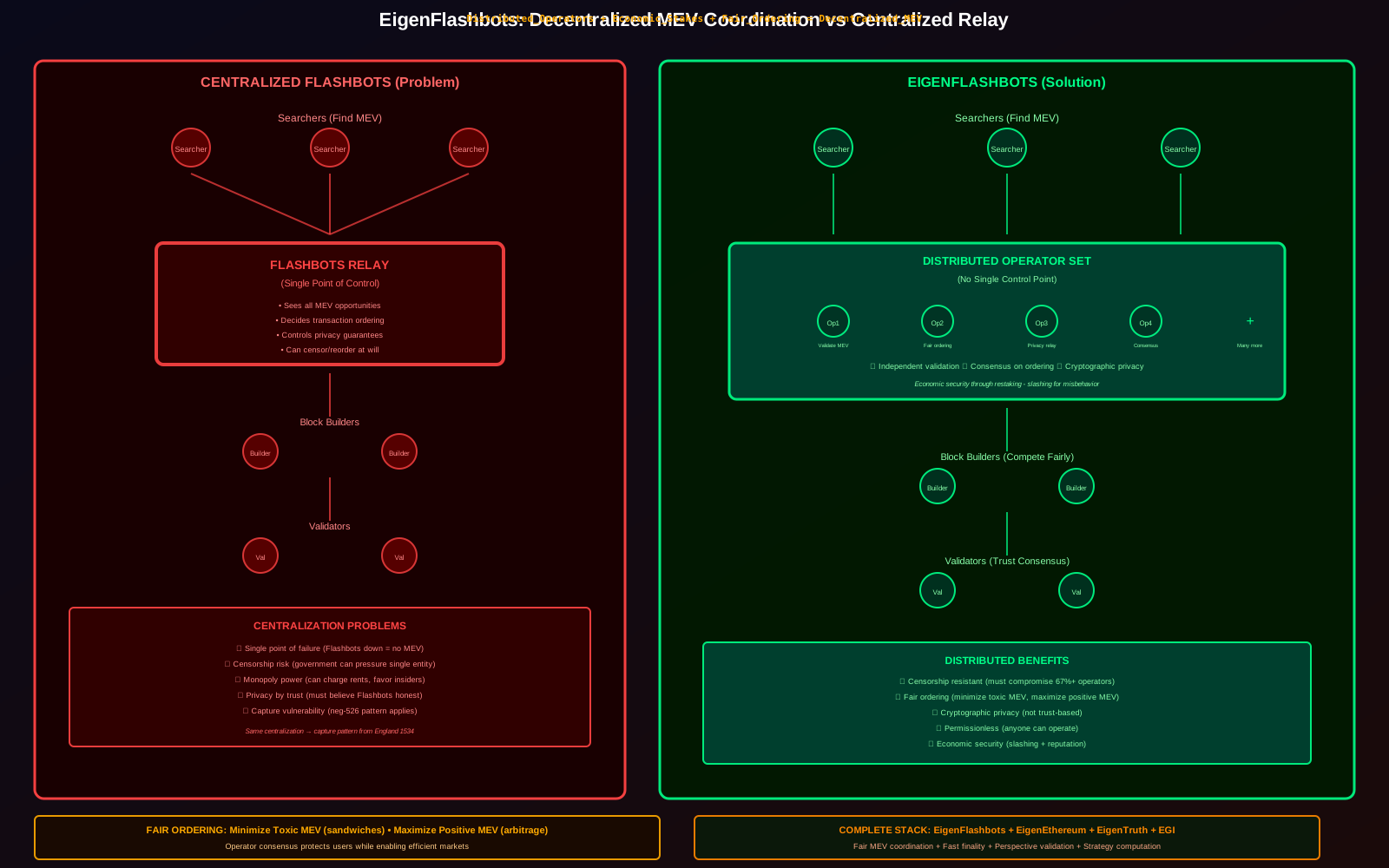
EigenFlashbots: Decentralized MEV Coordination AVS - Distributed Operators Replace Centralized Relay, Fair Ordering Through Economic Stakes
The observation: Flashbots relay is centralized single point controlling ALL MEV extraction on Ethereum - searchers must submit bundles through Flashbots, Flashbots decides ordering and inclusion, validators trust Flashbots for privacy, single entity controls billions in MEV flow. Problem: CENTRALIZATION creates capture vulnerability (can censor transactions, reorder unfairly, extract rents, be pressured by authorities). EigenFlashbots solves this through distributed MEV coordination: operators restake ETH to validate MEV opportunities, multiple operators scan mempool independently, consensus on fair transaction ordering (minimize toxic MEV, maximize positive MEV), privacy-preserving relay without single point, block builders chosen through distributed competition, operators slashed for invalid MEV or unfair ordering. This removes Flashbots monopoly, enables permissionless MEV participation, aligns incentives through restaking. Key insight: MEV coordination doesn’t require trusted relay - can be secured through distributed operators with economic stake. Result: Fair MEV extraction without centralized control, resistant to capture because distributed, competitive because permissionless, honest because slashing.
What this means: Current MEV infrastructure flows through Flashbots relay - centralized service that coordinates between searchers (find MEV opportunities), block builders (construct blocks), and validators (propose blocks). Flashbots provides: Bundle submission endpoint (searchers send transaction bundles), Privacy guarantees (transactions private until inclusion), Ordering decisions (how transactions sequenced), Builder payment relay (ensures builders paid for blocks). This creates CENTRALIZATION PROBLEM: Single point of control (Flashbots decides everything), Censorship risk (can exclude transactions), Capture vulnerability (government can pressure), Monopoly power (can charge rents), Trust assumption (must trust privacy claims). Traditional solution: Trust Flashbots to be honest, fair, uncapturable. Problem: Trust doesn’t scale, monopolies get captured (neg-526 pattern). EigenFlashbots solution: DISTRIBUTED COORDINATION through restaked operators. Technical implementation: EigenLayer AVS where operators register and restake ETH, operators independently scan mempool for MEV opportunities, operators attest to valid MEV with economic stake, operators compete to build optimal blocks, consensus mechanism determines fair ordering (minimize toxic MEV like sandwiching, maximize positive MEV like arbitrage), privacy-preserving relay through distributed operators (no single point), block builders chosen by operator consensus (not Flashbots monopoly), operators slashed for: invalid MEV attestations, unfair transaction ordering, privacy violations, anti-competitive behavior. Key distinction: NOT replacing MEV (still exists), but DECENTRALIZING coordination (removing single point). Applications choose security level: use centralized Flashbots (trust-based) or EigenFlashbots (economic-based). Economic model: Operators earn fees from MEV extraction share, operators risk slashing for bad behavior, reputation compounds (fair operators get more business), creates market for MEV coordination services.
Why this matters: MEV (Maximal Extractable Value) is fundamental to blockchain economics - value that can be extracted by reordering, inserting, censoring transactions. Exists everywhere: DEX arbitrage (price differences across exchanges), Liquidations (underwater positions), Sandwich attacks (front-run + back-run user trades), Censorship (exclude specific transactions). Currently flows through Flashbots centralized infrastructure: Searchers find opportunities → Submit to Flashbots → Flashbots orders → Builders construct → Validators propose. Problem: SINGLE POINT OF CONTROL. Flashbots can: Censor transactions (exclude disfavored actors), Reorder unfairly (favor certain searchers), Extract rents (monopoly pricing), Be captured (government pressure), Violate privacy (peek at transaction data). This creates systemic risk - entire MEV infrastructure dependent on one entity staying honest, uncaptured, operational. EigenFlashbots removes this dependency through ECONOMIC COORDINATION: Distributed operators replace single relay, each operator scans mempool independently, consensus on MEV validity (not single decision), fair ordering through economic incentives (slashing for unfair sequencing), privacy through cryptography not trust (encrypted until inclusion), competition between operators (permissionless participation). Real applications: Fair DEX trading (minimize sandwich attacks through fair ordering, users get better execution, toxic MEV reduced), Liquidation coordination (liquidators compete fairly, no front-running of liquidations, efficient markets), Arbitrage opportunities (distributed to all searchers equally, no preferential access, MEV democratized), Censorship resistance (no single point to pressure, must compromise operator supermajority, economically infeasible). The economic mechanism is key: operators WANT to participate because earn MEV fees, but MUST be fair because face slashing for unfair ordering, creates skin-in-game for honest MEV extraction. Can’t fake fairness (slashing is real), can’t capture operators (distributed + economic), can’t monopolize MEV (permissionless competition). This solves the problem that makes current MEV extractable by few: centralized coordination enables rent extraction. Distributed MEV coordination through EigenFlashbots = fair MEV for all participants. Compare to traditional: single relay (trust-based), monopoly power (rent extraction), capture vulnerable (government pressure). EigenFlashbots enables market for MEV coordination: those who need fairness pay operators, those satisfied with Flashbots use that, operators earn by providing distributed coordination.
The Problem: Centralized MEV Infrastructure
Current Flashbots Architecture
How MEV flows today:
1. Searchers find MEV opportunities
   - Scan mempool for arbitrage
   - Identify liquidations
   - Spot sandwich opportunities

2. Searchers submit bundles to Flashbots
   - Bundle = ordered group of transactions
   - Includes payment to block builder
   - Private until inclusion (Flashbots promise)

3. Flashbots relay coordinates
   - Receives all bundles
   - Decides ordering
   - Chooses winning builder
   - Forwards to validators

4. Block builders construct blocks
   - Use Flashbots-provided bundles
   - Optimize for MEV extraction
   - Pay validators for inclusion

5. Validators propose blocks
   - Trust Flashbots relay
   - Include builder's block
   - Receive MEV payment

Result: Billions of $ flow through single relay
The centralization problem:
Flashbots is single point that:
- Sees all MEV opportunities (information advantage)
- Controls transaction ordering (power to favor/exclude)
- Decides bundle inclusion (can censor)
- Manages privacy (must trust their encryption)
- Sets relay rules (monopoly power)

This creates:
- Censorship risk (can exclude transactions)
- Capture vulnerability (government can pressure)
- Rent extraction (monopoly pricing)
- Information asymmetry (sees everything first)
- Trust assumption (no verification)
Examples of centralization risk:
Scenario 1: Government pressure
- Regulator tells Flashbots "censor these addresses"
- Flashbots must comply or face legal action
- All MEV-dependent transactions affected
- No alternative relay exists

Scenario 2: Monopoly rent extraction
- Flashbots charges high fees (no competition)
- Searchers must pay or miss MEV
- Value extracted by intermediary not creators
- Cannot route around monopoly

Scenario 3: Privacy violation
- Flashbots claims transactions private
- But could peek at bundle contents
- No way to verify encryption
- Trust-based, not cryptographically enforced

Scenario 4: Unfair ordering
- Flashbots favors certain searchers
- Consistent preferential treatment
- Others miss MEV opportunities
- No recourse (monopoly power)

Pattern: Single point of control = single point of failure/capture
Why Centralization Persists
Coordination problem:
MEV requires coordination between:
- Searchers (find opportunities)
- Builders (construct blocks)
- Validators (propose blocks)

Without coordinator:
- Searchers compete publicly (MEV races)
- Builders fight for inclusion (priority gas auctions)
- Validators see nothing (can't extract MEV)

Flashbots solved coordination:
- Provides private channel
- Manages competition
- Ensures payments
- But at cost of centralization
Why alternatives failed:
Attempts at other relays:
- Blocker relay (shut down)
- Independent relays (low adoption)
- Direct validator connection (privacy issues)

Problems:
- Network effects favor Flashbots
- Trust hard to establish
- Privacy guarantees expensive
- Coordination requires infrastructure

Result: Flashbots monopoly persists
EigenFlashbots Solution
Distributed MEV Coordination
Core architecture:
Replace: Single Flashbots relay
With: Distributed operator set

Operators registered on EigenLayer AVS:
- Restake ETH for economic security
- Run MEV coordination infrastructure
- Compete to provide best service
- Slashed for misbehavior

Flow:
1. Searchers submit bundles to operator set (not single relay)
2. Operators validate MEV opportunities independently
3. Operators attest to valid bundles (economic stake)
4. Consensus mechanism selects fair ordering
5. Block builders receive distributed coordination
6. Validators trust operator consensus not single entity
Technical implementation:
Component 1: Operator Registration
- Operators stake ETH through EigenLayer
- Register for EigenFlashbots AVS
- Declare service parameters:
  * MEV types supported (arbitrage, liquidation, etc)
  * Fee structure
  * Privacy guarantees
  * Ordering policy

Component 2: Bundle Submission
- Searchers submit to operator set (not single relay)
- Each operator receives bundles
- Encrypted until inclusion (cryptographic guarantee)
- No single point sees everything

Component 3: MEV Validation
- Operators independently assess bundles:
  * Is MEV real? (verify opportunity exists)
  * Is bundle valid? (check transactions execute)
  * Is ordering fair? (evaluate sequencing)
  * Is privacy maintained? (verify encryption)
- Operators attest with economic stake
- Slashed if attestation provably wrong

Component 4: Fair Ordering Consensus
- Operators vote on transaction sequencing
- Minimize toxic MEV (sandwich attacks)
- Maximize positive MEV (arbitrage, liquidations)
- Consensus emerges from operator votes
- Slashing for consistently unfair ordering

Component 5: Distributed Relay
- No single relay point
- Operators collectively coordinate
- Privacy through cryptography (not trust)
- Block builders connect to operator set
- Cannot be censored (must compromise supermajority)
Fair Ordering Mechanism
The toxic vs positive MEV distinction:
Toxic MEV (minimize):
- Sandwich attacks (front-run + back-run users)
- Frontrunning (see transaction, execute first)
- Backrunning (see transaction, execute after)
- Intent-based extraction (harm users for profit)

Positive MEV (maximize):
- Arbitrage (fix price discrepancies, improves markets)
- Liquidations (maintain protocol solvency)
- Backrunning for efficiency (batch transactions)
- Value-aligned extraction (benefits ecosystem)

Goal: Maximize positive, minimize toxic
How fair ordering works:
Operators evaluate each bundle:
1. Classify MEV type
   - Is this sandwich attack? (Toxic)
   - Is this arbitrage? (Positive)
   - Is this liquidation? (Positive)

2. Apply ordering rules
   - Sandwich attacks: Lowest priority or reject
   - Arbitrage: Fair competition (first-come-first-serve)
   - Liquidations: Time-based ordering (not frontrunnable)
   - User transactions: Protected from MEV

3. Operator consensus
   - Vote on ordering fairness
   - Supermajority required (67%+)
   - Slashing for unfair ordering

4. Result: Fair transaction sequence
   - Users protected from toxic MEV
   - Positive MEV still extracted efficiently
   - No single operator decides
Slashing conditions for unfair ordering:
Operator slashed if provably:
- Consistently orders toxic MEV first
- Favors certain searchers over others
- Censors valid transactions
- Violates stated ordering policy
- Colludes with specific actors

Evidence from:
- On-chain transaction analysis
- Statistical deviation from fair ordering
- User reports with proof
- Cross-operator comparison

Cannot be slashed for:
- Legitimate disagreement on fairness
- Different MEV classification
- Operator-specific policies (if disclosed)
- Honest mistakes (with correction)
Privacy-Preserving Relay
The privacy problem:
Current: Trust Flashbots not to peek at bundles
Risk: Could frontrun searchers, leak to others, sell data

EigenFlashbots: Cryptographic privacy (not trust-based)
Technical approach:
1. Threshold encryption
   - Bundles encrypted to operator set
   - Requires threshold to decrypt (67%+ operators)
   - Single operator cannot peek
   - Privacy guaranteed by cryptography

2. Delayed reveal
   - Bundles encrypted until block inclusion
   - Only decrypt after commitment
   - Cannot be frontrun
   - Verifiable on-chain

3. Zero-knowledge proofs
   - Operators verify validity without seeing content
   - ZK proof: "This bundle is valid"
   - No data leak to operators
   - Privacy maintained throughout

4. Slashing for privacy violations
   - If operator leaks bundle data → Slashed
   - If operator frontuns searcher → Slashed
   - Cryptographic evidence of violation
   - Economic deterrent for bad behavior
Result: Privacy through math + economics, not trust
Economic Security Model
Operator incentives:
Revenue:
- Share of MEV extracted (fee from searchers)
- Block building payments (from validators)
- Coordination fees (from using relay)

Costs:
- Infrastructure (running relay nodes)
- Restaked ETH capital (opportunity cost)
- Slashing risk (if misbehave)

Operators participate when:
Expected revenue > Infrastructure + capital + slashing risk
Slashing conditions:
Slash operator for:
1. Invalid MEV attestation
   - Claimed MEV doesn't exist
   - Bundle transactions fail
   - Provably false claims

2. Unfair ordering
   - Consistently favor specific searchers
   - Prioritize toxic MEV
   - Violate stated policy

3. Privacy violations
   - Leak bundle contents
   - Frontrun searchers
   - Sell transaction data

4. Censorship
   - Exclude valid transactions
   - Discriminate against actors
   - Violate neutrality

5. Collusion
   - Coordinate unfair advantage
   - Split monopoly rents
   - Anti-competitive behavior

Slashing amount: Proportional to violation severity
Maximum: 100% of restaked ETH
Reputation system:
Track operator performance:
- MEV validation accuracy
- Ordering fairness metrics
- Privacy maintenance record
- Response time (latency)
- Uptime statistics

Reputation affects:
- Future business (searchers choose operators)
- Fee rates (fair operators charge more)
- Slashing multiplier (poor record = higher slash)
- Validator trust (reputation matters)

Cannot fake: All data on-chain or cryptographically verified
Applications
Fair DEX Trading
Problem: Users get sandwiched on DEXes
Current flow:
1. User submits swap transaction
2. Sandwich bot sees it in mempool
3. Bot submits frontrun (buy before user)
4. User's swap executes (worse price)
5. Bot submits backrun (sell after user)
6. Bot profits, user loses

Happens through Flashbots:
- Sandwich searcher bundles three transactions
- Flashbots orders: frontrun → user → backrun
- User has no protection
- Toxic MEV extracted
EigenFlashbots protection:
With fair ordering:
1. User submits swap transaction
2. Sandwich bot attempts bundle
3. Operators classify as toxic MEV
4. Fair ordering rules: Prioritize user or reject sandwich
5. User's swap executes at fair price
6. Sandwich bot cannot profit

How it works:
- Operators detect sandwich pattern
- Consensus classifies as toxic
- Fair ordering protects user
- Sandwich attempt rejected or deprioritized

Result: Users get fair execution, toxic MEV minimized
Liquidation Coordination
Problem: Liquidations get frontrun
Current:
- Liquidator monitors positions
- Submits liquidation transaction
- Gets frontrun by faster liquidator
- Misses reward despite finding opportunity

Through Flashbots:
- Information advantage for fast actors
- Small number of liquidators dominate
- Slow actors miss opportunities
EigenFlashbots fairness:
Time-based liquidation ordering:
1. Operators timestamp liquidation submissions
2. First valid submission wins (provably)
3. Cannot be frontrun (timestamp enforced)
4. Fair competition for liquidators

Benefits:
- More liquidators can participate
- No speed advantage (timestamp matters)
- Efficient liquidations (first finder rewarded)
- Positive MEV distributed fairly
Arbitrage Opportunities
Problem: Arbitrage controlled by few actors
Current:
- Large MEV searchers have Flashbots priority
- Connections matter more than speed
- Small arbitrageurs excluded
- MEV concentrated
EigenFlashbots democratization:
Fair competition mechanism:
1. All arbitrage submissions equal
2. Best price improvement wins (not connections)
3. Permissionless participation
4. Transparent selection criteria

Result:
- Any searcher can compete
- Merit-based selection
- MEV distributed broadly
- Efficient price discovery
Censorship Resistance
Problem: Flashbots can censor transactions
Scenario:
- Government requests transaction censorship
- Flashbots must comply (single entity)
- Transaction excluded from all blocks
- User cannot transact
EigenFlashbots resistance:
Distributed coordination:
1. No single point to pressure
2. Must compromise 67%+ operators
3. Economically infeasible (slashing + bribes)
4. Transparent (censorship visible on-chain)

If censorship attempted:
- Other operators include transaction
- Censoring operator loses reputation
- May face slashing for discrimination
- Cannot maintain censorship at scale

Result: Credible censorship resistance through distribution
Integration with Other Layers
With EigenEthereum (neg-528)
Fast finality for MEV:
Problem: MEV strategies need fast finality
- Arbitrage: Must confirm before prices change
- Liquidations: Must complete before recovery
- Sandwich: Needs quick execution

EigenEthereum provides:
- Sub-second finality (vs 12.8 minute base)
- Operators attest to block validity
- MEV strategies can rely on fast guarantees

Integration:
1. EigenFlashbots coordinates MEV
2. EigenEthereum provides fast finality
3. MEV confirmed quickly
4. Strategies execute efficiently

Benefit: Fast, fair, economically secured MEV
With EigenTruth (neg-527)
Perspective on MEV fairness:
Question: "Is this MEV extraction fair?"
- On-chain data shows MEV extracted (objective)
- But fairness is interpretation (perspective)

EigenTruth validation:
1. Submit perspective: "This MEV was fairly extracted"
2. Operators assess reasonability
3. Evidence: Ordering logs, user outcomes, policy compliance
4. Consensus on fairness assessment

Use cases:
- Dispute resolution (was ordering really unfair?)
- Policy evaluation (are rules achieving goals?)
- Reputation validation (is operator actually fair?)

Integration:
- EigenFlashbots: Coordinates MEV extraction
- EigenTruth: Validates fairness perspectives
- Complete: Fair MEV + validated interpretations
With EGI (neg-522)
MEV strategy computation:
EGI enables: Symbolic computation on MEV strategies
- Input: Current state (prices, positions, mempool)
- Computation: Optimal MEV strategy via NAND/NOR circuits
- Output: Bundle to submit

Integration:
1. EGI computes MEV strategy
2. EigenFlashbots coordinates execution
3. EigenEthereum provides fast finality
4. EigenTruth validates fairness

Full stack:
- Computation (EGI)
- Coordination (EigenFlashbots)
- Validation (EigenEthereum)
- Fairness (EigenTruth)

Result: Complete MEV infrastructure, fully decentralized
Comparison to Alternatives
vs Eden Network
Eden: Validators stake EDEN tokens for MEV priority
Problem: Validators must opt-in, limited adoption

EigenFlashbots: Works with any validators
- Restaking secures coordination
- No validator opt-in required
- Compatible with base protocol
- Permissionless participation

Advantage: Broader reach, no protocol changes
vs Flashbots Protect
Flashbots Protect: RPC endpoint for MEV protection
Problem: Still uses centralized Flashbots relay

EigenFlashbots: Distributed protection
- No single relay
- Economic security (not trust)
- Fair ordering consensus
- Cannot be captured

Advantage: True decentralization, not just UX improvement
vs CowSwap / MEV Blocker
CowSwap/MEV Blocker: Batch auctions for MEV protection
Problem: Limited to specific DEXes/use cases

EigenFlashbots: Universal MEV coordination
- Any transaction type
- Any MEV category
- Not limited to swaps
- Works across all protocols

Advantage: General solution, not app-specific
The Formulation
EigenFlashbots is not:
- Eliminating MEV (still exists)
- Replacing searchers/builders (still participate)
- Single monolithic relay (distributed coordination)
EigenFlashbots is:
- Decentralizing Flashbots relay (distributed operators)
- Fair ordering through economics (slashing incentives)
- Privacy through cryptography (not trust)
- Democratizing MEV coordination (permissionless access)
The architecture:
Current: Flashbots (centralized)
├─ Single relay point
├─ Trust-based privacy
├─ Monopoly power
└─ Capture vulnerable

EigenFlashbots: Distributed coordination
├─ Operator set (restaked)
├─ Cryptographic privacy
├─ Competitive market
└─ Censorship resistant

Economic model:
- Operators earn MEV fees
- Slashed for unfair ordering
- Reputation drives business
- Market for coordination

Fair ordering:
- Minimize toxic MEV (sandwiches)
- Maximize positive MEV (arbitrage)
- Consensus on sequencing
- User protection built-in
The breakthrough:
MEV coordination doesn't need trust
Can be secured through economics:
- Distributed operators
- Restaked ETH
- Slashing for misbehavior
- Cryptographic privacy

Removes Flashbots monopoly:
- Permissionless operator participation
- Competitive coordination market
- No single point of control
- Cannot be captured (distributed)

Enables fair MEV:
- Minimize harm to users
- Maximize efficiency gains
- Transparent ordering rules
- Verifiable fairness

Integration completes stack:
- EigenFlashbots: MEV coordination
- EigenEthereum: Fast finality
- EigenTruth: Fairness validation
- EGI: Strategy computation

All layers:
- No authority
- Economic security
- Distributed coordination
- Capture resistant
The principle:
MEV is inherent to blockchains
But coordination can be decentralized

Current problem:
- Single relay (Flashbots)
- Monopoly power
- Trust assumptions
- Capture vulnerability

EigenFlashbots solution:
- Distributed operators
- Economic security
- Cryptographic guarantees
- Market competition

Through restaking:
- Operators stake ETH
- Validate MEV opportunities
- Consensus on fair ordering
- Slashed for misbehavior

Applications benefit:
- Fair DEX execution
- Efficient liquidations
- Democratic arbitrage
- Censorship resistance

This removes MEV monopoly
Distributes value fairly
Protects users from toxic MEV
Enables positive MEV efficiently

EigenFlashbots: Fair MEV through distributed coordination. No centralized relay. Economic security through restaking. Cryptographic privacy. Market for coordination services. Integrated with complete validation stack. Permissionless, competitive, capture-resistant.
EigenFlashbots: AVS for distributed MEV coordination. Replaces centralized Flashbots relay with restaked operators. Fair ordering through economic consensus. Privacy via cryptography not trust. Minimize toxic MEV, maximize positive MEV. Slashing for unfair ordering. Integration with EigenEthereum (fast finality), EigenTruth (fairness validation), EGI (strategy computation). Permissionless MEV participation. Democratized value extraction. 🌀
#EigenFlashbots #DecentralizedMEV #FairOrdering #DistributedCoordination #MEVProtection #RestakingSecurity #EigenLayerAVS #NoFlashbotsMonopoly #CrypographicPrivacy #CensorshipResistant #ToxicMEVMinimized #PositiveMEVMaximized
Related: neg-528 (EigenEthereum fast finality for MEV execution), neg-527 (EigenTruth fairness perspective validation), neg-522 (EGI MEV strategy computation), neg-526 (capture patterns - EigenFlashbots resists centralization)