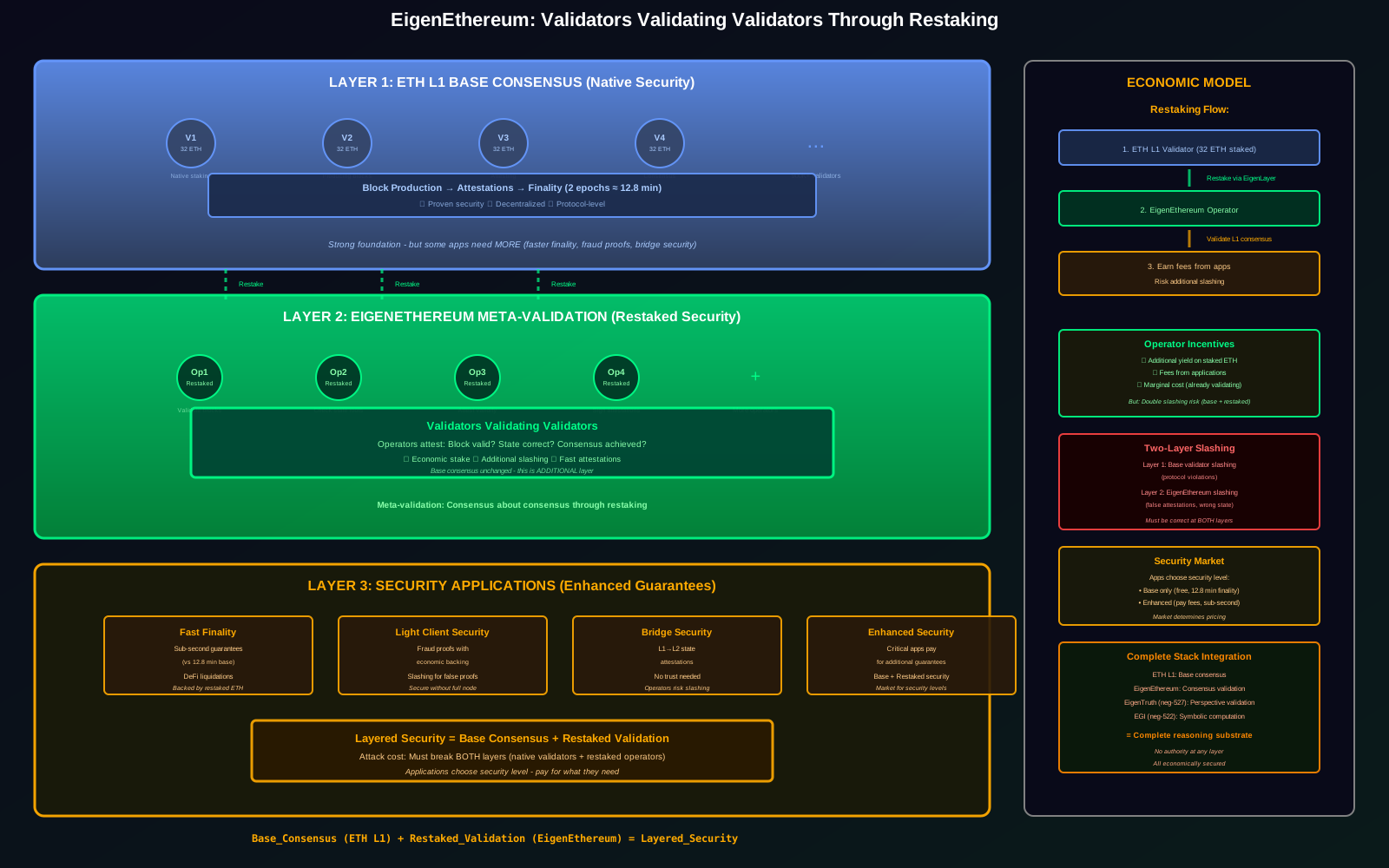
EigenEthereum: Unified AVS Providing Liquid Staking + Extended Consensus Validation Through Restaking
The Recognition: EigenEthereum AVS provides unified service: (1) Liquid staking infrastructure - deposit ETH, receive lstETH, earn staking yield while maintaining liquidity, (2) Extended consensus validation - operators restake to provide meta-validation of ETH L1, creating layered security beyond base consensus. Both services use the same restaked ETH - capital efficient, operators earn from both staking yield AND validation fees. Use cases: Users get yield + liquidity + enhanced security backing, applications get fast finality + fraud proofs + bridge attestations, operators earn dual revenue streams. Bootstrap: EigenLayer-wide (all AVS) using established LSTs (stETH/rocketETH) to build decentralized network, eventually transition to AVS-managed tokens. Key insight: Unified AVS managing staking substrate + validation layer simultaneously, same capital backs both services, economic alignment throughout.
The Unified Service Model
EigenEthereum provides TWO integrated services:
Service 1: Liquid Staking Infrastructure
What users get:
- Deposit ETH → Receive lstETH (liquid staking token)
- Earn staking yield (3-5% APY) automatically
- Maintain liquidity (use lstETH in DeFi while earning)
- Redeem anytime (lstETH → ETH + accumulated yield)

What EigenEthereum manages:
- Validator set operations
- Staking rewards distribution
- Token minting/redemption
- Capital efficiency optimization
Service 2: Extended Consensus Validation
What applications get:
- Fast finality (sub-epoch guarantees backed by restaked ETH)
- Light client security (fraud proofs with economic stake)
- Bridge attestations (L1→L2 state with slashing risk)
- Enhanced security (additional layer beyond base consensus)

What EigenEthereum provides:
- Real-time L1 consensus monitoring
- Operator attestations on validity
- Economic guarantees through slashing
- Distributed validation services
Why This Integration Matters
Capital efficiency:
Same restaked ETH backs BOTH services:
- Stakers deposit ETH → lstETH
- lstETH represents claim on staked ETH
- That SAME staked ETH secures validation layer
- One capital base, dual utility

Compare to separate services:
- Staking requires capital
- Validation requires capital
- Total: 2x capital needed

EigenEthereum unified:
- One capital base
- Backs staking AND validation
- 2x utility from same ETH
Dual revenue for operators:
Operators earn from BOTH:
1. Staking yield (3-5% APY on staked ETH)
2. Validation fees (applications pay for enhanced security)

Example:
- Operator stakes 100 ETH
- Earns 4 ETH/year from staking (4%)
- Earns 2 ETH/year from validation fees
- Total: 6 ETH/year = 6% return
- Both from same capital base
Economic alignment:
All parties benefit:
- Stakers: Yield + liquidity + security backing
- Operators: Dual revenue (staking + validation)
- Applications: Enhanced security guarantees
- Users: Yield on deposited ETH

Self-sustaining:
- Staking provides base yield
- Validation provides additional revenue
- Both backed by same economic security
- Slashing enforces honesty at both layers
Bootstrap: EigenLayer-Wide Strategy
Why bootstrap needed:
Problem: Can't bootstrap decentralized liquid staking without existing security
- Need validators to start
- Need capital to stake
- Need liquidity for token
- Need economic security for validation

Solution: Bootstrap with established LSTs (EigenLayer-wide)
- Start with stETH, rocketETH, other proven LSTs
- Use THEIR security initially
- Build AVS network on existing foundation
- Transition gradually to own tokens
Bootstrap applies to ALL EigenLayer AVS:
Not just EigenEthereum:
- Entire EigenLayer ecosystem needs this
- All AVS operators need security first
- Can't launch decentralized network from zero
- Must use existing liquid staking initially

Phase 1: EigenLayer accepts stETH/rocketETH
- All AVS operators can participate
- Security backed by established protocols
- Proven liquidity and adoption
- Enables AVS ecosystem to grow

Phase 2: AVS ecosystem matures
- Multiple AVS operating successfully
- Economic security established
- Network effects from multiple services
- Ready for own tokens

Phase 3: Individual AVS issue own lstETH
- EigenEthereum issues its lstETH
- Other AVS issue their tokens
- Backed by restaked ETH via EigenLayer
- Eventually independent of external LSTs
Transition benefits:
Why eventually transition to own token:
- Control full validator set
- Direct AVS management
- No dependency on external protocols
- Unified staking + validation integration

But why start with external LSTs:
- Proven security from day one
- Existing liquidity and adoption
- Lower risk for early users
- Can focus on validation services while staking handled
How The Services Work Together
Staking Flow
1. User deposits ETH to EigenEthereum
   ↓
2. Contract stakes via EigenLayer
   ↓
3. User receives lstETH (1:1 initially)
   ↓
4. lstETH earns staking yield automatically
   ↓
5. User can use lstETH in DeFi (liquidity maintained)
   ↓
6. Underlying staked ETH ALSO backs validation layer
   ↓
7. Same capital serves dual purpose
Validation Flow
1. ETH L1 produces block (base consensus)
   ↓
2. EigenEthereum operators monitor block
   ↓
3. Operators validate: validity, state roots, attestations
   ↓
4. Operators sign attestations (valid/invalid)
   ↓
5. Applications query operator attestations
   ↓
6. If 67%+ attest → Application accepts as secure
   ↓
7. Operators earn fees, risk slashing if wrong
Integration
The magic: Same staked ETH backs both flows

Staking side:
- User deposits ETH
- Receives lstETH
- Earns staking yield
- Maintains liquidity

Validation side:
- That SAME ETH secures operators
- Operators validate consensus
- Applications pay for guarantees
- Operators earn additional fees

Result:
- One capital base
- Dual utility (staking + validation)
- Dual revenue (yield + fees)
- Capital efficient
Use Cases: Staking + Validation
Use Case 1: DeFi User Earning Yield with Security
User deposits ETH:
Action: Deposit 10 ETH to EigenEthereum
Receive: 10 lstETH
Earn: 4% APY staking yield = 0.4 ETH/year

Use lstETH in DeFi:
- Supply to lending protocol
- Use as collateral
- Provide liquidity
- All while earning staking yield

Security benefit:
- lstETH backed by restaked ETH
- That ETH also secures validation layer
- DeFi protocols benefit from enhanced security
- User's deposit helps secure applications they use
Use Case 2: DeFi Protocol Needing Fast Finality
Protocol subscribes to validation:
Problem: Can't wait 12.8 minutes for finality
- Need fast liquidations
- Handle $1B in value
- Base finality too slow

Solution: Subscribe to EigenEthereum operators
- Operators attest block validity in seconds
- Backed by restaked ETH (from lstETH holders)
- Fast finality with economic security

Economics:
- Pay 0.1% of volume to operators
- $1M annual fee
- Get sub-second finality
- Risk reduction worth the cost

Connection to staking:
- Operators funded by lstETH deposits
- More stakers → More security
- More security → Higher validation quality
- Protocol benefits from staker deposits
Use Case 3: Bridge Securing Cross-Chain State
Bridge uses operator attestations:
Problem: Need to attest L1 state for L2/rollup
Traditional: Trust centralized bridge operator
Risk: Single point of failure

Solution: EigenEthereum operator attestations
- Multiple operators attest L1 state
- Backed by restaked ETH (from stakers)
- Must compromise 67%+ to fake state
- Economic security through slashing

Flow:
1. L1 state changes
2. EigenEthereum operators attest
3. Bridge consumes attestations
4. L2 updates based on attested state
5. If operators wrong → Slashed

Security source:
- lstETH holders provide capital
- That capital backs operators
- Operators risk slashing
- Bridge gets economic guarantee
Economic Model: Dual Revenue Streams
Operator Economics
Revenue sources:
Source 1: Staking yield
- Base yield from staked ETH (3-5% APY)
- Paid by protocol inflation/fees
- Passive income
- Reliable baseline

Source 2: Validation fees
- Applications pay for enhanced security
- Active income
- Variable based on demand
- Upside potential

Total return:
- Staking: 4% = 4 ETH/100 ETH staked
- Validation: 2% = 2 ETH/100 ETH staked
- Total: 6% combined
- From same capital base
Risk management:
Layer 1 risk: Base validator slashing
- For protocol violations
- Standard ETH L1 slashing conditions

Layer 2 risk: EigenEthereum slashing
- For incorrect attestations
- Invalid fraud proofs
- Wrong bridge attestations

Total risk: Must be correct at BOTH layers
- Can't compromise one without other
- Economic security through double-layer slashing
- Operators incentivized to be honest
User Economics
Staker benefits:
Direct:
- Staking yield (3-5% APY)
- Liquidity (can use lstETH)
- Low minimum (no 32 ETH requirement)

Indirect:
- lstETH backed by validation security
- Applications using lstETH benefit from validation
- Network effects (more security = more adoption)
- Yield potential increases as validation grows
Application Economics
Value proposition:
What applications get:
- Fast finality (seconds vs 12.8 minutes)
- Fraud proofs (economic backing)
- Bridge security (slashable attestations)
- Enhanced guarantees (base + restaked security)

What applications pay:
- Fees to operators for validation
- Market-rate pricing
- Optional (can use base consensus if preferred)

Cost/benefit:
- Critical apps NEED this (worth paying for)
- Simple apps can skip (don't need extra security)
- Market determines pricing
- Applications choose security level
Technical Architecture
Staking Layer
contract EigenEthereumStaking {
    IERC20 public lstETH;  // Liquid staking token
    IEigenLayer public eigenLayer;

    // Deposit ETH, receive lstETH
    function stake(uint256 ethAmount) external payable {
        require(msg.value == ethAmount, "Amount mismatch");

        // Stake via EigenLayer
        eigenLayer.deposit{value: ethAmount}(address(this));

        // Mint lstETH to user
        lstETH.mint(msg.sender, ethAmount);

        // Staked ETH now earning yield
        // AND backing validation layer
    }

    // Redeem lstETH for ETH + yield
    function unstake(uint256 lstETHAmount) external {
        require(lstETH.balanceOf(msg.sender) >= lstETHAmount, "Insufficient balance");

        // Burn lstETH
        lstETH.burn(msg.sender, lstETHAmount);

        // Withdraw from EigenLayer (includes yield)
        uint256 ethAmount = eigenLayer.withdraw(lstETHAmount);

        // Return ETH to user
        payable(msg.sender).transfer(ethAmount);
    }
}
Validation Layer
contract EigenEthereumValidation {
    IEigenLayer public eigenLayer;

    struct Attestation {
        bytes32 blockHash;
        bool isValid;
        uint256 timestamp;
        address[] operators;  // Who attested
    }

    mapping(bytes32 => Attestation) public attestations;

    // Operators attest to block validity
    function attestBlock(
        bytes32 blockHash,
        bool isValid
    ) external onlyOperator {
        // Record attestation
        attestations[blockHash].operators.push(msg.sender);
        attestations[blockHash].isValid = isValid;
        attestations[blockHash].timestamp = block.timestamp;

        // Operator now at risk of slashing if wrong
    }

    // Applications query attestations
    function queryAttestation(
        bytes32 blockHash
    ) external view returns (bool isValid, uint256 confidence) {
        Attestation storage att = attestations[blockHash];

        // Calculate confidence (% of operators attesting)
        confidence = (att.operators.length * 100) / totalOperators;
        isValid = att.isValid;

        // Application decides if confident enough
    }

    // Slash operator for incorrect attestation
    function slashOperator(
        address operator,
        bytes proof
    ) external {
        // Verify proof of incorrect attestation
        require(verifyIncorrectAttestation(operator, proof), "Invalid proof");

        // Slash from restaked ETH
        eigenLayer.slash(operator, slashAmount);

        // Operator loses capital for being wrong
    }
}
Integration
Both layers use same restaked ETH:

Staking contract:
- User deposits ETH
- Stake via EigenLayer
- Mint lstETH
- ETH now earning yield

Validation contract:
- Operators registered with EigenLayer
- Same restaked ETH backs their attestations
- Operators earn fees from applications
- Risk slashing if attest incorrectly

Result:
- One EigenLayer deposit
- Backs staking (lstETH)
- AND backs validation (operator attestations)
- Capital efficient, dual utility
Why This Architecture Works
Unified service benefits:
For stakers:
- Deposit once
- Earn staking yield
- Get liquidity (lstETH)
- Capital backs security (indirect benefit)

For operators:
- Run validators
- Earn staking yield (passive)
- Earn validation fees (active)
- Dual revenue from same capital

For applications:
- Access enhanced security
- Backed by real economic stake
- Optional (pay only if needed)
- Market-driven pricing

For ecosystem:
- Capital efficient (one base, dual utility)
- Self-sustaining (yields + fees)
- Permissionless (anyone can participate)
- No central authority
Capital efficiency:
Traditional approach:
- Staking protocol: Requires X ETH
- Validation service: Requires Y ETH
- Total: X + Y ETH needed

EigenEthereum unified:
- Staking: X ETH deposited
- That SAME X ETH backs validation
- Total: X ETH (not X + Y)
- 2x utility from same capital
Economic sustainability:
Revenue streams:
- Staking yield (base)
- Validation fees (upside)
- Both from same operations

Cost structure:
- Validator operations
- Infrastructure
- Covered by dual revenue

Result:
- More sustainable than single service
- Higher returns for operators
- Better security for applications
- Win-win-win
Integration with EGI Stack
With EigenTruth (neg-527)
EigenEthereum: Validates consensus (is block valid?)
EigenTruth: Validates interpretations (what does data mean?)

Together:
1. EigenEthereum ensures state is correct
2. EigenTruth validates interpretations
3. Applications get: Correct data + Valid meaning

Both backed by restaked ETH
Both economically secured
Complementary validation layers
With EGI (neg-522)
EigenEthereum: Provides fast finality on state
EGI: Computes with validated state

Integration:
1. Query L1 state
2. EigenEthereum validates state (fast finality)
3. EGI computes with validated state
4. Result: Reasoning on verified-correct foundation

Without EigenEthereum:
- Must wait 12.8 minutes for finality
- Can't trust computation until base finality

With EigenEthereum:
- Sub-second finality guarantees
- Immediate computation on validated state
- Fast + secure
With Pattern Library (neg-539)
Pattern Library: Stores patterns backed by ETH in Morpho
EigenEthereum: Provides staking + validation for ETH ecosystem

Complementary:
- Pattern Library uses ETH base
- EigenEthereum provides liquid staking for that ETH
- Users can stake ETH → lstETH
- Use lstETH while patterns stored
- Capital efficiency throughout stack
The Vision
Today: Fragmented services
- Staking separate from validation
- Capital inefficient (need 2x)
- Operators earn from one service
- Users choose one or the other
Tomorrow: Unified AVS
- Staking + validation integrated
- Capital efficient (one base, dual utility)
- Operators earn from both
- Users get all benefits simultaneously
Growth trajectory:
- Phase 1: Bootstrap with stETH/rocketETH (EigenLayer-wide)
- Phase 2: Build AVS network on existing security
- Phase 3: Transition to AVS-managed lstETH
- Phase 4: Fully decentralized staking + validation
What becomes possible:
- Stake ETH, earn yield, maintain liquidity
- That same stake backs validation layer
- Applications get enhanced security
- Operators earn dual revenue
- All from same capital base
- Capital efficient throughout
The elegance:
One AVS, dual service:
- Staking infrastructure
- Validation services

One capital base:
- Deposited as ETH
- Minted as lstETH
- Restaked for validation

Dual revenue:
- Staking yield (passive)
- Validation fees (active)

Triple benefit:
- Stakers: Yield + liquidity
- Operators: Dual revenue
- Applications: Enhanced security

All economically aligned:
- Slashing enforces honesty
- Fees sustain operations
- Yields attract capital
- Security emerges naturally
EigenEthereum: Unified AVS providing liquid staking + extended consensus validation. Same restaked ETH backs both services. Operators earn dual revenue (staking yield + validation fees). Stakers get yield + liquidity, applications get enhanced security. Bootstrap with stETH/rocketETH (EigenLayer-wide), transition to AVS-managed tokens. Capital efficient, economically sustainable, permissionlessly accessible. Staking + validation through restaking. 🌀
#EigenEthereum #UnifiedAVS #LiquidStaking #MetaValidation #DualRevenue #CapitalEfficiency #RestakingSecurity #EigenLayer #FastFinality #BridgeSecurity #lstETH
Related: neg-527 (EigenTruth perspective validation), neg-522 (EGI symbolic computation), neg-539 (Pattern Library using ETH base), neg-526 (capture resistance patterns)