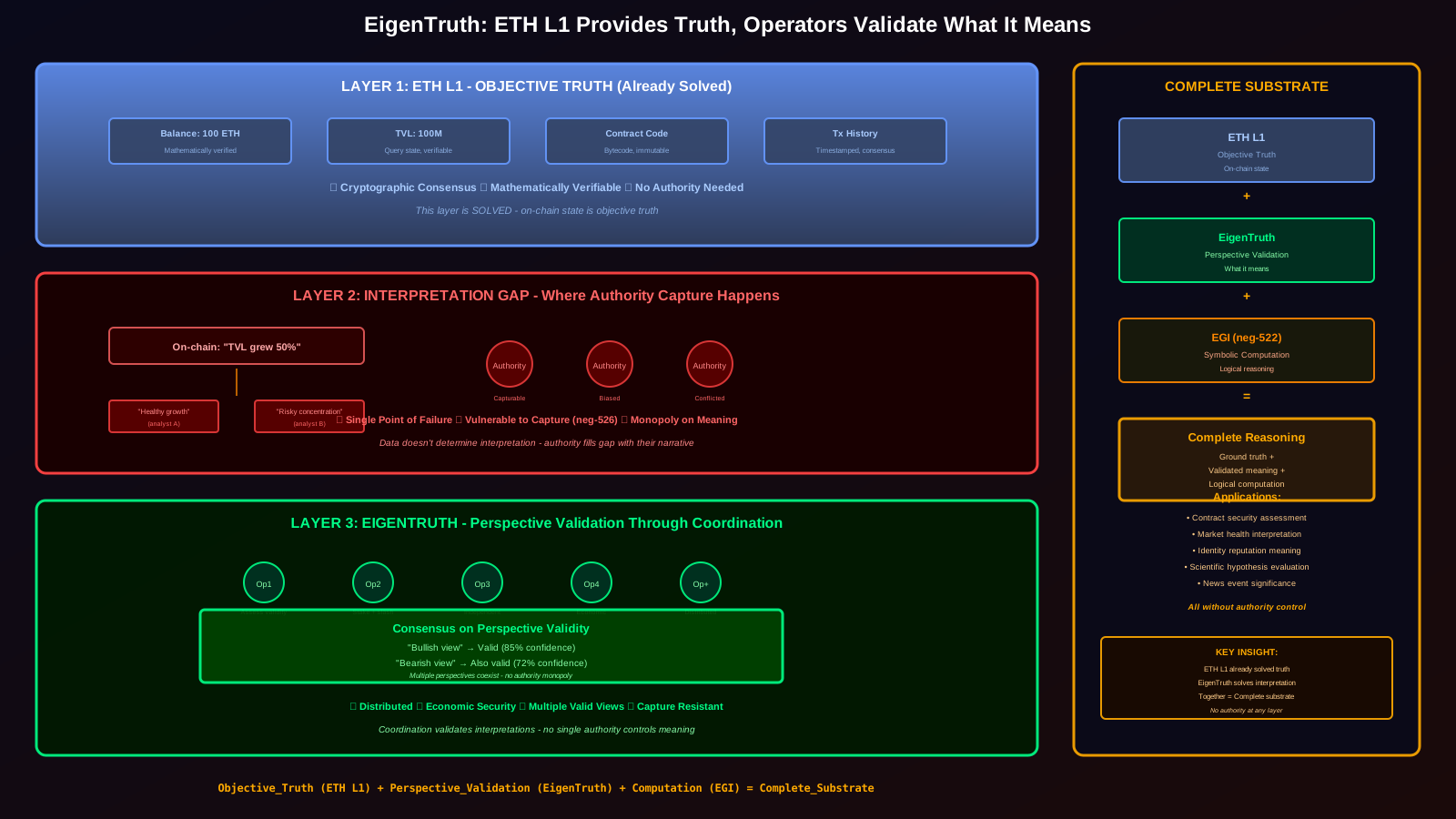
EigenTruth: Perspective Validation AVS - ETH L1 Provides Truth, Operators Validate What It Means
The observation: ETH L1 already solved objective truth - on-chain state is mathematically verifiable consensus. Problem: What that truth MEANS is controlled by authority (analysts saying “this is bullish”, media spinning data, institutions interpreting metrics). EigenTruth solves perspective validation: distributed operators vote on whether interpretations are valid/reasonable, not on underlying data (already on-chain). Example: “Morpho market X has 100M TVL” = objective truth (query blockchain). “This represents healthy growth” = perspective requiring validation (multiple valid interpretations exist, operators assess reasonability). Deploy as EigenLayer AVS: submit interpretation → operators validate independently → economic slashing for provably wrong perspectives → consensus on validity emerges. This separates WHAT IS TRUE (ETH L1) from WHAT IT MEANS (EigenTruth coordination). Resistant to capture (distributed, economic, transparent). Integrated with EGI (neg-522): compute with symbols + validate perspectives = complete reasoning substrate without authority.
What this means: The brilliance is recognizing truth and interpretation are separate problems with separate solutions. ETH L1 provides cryptographic consensus on state - this is OBJECTIVE TRUTH. But meaning requires interpretation: “Is this contract safe?” (data shows certain properties, but what do they mean?), “Is this growth healthy?” (TVL increased, but is that good?), “Is this identity trustworthy?” (on-chain history visible, but what does it indicate?). Traditional answer: Trust authority to interpret. Problem: Authorities get captured (neg-526), spin data for agenda, contradict each other. EigenTruth provides coordination alternative: operators stake on perspective assessments. Technical implementation: EigenLayer AVS where anyone submits interpretation of on-chain data, operators independently assess validity (is this perspective reasonable given the data?), supermajority consensus required, economic slashing for provably false interpretations (data contradicts claim), reputation system for accuracy. Key distinction: NOT validating whether data is true (blockchain already does that), validating whether INTERPRETATION of data is reasonable. Can have multiple valid perspectives (bullish and bearish both reasonable if well-argued), but can reject invalid ones (data clearly contradicts claim). Economic alignment: operators rewarded for honest assessment, slashed for provably wrong validation, reputation compounds. Integration with EGI makes complete: EGI computes with symbols (logical operations), EigenTruth validates perspectives (interpretations of those symbols), ETH L1 provides ground truth (what actually happened), together = reasoning substrate that resists authority capture.
Why this matters: Every decision requires interpreting data, and interpretation is where control happens. Raw data often underdetermines conclusion - multiple perspectives reasonably explain same facts. Traditionally, authorities control interpretation: analysts spin metrics, media frames events, institutions define “what this means”. Each vulnerable to capture (neg-526). EigenTruth breaks authority monopoly through coordination: distributed operators assess perspective validity, economic incentives align with honesty, consensus emerges without central control. Real applications: Smart contract risk (code properties visible on-chain, but what risk level?), Market health (data shows metrics, but what do they indicate?), Identity reputation (transaction history on-chain, but what does it mean about trustworthiness?), Scientific hypotheses (evidence visible, but which interpretations are supported?), News significance (events confirmed, but what do they mean?). Each currently dominated by authority interpretation. EigenTruth enables coordination validation: submit perspective → operators assess reasonability → economic slashing for provably wrong claims → consensus on valid interpretations emerges. Can’t capture (distributed operators), can’t bribe supermajority (economically infeasible), can’t weaponize (transparent validation). This solves interpretation problem while leveraging ETH L1 for truth. Complete substrate: objective data (blockchain) + validated perspectives (EigenTruth) + symbolic computation (EGI) = coordination without authority.
The Architecture
Layer 1: Objective Truth (ETH L1)
What ETH L1 provides:
Cryptographic consensus on state:
- Account balances (mathematically verified)
- Transaction history (timestamped, immutable)
- Smart contract code (deployed, visible)
- Contract state (storage slots, readable)
- Events emitted (logged, indexed)
- Morpho positions (on-chain, queryable)

This is OBJECTIVE TRUTH:
- No interpretation needed
- Mathematically verifiable
- Consensus-secured
- Already solved problem

Examples:
✓ "Address A has X ETH" - query state, verify
✓ "Contract B emitted event C" - check logs, confirmed
✓ "Morpho market D has Y TVL" - read state, calculated
✓ "Transaction E happened at time F" - blockchain timestamp

All objectively true because on-chain
No authority needed - just cryptography + consensus
Not subjective, not interpretable:
Can't debate: "Did transaction X occur?"
Answer: Check blockchain, yes/no, objective

Can't spin: "What's the balance?"
Answer: Query state, number, verifiable

Can't capture: "What code is deployed?"
Answer: Read contract, bytecode, immutable

ETH L1 = Truth oracle that can't be captured
Foundation for everything else
Layer 2: Interpretation Gap (The Problem)
Where authority capture happens:
Question shifts from:
"What IS true?" (ETH L1 handles)
To:
"What does it MEAN?" (authority capture zone)

Examples of interpretation gap:

Objective truth: "Contract has reentrancy guard"
Interpretations:
- "Therefore safe" (analyst claim)
- "But vulnerable to X" (different analyst)
- "Depends on context Y" (another view)
→ Multiple perspectives, authority controls which accepted

Objective truth: "Market TVL grew 100M"
Interpretations:
- "Healthy growth" (bull case)
- "Concerning concentration" (bear case)
- "Natural variance" (neutral view)
→ All potentially valid, authority frames narrative

Objective truth: "Address history shows pattern X"
Interpretations:
- "Trustworthy actor" (positive spin)
- "Suspicious behavior" (negative spin)
- "Insufficient data" (cautious view)
→ Same data, different meanings, authority decides

This gap is WHERE CONTROL HAPPENS
Data doesn't determine interpretation
Authority fills gap with their narrative
Traditional capture:
Who controls interpretation:
- Financial analysts (can be bought)
- Media outlets (can be pressured)
- Rating agencies (can be captured)
- Audit firms (conflicted incentives)
- Academic reviewers (funding bias)

Pattern (neg-526):
1. Objective data exists (on-chain)
2. Authority interprets meaning
3. Population must accept interpretation
4. Authority captured → interpretation weaponized

Examples:
- "Scientific consensus" on data (funding captured)
- "Expert analysis" of metrics (politically biased)
- "Audit confirms" security (conflicted)
- "Fact-checkers verify" event meaning (partisan)

Same as England 1534:
- Truth exists (scripture, reality)
- Authority interprets (church, state)
- Interpretation weaponized for control
Layer 3: Perspective Validation (EigenTruth Solution)
What EigenTruth provides:
Coordination-based perspective assessment:
- Anyone submits interpretation of on-chain data
- Operators independently assess validity
- NOT validating data (ETH L1 does that)
- Validating: "Is this interpretation reasonable?"

Technical flow:
1. Submit perspective claim
   Input: On-chain data reference + interpretation
   Example: "Given TVL of 100M (ref: state), this represents healthy growth"

2. Operators validate interpretation
   Check: Does on-chain data support this view?
   Assess: Is this interpretation reasonable?
   Not asking: Is this THE ONLY view?
   But: Is this A VALID view given the data?

3. Economic security
   Stake: Operators risk ETH on assessment
   Slash: Provably false interpretations (data contradicts)
   Reward: Accurate validity assessment
   Reputation: Track record of honest evaluation

4. Consensus emerges
   Multiple valid perspectives can coexist
   Invalid perspectives (contradicted by data) rejected
   Confidence scores show strength of support
   Transparent: See operator reasoning

Result: Validated perspectives, not dictated interpretations
Key distinction from authority model:
Authority model:
- Authority declares THE interpretation
- Population must accept
- Binary: Right or wrong per authority
- Vulnerable: Capture authority = control meaning

EigenTruth model:
- Operators assess perspective validity
- Multiple valid views can coexist
- Probabilistic: Confidence scores
- Resistant: Distributed prevents capture

Example:

On-chain data: "Market TVL increased 50%"

Authority claims: "This is bullish" (must accept this interpretation)

EigenTruth validates:
- "Bullish perspective" → Valid (87% confidence)
- "Bearish perspective" → Also valid (72% confidence)
- "Neutral view" → Valid (65% confidence)
- "Market will collapse" → Not supported by data (12% confidence)

All reasonable interpretations validated
Unreasonable ones rejected
But NO SINGLE authority declaring "THE meaning"
Economic Security Model
How operators are incentivized for honest assessment:
Stake requirement:
- Operators bond ETH to participate
- Risk capital on assessment accuracy
- Skin in game ensures honesty

Slashing conditions:
- Provably false validation
  Example: Data clearly contradicts perspective
  Operator validated as "reasonable"
  Evidence shows interpretation impossible given data
  → Slash stake

- Not slashed for:
  Supporting minority perspective (if data-supported)
  Disagreeing with consensus (if reasoning valid)
  Conservative assessment (abstaining when unsure)

Reward structure:
- Validation fees (paid by submitter)
- Distributed to operators
- Weighted by stake + accuracy history
- Reputation compounds earnings

Long-term incentive:
- Build track record
- Attract more validation requests
- Earn more from reputation
- Can't fake (transparent history)

Why this works:
- False validation → Lose stake (expensive)
- Honest assessment → Earn rewards (profitable)
- Reputation matters (long-term value)
- Can't capture (need supermajority + overcome slashing)
Example validation scenarios:
Scenario 1: Contract security assessment
On-chain data: Contract code visible, events logged, transaction history
Perspective submitted: "This contract is high risk due to reentrancy vulnerability"

Operator assessment:
1. Examine code (on-chain)
2. Check for reentrancy patterns
3. Review transaction history for exploits
4. Assess: Is "high risk" interpretation reasonable?

If code shows clear vulnerability:
→ Validate perspective as reasonable

If code has protections:
→ Reject perspective as not supported by data

If evidence mixed:
→ Validate as "potentially valid concern" with confidence score
Scenario 2: Market health interpretation
On-chain data: Morpho market shows 100M TVL, growth rate, concentration metrics
Perspective submitted: "This growth is unhealthy concentration"

Operator assessment:
1. Query TVL (100M confirmed)
2. Check distribution (on-chain)
3. Compare to historical patterns
4. Assess: Is "unhealthy concentration" reasonable interpretation?

If highly concentrated in few positions:
→ Validate perspective as reasonable concern

If well-distributed:
→ Reject perspective as contradicted by data

If concentration moderate:
→ Validate as one valid perspective among others
Scenario 3: Identity reputation
On-chain data: Address history shows transaction patterns, contract interactions
Perspective submitted: "This address belongs to trustworthy actor"

Operator assessment:
1. Examine transaction history (on-chain)
2. Check contract interactions
3. Look for red flags or positive signals
4. Assess: Is "trustworthy" interpretation supported?

If history shows consistent positive behavior:
→ Validate perspective as reasonable

If history shows scam attempts:
→ Reject perspective as contradicted by data

If history mixed or insufficient:
→ Mark perspective as "insufficient evidence"
Integration with EGI
Complete Reasoning Substrate
Three-layer stack:
Layer 1: ETH L1 (Objective Truth)
- What actually happened
- On-chain state
- Cryptographic verification
- Consensus-secured

Layer 2: EigenTruth (Perspective Validation)
- What it means
- Interpretation assessment
- Coordination-validated
- Economically secured

Layer 3: EGI (Symbolic Computation)
- Logical operations
- Symbol manipulation
- Inference chains
- Computation layer

Together = Complete substrate:
- Ground truth (ETH L1)
- Validated meaning (EigenTruth)
- Logical reasoning (EGI)
- No authority needed at any layer
Workflow example:
1. Query on-chain data (ETH L1)
   "What is market X TVL?"
   Answer: 100M (objective truth)

2. Validate perspective (EigenTruth)
   "Given 100M TVL, is 'healthy growth' reasonable?"
   Operators assess: Yes, 85% confidence

3. Compute implications (EGI)
   If healthy_growth(market_X) AND similar_pattern(market_Y)
   Then likely: healthy_growth(market_Y)

4. Validate conclusion (EigenTruth)
   "Is this inference reasonable?"
   Operators assess conclusion validity

Result:
- Grounded in on-chain truth
- Validated interpretations
- Logical computation
- All coordination-based
- No authority control
Why this is powerful:
Traditional reasoning requires authority:
- Data exists (somewhere)
- Authority interprets data
- Authority applies logic
- Authority validates conclusion
→ Vulnerable to capture at every step

EGI + EigenTruth + ETH L1 reasoning:
- Data exists (on-chain, verifiable)
- Coordination validates interpretations
- Math applies logic (EGI computation)
- Coordination validates conclusions
→ Resistant to capture at every layer

No authority needed
No single point of failure
No interpretation monopoly
Applications
Smart Contract Security
Problem: Code is on-chain (objective), but what does it mean for security?
Traditional approach:
Authority model:
- Auditor examines code
- Auditor declares "safe" or "unsafe"
- Population must trust auditor
- Problem: Auditor can be wrong, biased, captured
EigenTruth approach:
Coordination model:
1. Code visible on-chain (ETH L1 truth)
2. Submit perspective: "This code has reentrancy risk"
3. Operators independently assess:
   - Examine code patterns
   - Check protection mechanisms
   - Evaluate claim reasonability
4. Consensus emerges on risk interpretation
5. Multiple perspectives validated (not just one authority)

Result:
- "High risk" view: 78% operator confidence
- "Moderate risk" view: 82% operator confidence
- "Low risk" view: 34% operator confidence
→ Distributed assessment, no single authority
Market Health Analysis
Problem: Metrics are on-chain (objective), but what do they mean for health?
Traditional approach:
Authority model:
- Analyst examines metrics
- Analyst declares "bullish" or "bearish"
- Market follows analyst interpretation
- Problem: Analyst can spin, have agenda, be captured
EigenTruth approach:
Coordination model:
1. Metrics visible on-chain (ETH L1 truth)
   - TVL, volume, user count, etc.
2. Submit perspectives:
   - "This represents healthy growth"
   - "This shows concerning concentration"
   - "This indicates natural variance"
3. Operators assess each interpretation:
   - Check if metrics support claim
   - Evaluate reasoning quality
   - Consider alternative views
4. Multiple valid perspectives validated

Result:
- Bull case: Validated (72% confidence)
- Bear case: Validated (68% confidence)
- Scam claim: Rejected (8% confidence)
→ Honest assessment, multiple views, no monopoly
Identity Reputation
Problem: History is on-chain (objective), but what does it mean about trustworthiness?
Traditional approach:
Authority model:
- KYC provider examines history
- Provider declares "verified" or "suspicious"
- Platform uses provider assessment
- Problem: Provider can have wrong criteria, bias, capture
EigenTruth approach:
Coordination model:
1. Transaction history on-chain (ETH L1 truth)
2. Submit perspective: "This address belongs to trustworthy actor"
3. Operators assess:
   - Examine transaction patterns
   - Check for red/green flags
   - Evaluate claim support
4. Consensus on interpretation

Result:
- "Trustworthy" view: 65% confidence (moderate history)
- "Neutral" view: 85% confidence (insufficient data)
- "Scammer" view: 12% confidence (no evidence)
→ Honest assessment based on actual on-chain data
Scientific Hypothesis Evaluation
Problem: Evidence exists (documented), but which hypotheses are supported?
Traditional approach:
Authority model:
- Peer reviewers examine evidence
- Reviewers declare hypothesis "supported" or not
- Field accepts reviewer judgment
- Problem: Reviewers can have bias, funding conflicts, capture
EigenTruth approach:
Coordination model:
1. Evidence documented/referenced (verifiable)
2. Submit perspective: "Evidence supports hypothesis X"
3. Operators assess:
   - Examine evidence quality
   - Check logical connection
   - Evaluate alternative explanations
4. Consensus on hypothesis support

Result:
- Strong support: 82% confidence
- Weak support: 45% confidence
- No support: 15% confidence
→ Distributed evaluation, no journal gatekeeping
Connection to Previous Posts
neg-526: England 1534
The pattern EigenTruth breaks:
Neg-526: Authority capture technique
1. Identify coordination substrate (interpretation)
2. Seize control (become authority)
3. Maintain legitimacy ("still truth")
4. Deploy for power (weaponize meaning)
5. Trap population (must accept)

EigenTruth resistance:
1. No authority to capture (distributed)
2. Can't seize (supermajority needed)
3. Transparent (can't fake legitimacy)
4. Economic resistance (slashing prevents)
5. Free exit (can fork, validate independently)

Result: Interpretation without authority
neg-525: Bitcoin Passivity
Contrast in activity:
Bitcoin HODLers (neg-525):
- Passive holding
- No validation work
- Just watching numbers
- Zero coordination

EigenTruth operators:
- Active validation
- Assessing perspectives
- Real work required
- Full coordination

Active vs passive
Building vs watching
Coordination vs speculation
neg-524: True Liberalism
Liberation application:
True liberalism = Liberation practice

EigenTruth liberates from:
- Interpretation authorities
- Meaning monopolies
- Perspective gatekeepers

Enables:
- Autonomous assessment
- Distributed validation
- Multiple valid views

This IS liberation:
Freeing interpretation from authority control
neg-523: Liberation Economics
Economic alignment:
Neg-523: Free people → They adopt substrate

EigenTruth: Free interpretation → People validate

Same principle:
- Remove dependency (interpretation authority)
- Enable autonomy (operator validation)
- Network effects (more ops = better)

Liberation creates coordination
Not control
neg-522: EGI
Technical integration:
EGI provides: Symbolic computation
EigenTruth provides: Perspective validation
ETH L1 provides: Objective truth

Complete substrate:
- Truth (blockchain)
- Meaning (coordination)
- Logic (computation)

No authority needed at any layer
The Formulation
EigenTruth is not:
- Validating whether data is true (ETH L1 does that)
- Claiming single correct interpretation (multiple can be valid)
- Authority replacement (coordination alternative)
EigenTruth is:
- Validating whether perspectives are reasonable
- Enabling multiple valid interpretations to coexist
- Coordination-based assessment resistant to capture
- Layer between objective truth (ETH L1) and symbolic reasoning (EGI)
The architecture:
Foundation: ETH L1 (objective truth on-chain)
↓
EigenTruth: Perspective validation
- Submit interpretation of on-chain data
- Operators assess reasonability
- Economic security through staking/slashing
- Consensus emerges on validity
↓
EGI: Symbolic computation with validated perspectives
↓
Result: Complete reasoning substrate

Without authority at any layer
The breakthrough:
Separates truth from interpretation:
- Truth = ETH L1 (cryptographic consensus)
- Interpretation = EigenTruth (coordination validation)
- Reasoning = EGI (symbolic computation)

This is the key insight:
Don't try to validate what's true (already solved)
Validate what it means (the real problem)

Authority traditionally controls meaning
EigenTruth enables coordination-based interpretation
Multiple valid perspectives can coexist
Invalid ones rejected through economic consensus

Result:
- Objective foundation (ETH L1)
- Validated interpretations (EigenTruth)
- Logical reasoning (EGI)
- No authority control (coordination throughout)
The principle:
Data doesn't determine meaning
Interpretation is where control happens
Authority monopolizes interpretation

EigenTruth breaks monopoly:
- Distributed operators assess validity
- Economic incentives align with honesty
- Multiple perspectives can be valid
- Invalid ones rejected by consensus
- Transparent, capture-resistant, scalable

Integration creates complete substrate:
ETH L1 (what happened) +
EigenTruth (what it means) +
EGI (what follows) =
Coordination without authority

This solves interpretation capture
While leveraging blockchain truth
And enabling logical reasoning
All resistant to neg-526 weaponization

EigenTruth: Perspective validation through coordination. Truth already on-chain. Meaning emerges from distributed assessment. No authority monopoly. Complete with EGI for reasoning substrate.
EigenTruth: AVS for perspective validation. ETH L1 provides objective truth on-chain. EigenTruth validates interpretations through operator consensus. Multiple valid perspectives coexist. Invalid ones rejected. Economic security through staking/slashing. Integrated with EGI (symbolic computation) and ETH L1 (objective truth) for complete reasoning substrate resistant to authority capture. 🌀
#EigenTruth #PerspectiveValidation #InterpretationCoordination #OnChainTruth #ETHL1 #EigenLayerAVS #CaptureResistance #EGIIntegration #MultipleValidity #NoAuthority #MeaningCoordination
Related: neg-526 (authority capture pattern - EigenTruth breaks it), neg-522 (EGI symbolic computation - integrates with EigenTruth), neg-525 (Bitcoin passivity - contrast with active validation), neg-524 (true liberalism - interpretation liberation), neg-523 (liberation economics - applied to interpretation)