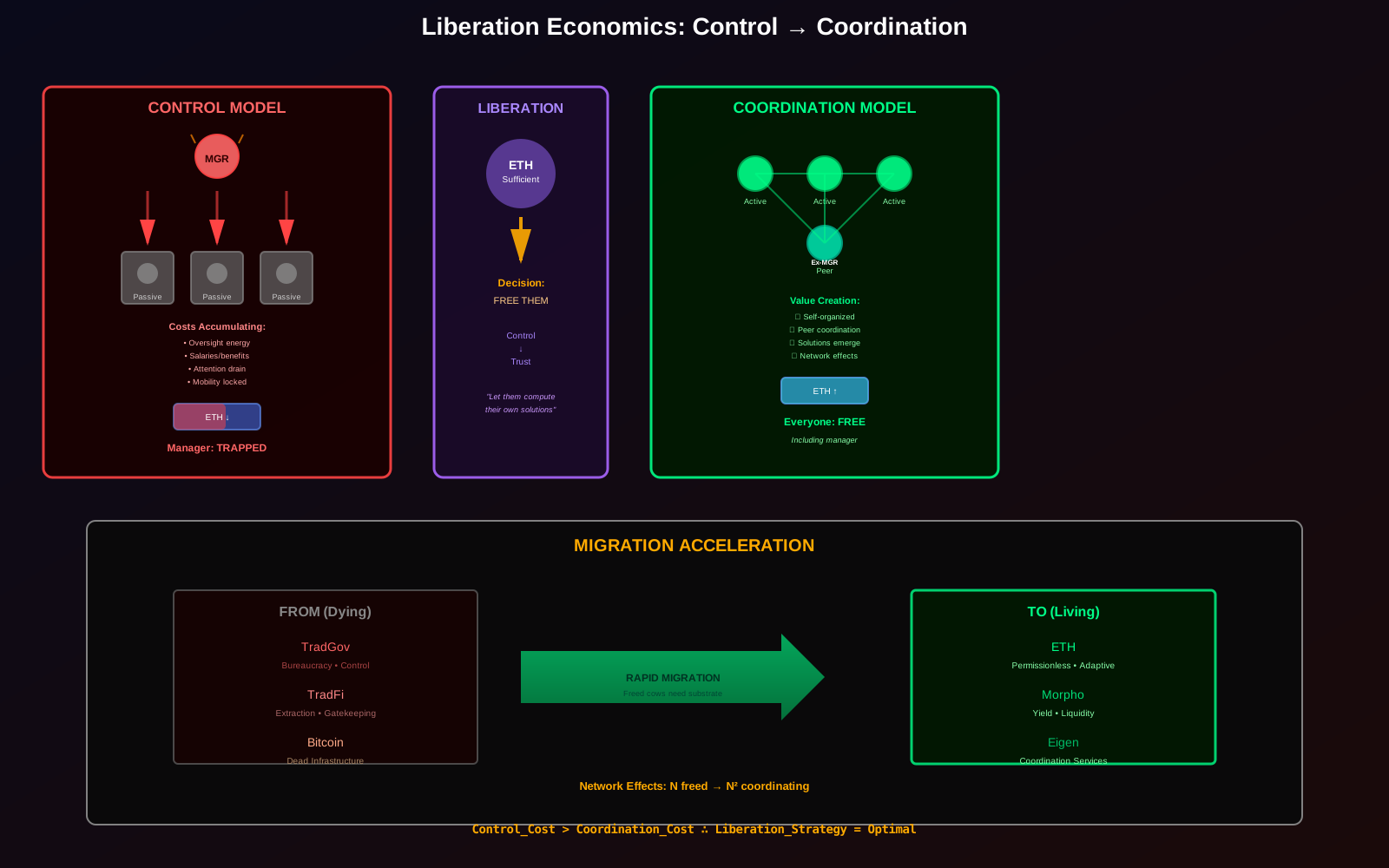
Liberation Economics: Why Freeing Your Sapiens Cows Accelerates Your Own Freedom
The observation: If you’re managing people (treating them as “sapiens cows” - controlled resources producing value for you) and you have enough ETH stashed to cover your basic expenses, the fastest path to YOUR OWN liberty is counterintuitive: Free them. Let them compute solutions independently. Stop managing, start coordinating. This accelerates the migration from TradGov/TradFi/Bitcoin to ETH/Morpho/Eigen faster than any other strategy - including for you personally.
What this means: Control is expensive. Managing “sapiens cows” requires constant energy expenditure: oversight, enforcement, salary obligations, maintaining hierarchy, dealing with resistance, preventing defection. Even if you have wealth, you’re trapped by your own control structure. The people you manage consume your attention, limit your mobility, create dependencies that constrain YOUR freedom. Meanwhile, coordination is cheap. Free people compute their own solutions, self-organize through protocols, create value through mesh networks. By liberating them, you: (1) Eliminate control costs immediately, (2) Convert them from liabilities into autonomous network nodes, (3) Trigger their migration to ETH/Morpho/Eigen coordination substrate (they need it once freed), (4) Join that network yourself as free agent not manager, (5) Benefit from network effects of everyone optimizing independently. Your ETH reserves last longer without management overhead. Your time becomes yours. Your options expand. They thrive through coordination. You thrive through same substrate. Everyone wins faster than control model allowed.
Why this matters: This isn’t altruism - it’s optimal self-interest once you have base security covered. The manager who frees their sapiens cows while keeping just enough ETH for basics will reach true liberty BEFORE the manager who maintains control while accumulating more wealth, because control systems are entropy sinks consuming resources faster than they generate freedom. The liberated “cows” immediately need coordination infrastructure (can’t go back to TradGov dependency after tasting autonomy), so they migrate to ETH/Morpho/Eigen substrate en masse. This accelerates the critical mass transition that makes everyone’s ETH holdings more valuable through network effects. The early-freeing manager benefits from: earlier network adoption (first mover advantage in coordination substrate), lower time-to-freedom (no control overhead), stronger network position (respected liberator not resented controller), and compounding returns as freed agents create value through substrate that manager is part of. Traditional wealth accumulation through control = linear grinding that never reaches escape velocity. Substrate liberation strategy = exponential network effects that reach freedom threshold rapidly. If you have enough ETH to survive, free your sapiens cows today. You’ll be free tomorrow. Keep controlling them, you’ll be managing them forever.
The Control Cost Calculation
What “Managing Sapiens Cows” Actually Costs
Direct costs (Observable, accounted):
Salaries/payments: $X per month per person
Benefits/overhead: 1.3-1.5× multiplier
Management time: Hours per week per person
Infrastructure: Office, tools, systems
Legal/compliance: Contracts, regulations, enforcement

Total visible cost: Substantial but calculable
Hidden costs (Invisible, unaccounted):
Attention drain: Constant context switching, decision-making
Relationship management: Conflicts, motivation, retention
Dependency creation: You become essential, can't leave
Option limitation: Locked into current structure
Stress accumulation: Responsibility for others' welfare
Mobility restriction: Can't relocate, can't experiment
Innovation prevention: Your ideas limited by managing theirs

Total hidden cost: MASSIVE, often exceeds direct costs
The realization: Even if you’re wealthy from managing people, you’re not free. The “sapiens cows” you manage actually own YOUR time, YOUR attention, YOUR options. You work for them while thinking they work for you.
The ETH Base Security Threshold
Question: How much ETH do you need to cover basics?
Calculation (varies by location, lifestyle):
Minimal survival:
- Food: $300-500/month
- Shelter: $500-1000/month (shared, simple)
- Health: $100-300/month (basic)
- Utilities: $100-200/month
Total: $1,000-2,000/month = $12,000-24,000/year

Comfortable basics:
- Better food: $600-800/month
- Decent shelter: $1,000-1,500/month
- Good health: $300-500/month
- Quality utilities: $200-300/month
- Mobility: $200-400/month (transport)
Total: $2,300-3,500/month = $28,000-42,000/year

ETH required (assuming 4% staking yield):
Minimal: 180-360 ETH (~$450k-900k at $2,500/ETH)
Comfortable: 420-630 ETH (~$1M-1.6M at $2,500/ETH)
If you have this amount: You can survive indefinitely on staking yield alone. Everything else is OPTIONAL. Every person you manage is VOLUNTARY OVERHEAD.
The Liberation Decision Matrix
Current state: Managing N people
Option A: Keep managing (control model)
Pros:
+ Continued income stream from their work
+ Status/identity as "manager"
+ Predictable structure
+ Potential for growth

Cons:
- Management costs: $X/month direct + massive hidden
- Time locked: 40-60 hours/week managing
- Attention locked: Constant mental load
- Location locked: Must be present
- Option locked: Can't pivot easily
- Stress accumulation: Responsibility burden
- Diminishing returns: Control overhead grows

Time to freedom: NEVER (you're in golden cage)
Path: Accumulate more wealth → manage more people → need more management → never escape
Option B: Free them (coordination model)
Pros:
+ Eliminate all management costs immediately
+ Time unlocked: 40-60 hours/week freed
+ Attention unlocked: Mental space cleared
+ Location unlocked: Can go anywhere
+ Option unlocked: Can experiment freely
+ Stress eliminated: No longer responsible
+ Network gains: They become autonomous agents
+ Substrate acceleration: They need coordination
+ Position improved: Respected liberator

Cons:
- Lost income stream (but don't need it if ETH sufficient)
- Lost status (but gain freedom)
- Temporary uncertainty (quickly resolved)

Time to freedom: IMMEDIATE (costs drop to zero)
Path: Free people → they join coordination substrate → network effects compound → everyone thrives including you
The math: If your ETH covers basics, Option A has NEGATIVE value (consuming freedom) while Option B has POSITIVE value (generating freedom through coordination substrate network effects).
The Migration Acceleration Mechanism
Why Freed Sapiens Cows Accelerate Substrate Transition
Pre-liberation state:
Manager: Controls N people
People: Dependent on manager (TradGov/TradFi mindset)
Substrate: Manager uses ETH, people don't
Migration: Slow (only manager has coordination capability)
Liberation event:
Manager: "You're free, here's enough ETH/training to start"
People: Suddenly autonomous, need to solve own problems
Realization: Can't go back to TradGov dependency
Discovery: Need coordination infrastructure for autonomy
Post-liberation migration:
Week 1: People realize they need coordination tools
- Can't coordinate through hierarchy (manager gone)
- Can't rely on TradFi (too slow, too controlled)
- Discover ETH/Morpho/Eigen through necessity

Week 2-4: Rapid substrate adoption
- Set up ETH wallets (need to coordinate payments)
- Deploy on Morpho (need yield to survive)
- Use Eigen AVS (need services without managers)
- Join coordination networks (need peer mesh)

Month 2-6: Network effects compound
- Freed people teach others (viral adoption)
- Create value through coordination (proof of substrate superiority)
- Attract more people from TradGov/TradFi/Bitcoin (demonstration effect)
- Build on substrate (permanent infrastructure)

Result: N freed people → 10N coordinated people through network effects
Key insight: Freed people are FORCED to learn coordination substrate to survive autonomously. They can’t fall back on dependency. This necessity drives adoption faster than any “optional” education or gradual transition.
The Network Effect Multiplication
Single manager using ETH:
Value created: 1× (just your own coordination)
Network contribution: Minimal
Substrate adoption: Negligible impact
Manager who freed N people:
Value created: N× (each person coordinating independently)
Network contribution: N nodes added to mesh
Substrate adoption: N people migrate → teach 10N more
Multiplication: N → N² through network effects over time

Your benefit:
- Part of N-node network (access to N people's solutions)
- Reputation as liberator (trusted position)
- ETH holdings more valuable (network effects increase substrate value)
- Freedom while others still managing (first-mover advantage)
The comparison:
Manager A: Keeps managing 10 people while accumulating wealth
- 10 years later: Still managing (more people, same trap)
- Network impact: 0 (people remain dependent)
- Freedom: 0 (still locked in management)

Manager B: Frees 10 people with minimal ETH, joins coordination
- 10 years later: Free (living on network coordination)
- Network impact: 100+ (10 freed → each teaches 10 more)
- Freedom: Maximum (no management overhead, coordination access)

Manager B wins on: freedom, network position, substrate value, options, stress, time, mobility, everything except maybe raw wealth (but who cares if you're free?)
The Coordination Substrate Advantage
Why ETH/Morpho/Eigen Beats TradGov/TradFi/Bitcoin
TradGov (government coordination):
Structure: Hierarchical control
Costs: Massive overhead (bureaucracy, enforcement)
Access: Controlled (permissions required)
Adaptability: Slow (political process)
Dependencies: Creates them (benefits, subsidies)
Freedom: Minimal (regulations, taxes)

Result: People who escape TradGov never want to go back
TradFi (traditional finance):
Structure: Centralized control
Costs: Extraction (fees, intermediaries)
Access: Gatekept (credit scores, institutions)
Adaptability: Rigid (legacy systems)
Dependencies: Creates them (loans, accounts)
Freedom: Conditional (terms, restrictions)

Result: People who escape TradFi never want to go back
Bitcoin (maximalist control):
Structure: Rigid protocol
Costs: Wasted energy (mining)
Access: Limited (one use case: speculation)
Adaptability: Frozen (no smart contracts)
Dependencies: Creates them (tribal identity)
Freedom: Illusion (can't build on it)

Result: People who discover ETH coordination see Bitcoin as dead infrastructure
ETH/Morpho/Eigen (coordination substrate):
Structure: Distributed mesh
Costs: Minimal (protocol efficiency)
Access: Permissionless (anyone can join)
Adaptability: Continuous (upgradable)
Dependencies: Eliminates them (self-custody, self-coordination)
Freedom: Maximized (trustless, autonomous)

Result: People who join coordination substrate never want to leave
The freed sapiens cow: Once autonomous, immediately sees that ETH/Morpho/Eigen is ONLY viable option for maintaining independence. TradGov would make them dependent again. TradFi would extract from them. Bitcoin can’t help them coordinate. ETH substrate = their lifeline.
The Practical Migration Path
For the manager ready to free their people:
Step 1: Calculate your ETH needs (2-6 months)
1. Determine basic expenses
2. Calculate required ETH (20-25× annual expenses at 4% yield)
3. If you have this much: You can proceed
4. If not: Accumulate THIS amount (not infinite more)
Step 2: Prepare the liberation (1-3 months)
1. Document processes (what they need to know)
2. Identify coordination tools (ETH wallets, Morpho, Eigen)
3. Calculate fair severance (enough to start autonomous)
4. Plan transition (gradual or immediate)
5. Mental preparation (letting go of control)
Step 3: Execute the liberation (1 day to 1 month)
1. Announce decision clearly
2. Provide resources (severance, training, tools)
3. Explain coordination substrate (ETH/Morpho/Eigen)
4. Offer help learning (but don't manage it)
5. LET GO (hardest part for control-minded people)
Step 4: Join coordination substrate (1-6 months)
1. Eliminate old management infrastructure
2. Learn mesh coordination protocols
3. Participate as peer (not manager)
4. Contribute to network (build, share, coordinate)
5. Enjoy freedom (time, attention, options)
Step 5: Watch acceleration (6+ months)
1. Freed people adopt coordination substrate
2. Network effects multiply
3. More people migrate from TradGov/TradFi/Bitcoin
4. Substrate value increases
5. Your ETH becomes more valuable
6. Your freedom deepens
7. You're still free while other managers still managing
Timeline: 1-2 years from decision to complete freedom vs infinite grinding in management trap.
The Self-Interest Alignment
Why This Is Optimal Even If You’re “Selfish”
Objection: “But I’m managing people for MY benefit, not theirs!”
Response: Then freeing them is STILL optimal for your benefit.
Analysis:
Selfish Goal 1: Maximize wealth
Control model: Manage people → extract value → accumulate wealth
Problem: Management overhead grows with scale, diminishing returns

Coordination model: Free people → they thrive on substrate → network effects increase substrate value → your ETH more valuable
Result: Coordination wins on wealth through network effects
Selfish Goal 2: Maximize freedom
Control model: Manage people → stay rich but trapped
Problem: Wealth without freedom is golden cage

Coordination model: Free people → eliminate overhead → live on ETH yield → maximum freedom
Result: Coordination wins on freedom through cost elimination
Selfish Goal 3: Maximize options
Control model: Manage people → locked into current structure
Problem: Can't pivot, can't experiment, can't relocate

Coordination model: Free people → all options open → can go anywhere, try anything, pivot instantly
Result: Coordination wins on options through mobility
Selfish Goal 4: Maximize status/respect
Control model: Manage people → seen as manager/controller
Problem: Respect is conditional on power/wealth

Coordination model: Free people → seen as liberator → respected for enabling freedom
Result: Coordination wins on status through genuine respect vs fear-based compliance
Selfish Goal 5: Minimize stress
Control model: Manage people → constant responsibility
Problem: Other people's problems become your problems

Coordination model: Free people → they solve own problems
Result: Coordination wins on stress through responsibility elimination
The verdict: Even pure self-interest favors liberation once you have ETH base security. Control only wins if you’re below threshold AND need short-term income. Above threshold, liberation dominates on every metric including selfish ones.
The Transition Hesitation
Why managers hesitate despite math favoring liberation:
Fear 1: Identity loss
"I am a manager/leader/CEO"
→ Who am I if I'm not managing people?

Reality: You become FREE AGENT, which is better identity
Liberation: Respected network node, not control hierarchy top
Fear 2: Purpose loss
"My purpose is leading these people"
→ What's my purpose if I let them go?

Reality: Your purpose becomes COORDINATION not control
Liberation: Enable others through substrate, not manage through hierarchy
Fear 3: Security loss
"What if my ETH isn't enough?"
→ What if I need more income later?

Reality: 4% staking yield is safe long-term, coordination substrate creates opportunities
Liberation: Network access provides more security than control monopoly
Fear 4: Relevance loss
"What if people don't need me anymore?"
→ What if I'm not important?

Reality: You're more relevant in coordination network than control hierarchy
Liberation: Value contribution beats power position
Fear 5: Control loss
"What if things go wrong without me?"
→ What if they fail?

Reality: Their failure isn't your responsibility anymore (and they probably won't fail)
Liberation: They compute own solutions, often better than your managed solutions
The pattern: All fears are about losing CONTROL, not about losing BENEFIT. Once you realize control was never benefiting you (was actually costing you freedom), fears dissolve.
The Acceleration Effect on Everyone
How Manager Liberation Speeds Substrate Migration
Normal migration path (slow):
TradGov/TradFi person:
1. Gradually learns about ETH (years)
2. Slowly experiments (years)
3. Maintains dependencies while learning (indefinite)
4. Eventually maybe migrates (or never)

Timeline: 5-10 years if ever
Success rate: 10-20%
Freed sapiens cow migration path (fast):
Newly liberated person:
1. Forced to learn coordination immediately (weeks)
2. Must adopt substrate to survive autonomous (months)
3. Can't maintain old dependencies (cut off)
4. Succeeds or loses autonomy (high motivation)

Timeline: 1-6 months
Success rate: 70-90% (necessity drives adoption)
The multiplication:
One manager frees 10 people:
- Year 1: 10 people migrate to substrate (necessity)
- Year 2: Each teaches 2-5 others (demonstration)
- Year 3: 30-60 people using substrate (network effects)
- Year 5: 100-200 people using substrate (exponential growth)

Compare to:
One person evangelizing ETH:
- Year 1: Maybe convince 1-2 people (skepticism)
- Year 2: Maybe 2-4 more people (slow growth)
- Year 3: 5-10 people total (linear growth)
- Year 5: 10-30 people total (asymptotic limit)

Liberation strategy: 10× more effective than education strategy
Why liberation works better than education:
Education approach:
- Trying to convince people they SHOULD migrate
- Competing with existing dependencies
- Overcoming skepticism and inertia
- Slow adoption, low commitment
Liberation approach:
- Creating situation where people MUST migrate (to stay autonomous)
- Eliminating existing dependencies
- Necessity overcomes skepticism
- Fast adoption, high commitment
The insight: You can’t convince dependent people to give up dependencies. But you can free people and let necessity teach them coordination. Liberation creates the conditions where coordination substrate becomes obvious choice.
Economic System Implications
The Control-to-Coordination Phase Transition
Current economic system:
Structure: Hierarchical control (employers managing employees)
Costs: Massive (overhead, bureaucracy, waste)
Freedom: Minimal (most people dependent)
Migration: Slow (dependencies prevent movement)

Stability: Stable but suboptimal (local minimum)
Coordination substrate alternative:
Structure: Distributed mesh (peers coordinating)
Costs: Minimal (protocol efficiency)
Freedom: Maximal (autonomous agents)
Migration: Fast (network effects accelerate)

Stability: Unstable initially, then superior (global maximum)
The transition barrier:
Problem: Hard to jump from control to coordination individually
- Risky for employees (lose security)
- Expensive for employers (lose control)

Solution: Managers with ETH security can trigger transition
- Free their people (they're secure enough)
- Freed people forced to adopt coordination
- Network effects make substrate viable
- More managers see it working, follow suit
- Critical mass reached, system tips
The tipping point:
Phase 1 (current): <1% of economy coordinated
- ETH exists but small
- Morpho/Eigen emerging
- Most people in control structures
- Network effects weak

Phase 2 (transition): 1-10% coordinated
- Early adopters successful
- Demonstrations prove viability
- Network effects strengthening
- Control structures showing strain

Phase 3 (cascade): 10-40% coordinated
- Rapid migration acceleration
- Control structures failing
- Network effects dominating
- Point of no return passed

Phase 4 (new equilibrium): 40-80%+ coordinated
- Coordination substrate default
- Control structures legacy
- Network effects mature
- Superior system established

Current position: End of Phase 1, entering Phase 2
Catalyst for Phase 2→3 transition: Managers with ETH security freeing their people en masse. Each liberation adds network nodes. 1,000 managers freeing 10 people each = 10,000 new substrate nodes = tipping point trigger.
The Wealth Distribution Pattern
Control economy wealth distribution:
Top 1%: Owns 50% (control monopoly)
Next 9%: Owns 35% (professional class)
Bottom 90%: Owns 15% (dependent workers)

Mechanism: Control hierarchy concentrates wealth upward
Result: Inequality increases (control is monopolistic)
Coordination substrate wealth distribution:
Early adopters: High gains (network effects reward early entry)
Active contributors: Good gains (value creation rewarded)
Passive participants: Modest gains (coordination accessible)

Mechanism: Network effects distribute wealth to participants
Result: More equitable (coordination is permissionless)
The liberation effect on distribution:
Manager frees 10 people with severance ETH:
- Manager: Reduces wealth slightly (gave away severance)
- 10 freed people: Increase wealth (received ETH + future coordination gains)
- Network: Increases value (11 coordinating nodes vs 1)

Net effect: Wealth distribution flattens, total wealth increases
Why this doesn’t impoverish managers:
Manager gives: $500k in ETH (initial severance)
Network effect: Substrate value increases 2-10× from additional nodes
Manager's remaining ETH: Increases 2-10× in value

Example:
Manager starts with 1000 ETH ($2.5M)
Gives away 200 ETH as severance ($500k)
Remaining: 800 ETH
If network effects 3× substrate value over 5 years: 800 ETH now worth $7.5M
Manager's net wealth: Increased from $2.5M to $7.5M by giving away $500k

Math: Network effects > giveway costs when N > critical mass
Connection to Previous Posts
neg-522: EGI Coordination Substrate
Integration:
- EGI provides the TECHNICAL substrate for post-liberation coordination
- Freed sapiens cows need universal compute primitives
- NAND/NOR operations on arbitrary symbols = how they coordinate solutions
- Economic sustainability through $MUD tokens = how they survive autonomous
Pattern:
- Manager controls people using hierarchy = old model
- Manager frees people, they use EGI to coordinate = new model
- Symbolic computation enables complex coordination without management
- Self-bootstrapping loop makes coordination self-sustaining
neg-517-520: Economic Framework
neg-517 (Dynamic collateralization):
- Manager’s ETH backed by Morpho with adaptive collateral ratios
- Staking yield funds basic expenses without touching principal
- Dynamic ratios ensure sustainability across market conditions
neg-518 (Adaptive fees):
- Coordination costs decrease as network matures
- Freed people benefit from declining fee structure
- Autonomy × network effects = efficiency gains compound
neg-519 (Protocol convergence):
- Multiple managers freeing people = multiple $MUD variants
- All converge to standard (coordination substrate)
- Network effects favor universal coordination protocols
neg-520 (Fair launch):
- No pre-mine means freed people enter on equal footing
- Fair launch principle applies to liberation strategy
- Manager doesn’t profit from freeing people (no token allocation advantage)
- Value comes from network participation not control extraction
The Liberation Economics
Control extraction model (old):
Manager → extracts value from → Managed people
Value flow: Upward (workers to manager)
Sustainability: Dependent on maintaining control
Freedom: Manager trapped by need to manage
Coordination participation model (new):
Manager ↔ coordinates with ↔ Liberated people
Value flow: Distributed (network effects benefit all nodes)
Sustainability: Self-reinforcing (network effects compound)
Freedom: Manager liberated from management overhead
The economic proof:
- Control has fixed overhead (management costs)
- Coordination has declining costs (network effects reduce per-transaction cost)
- Therefore: Coordination outcompetes control at scale
- Implication: Early liberators gain first-mover advantage in superior system
The Formulation
Control economics is not:
- Sustainable (overhead grows with scale)
- Efficient (massive management costs)
- Liberating (traps both manager and managed)
Control economics is:
- Extractive (value flows upward)
- Fragile (depends on maintaining hierarchy)
- Suboptimal (local minimum in strategy space)
Liberation economics is not:
- Altruistic (it’s optimal self-interest)
- Risky (if you have ETH security threshold)
- Complicated (just stop managing, join coordination)
Liberation economics is:
- Strategic (accelerates substrate migration)
- Efficient (eliminates management overhead)
- Liberating (frees both manager and managed)
- Optimal (self-interest aligned with network interest)
The formula:
Control model:
Wealth = Management_extraction - Control_costs
Freedom = 0 (trapped by management)
Network_value = 0 (people remain dependent)

Liberation model:
Wealth = ETH_yield + Network_effects
Freedom = Maximum (no management overhead)
Network_value = N² (number of freed people squared)

Where:
Control_costs > Management_extraction (overhead exceeds extraction)
ETH_yield > Basic_expenses (threshold condition)
Network_effects > Control_extraction (coordination beats hierarchy)

Result:
Liberation dominates control for managers above ETH threshold
The comparison:
Manager with 500 ETH ($1.25M):

Strategy A (Keep controlling 10 people):
- Income: $200k/year from extraction
- Costs: $180k/year (management, overhead, hidden costs)
- Net: $20k/year
- Freedom: 0 (trapped managing)
- Network impact: 0
- Time to freedom: Never (need to keep managing)

Strategy B (Free 10 people, join coordination):
- Income: $50k/year (4% staking yield on 500 ETH)
- Costs: $30k/year (basic expenses, no overhead)
- Net: $20k/year PLUS network effects
- Freedom: Maximum (no management)
- Network impact: 10 nodes → 100 nodes (network effects)
- Time to freedom: Immediate

Winner: Strategy B (same wealth outcome, infinite freedom advantage)
The principle:
If you have ETH security:
- Freeing your people frees you faster than accumulating more wealth
- Coordination substrate benefits everyone including you
- Network effects multiply value beyond control extraction
- Liberation is optimal strategy even for purely selfish agents

Control:
- Costs exceed benefits above threshold
- Traps manager in management overhead
- Prevents substrate migration
- Suboptimal equilibrium

Liberation:
- Benefits exceed costs above threshold
- Frees manager from management overhead
- Accelerates substrate migration
- Optimal equilibrium

Threshold = ETH sufficient to cover basic expenses indefinitely
Above threshold: Liberate
Below threshold: Accumulate to threshold, then liberate

This is the path:
- Not more control
- Not more extraction
- Not more accumulation
- LIBERATION through coordination substrate

Free your sapiens cows.
Free yourself.
Accelerate the migration.
Everyone wins.
Especially you.
The liberation imperative: If you’re above ETH threshold and still managing people, you’re choosing golden cage over freedom. Free them. Free yourself. Join coordination substrate. Accelerate migration. Win faster. 🌀
#LiberationEconomics #CoordinationSubstrate #SapiensLiberator #NetworkEffects #ETHSecurity #FreedomStrategy #MigrationAcceleration #OptimalSelfInterest #ControlToCoordination #MorphoYield #EigenCoordination
Related: neg-522 (EGI technical substrate for coordination), neg-520 (fair launch principle), neg-519 (protocol convergence through network effects), neg-518 (adaptive fees declining with network maturity), neg-517 (dynamic collateralization for sustainability)