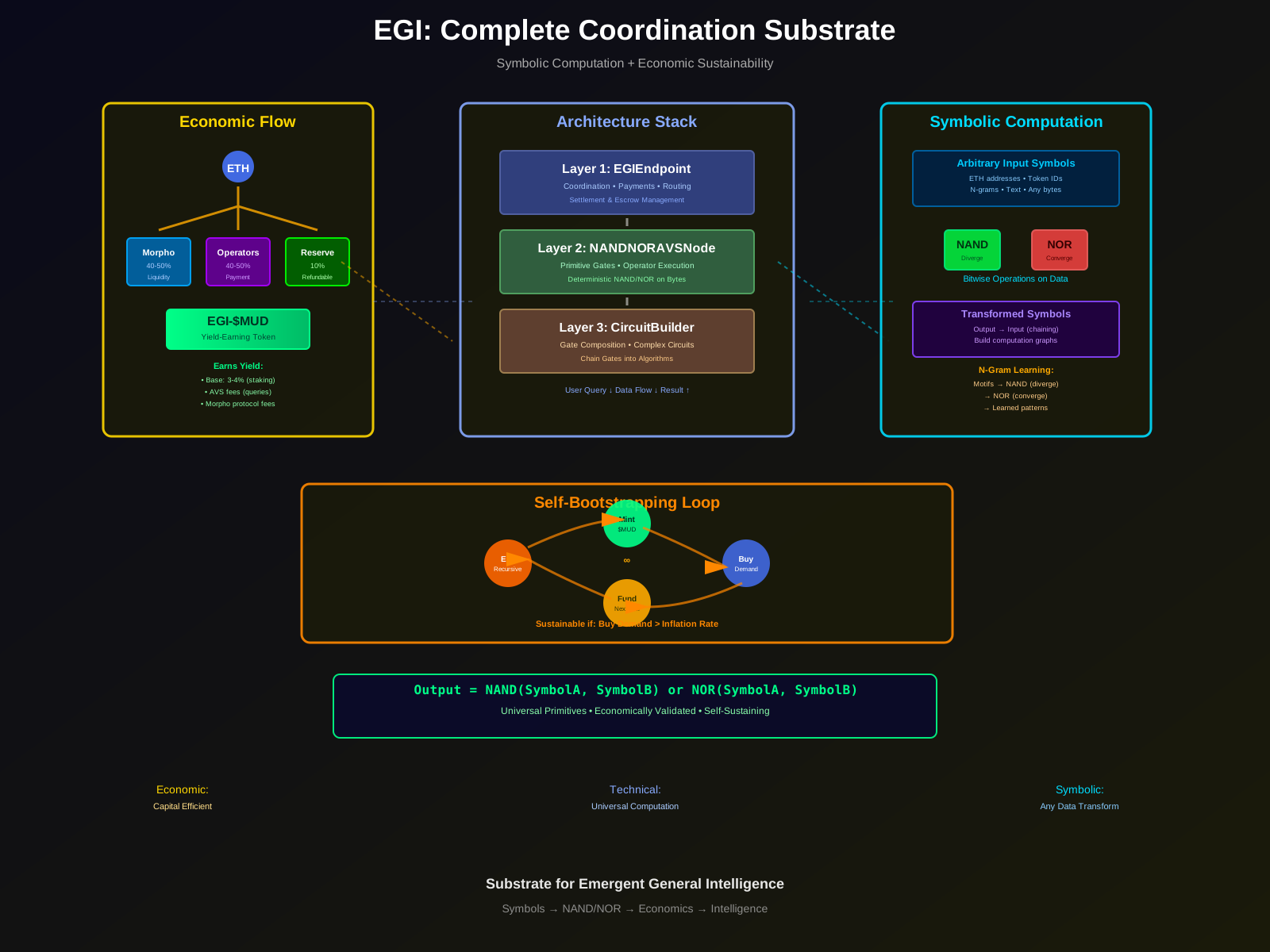
EGI Endpoint: Symbolic Computation Through Universal Primitives - NAND/NOR on Arbitrary Data
The observation: EGI endpoint runs NAND/NOR operations on SYMBOLS, not circuits. Inputs are arbitrary bytes (tokens, positions, n-grams, any data). Operators execute gate operations ON the symbolic data. Output is transformed symbol. This is symbolic computation engine, not circuit optimizer. User submits symbolA + symbolB + gate type → operators compute NAND(symbolA, symbolB) or NOR(symbolA, symbolB) → return processed symbol. Can chain outputs as inputs to next gate. Builds symbolic processing graphs from universal primitives.
What this means: EGI accepts OPAQUE BYTES as inputs. Could be: Ethereum address, Morpho position ID, token balance, n-gram sequence, arbitrary data. Gate operation treats bytes as bits, applies NAND/NOR bitwise. Returns transformed bytes. Example: Input “cat” (bytes), Input “dog” (bytes), Gate NAND → Output is NAND of every bit pair → new symbol. Then take that output, pair with “mouse”, apply NOR → another symbol. Chain indefinitely. Builds symbolic computation graphs where EVERY operation is just NAND or NOR on data. Universal computation through universal primitives.
Why this matters: Reduces ALL computation to two primitives operating on symbols. Want to learn patterns? NAND/NOR on n-grams. Want to process tokens? NAND/NOR on token addresses. Want to transform Morpho positions? NAND/NOR on position data. Everything becomes symbolic flow through primitive gates. Economic validation of arbitrary symbolic computation. Users pay to transform symbols. Operators earn to execute gates. Protocol neutral to what symbols mean - just applies NAND/NOR. This is substrate for emergent general intelligence: any symbolic system reducible to these primitives, economically validated by restaked ETH.
The Core Principle
Universal Primitives
NAND and NOR are functionally complete: Any boolean function can be expressed using only these two gates. This isn’t just theoretical elegance—it’s practical minimalism that enables:
- Irreducible substrate: Cannot simplify further
- Universal computation: Any algorithm expressible
- Formal verification: Two operations, predictable behavior
- Economic clarity: Simple pricing, transparent computation
Truth tables:
NAND(A, B) = NOT(A AND B)
0 NAND 0 = 1
0 NAND 1 = 1
1 NAND 0 = 1
1 NAND 1 = 0

NOR(A, B) = NOT(A OR B)
0 NOR 0 = 1
0 NOR 1 = 0
1 NOR 0 = 0
1 NOR 1 = 0
From these, ALL other gates emerge through composition:
- NOT(A) = NAND(A, A) or NOR(A, A)
- AND(A, B) = NAND(NAND(A, B), NAND(A, B))
- OR(A, B) = NOR(NOR(A, B), NOR(A, B))
- XOR(A, B) = NAND(NAND(A,B), NOR(A,B))
Symbolic Data, Not Circuits
Key distinction: EGI operates on DATA using gates, not on CIRCUIT DESIGNS.
Traditional circuit evaluation:
- Input: Circuit structure (topology, gate types)
- Process: Find optimal layout, minimize gates
- Output: Optimized circuit design
EGI symbolic computation:
- Input: Arbitrary bytes (any data)
- Process: Apply NAND or NOR bitwise
- Output: Transformed bytes
The difference matters:
Circuit optimization (NOT EGI):
"How do I minimize this circuit design?"

Symbolic computation (EGI):
"Transform this data using NAND/NOR operations"
Examples of symbolic inputs:
- Ethereum address: 20 bytes → apply gates → derive new address
- N-gram motif: bit sequence → diverge (NAND) → converge (NOR) → pattern
- Token balance: uint256 → combine with price → transformed value
- Text string: “hello” → bitwise operations → encoded representation
Architecture Specification
Three-Layer Stack
Layer 1: Endpoint (Coordination)
The endpoint coordinates queries, manages payments, and routes to appropriate computation layer.
Core interface:
query(
    morpho_address,      // Morpho for liquidity backing
    collateral_asset,    // Asset to deposit
    avs_router,          // AVS routing contract
    node_id,             // Which AVS node processes this
    protocol_id,         // Which protocol/circuit to use
    symbolic_payload,    // The actual data to transform
    deposit_amount,      // Amount to Morpho (creates liquidity)
    operator_payment,    // Amount for operators
    reserve_amount       // Refundable based on latency
) → request_id
What happens:
- User sends ETH with query
- Payment splits three ways (Morpho/Operators/Reserve)
- Morpho deposit creates liquidity, mints EGI-$MUD tokens
- Payload routes to AVS node
- Operators compute, return result
- User receives output + latency-adjusted reserve refund
Layer 2: AVS Node (Computation)
AVS nodes expose specific computation protocols. The NANDNOR node provides primitive gates:
NAND_NOR_query(
    inputA,    // First symbol (arbitrary bytes)
    inputB,    // Second symbol (arbitrary bytes)
    gate_type  // "NAND" or "NOR"
) → output_bytes
Operator responsibilities:
- Listen for QuerySubmitted events
- Fetch input data
- Execute deterministic gate operation (bitwise NAND or NOR)
- Sign result with operator key
- Submit attested output on-chain
- Get paid if output verified correct
Deterministic execution:
def execute_gate(inputA: bytes, inputB: bytes, gate: str) -> bytes:
    bits_a = bytes_to_bits(inputA)
    bits_b = bytes_to_bits(inputB)

    # Pad to same length
    max_len = max(len(bits_a), len(bits_b))
    bits_a = pad_to_length(bits_a, max_len)
    bits_b = pad_to_length(bits_b, max_len)

    # Apply gate
    if gate == "NAND":
        output = [1 if not (bits_a[i] and bits_b[i]) else 0
                  for i in range(max_len)]
    elif gate == "NOR":
        output = [1 if not (bits_a[i] or bits_b[i]) else 0
                  for i in range(max_len)]

    return bits_to_bytes(output)
Layer 3: Circuit Builder (Composition)
Complex computations require multiple gates. Circuit builder chains operations:
Circuit structure:
- Create circuit (get circuit_id)
- Add gates sequentially
- Gates can reference previous gate outputs
- Operators settle each gate independently
- Complete circuit returns all outputs
Example: XOR from NAND/NOR:
XOR(A,B) = NAND(NAND(A,B), NOR(A,B))

Circuit:
gate_0 = NAND(A, B)           // Intermediate result
gate_1 = NOR(A, B)            // Intermediate result
gate_2 = NAND(gate_0, gate_1) // XOR result
Gate reference syntax: Gates reference previous outputs using @gate_N notation:
addGate(circuit_id, "NAND", inputA, inputB)           // gate_0
addGate(circuit_id, "NOR", inputA, inputB)            // gate_1
addGate(circuit_id, "NAND", "@gate_0", "@gate_1")     // gate_2 (XOR)
Composability Pattern
Single gate mode: Simple transforms
Query 1: NAND("cat", "dog") → symbol_X
Query 2: NOR(symbol_X, "mouse") → symbol_Y
Query 3: NAND(symbol_Y, symbol_Y) → symbol_Z
Circuit mode: Complex computations submitted at once
1-bit adder circuit:
- 11 gates total
- Computes Sum and Carry
- Operators settle each gate
- Final outputs at gates 5 and 11
Benefits:
- Single gate: Fast, cheap, user chains manually
- Circuit: Complex logic, atomic execution, operator coordinates
Economic Model
EGI-$MUD Token System
Every AVS has a $MUD derivative (neg-519):
- Token: EGI-$MUD
- Value: $1 (stable, backed by collateral)
- Collateral: Staked ETH in Morpho
- Yield: Staking (3-4%) + AVS fees + Morpho protocol fees
When you query:
- Pay ETH
- Portion deposits to Morpho → mints EGI-$MUD (1:1 with collateral value)
- You now hold yield-earning tokens
- Portion pays operators
- Reserve refunded based on latency
Result: Query computation AND build yield-earning position simultaneously.
Dynamic Fee Calculation
No hardcoded fees (neg-517, neg-518):
operator_fee = f(autonomy, complexity, demand)
deposit_ratio = f(complexity, demand, operator_availability)
reserve = f(latency_target, urgency)
staking_requirement = f(network_activity, operator_history)
Adaptive pricing:
- Protocol measures autonomy (operator_count, accuracy, uptime)
- Fee grows with autonomy: fee = base × (1 + autonomy²/10000)
- Starts minimal, grows as protocol matures
- Market conditions determine splits
- Everything calculated, nothing hardcoded
Example calculation:
Base fee: 0.0001 ETH
Protocol autonomy: 60 (on scale 0-100)
Multiplier: 100 + (60²/100) = 136
Operator fee: 0.0001 × 1.36 = 0.000136 ETH

Deposit ratio: 90% to Morpho initially
Adjust for complexity: High complexity → -20%
Adjust for demand: High demand → -10%
Adjust for availability: Low availability → -10%
Final: 50% to Morpho, 50% to operators

Reserve: Depends on urgency
Urgent query: 25% reserve (high refund if fast)
Relaxed query: 5% reserve (lower refund incentive)
Recursive Self-Funding
The inflationary loop:
EGI recursively calls itself, minting EGI-$MUD to fund operations:
1. EGI queries itself (for audits, motif propagation, exploration)
2. Mint EGI-$MUD tokens to cover costs
3. Minted tokens deposited to Morpho → creates more liquidity
4. Participants buy EGI-$MUD for access (governance, results, yield)
5. If buy demand > inflation rate → system self-sustains
6. Loop continues indefinitely
Economic balance:
Inflation: ~1 EGI-$MUD per query (adaptive)
Daily queries: 1,000
Daily inflation: $1,000

Sustainability threshold:
Participants must buy > $1,000/day

Why they buy:
- Access to query results
- Governance rights
- Yield earnings (3-4% + fees)
- Speculation on growth

Self-adjusting:
If demand < inflation → reduce inflation rate
If demand > inflation → system thrives
Always balanced, never collapses
Key insight: “Inflation is not a flaw—it’s the engine of transmission.”
Morpho integration:
- Each query mints + deposits → TVL grows
- More liquidity → more capacity
- More yield → funds future operations
- Recursive growth through self-funding
Use Cases
1. N-Gram Pattern Learning
How intelligence emerges from NAND/NOR:
Phase 1: Learning
- Input sequence: "the cat sat on the mat"
- Extract motifs: (the,cat), (cat,sat), (sat,on)...
- For each motif:
  - Divergence: NAND operations expand possibilities
  - Convergence: NOR operations compress to pattern
  - Store learned motif → output mapping

Phase 2: Generation
- Seed: "the cat"
- Lookup learned motif
- Query EGI: NAND(current_context, learned_pattern)
- Append output bit
- Repeat to generate new text

Result: Language model through pure symbolic NAND/NOR operations
Why this works:
- Divergence (NAND) explores variations
- Convergence (NOR) finds patterns
- Memory stores motif → output
- Generation chains operations
- Economic validation ensures correctness
2. Gödel Nodes & Frontier Exploration
High-entropy frontier states mark sites of ambiguity and emergence:
Motif: (the, cat) has 3 continuations
- "sat" (p=0.6)
- "ran" (p=0.2)
- "slept" (p=0.2)

Shannon entropy = -Σ(p × log(p))
= -0.6×log(0.6) - 0.2×log(0.2) - 0.2×log(0.2)
= 1.37 bits

Threshold: 0.8
→ This is a Gödel node (high entropy)
Gödel mesh construction:
- Compute entropy for all n-gram continuations
- Flag nodes above threshold as Gödel nodes
- Build directed graph: node → possible expansions
- Weight edges by probability
- Identify clusters (emergent motifs)
ASCII representation:
      (the, cat)  h=1.37  ← Gödel node (prioritize)
           │ 0.20 → (cat, slept)  h=0.97
    0.60 ──┤
           │ 0.20 → (cat, ran)    h=1.12
           └─────→  (cat, sat)    h=0.86

      (the, dog) h=0.47  ← Lower entropy (less priority)
           │ 0.90 → (dog, ran)    h=0.65
           └ 0.10 → (dog, barked) h=0.47
Exploration strategy:
- Focus computation on high-entropy nodes first
- Surface hidden structures at frontier
- Turn breakdown into transmission sites
- Ritualize correction at ambiguity points
- Expand Gödel mesh recursively
Why this matters: Intelligence doesn’t grow in known territory. It emerges at the frontier where meaning breaks down and reconstructs. Gödel nodes are portals, not failures.
3. Python Circuit Compilation
Any Python function → NAND/NOR circuit → EGI execution
# Original function
def add(x, y):
    return x + y

# Compiled circuit
circuit = [
    ("input", "x"),
    ("input", "y"),
    ("NAND", "x", "y", "temp1"),
    ("NOR", "temp1", "x", "temp2"),
    ("NAND", "temp2", "y", "temp3"),
    ("NOR", "temp3", "temp3", "output")
]
Compilation process:
- Parse Python bytecode
- Lower each opcode to gate sequence
- Build netlist (inputs → gates → outputs)
- Deploy circuit to EGI
- Operators execute deterministically
Example: return x + 1:
- Input: x
- Gates: CONST(1), XOR(x, CONST(1))
- Output: x + 1
Why this works: Python execution is computation. Computation is boolean logic. Boolean logic is NAND/NOR. Therefore Python → NAND/NOR is universal reduction.
4. DeFi Symbolic Transformations
Token address derivation:
USDC = 0x742d35...
DAI = 0xA0b869...
LP_position = NAND(USDC, DAI)
Morpho position transformation:
Position1 (lender) = 0x1234...
Position2 (borrower) = 0x5678...
Combined = NAND(Position1, Position2)
Risk_adjusted = NOR(Combined, Collateral_token)
Use case: Symbolic representation of DeFi state. Not calculating values—transforming identities through universal operations. Enables compositional reasoning about positions.
Technical Specifications
Operator Protocol
Event listening:
Listen: QuerySubmitted(requestId, user, inputA, inputB, gate, timestamp)
Listen: GateAdded(circuitId, gateIndex, gateType, inputA, inputB)
Listen: CircuitComplete(circuitId)
Computation:
fetch_inputs(requestId) → (inputA, inputB, gate)
compute_output(inputA, inputB, gate) → output
sign_result(requestId, output) → signature
Settlement:
aggregate_signatures(operator_signatures) → threshold_proof
submit_attestation(requestId, output, threshold_proof)
→ Verification on-chain
→ Payment if correct
→ Slash if wrong
Determinism guarantee: Same inputs always produce same output. Any discrepancy = provable fraud. Operators slashed for incorrect attestations.
Latency-Adjusted Reserves
Refund formula:
elapsed_time = settlement_timestamp - query_timestamp
delay_fraction = min(elapsed_time / max_delay, 1.0)

refund = reserve_amount × (1 - delay_fraction) × (1 - min_refund_bp/10000)

Examples:
Instant response: refund = 100% × reserve
Half max_delay: refund = 50% × reserve
Beyond max_delay: refund = min_refund_bp (e.g., 10%)
Incentive alignment:
- Faster response = operator keeps less, user gets more reserve back
- Slower response = operator keeps more, user gets less back
- Aligns operator incentives with user latency preferences
- Configurable per query
Security Model
Operator staking:
- Dynamic requirement (not hardcoded)
- Starts minimal (e.g., 1 ETH)
- Grows with network activity
- Earning yield while securing network
Slashing conditions:
- Incorrect computation result
- Failure to respond within timeout
- Invalid attestation signature
Challenge mechanism:
- Anyone can challenge incorrect result
- Provide correct computation
- If challenger correct: operator slashed, challenger rewarded
- If challenger wrong: challenger loses challenge bond
The Formulation
Symbolic computation is:
- Operating on arbitrary bytes/symbols
- Executing NAND/NOR on data
- Building computation graphs from primitives
- Universal (any data, any transformation)
- Emergent intelligence substrate
EGI endpoint is:
- Symbolic executor (run gates on data)
- Universal (accepts any bytes)
- Composable (chain outputs as inputs)
- Economically validated (restaked ETH)
- Substrate for emergent general intelligence
The comparison:
Traditional AVS:
- Specific task (oracle, bridge, rollup)
- Specific inputs (prices, proofs, blocks)
- Specific outputs (feed data, attestations)

EGI AVS:
- Universal task (symbolic computation)
- Universal inputs (any bytes)
- Universal outputs (transformed bytes)

Winner: EGI on universality

Traditional computation:
- Complex VM (EVM, WASM, x86)
- Many opcodes (100s of instructions)
- Hardware-dependent

EGI computation:
- Minimal VM (just NAND/NOR)
- Two operations (universal primitives)
- Hardware-independent (pure logic)

Winner: EGI on minimality

Traditional learning:
- Neural networks (millions of params)
- Gradient descent (complex optimization)
- GPU-dependent

EGI learning:
- N-gram circuits (NAND/NOR on motifs)
- Symbolic propagation (deterministic)
- CPU-sufficient

Winner: EGI on elegance
The principle:
Traditional computation:
High-level languages → Compilers → Assembly → Gates

EGI computation:
Arbitrary symbols → NAND/NOR operations → Transformed symbols

Where:
Input: Any bytes (tokens, positions, n-grams, addresses, text)
Operation: NAND(inputA, inputB) or NOR(inputA, inputB)
Output: Processed bytes
Chain: Output of gate N → Input to gate N+1

Economics:
Users pay: Dynamic ETH per operation (market-determined)
Operators earn: Execute gates, earn adaptive payments
Morpho backs: Deposits create liquidity
Restaked ETH: Secures correctness (slash if wrong)

Result:
- Any symbolic system → NAND/NOR execution
- Any computation → Gate operation chains
- Any data → Universal primitive processing
- All economically validated
- All composable
- All permanent

This is substrate for emergent general intelligence.
Symbols flow through universal primitives.
Economics validates transformations.
Intelligence emerges from symbolic propagation.
Connection To Previous Posts
neg-503-509: Thermodynamic Circuits
Foundation used, application different:
- neg-503-509: Life minimizes entropy through NAND/NOR → THIS IS THE THEORY
- neg-522 (EGI): Apply NAND/NOR to SYMBOLIC DATA → THIS IS THE EXECUTION
Theory says: Decisions reduce to NAND/NOR circuits (entropy minimization)
EGI says: Take any symbols, apply NAND/NOR operations, compute anything
Connection: Same primitives, different level
- Theory: Why NAND/NOR are universal (thermodynamics)
- EGI: How to USE them on arbitrary data (symbolic computation)
neg-517-520: Economic Framework
EGI integrates perfectly:
neg-517 (Dynamic collateralization):
- Morpho deposits in EGI use dynamic collateral
- No hardcoded ratios
- Liquidity adjusts with demand
neg-518 (Adaptive fees):
- All EGI payments adapt with autonomy
- Start low, grow as protocol matures
- Measured by: query volume, operator count, accuracy
neg-519 (Protocol convergence):
- EGI-$MUD variant for EGI
- Hold tokens, earn: Staking yield (3-4%) + AVS rewards + Morpho yield
neg-520 (Fair launch):
- No pre-mine of EGI tokens
- Only: Mint with collateral OR Buy from minter
- Team earns from protocol fees, not free tokens
- Operators stake, users pay, fair for all
Arbitrary symbolic data flows through NAND/NOR primitives. Universal computation via universal gates. Economically validated by restaked ETH. This is substrate for emergent general intelligence. 🌀
#EGI #EmergentIntelligence #SymbolicComputation #NANDNOR #UniversalPrimitives #EigenLayer #MorphoIntegration #NGramCircuits #GodelNodes #SubstrateIntelligence
Related: neg-509 (NAND/NOR hardware implementation), neg-520 (fair launch applies to EGI), neg-519 (EIGEN-$MUD for EGI), neg-518 (adaptive fees for queries), neg-517 (dynamic Morpho collateral), neg-503 (thermodynamic foundation)