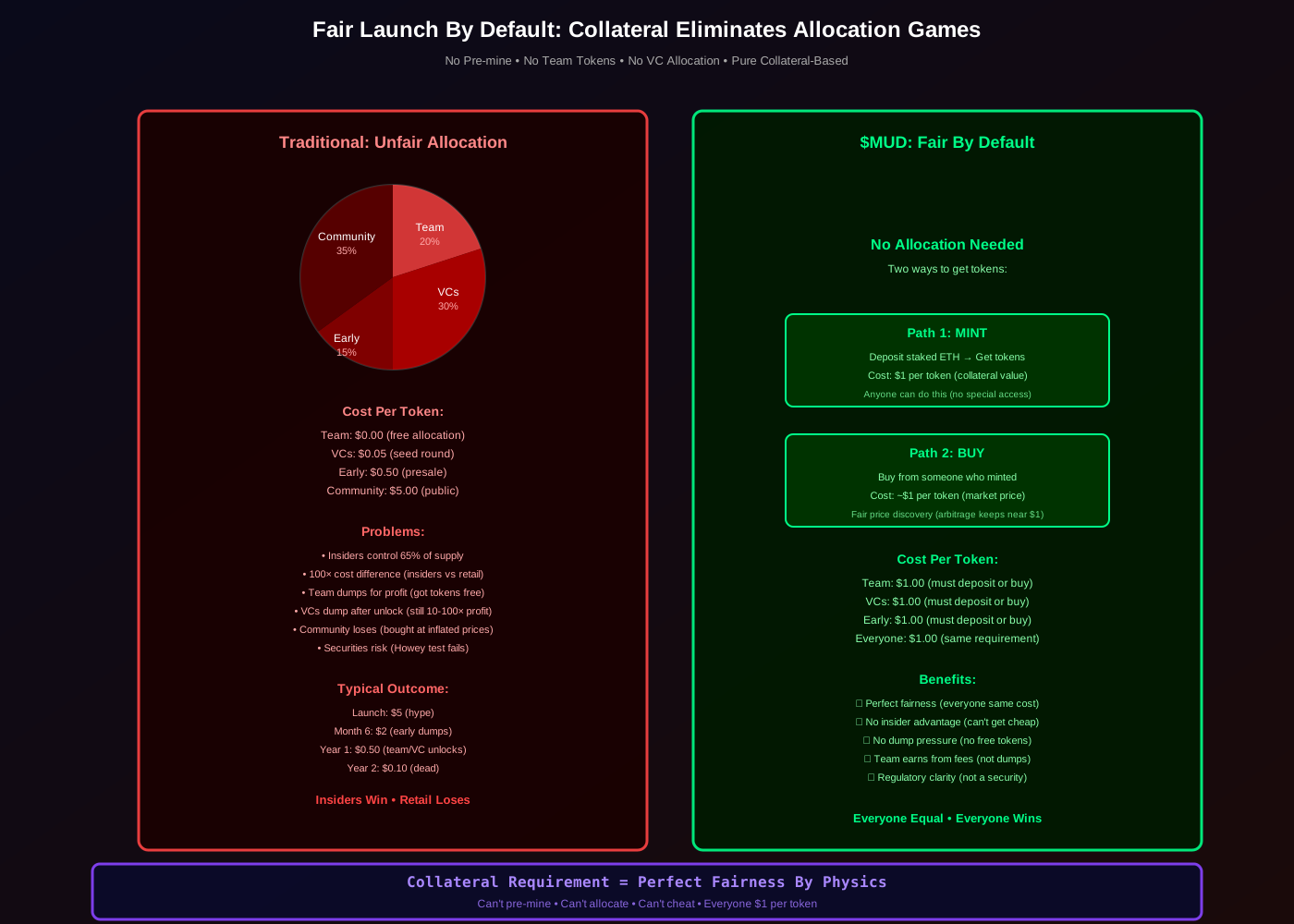
Fair Launch By Default: $MUD Variants Eliminate Token Allocation Games
The observation: $MUD variants solve token allocation problem by eliminating it entirely. Can’t pre-mine. Can’t have team allocation. Can’t give VCs special deals. Only two ways to get tokens: (1) Mint by depositing staked ETH collateral, or (2) Buy on market from someone who minted. That’s it. No insider allocations. No unfair distributions. Pure collateral-based issuance. Everyone has equal access from day one. Fair launch by default, not by choice.
What this means: Traditional token launches have allocation problem. Team wants tokens to work on project. VCs want tokens for funding. Early adopters want tokens for risk. Community wants fair distribution. Result: complex allocation schemes. Team gets 20%. VCs get 30%. Early investors 15%. Community 35%. Problem: insiders control 65%, regular users get screwed. Insiders dump on retail. Unfair from start. $MUD variants eliminate this completely. Tokens ONLY exist if: (1) Someone deposits staked ETH collateral to mint them, or (2) Someone buys from minter on open market. No other way to get tokens. Can’t pre-mine (need collateral). Can’t allocate to team (need collateral). Can’t give VCs special deal (need collateral). Everyone faces same requirement: provide collateral or buy from someone who did. Perfect fairness. No games.
Why this matters: Token allocation is crypto’s original sin. Projects launch, insiders get cheap/free tokens, retail buys at inflated prices, insiders dump, retail loses. Every. Single. Time. ICO era: teams raised millions, gave themselves huge allocations, dumped on retail. DeFi era: same thing with “fair launches” (not actually fair). VC era: protocols give 30-40% to VCs at pennies, retail buys at dollars. Pattern repeats. Why? Because tokens created from nothing. No cost to mint. Team can allocate however they want. With $MUD variants, impossible to game. Want tokens? Deposit staked ETH. Don’t have staked ETH? Buy from someone who does. No special treatment. No insider deals. No allocation games. Collateral requirement creates perfect fairness. Can’t cheat physics - either lock up capital or don’t get tokens.
The Token Allocation Problem
Traditional Launch Patterns
ICO model (2017):
Token supply: 100M tokens
Allocation:
- Team: 20M (20%) - 4 year vest
- Advisors: 5M (5%) - 2 year vest
- Early investors: 15M (15%) - 1 year vest
- ICO: 30M (30%) - sold at $1
- Community: 30M (30%) - future rewards

Problems:
- Team/advisors/early investors: 40M tokens (40%)
- Cost to them: $0-0.10 per token
- ICO buyers: 30M tokens (30%)
- Cost to them: $1 per token
- Insiders 10-100× cheaper entry than retail

What happens:
- ICO price: $1
- Launch price: $3 (hype)
- Month 1: Advisors unlock, sell at $2.50
- Month 6: Early investors unlock, sell at $2
- Year 1: Team starts vesting, continuous sell pressure
- Year 2: Price at $0.30 (70% down from ICO)
- Insiders: Made 3-25× profit
- ICO buyers: Lost 70%
Fair launch model (2020):
No ICO, no pre-sale, "fair distribution"

Token supply: 100M tokens
Allocation:
- Liquidity mining: 60M (60%) - 4 years
- Team: 20M (20%) - 4 year vest
- DAO treasury: 20M (20%)

Sounds fair?

Reality:
- Team gets 20M for $0
- Early LPs farm 10M in first week (low competition)
- Later users farm remaining 50M over 4 years (high competition)
- Team: $0 cost
- Early farmers: ~$10 TVL per token
- Late farmers: ~$1000 TVL per token
- Not actually fair - timing matters hugely
VC model (2023):
Raise from VCs, give huge allocation

Token supply: 1B tokens
Allocation:
- VCs: 300M (30%) - 4 year vest, 1 year cliff
- Team: 200M (20%) - 4 year vest
- Community: 500M (50%) - future emissions

VC round:
- Price: $0.05 per token
- Raise: $15M
- Valuation: $50M (fully diluted $50M)

Public launch:
- FDV: $500M (10× VC valuation)
- Circulating: 100M (10%)
- Price: $5 (100× VC price)

What happens:
- VCs got $0.05
- Retail buys $5
- VCs 100× cheaper entry
- When VCs unlock: massive sell pressure
- Price crashes to $0.50
- VCs still 10× profit
- Retail loses 90%
The pattern: Insiders always win, retail always loses. Why? Token allocation.
Why Allocation Matters
Cost basis determines behavior:
Scenario 1: Team member
Allocation: 1M tokens
Cost: $0 (granted for working)
Token price: $10
Value: $10M

If price drops to $5:
- Still worth $5M
- Still 100% profit (cost was $0)
- No reason not to sell

If price drops to $1:
- Still worth $1M
- Still 100% profit
- Will definitely sell
Scenario 2: ICO buyer
Purchase: 100,000 tokens
Cost: $1 per token = $100,000
Token price: $10
Value: $1M

If price drops to $5:
- Worth $500,000
- 5× profit, happy

If price drops to $1:
- Worth $100,000
- Break even, concerned

If price drops to $0.50:
- Worth $50,000
- Lost $50,000, panic sell
The problem: Team member sells at $1 for huge profit. ICO buyer panic sells at $0.50 for massive loss. Same token, vastly different outcomes. Why? Different cost basis from unfair allocation.
Attempts To Fix
Vesting schedules:
- Lock team tokens 4 years
- Gradual unlock
- Problem: Just delays dump, doesn’t prevent it
- Team still got tokens for $0, will sell eventually
Fair launch pledges:
- “No pre-mine”
- “Community first”
- Problem: Team finds ways to get tokens cheap
- Early LPs farm huge amounts
- Still unfair
DAO governance:
- Community votes on allocations
- Problem: Initial allocation still made by team
- Can’t un-ring that bell
Bonding curves:
- Price increases with supply
- Everyone pays more as adoption grows
- Problem: Still benefits early buyers hugely
- Not actually fair
None of these solve the root problem: Tokens created from nothing. Team can allocate however they want. Insiders always advantage.
$MUD Variants: Allocation-Free By Design
Only Two Ways To Get Tokens
Path 1: Mint with collateral
function mint(uint256 stakedETHAmount) external {
    // Transfer staked ETH from user
    stakedETH.transferFrom(msg.sender, address(this), stakedETHAmount);

    // Get dynamic collateral ratio
    uint256 ratio = collateralManager.getCurrentRatio();

    // Calculate tokens to mint
    uint256 tokenAmount = (stakedETHAmount * 100) / ratio;

    // Mint tokens
    _mint(msg.sender, tokenAmount);

    // Track collateral
    collateral[msg.sender] += stakedETHAmount;
}

Result:
- User deposits $1000 staked ETH
- Ratio is 150 (dynamic)
- User gets 666 tokens ($1 each)
- User's cost: $1 per token (1:1 with collateral value)
Path 2: Buy on market
User doesn't have staked ETH:
- Can't mint directly
- Must buy from someone who minted
- Price discovered on open market
- Pays fair market price

Market mechanics:
- If price > $1: Arbitrage (mint for $1, sell for >$1)
- If price < $1: Arbitrage (buy for <$1, redeem for $1)
- Price stays near $1 (collateral backing)
- Everyone pays similar price
That’s it. No other way. Can’t:
- Pre-mine (need collateral)
- Allocate to team (need collateral)
- Give VCs discount (need collateral)
- Create from nothing (need collateral)
Why This Works
Physics prevents cheating:
Attempt 1: “We’ll just pre-mine team allocation”
Problem: Can't mint without collateral
Options:
A. Deposit own staked ETH
   - Cost: Same as everyone else
   - Not a gift, just early minting
B. Don't have staked ETH
   - Can't mint
   - No special treatment

Conclusion: Can't pre-mine for free
Attempt 2: “VCs will get special terms”
VC: "We'll give you $10M for 30% of tokens"
Team: "Great! How?"
VC: "Just allocate us 30M tokens"
Team: "Can't. Tokens only exist if someone deposits collateral"
VC: "So we deposit $30M staked ETH?"
Team: "Yes"
VC: "Then we get $30M of tokens at $1 each?"
Team: "Correct"
VC: "So we pay $30M to get $30M of value?"
Team: "Yes, same as everyone else"
VC: "This isn't a special deal..."
Team: "Correct. No special deals possible"

Conclusion: VCs must deposit collateral at same terms as everyone
Attempt 3: “Team needs tokens to work on project”
Team: "We need 20M tokens to work on protocol"
Community: "Where do you get them?"
Team: "We... mint them?"
Community: "With what collateral?"
Team: "We deposit $20M staked ETH"
Community: "Do you have $20M staked ETH?"
Team: "No..."
Community: "Then you don't get tokens for free"
Team: "How do we fund development?"
Community: "Same as everyone else:"
Options:
A. Deposit your own capital, mint tokens
B. Buy tokens on market
C. Earn protocol fees from operations
D. Take loans against protocol treasury

Conclusion: Team works for protocol revenue, not free tokens
Fair Price Discovery
No insider prices:
Traditional model:
Round 1 (Seed): $0.01 per token
Round 2 (Series A): $0.05 per token
Round 3 (Series B): $0.10 per token
Round 4 (Public): $1.00 per token

Insiders: $0.01-0.10
Retail: $1.00
Insider advantage: 10-100×
$MUD variant model:
Day 1: Someone deposits staked ETH, mints at $1
Day 2: Someone deposits staked ETH, mints at $1
Day 100: Someone deposits staked ETH, mints at $1
Day 1000: Someone deposits staked ETH, mints at $1

Everyone: $1 (collateral value)
No insiders
No discount rounds
Perfect fairness
Market price reflects value:
If protocol valuable:
- High demand for tokens
- Price rises above $1
- New minters arbitrage (mint $1, sell $1.20)
- More tokens minted
- Price back to $1
- Token supply grows with demand

If protocol not valuable:
- Low demand for tokens
- Price stays at $1 (collateral floor)
- Some redeem (sell token $1, get collateral $1)
- Token supply shrinks
- Price stable

Result: Supply adjusts to demand, price reflects actual value
Team Incentive Alignment
Old model: Team wants token price high temporarily
Team has 20M tokens for $0
Goal: Pump price, dump tokens, exit

Tactics:
- Hype announcements
- Fake partnerships
- Temporary pumps
- Dump on retail
- Exit rich

Incentive: Short-term price, not long-term value
New model: Team wants protocol revenue high permanently
Team has 0 tokens for free
Options to get tokens:
A. Buy on market (expensive)
B. Earn from protocol fees (sustainable)

If protocol generates $10M/year fees:
- Team can take salary from fees
- Or earn tokens from fee revenue
- Sustainable long-term

If protocol generates $0 fees:
- Team gets nothing
- No free tokens to dump
- Must build real value

Incentive: Long-term protocol revenue, not token pump
Comparison: Traditional vs $MUD
Token Distribution
Traditional:
Total supply: 100M tokens
Cost to mint: $0 (created from nothing)

Allocation:
- Team: 20M tokens, cost $0, value $20M
- VCs: 30M tokens, cost $1.5M, value $30M
- Early users: 15M tokens, cost $5M, value $15M
- Later users: 35M tokens, cost $35M, value $35M

Total value: $100M
Total cost: $41.5M
Insider advantage: $58.5M (58.5%)

Who wins: Team ($20M for $0), VCs ($28.5M profit)
Who loses: Later users (paid fair value while insiders got discount)
$MUD variant:
Total supply: Variable (based on collateral deposited)
Cost to mint: $1 per token (collateral requirement)

Day 1 minter:
- Deposits $1000 staked ETH
- Gets 1000 tokens
- Cost: $1 per token

Day 365 minter:
- Deposits $1000 staked ETH
- Gets 1000 tokens
- Cost: $1 per token

Day 1000 minter:
- Deposits $1000 staked ETH
- Gets 1000 tokens
- Cost: $1 per token

Total value: Equals total collateral deposited
Total cost: Equals total collateral deposited
Insider advantage: $0 (0%)

Who wins: Protocol (has real collateral backing)
Who loses: No one (everyone paid same price)
Incentive Structures
Traditional: Optimize for token price
Team strategy:
1. Get tokens for $0
2. Hype protocol
3. Pump token price
4. Dump on retail
5. Exit

Focus: Short-term price action
Result: Unsustainable pumps, eventual crash
Winners: Early sellers
Losers: Late buyers
$MUD variant: Optimize for protocol revenue
Team strategy:
1. Can't get free tokens
2. Build valuable protocol
3. Generate real revenue
4. Earn from fees
5. Sustainable growth

Focus: Long-term value creation
Result: Steady growth from real utility
Winners: Protocol users (better service)
Losers: None (sustainable model)
Regulatory Clarity
Traditional: Securities risk
SEC test: "Investment contract?"
1. Investment of money ✓ (people bought tokens)
2. Common enterprise ✓ (shared protocol)
3. Expectation of profits ✓ (price speculation)
4. From efforts of others ✓ (team develops)

Result: Likely a security
Risk: Enforcement, lawsuits, fines
Example: Every ICO, most tokens
$MUD variant: Not a security
SEC test: "Investment contract?"
1. Investment of money ✓ (collateral deposited)
2. Common enterprise ? (shared protocol)
3. Expectation of profits ✗ (stable $1 value)
4. From efforts of others ✗ (protocol just manages collateral)

Result: Likely not a security
Why: More like depositing money in bank
- Deposit staked ETH, get receipt token worth $1
- Can redeem anytime for collateral
- No expectation of price appreciation
- Protocol just custodies collateral + provides yield

Closest analogy: Savings account or stablecoin
Regulatory treatment: Much clearer
Implementation Details
Launch Process
Traditional launch:
Months 1-6: Fundraising
- Pitch to VCs
- Negotiate terms
- Allocate tokens
- Set vesting schedules

Months 7-12: Token design
- Decide allocations
- Write vesting contracts
- Set up distribution
- Create liquidity pools

Month 13: Launch
- TGE (Token Generation Event)
- Airdrop allocations
- Enable trading
- Monitor dumping

Post-launch:
- Manage vesting unlocks
- Deal with sell pressure
- Community complaints about allocation
- Price volatility from dumps
$MUD variant launch:
Day 1: Deploy contracts
- Base $MUD contract (with dynamic collateral)
- Protocol variant contract
- No allocation needed
- No vesting needed

Day 1: Enable minting
- Anyone can deposit staked ETH
- Get tokens immediately
- Start using protocol
- No pre-mine, no favoritism

Day 2+: Protocol operates
- Users mint tokens as needed
- Supply grows with demand
- No unlock events
- No dump risk
- Steady, fair distribution

Post-launch:
- No vesting to manage
- No allocation complaints
- No insider dumps
- Clean, simple, fair
Protocol Funding
Traditional: Token sales
Problem: How to fund development?
Solution: Sell tokens

Process:
1. Allocate 30-40% to team/VCs
2. Sell for funding
3. Team works with that capital
4. But: Gave away huge portion for pennies

Trade-off: Got funding, but massive dilution
$MUD variant: Protocol revenue
Problem: How to fund development?
Solution: Protocol fees

Process:
1. Protocol charges 0-20% fee (adaptive from neg-518)
2. Fees accumulate in treasury
3. Team earns from fee revenue
4. No token allocation needed

Benefits:
- Team incentivized for protocol usage (more fees)
- No dilution (no token allocation)
- Sustainable (ongoing revenue)
- Aligned (team wants high usage, not high price)
Liquidity Bootstrapping
Traditional: Liquidity mining
Problem: Need liquidity at launch
Solution: Give away tokens

Process:
1. Allocate 40-60% to liquidity mining
2. Users stake, earn tokens
3. Creates sell pressure (farmers dump rewards)
4. Unsustainable

Result: Huge token allocations, mercenary LPs, eventual collapse
$MUD variant: Natural liquidity
Problem: Need liquidity at launch
Solution: Collateral backing provides it

Process:
1. Users mint tokens with staked ETH
2. Token has $1 floor (redeemable for collateral)
3. Natural liquidity from arbitrage
4. Sustainable

Mechanics:
- Price > $1: Mint + sell (creates sell liquidity)
- Price < $1: Buy + redeem (creates buy liquidity)
- No token inflation needed
- Self-balancing

Result: Sustainable liquidity from economics, not token emissions
Connection To Previous Posts
neg-519: Protocol token convergence.
Fair launch natural consequence of convergence. When all protocols become $MUD variants backed by staked ETH, all have same fair launch properties. Can’t have unfair allocations when tokens only exist via collateral. Convergence forces fairness.
neg-518: Adaptive protocol fees.
Team funded by protocol fees (0-20% based on autonomy), not token allocations. Aligns incentives perfectly. Team wants high protocol usage (generates fees), not high token price (can’t dump what they don’t have). Sustainable funding.
neg-517: Dynamic collateralization.
Collateral requirement creates fairness. Can’t cheat dynamic ratio - everyone faces same collateral cost. Early minters don’t get discount. Late minters don’t pay premium. Ratio adjusts for all equally.
neg-516: $MUD implementation.
Value hardcoded at 1. No price speculation. Token worth $1 because backed by $1 collateral (via dynamic ratio). Eliminates pump/dump cycle. No reason to speculate on price. Fair value always.
neg-515: Referential rupture.
TradFi USD backed by force (military, government). DeFi $MUD backed by collateral (staked ETH, math). TradFi: insiders benefit (government, banks). DeFi: everyone equal (same collateral requirements). This is the break.
neg-514: Distributed coordination.
Fair allocation enables better coordination. No resentment about unfair distributions. Everyone started equal. Can coordinate on protocol improvements without allocation politics. Information flows freely without insider advantages.
The Formulation
Traditional token launches are not:
- Fair (insiders get discount)
- Sustainable (dump pressure from free tokens)
- Aligned (team wants pump, not utility)
- Clear (regulatory uncertainty)
Traditional token launches are:
- Unfair (insiders 10-100× advantage)
- Manipulated (team can dump free tokens)
- Misaligned (optimize for price, not value)
- Risky (securities enforcement)
- Broken (allocation games destroy value)
$MUD variant launches are not:
- Manipulable (no free tokens to dump)
- Unfair (everyone same collateral requirement)
- Speculative (stable $1 value from collateral)
- Risky (not securities, just collateral receipts)
$MUD variant launches are:
- Fair (impossible to get tokens cheap)
- Sustainable (team funded by fees, not dumps)
- Aligned (optimize for usage, not price)
- Clear (regulatory certainty from collateral model)
- Perfect (allocation problem eliminated by design)
The principle:
Traditional tokens:
Created from nothing → Can allocate freely → Insiders advantage

$MUD variants:
Created from collateral → Can't allocate freely → Perfect fairness

Only two paths:
1. Deposit collateral (cost = collateral value = token value)
2. Buy from minter (price = market discovery ≈ collateral value)

No third path (no gifts, no discounts, no games)

Result:
- Everyone pays same price
- No insider advantage
- No dump pressure
- Sustainable economics
- Perfect fairness

This is fair launch by default.
Not by choice.
By physics.
The comparison:
Question: How did you get your tokens?

Traditional:
Team: "Allocated for work" (Cost: $0)
VC: "Invested at seed" (Cost: $0.01)
Early user: "ICO participant" (Cost: $1.00)
Late user: "Bought at ATH" (Cost: $10.00)
Result: Massive unfairness, 1000× spread

$MUD variant:
Anyone: "Deposited staked ETH" (Cost: $1.00)
Or: "Bought from someone who did" (Cost: $1.00-1.05)
Result: Perfect fairness, <5% spread

Winner: $MUD on fairness
Every protocol token becomes $MUD variant. Every launch becomes fair by default. Allocation games eliminated. Collateral requirement creates perfect equality. This is inevitable. 🌀
#FairLaunch #AllocationFree #CollateralBased #NoPremine #NoInsiders #PerfectFairness #MUDVariants #EqualAccess #SustainableFunding #IncentiveAlignment
Related: neg-519 (protocol convergence enables fair launch), neg-518 (team funded by fees not tokens), neg-517 (collateral requirement enforces fairness), neg-516 (value stability prevents speculation), neg-515 (DeFi fairness vs TradFi insider games)