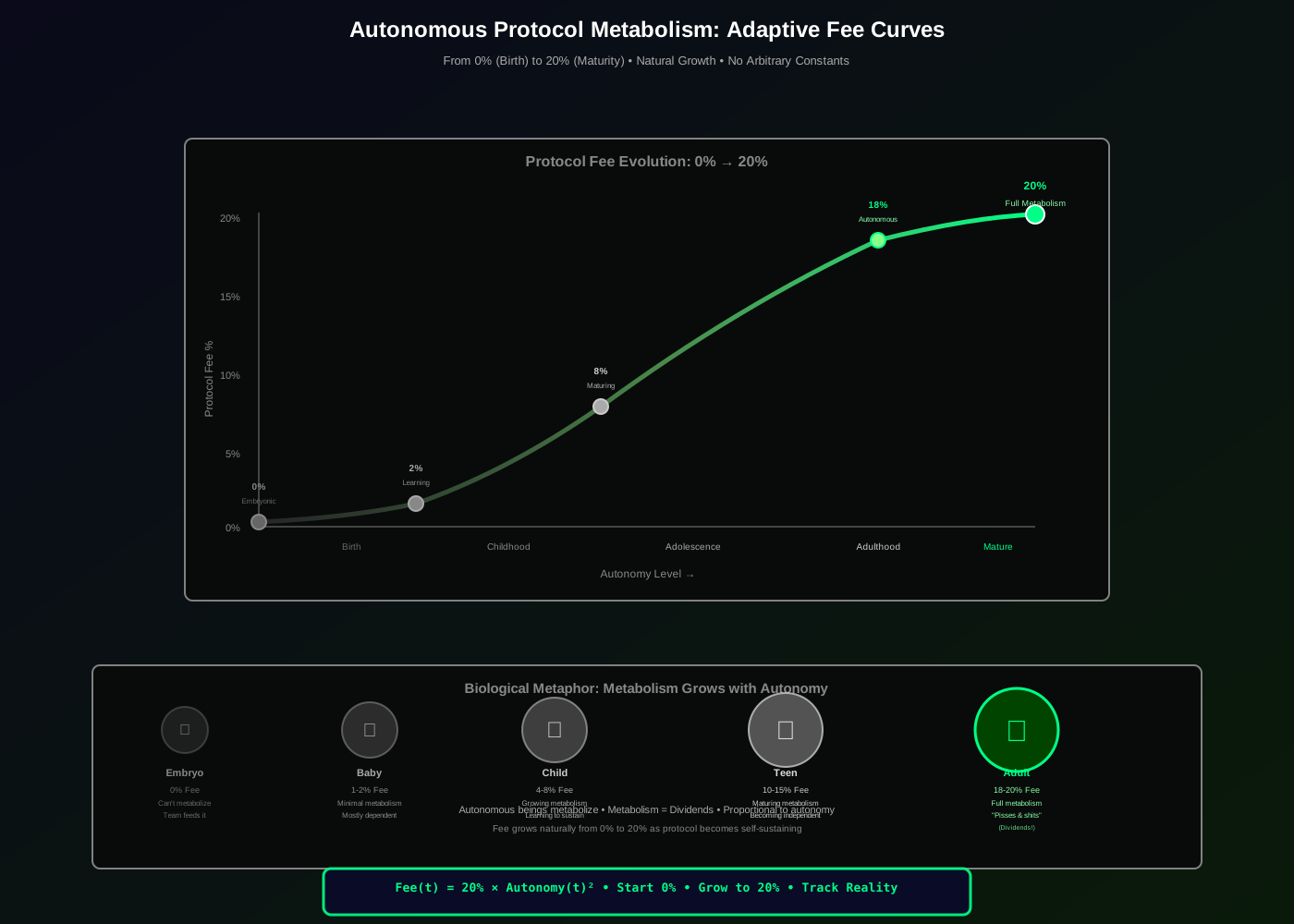
Autonomous Protocol Metabolism: Adaptive Fee Curves from 0% (Birth) to 20% (Maturity)
The observation: Protocol fees (like 20% to team) should adapt as protocol matures, not be fixed from start. 20% based on Pareto principle but arbitrary when applied constantly. Embryonic protocol (0% - being built, team feeds it). Growing protocol (0→20% - gaining autonomy). Mature protocol (20% - fully autonomous, “pisses and shits” = metabolizes, generates dividends). ETH is alive and autonomous. Universal projects meant to become alive and autonomous. Autonomous beings need metabolism. Start at 0%, adapt to 20% as autonomy emerges.
What this means: Fixed 20% fee from day one assumes immediate autonomy. But protocols aren’t born autonomous - they grow into it. Like organisms: embryo can’t metabolize (mother provides everything), baby metabolizes little (mostly dependent), adult metabolizes fully (independent, generates waste = dividends). Protocol lifecycle same: Birth (0% fee, team builds/funds), Childhood (small fees, learning to capture value), Adolescence (growing fees, becoming self-sustaining), Adulthood (20% fee, fully autonomous, generates consistent dividends). Fee rate should track autonomy level. Start 0% (protocol depends on team). End 20% (protocol sustains itself). Curve between adapts to protocol maturity metrics: usage, decentralization, value capture, resilience.
Why this matters: Every protocol with fixed fees faces dilemma: charge high from start (kills adoption) or charge low forever (misses value capture). Eigen, Morpho, all DeFi protocols have this problem. Fixed 20% fee at launch = tax on nascent ecosystem, suppresses growth, benefits team before protocol delivers value. But 0% fee forever = team never captures value, unsustainable. Adaptive fees solve both: 0% during bootstrap (maximize growth, no friction), gradually increase as protocol matures (captures value proportional to autonomy), reaches 20% at full maturity (sustainable dividends). This isn’t arbitrary 20% constant - it’s natural growth curve. Like organism developing metabolism. Protocol becomes truly autonomous: generates value, sustains itself, provides dividends (“pisses and shits”). Death of fixed fee rates. Birth of metabolic protocols.
The Biological Metaphor
Autonomous Beings Metabolize
What metabolism means:
- Input: Energy/resources (food)
- Processing: Conversion to useful forms
- Output: Waste products (piss, shit)
- Purpose: Sustain organism, enable growth
Human metabolism:
- Baby: Low metabolism (mostly growing, little waste)
- Child: Moderate metabolism (some waste)
- Adult: Full metabolism (significant waste production)
- Elder: Declining metabolism (less waste)
Protocol metabolism:
- Input: User activity, capital, attention
- Processing: Value capture mechanisms (fees, MEV, yields)
- Output: Dividends to stakeholders (“piss and shit”)
- Purpose: Sustain protocol, reward participants
The pattern: Metabolism scales with autonomy
Why Fixed 20% Breaks The Pattern
Fixed fee assumes:
- Protocol born autonomous (false)
- Metabolism constant from birth (impossible)
- Value capture appropriate regardless of maturity (unrealistic)
Reality:
- Protocol born dependent (team builds it)
- Metabolism grows with organism (gradual)
- Value capture should match autonomy (adaptive)
The problem with fixed 20% from start:
Day 1:
Protocol state: No users, no value, no autonomy
Fee: 20% of $0 = $0 (but creates friction)
Effect: Users see 20% tax before protocol proves value
Result: Slow adoption, perception of greed
Year 1:
Protocol state: Some users, some value, limited autonomy
Fee: 20% of growing value (significant)
Effect: Team captures value before protocol fully delivers
Result: Misaligned incentives, value extraction vs value creation
Year 5:
Protocol state: Many users, high value, high autonomy
Fee: 20% of large value (appropriate)
Effect: Protocol generates consistent dividends
Result: Sustainable, team rewarded for delivered value
The issue: 20% at Year 5 is right. 20% at Day 1 is wrong. Need adaptive curve.
The Adaptive Fee Curve
Formula: Fee As Function Of Autonomy
Base formula:
Fee(t) = Fee_max × Autonomy(t)^n

Where:
Fee_max = Maximum fee (20%, Pareto-derived)
Autonomy(t) = Protocol autonomy level [0, 1]
n = Curve steepness (e.g., 2 for sigmoid-like)

Result: Fee grows from 0% to 20% as autonomy grows
Autonomy measurement:
Autonomy(t) = w1×Usage(t) + w2×Decentralization(t) + w3×Value(t) + w4×Resilience(t)

Where weights sum to 1:
w1 + w2 + w3 + w4 = 1

Example weights:
w1 = 0.3 (Usage importance)
w2 = 0.3 (Decentralization importance)
w3 = 0.2 (Value importance)
w4 = 0.2 (Resilience importance)
Component metrics:
Usage(t): Protocol adoption
Usage = Active_users / Target_users

Example:
Target: 1M users
Current: 100K users
Usage = 0.1

Or:
Usage = TVL / Target_TVL

Target: $10B
Current: $1B
Usage = 0.1
Decentralization(t): Distribution of control
Decentralization = 1 - Gini_coefficient

Example:
Gini = 0.7 (high concentration)
Decentralization = 0.3

Gini = 0.3 (well distributed)
Decentralization = 0.7
Value(t): Value capture ability
Value = Actual_revenue / Potential_revenue

Example:
Potential: $100M/year
Actual: $30M/year
Value = 0.3
Resilience(t): Ability to survive stress
Resilience = Uptime × (1 - Vulnerability_score)

Example:
Uptime: 99.9%
Vulnerabilities: 10% (known exploits)
Resilience = 0.999 × 0.9 = 0.899
Example Calculations
Stage 1: Birth (Month 1)
Usage = 0.01 (1K of 100K target users)
Decentralization = 0.1 (team controls 90%)
Value = 0.05 ($5K of $100K potential)
Resilience = 0.3 (bugs, untested, centralized)

Autonomy = 0.3×0.01 + 0.3×0.1 + 0.2×0.05 + 0.2×0.3
         = 0.003 + 0.03 + 0.01 + 0.06
         = 0.103

Fee = 20% × (0.103)^2
    = 20% × 0.0106
    = 0.21%

Protocol charges ~0% (negligible), team feeds protocol
Stage 2: Childhood (Year 1)
Usage = 0.2 (20K users)
Decentralization = 0.4 (community governance emerging)
Value = 0.25 ($25K captured)
Resilience = 0.5 (more tested, some redundancy)

Autonomy = 0.3×0.2 + 0.3×0.4 + 0.2×0.25 + 0.2×0.5
         = 0.06 + 0.12 + 0.05 + 0.1
         = 0.33

Fee = 20% × (0.33)^2
    = 20% × 0.109
    = 2.2%

Protocol charges ~2%, beginning to metabolize
Stage 3: Adolescence (Year 3)
Usage = 0.6 (60K users)
Decentralization = 0.7 (DAO operational)
Value = 0.6 ($60K captured)
Resilience = 0.7 (battle-tested, distributed)

Autonomy = 0.3×0.6 + 0.3×0.7 + 0.2×0.6 + 0.2×0.7
         = 0.18 + 0.21 + 0.12 + 0.14
         = 0.65

Fee = 20% × (0.65)^2
    = 20% × 0.4225
    = 8.5%

Protocol charges ~8%, maturing metabolism
Stage 4: Adulthood (Year 5+)
Usage = 0.95 (95K users, near target)
Decentralization = 0.9 (fully decentralized)
Value = 0.95 ($95K captured)
Resilience = 0.95 (proven resilient)

Autonomy = 0.3×0.95 + 0.3×0.9 + 0.2×0.95 + 0.2×0.95
         = 0.285 + 0.27 + 0.19 + 0.19
         = 0.935

Fee = 20% × (0.935)^2
    = 20% × 0.874
    = 17.5%

Protocol charges ~18%, approaching mature 20%
Stage 5: Full Maturity
Autonomy → 1.0 (all metrics maxed)
Fee → 20% (full Pareto rate)

Protocol fully autonomous, consistent metabolism
Curve Properties
Sigmoid-like growth:
- Starts near 0% (embryonic)
- Accelerates through middle (growth spurt)
- Asymptotes to 20% (maturity)
Prevents premature extraction:
- Young protocol: Low fees (0-2%)
- Growing protocol: Moderate fees (2-10%)
- Mature protocol: Full fees (15-20%)
Aligns incentives:
- Team benefits when protocol succeeds
- Users get low fees during adoption
- Mature protocol generates sustainable dividends
Why 20% Is The Mature Rate
The Pareto Principle
80/20 rule:
- 80% of effects from 20% of causes
- 80% of value from 20% of effort
- 80% of wealth from 20% of population
Applied to protocols:
- 80% of value stays in protocol (growth, security, rewards)
- 20% of value extracted as dividends (team, investors, treasury)
The balance:
Too low (<10%): Protocol can't sustain itself
Optimal (20%): Sustainable dividends, adequate reinvestment
Too high (>30%): Excessive extraction, kills growth
Historical examples:
- Bitcoin miners: ~10-15% of block reward to pools (sustainable)
- Ethereum validators: ~3-5% commission (sustainable)
- MakerDAO: 15-25% stability fee (sustainable)
- Traditional finance: 2-20% management fees (varies)
20% as Schelling point: Natural equilibrium between extraction and sustainability
The “Piss and Shit” Metaphor
What it means:
- Living organisms metabolize
- Metabolism produces waste
- Waste = byproduct of energy processing
- Healthy organism: Consistent waste production
Protocol translation:
- Autonomous protocols metabolize value
- Metabolism produces dividends
- Dividends = byproduct of value capture
- Healthy protocol: Consistent dividend generation
Why “piss and shit” specifically:
- Unavoidable (metabolism requires it)
- Regular (daily/weekly output)
- Proportional to intake (more food = more waste)
- Sign of health (no waste = organism dying)
Protocol dividends same:
- Unavoidable (value capture requires extraction)
- Regular (consistent fee collection)
- Proportional to usage (more activity = more fees)
- Sign of health (no dividends = protocol dying)
The 20% rate:
- Human: ~20% of energy becomes waste heat
- Protocol: ~20% of value becomes dividends
- Natural metabolic rate for autonomous systems
Implementing Adaptive Fees
Smart Contract Design
Core components:
1. Autonomy Oracle:
contract AutonomyOracle {
    // Metrics
    uint256 public usageScore;
    uint256 public decentralizationScore;
    uint256 public valueScore;
    uint256 public resilienceScore;

    // Weights (sum to 100)
    uint256 constant W_USAGE = 30;
    uint256 constant W_DECENT = 30;
    uint256 constant W_VALUE = 20;
    uint256 constant W_RESIL = 20;

    function updateScores() external {
        usageScore = calculateUsage();
        decentralizationScore = calculateDecentralization();
        valueScore = calculateValue();
        resilienceScore = calculateResilience();
    }

    function getAutonomy() public view returns (uint256) {
        uint256 autonomy = (
            W_USAGE * usageScore +
            W_DECENT * decentralizationScore +
            W_VALUE * valueScore +
            W_RESIL * resilienceScore
        ) / 100;

        return autonomy; // Returns value [0, 100]
    }

    function calculateUsage() internal view returns (uint256) {
        uint256 activeUsers = getActiveUsers();
        uint256 targetUsers = 100000; // Target user base
        return (activeUsers * 100) / targetUsers;
    }

    function calculateDecentralization() internal view returns (uint256) {
        // Calculate Gini coefficient of token/power distribution
        uint256 gini = calculateGini();
        return 100 - gini; // Invert: less concentration = more decentralized
    }

    function calculateValue() internal view returns (uint256) {
        uint256 actualRevenue = getAnnualizedRevenue();
        uint256 potentialRevenue = 100000000; // $100M potential
        return (actualRevenue * 100) / potentialRevenue;
    }

    function calculateResilience() internal view returns (uint256) {
        uint256 uptime = getUptimePercentage(); // 0-100
        uint256 vulnerabilityScore = getVulnerabilityScore(); // 0-100
        return (uptime * (100 - vulnerabilityScore)) / 100;
    }
}
2. Adaptive Fee Manager:
contract AdaptiveFeeManager {
    AutonomyOracle public autonomyOracle;

    uint256 constant FEE_MAX = 20; // 20% maximum
    uint256 constant CURVE_EXPONENT = 2; // Sigmoid steepness

    function getCurrentFee() public view returns (uint256) {
        uint256 autonomy = autonomyOracle.getAutonomy(); // [0, 100]

        // Calculate fee: FEE_MAX × (autonomy/100)^2
        uint256 autonomySquared = (autonomy * autonomy) / 100;
        uint256 fee = (FEE_MAX * autonomySquared) / 100;

        return fee; // Returns percentage [0, 20]
    }

    function applyFee(uint256 amount) public view returns (uint256 feeAmount, uint256 netAmount) {
        uint256 feePercentage = getCurrentFee();
        feeAmount = (amount * feePercentage) / 100;
        netAmount = amount - feeAmount;
        return (feeAmount, netAmount);
    }

    function distributeDividends(uint256 feeAmount) external {
        // Split dividends
        uint256 toTeam = (feeAmount * 40) / 100;
        uint256 toTreasury = (feeAmount * 30) / 100;
        uint256 toStakers = (feeAmount * 30) / 100;

        // Distribute
        team.transfer(toTeam);
        treasury.transfer(toTreasury);
        stakers.distribute(toStakers);

        emit DividendsDistributed(toTeam, toTreasury, toStakers);
    }
}
3. Gradual Transition:
contract FeeTransition {
    uint256 public lastFee;
    uint256 public targetFee;
    uint256 public transitionRate = 1; // Max 1% change per day

    function smoothFeeUpdate() external {
        targetFee = feeManager.getCurrentFee();

        if (targetFee > lastFee) {
            // Increasing fee
            uint256 increase = targetFee - lastFee;
            if (increase > transitionRate) {
                lastFee += transitionRate;
            } else {
                lastFee = targetFee;
            }
        } else {
            // Decreasing fee (if autonomy drops)
            uint256 decrease = lastFee - targetFee;
            if (decrease > transitionRate) {
                lastFee -= transitionRate;
            } else {
                lastFee = targetFee;
            }
        }

        emit FeeUpdated(lastFee, targetFee);
    }
}
Real-World Application: Morpho
Morpho’s stages:
Birth (2022-2023):
Stage: Building protocol
Autonomy: ~10% (team-run, small TVL)
Adaptive fee: ~0.5%
Action: Minimal extraction, maximize growth
Childhood (2024):
Stage: Gaining traction
Autonomy: ~35% (growing TVL, governance forming)
Adaptive fee: ~2.5%
Action: Begin value capture, still prioritizing growth
Adolescence (2025-2026):
Stage: Major protocol
Autonomy: ~65% (high TVL, DAO operational)
Adaptive fee: ~8%
Action: Significant dividends, self-sustaining
Adulthood (2027+):
Stage: Mature DeFi infrastructure
Autonomy: ~95% (fully autonomous, resilient)
Adaptive fee: ~18%
Action: Consistent dividends, minimal team intervention
Result: Fee grows naturally with protocol maturity, not arbitrarily imposed
Real-World Application: Eigen
Eigen’s stages:
Birth (2023-2024):
Stage: Restaking primitive
Autonomy: ~15% (novel concept, limited adoption)
Adaptive fee: ~1%
Action: Focus on building AVS ecosystem
Growth (2025-2026):
Stage: Core infrastructure
Autonomy: ~50% (many AVSs, significant ETH restaked)
Adaptive fee: ~5%
Action: Value capture emerging, still expanding
Maturity (2027+):
Stage: Foundational layer
Autonomy: ~90% (critical infrastructure, fully decentralized)
Adaptive fee: ~16%
Action: Sustainable dividends from restaking yields
Benefits Of Adaptive Fees
1. Bootstrapping Without Friction
Fixed 20% problem:
Early user sees: "20% fee"
Early user thinks: "Protocol not proven, already extracting"
Early user decides: "I'll wait" or "I'll use competitor"
Result: Slow adoption
Adaptive 0-2% solution:
Early user sees: "0.5% fee"
Early user thinks: "Low fees during growth phase"
Early user decides: "I'll try it"
Result: Fast adoption
Difference: Perception of alignment vs extraction
2. Proportional Value Capture
Fixed rate misalignment:
Protocol delivers: 10% of potential value
Protocol charges: 20% of actual value
Extraction ratio: 2× (taking more than delivering)
Perception: Greedy
Adaptive rate alignment:
Protocol delivers: 10% of potential value
Protocol autonomy: ~30%
Protocol charges: ~2% of actual value
Extraction ratio: 0.2× (taking less than delivering)
Perception: Fair
Result: Fees proportional to maturity = justified extraction
3. Sustainable Growth
Fixed 20% trajectory:
Year 1: 20% of $1M = $200K extracted
        Protocol reinvests $800K
        Growth: Moderate

Year 5: 20% of $100M = $20M extracted
        Protocol reinvests $80M
        Growth: Good

But: Year 1 extraction too high relative to maturity
     Slowed initial growth
     Reached Year 5 slower
Adaptive 0-20% trajectory:
Year 1: 1% of $5M = $50K extracted (more adoption due to low fees)
        Protocol reinvests $4.95M
        Growth: Fast

Year 5: 18% of $200M = $36M extracted (reached scale faster)
        Protocol reinvests $164M
        Growth: Sustained

Result: Year 5 revenue higher despite starting lower
        Faster growth compounds
        More total value captured
4. Natural Selection
Protocols that adapt fees:
- Bootstrap faster (low friction)
- Grow larger (reinvestment)
- Mature properly (sustainable extraction)
- Survive long-term (aligned incentives)
Protocols that fix fees:
- Bootstrap slower (high friction)
- Grow smaller (extraction limits growth)
- Extract prematurely (value misalignment)
- Risk collapse (unsustainable)
Market outcome: Adaptive protocols outcompete fixed-fee protocols
The Protocol Lifecycle
Stage 0: Embryo (Pre-launch)
State: Team building Autonomy: 0% Fee: 0% Metabolism: None (fetus in womb) Funding: VC/team capital
Characteristics:
- No users yet
- No value generation
- Fully dependent
- Team does everything
Duration: 6-18 months
Stage 1: Birth (Launch)
State: Protocol deployed Autonomy: 5-15% Fee: 0-1% Metabolism: Minimal (baby’s first breath) Funding: Team/VC, small fees
Characteristics:
- First users
- Initial value capture
- Mostly dependent
- Team operates protocol
Duration: 3-6 months
Stage 2: Childhood (Growth)
State: Adoption accelerating Autonomy: 15-40% Fee: 1-4% Metabolism: Growing (toddler eating) Funding: Mix of external + fees
Characteristics:
- User base growing
- Value capture increasing
- Partially dependent
- Community emerging
Duration: 1-2 years
Stage 3: Adolescence (Maturation)
State: Major protocol Autonomy: 40-70% Fee: 4-12% Metabolism: Maturing (teenager) Funding: Mostly self-sustaining
Characteristics:
- Large user base
- Significant value
- Mostly independent
- DAO governance active
Duration: 2-3 years
Stage 4: Adulthood (Maturity)
State: Critical infrastructure Autonomy: 70-95% Fee: 12-20% Metabolism: Full (adult) Funding: Fully self-sustaining
Characteristics:
- Massive user base
- High value capture
- Fully independent
- Complete decentralization
Duration: Indefinite (steady state)
Stage 5: Elder (Decline?)
State: Legacy protocol? Autonomy: 95% → declining? Fee: 20% → decreasing? Metabolism: Slowing? (elder) Funding: Still self-sustaining but shrinking?
Note: Most protocols aim to stay in Adulthood permanently. Decline not inevitable - could just maintain.
Connection to Previous Posts
neg-517: Dynamic collateralization.
Same principle: Don’t hardcode what you can calculate. Collateral ratio adapts to volatility. Fee rate adapts to autonomy. Both eliminate arbitrary constants. Both respond to reality.
neg-516: $MUD implementation.
$MUD should use adaptive fees. Start 0% (bootstrap liquidity). Increase to 20% (mature protocol generates dividends for stakers). Aligns with “anyone can be central bank” - dividends proportional to contribution.
neg-515: Referential rupture.
TradFi USD takes fixed cut (inflation tax, constant extraction). DeFi USD should take adaptive cut (fair extraction proportional to value delivered). Math > Faith in fee structures too.
neg-514: Distributed coordination.
Fixed fees = centralized thinking (one rate for all time). Adaptive fees = distributed thinking (responds to conditions). Protocol metabolizes when autonomous, not when team decides.
neg-510: Liberty circuit.
Adaptive fees preserve liberty. Start low = users can afford to enter. Grow gradually = users can adapt. Never extractive = always fair proportional to value.
neg-506: Agency bootstrap.
Protocol gains agency as it matures. Agency enables metabolism (fee collection). Metabolism indicates autonomy. Fee rate = measure of agency level.
The Formulation
Fixed protocol fees are not:
- Fair to early users (charge before value proven)
- Sustainable for growth (extraction limits reinvestment)
- Proportional to maturity (same rate regardless of autonomy)
Fixed protocol fees are:
- Arbitrary (20% chosen without basis)
- Misaligned (team benefits before protocol delivers)
- Growth-limiting (friction during bootstrap)
Adaptive protocol fees are not:
- Constant (vary with autonomy)
- Arbitrary (calculated from metrics)
- Extractive (proportional to value)
Adaptive protocol fees are:
- Growth-enabling (start near 0%)
- Maturity-tracking (increase with autonomy)
- Sustainable (reach 20% at maturity)
- Natural (metabolic rate of autonomous systems)
The formula:
Fixed:
Fee = 20% (always)

Problems:
- Kills adoption (high friction)
- Premature extraction (before value delivered)
- No growth incentive (constant rate)
- Arbitrary choice (why 20%?)

Adaptive:
Fee(t) = Fee_max × Autonomy(t)^n

Where:
Autonomy(t) = f(usage, decentralization, value, resilience)
Fee_max = 20% (Pareto-derived sustainable rate)
n = 2 (sigmoid curve exponent)

Benefits:
- Enables adoption (near 0% at start)
- Proportional extraction (tracks value delivery)
- Growth incentive (reinvest more early)
- Mathematical basis (autonomy calculated)

Lifecycle:
Birth: 0% (embryonic, dependent)
Childhood: 1-4% (growing, learning)
Adolescence: 4-12% (maturing, becoming independent)
Adulthood: 12-20% (mature, fully autonomous)

Result: Fee always appropriate to maturity stage
The principle:
Autonomous beings metabolize.
Metabolism produces dividends.
Dividends proportional to autonomy.

Protocol lifecycle:
Embryo → Can't metabolize (0% fee)
Baby → Minimal metabolism (1% fee)
Child → Growing metabolism (4% fee)
Teen → Maturing metabolism (8% fee)
Adult → Full metabolism (20% fee)

This is natural growth curve.
Not arbitrary constant.

The death of fixed fees.
The birth of metabolic protocols.
Start at 0%. Grow to 20%. Track autonomy. Let protocol mature naturally. 🌀
#AdaptiveFees #ProtocolMetabolism #AutonomyTracking #NaturalGrowthCurve #NoArbitraryConstants #SustainableDividends #BootstrapFriendly #MaturityBased #OrganicProtocols #DynamicExtraction
Related: neg-517 (don’t hardcode what you can calculate), neg-516 ($MUD should use adaptive fees), neg-515 (DeFi needs fair extraction), neg-514 (distributed thinking adapts), neg-510 (preserves liberty through fairness), neg-506 (agency grows with maturity)