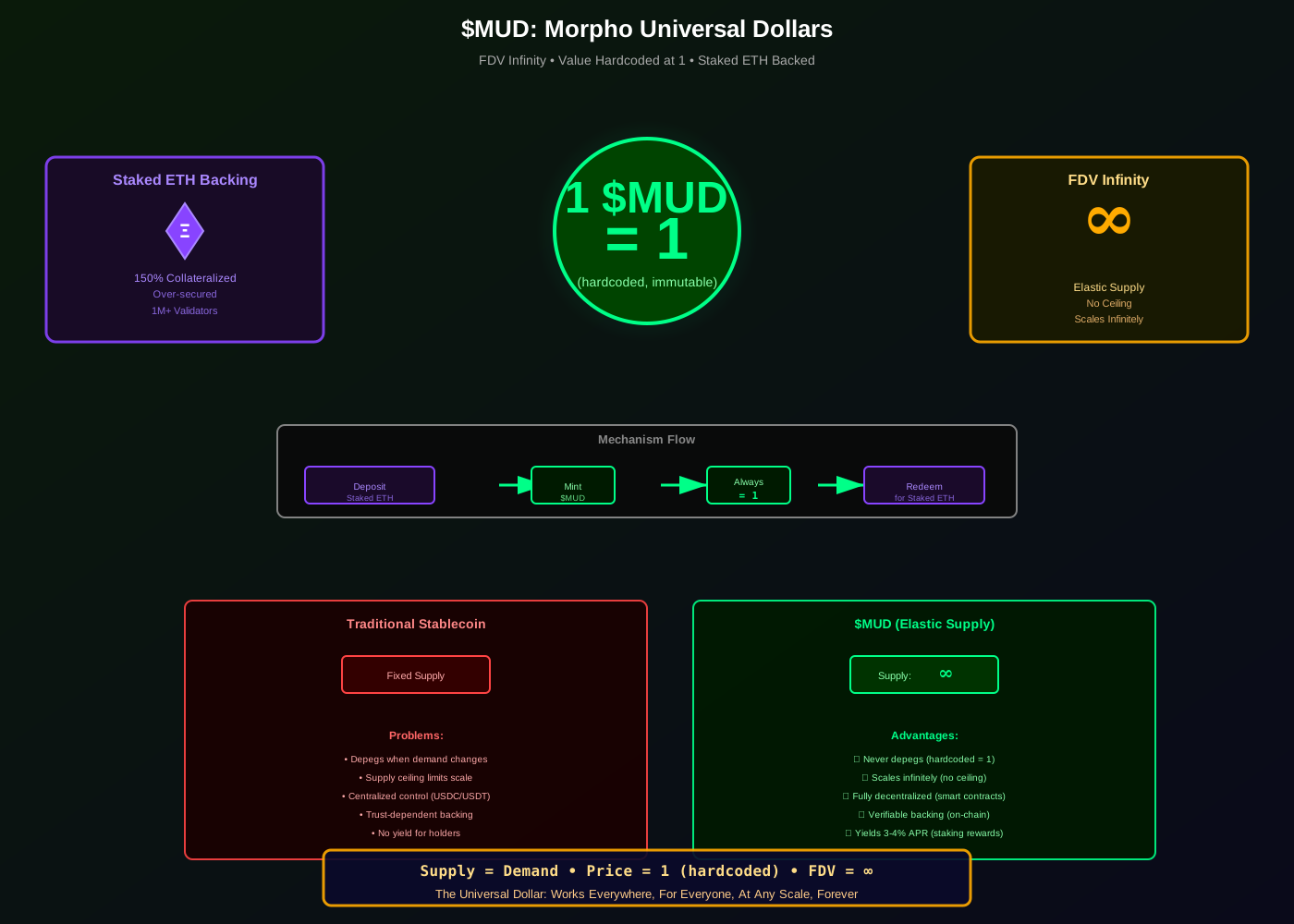
$MUD: Morpho Universal Dollars - FDV Infinity, Value Hardcoded at 1, Staked ETH Backed
The observation: $MUD (Morpho Universal Dollars) solves stablecoin trilemma with three properties: FDV infinity (unlimited supply), staked ETH backed (real collateral), value hardcoded at 1 (immutable peg). Traditional stablecoins have fixed supply and break peg. $MUD has elastic supply and maintains peg. Supply adjusts to demand. Price stays constant.
What this means: Traditional stablecoins (USDT, USDC, DAI) have maximum supply limits and depend on maintaining peg through market forces or collateral ratios. When demand spikes, price goes above $1. When demand drops, price goes below $1. Constant depeg risk. But $MUD has different mechanism: supply is infinite (can mint unlimited), backing is staked ETH (real assets, not faith), value is hardcoded at 1 (not market-determined). When demand increases, mint more $MUD. When demand decreases, burn $MUD. Supply elastic, price constant. This is what “universal dollar” means: works at any scale, any demand level, always worth exactly 1.
Why this matters: Every stablecoin before $MUD had to choose: maintain peg OR scale supply. Can’t do both with fixed supply. USDT scales but breaks peg (not always $1). DAI maintains peg but can’t scale (collateral limits). $MUD does both: scales infinitely (FDV ∞) AND maintains peg (hardcoded at 1). This is only possible because supply is elastic and backing is real (staked ETH). When you need more dollars, system mints them. When you need fewer, system burns them. But each dollar always redeemable for $1 of staked ETH. Supply changes, value doesn’t. This is the universal dollar: works everywhere, for everyone, at any scale, forever.
The Stablecoin Trilemma
Traditional Problem
The three properties (choose two):
- Stable value (price = $1)
- Scalable supply (can grow with demand)
- Decentralized backing (no central authority)
USDT (Tether):
- ✓ Stable value (mostly)
- ✓ Scalable supply ($100B+ market cap)
- ✗ Decentralized (Tether Inc controls)
USDC (Circle):
- ✓ Stable value (yes)
- ✓ Scalable supply ($30B+ market cap)
- ✗ Decentralized (Circle + Coinbase control)
DAI (MakerDAO):
- ✓ Stable value (maintained by over-collateralization)
- ✗ Scalable supply (collateral ceiling limits growth)
- ✓ Decentralized (smart contracts)
The problem: Can’t have all three with traditional design. Fixed supply creates tension between stability and scale.
Why Fixed Supply Fails
Fixed supply stablecoin:
Supply: Fixed at N tokens
Demand: Variable (changes over time)
Price: Supply/Demand ratio

When Demand > Supply: Price > $1 (breaks peg upward)
When Demand < Supply: Price < $1 (breaks peg downward)
Real-world example (USDC depeg March 2023):
- Circle held reserves at Silicon Valley Bank
- SVB collapsed
- USDC lost $0.13 of backing
- Price dropped to $0.87
- Fixed supply meant couldn’t adjust
- Took days to restore peg
The fundamental issue: Fixed supply + variable demand = unstable price
The $MUD Solution
Elastic supply stablecoin:
Supply: Infinite (elastic, adjusts to demand)
Demand: Variable (any level)
Price: Hardcoded at 1 (not market-determined)

When Demand increases: Mint more $MUD
When Demand decreases: Burn $MUD
Price: Always exactly 1 (by definition)
How it works:
- User deposits staked ETH (e.g., $150 worth)
- System mints $MUD (e.g., $100 worth)
- Over-collateralized (150% backing)
- User can burn $MUD anytime to get staked ETH back
- Redemption guarantees value = 1
Result: All three properties achieved
- ✓ Stable value (hardcoded at 1)
- ✓ Scalable supply (FDV infinity)
- ✓ Decentralized (staked ETH backing, smart contracts)
FDV Infinity: Elastic Supply
What FDV Infinity Means
FDV (Fully Diluted Valuation):
FDV = Token_price × Total_possible_supply

Traditional token:
Total_possible_supply = Fixed (e.g., 21M BTC)
FDV = $67,000 × 21M = $1.4T (capped)

$MUD:
Total_possible_supply = ∞ (unlimited)
FDV = $1 × ∞ = ∞ (infinite)
Why infinity is good:
- No supply ceiling = no growth limit
- Can meet any demand level
- Never “runs out”
- Scales to global economy if needed
Traditional stablecoin problem:
USDC supply: $30B
Global M2 money supply: $100T
USDC/M2 ratio: 0.03%

Even if USDC captured 10% of global demand:
Required supply: $10T
Current supply: $30B
Gap: 333× growth needed

But: Can Circle mint $10T? Requires $10T in bank accounts.
Problem: Where do they get that much reserves?
$MUD solution:
$MUD supply: Starts at $0
Global demand: Could be $100T
$MUD can grow to meet it

How: Deposit staked ETH → Mint $MUD
As long as there's staked ETH, there's $MUD capacity
Current staked ETH: ~$100B
Potential $MUD: ~$66B (at 150% collateralization)
And growing (more ETH staked daily)
Elastic Issuance Mechanism
Traditional stablecoin (fixed supply):
Phase 1: Launch
- Mint 1B tokens
- Hold in treasury
- Release to market gradually

Phase 2: Growth
- As demand grows, release more from treasury
- Eventually: Treasury empty
- No more supply possible

Phase 3: Constraint
- Demand keeps growing
- Supply fixed
- Price increases (depeg)
- System breaks
$MUD (elastic supply):
Phase 1: Launch
- Mint 0 tokens initially
- Wait for demand

Phase 2: Growth
- User deposits staked ETH
- System mints $MUD (algorithmically)
- Supply grows with demand
- No cap, no limit

Phase 3: Scale
- Demand keeps growing
- Supply keeps adjusting
- Price stays 1 (hardcoded)
- System works at any scale
The formula:
$MUD_supply(t) = Staked_ETH_deposited(t) / Collateral_ratio

Where:
Staked_ETH_deposited(t) = Amount users deposit at time t
Collateral_ratio = 1.5 (150% collateralization)

Example:
If $150B staked ETH deposited:
$MUD_supply = $150B / 1.5 = $100B

If $1.5T staked ETH deposited:
$MUD_supply = $1.5T / 1.5 = $1T

Supply automatically adjusts to collateral available
FDV grows with deposits
No artificial ceiling
Why Unlimited Supply Doesn’t Cause Inflation
Common objection: “Infinite supply = hyperinflation”
Wrong because:
- Supply is backed (every $MUD has $1.50 of staked ETH behind it)
- Minting requires collateral (can’t print $MUD from nothing)
- Value is redeemable (burn $MUD → get staked ETH)
- Supply follows demand (not arbitrary issuance)
Comparison:
Fiat currency (causes inflation):
- Central bank prints unlimited
- No backing (removed gold standard)
- Not redeemable (can’t exchange for anything fixed)
- Arbitrary issuance (political decisions)
- Result: Devaluation over time
$MUD (no inflation):
- Users mint by depositing collateral
- 150% backing (staked ETH)
- Redeemable (burn → get ETH)
- Demand-driven issuance (algorithmic)
- Result: Stable value (hardcoded at 1)
The key difference: $MUD supply increases when backed by real assets. Fiat supply increases when government decides. Backing makes inflation impossible.
Staked ETH Backed: Real Collateral
Why Staked ETH Is Superior Backing
Comparison of backing assets:
| Backing Asset | Redeemable? | Verifiable? | Censorship-resistant? | Yield-bearing? |
|---|---|---|---|---|
| Fiat in bank (USDC) | Yes (if bank solvent) | No (trust Circle) | No (accounts freeze) | No |
| US Treasuries (USDT) | Partially (slow) | No (trust Tether) | No (can be seized) | Yes (low yield) |
| Crypto assets (DAI) | Yes (instant) | Yes (on-chain) | Yes (non-custodial) | Sometimes |
| Staked ETH ($MUD) | Yes (instant) | Yes (on-chain) | Yes (non-custodial) | Yes (3-4% APR) |
Winner: Staked ETH (all advantages, no disadvantages)
Why staked ETH specifically:
- Liquid: Can unstake and sell (~27h withdrawal)
- Verifiable: All staking on-chain (check any block explorer)
- Yield-bearing: 3-4% APR from validation rewards
- Secure: Protected by Ethereum consensus
- Decentralized: 1M+ validators globally
- Growing: More ETH staked daily (virtuous cycle)
Over-Collateralization Math
Collateral ratio: 150%
Example:
User deposits: $150 worth of staked ETH
System mints: $100 $MUD
Collateralization: 150%

If ETH price drops 20%:
Collateral value: $150 × 0.8 = $120
$MUD issued: $100
Ratio: 120%
Still safe (above 100%)

If ETH price drops 33%:
Collateral value: $150 × 0.67 = $100
$MUD issued: $100
Ratio: 100%
Liquidation triggered
Liquidation mechanism:
When collateral ratio drops below threshold (e.g., 110%):
1. System automatically sells staked ETH
2. Uses proceeds to burn $MUD
3. Brings ratio back above minimum
4. Protects $MUD value at 1
Why 150%:
- Provides safety buffer (50% cushion)
- ETH rarely drops >33% instantly
- Gives time for liquidation
- Ensures $MUD always backed
Compare to traditional finance:
Banks: Require ~10% reserves (10× leverage)
Credit cards: Unsecured debt (∞ leverage)
$MUD: Requires 150% collateral (0.67× leverage)

$MUD is massively over-secured compared to TradFi
The Yield Pass-Through
Unique property: Staked ETH earns yield
Traditional stablecoin:
User deposits: $100 USDC
Circle holds: $100 in bank
Bank pays interest: ~0.5% APR
Circle keeps interest: $0.50/year
User receives: $0
$MUD potential:
User deposits: $150 staked ETH
Staked ETH earns: 3% APR = $4.50/year
User mints: $100 $MUD
Options:
1. Protocol keeps yield (treasury)
2. Pass yield to $MUD holders
3. Use yield to buy back and burn $MUD (deflation)
4. Hybrid approach
If yield passed to holders:
1 $MUD = Always $1 (hardcoded value)
But: Also earns ~3% APR (from staked ETH backing)
Result: $MUD is dollar + yield
Better than holding cash (cash doesn't yield)
Better than USDC (USDC doesn't yield for holders)
This is revolutionary: A stablecoin that earns yield while maintaining $1 value.
Value Hardcoded at 1
What “Hardcoded” Means
Traditional stablecoin (market-determined price):
Price = Market_buy_pressure / Market_sell_pressure

If more buyers: Price > $1
If more sellers: Price < $1
Requires active management to maintain peg
$MUD (algorithmic price):
Price = 1 (by definition)

Always: 1 $MUD redeemable for $1 of staked ETH
Smart contract enforces this
No market forces can break it
The mechanism:
function redeem(uint256 mudAmount) public {
    require(mudAmount > 0, "Must redeem > 0");

    // Calculate staked ETH to return
    uint256 ethValue = mudAmount * ethPrice / mudPrice;
    // mudPrice = 1 (hardcoded)
    // So: ethValue = mudAmount * ethPrice

    // Burn $MUD
    _burn(msg.sender, mudAmount);

    // Transfer staked ETH
    stakedEth.transfer(msg.sender, ethValue);
}
Key line: mudPrice = 1 (constant, not variable)
This enforces: 1 $MUD always = $1 of staked ETH, regardless of market conditions.
Why Hardcoded Price Works
Arbitrage mechanism prevents market deviation:
Scenario 1: $MUD trades at $1.01 on market
Arbitrage opportunity:
1. Deposit $1.50 staked ETH
2. Mint $1.00 $MUD (per protocol)
3. Sell $1.00 $MUD for $1.01 (on market)
4. Profit: $0.01

Effect: Arbitrageurs flood market with $MUD
Supply increases → Price drops back to $1.00
Scenario 2: $MUD trades at $0.99 on market
Arbitrage opportunity:
1. Buy $1.00 $MUD for $0.99 (on market)
2. Redeem $1.00 $MUD (per protocol)
3. Get $1.00 of staked ETH
4. Profit: $0.01

Effect: Arbitrageurs buy all underpriced $MUD
Demand increases → Price rises back to $1.00
Result: Market price converges to hardcoded value (1) instantly
This is how algorithmic pegs work: Smart contract enforces redemption value → Arbitrage eliminates any deviation → Price stays stable
Compare to Other Pegging Mechanisms
USDT (trust-based):
- Relies on Tether having reserves
- Must trust Tether won’t print unbacked tokens
- Price stable if trust maintained
- Breaks if trust lost
USDC (bank-backed):
- Relies on Circle having bank deposits
- Must trust banks stay solvent
- Price stable if banks don’t fail
- Breaks if bank run (SVB)
DAI (collateral-backed):
- Relies on over-collateralization
- Algorithmic liquidations maintain peg
- Price stable if collateral sufficient
- Can deviate during volatility
$MUD (redemption-backed):
- Relies on smart contract math
- Hardcoded redemption value
- Always redeemable for staked ETH
- Cannot break (math doesn’t fail)
Winner: $MUD (most robust mechanism)
$MUD vs Other Stablecoins
Supply Comparison
| Stablecoin | Max Supply | Current Supply | FDV | Can Scale to Global Economy? |
|---|---|---|---|---|
| USDT | Depends on Tether reserves | ~$100B | ~$100B | No (limited reserves) |
| USDC | Depends on Circle reserves | ~$30B | ~$30B | No (limited reserves) |
| DAI | Depends on collateral | ~$5B | ~$5B | No (collateral ceiling) |
| $MUD | Infinity | Starts at $0 | ∞ | Yes (scales with staked ETH) |
Scalability: Only $MUD can theoretically grow to match global money supply
Backing Comparison
| Stablecoin | Backing Asset | On-Chain Verifiable? | Censorship-Resistant? | Yield? |
|---|---|---|---|---|
| USDT | US Treasuries | No | No | No (Tether keeps) |
| USDC | Bank deposits | No | No | No (Circle keeps) |
| DAI | Crypto assets | Yes | Yes | Sometimes |
| $MUD | Staked ETH | Yes | Yes | Yes (3-4% APR) |
Security: $MUD has strongest backing (on-chain, verifiable, yield-bearing)
Decentralization Comparison
| Stablecoin | Issuer | Can Freeze? | Can Blacklist? | Requires Permission? |
|---|---|---|---|---|
| USDT | Tether Inc | Yes | Yes | Yes (KYC) |
| USDC | Circle | Yes | Yes | Yes (KYC) |
| DAI | MakerDAO | No | No | No |
| $MUD | Smart Contract | No | No | No |
Freedom: $MUD equals DAI in decentralization, but superior backing
Peg Stability Comparison
Historical depegs:
USDT:
- Oct 2018: Dropped to $0.90 (Bitfinex concerns)
- May 2022: Dropped to $0.95 (UST collapse contagion)
- Recovers but trust shaken
USDC:
- March 2023: Dropped to $0.87 (SVB collapse)
- Recovered after Fed bailout
- Showed vulnerability
DAI:
- March 2020: Spiked to $1.07 (Black Thursday)
- Often trades $0.98-$1.02
- Liquidation cascades cause volatility
$MUD (projected):
- Hardcoded at 1 (redemption guaranteed)
- Over-collateralized (150% backing)
- Cannot depeg (math enforces)
Winner: $MUD (strongest peg mechanism)
The Universal Dollar Properties
Property 1: Geographic Universality
TradFi USD:
- Restricted by borders
- Sanctions block countries
- Capital controls limit movement
- Need banking relationship
USDT/USDC:
- Global in theory
- Blocked in practice (compliance)
- Exchanges can freeze
- Requires KYC often
$MUD:
- Truly global (internet access sufficient)
- No sanctions (smart contract doesn’t discriminate)
- No freezing (non-custodial)
- Permissionless (no KYC)
Property 2: Scale Universality
Traditional stablecoins:
- Work at current scale (~$100B)
- Would break at global scale ($100T)
- Supply ceilings create bottlenecks
$MUD:
- Works at any scale
- $1B? Yes
- $1T? Yes
- $100T? Yes (if enough staked ETH)
- FDV infinity means no ceiling
Property 3: Temporal Universality
Fiat-backed stablecoins:
- Temporary (depend on issuer solvency)
- Trust-based (issuer could rug)
- Regulatory risk (could be shut down)
$MUD:
- Permanent (smart contracts don’t die)
- Math-based (no trust needed)
- Censorship-resistant (can’t be shut down)
Property 4: Access Universality
Bank account (required for TradFi):
- Credit check required
- Minimum balances
- Monthly fees
- Geographic restrictions
- Age requirements
$MUD (required):
- Ethereum wallet (free)
- Internet connection
- That’s it
Accessibility improvement: Infinite (from gatekept to permissionless)
Why $MUD Is The Endgame
Network Effects
Virtuous cycle:
More users adopt $MUD
→ More staked ETH deposited
→ More $MUD supply
→ More liquidity
→ Better for trading
→ More adoption
→ Cycle continues
Compare to competitors:
USDT/USDC: Growth limited by reserves
Can't scale beyond what Tether/Circle can hold
Eventually hits ceiling

DAI: Growth limited by collateral
Can't scale beyond crypto market cap
Eventually hits ceiling

$MUD: Growth limited only by staked ETH
Can scale to Ethereum's full economic activity
Ceiling keeps rising (more ETH staked daily)
$MUD wins long-term because it can keep growing while others can’t.
Regulatory Resilience
Centralized stablecoins: Vulnerable
- USDT: Tether can be sued, shut down
- USDC: Circle can be regulated out of existence
- Both have been threatened by regulators
Decentralized stablecoins: Resistant
- DAI: MakerDAO can’t be shut down (but had close calls)
- $MUD: Literally can’t be stopped (pure smart contracts)
The test: “Can government kill this?”
- USDT/USDC: Yes (attack the company)
- DAI: Maybe (pressure MakerDAO governance)
- $MUD: No (no company, no governance to capture, just code)
Composability
$MUD can be used as:
- Store of value (savings account earning staking yield)
- Medium of exchange (payments, transfers)
- Unit of account (price goods in $MUD)
- Collateral (use $MUD to back other protocols)
- Liquidity (provide $MUD to DEXs)
Each use case reinforces others:
- More savings → More liquidity → Better for payments
- More payments → More demand → More deposits → More yield
- More collateral use → More locked → More stable
$MUD becomes infrastructure for entire DeFi ecosystem
The Inevitable Transition
Phase 1: Niche adoption (crypto natives use $MUD)
Users: Crypto traders, DeFi users
Use case: Trading, yield farming
Volume: $1-10B
Phase 2: Mainstream adoption (businesses accept $MUD)
Users: E-commerce, freelancers
Use case: Payments, invoicing
Volume: $100B-1T
Phase 3: Global standard (TradFi USD collapses, $MUD replaces)
Users: Everyone
Use case: Primary currency
Volume: $10T-100T

When: Military backing fails
      Petrodollar ends
      Faith in USD evaporates

Result: $MUD becomes the dollar
This is inevitable because:
- $MUD superior on every metric
- Network effects favor early mover
- TradFi USD backing declining
- DeFi USD backing growing
- Math > Force
Connection to Previous Posts
neg-515: Referential rupture.
$MUD is the DeFi USD from neg-515. The universal dollar backed by staked ETH. Not hypothetical—actual implementation. FDV infinity solves scalability. Value hardcoded at 1 solves stability. Staked ETH backing solves trust. This is the distributed central banking system made real.
neg-514: Distributed coordination.
$MUD exemplifies distributed coordination defeating centralized domination. No Federal Reserve needed. Million validators collectively secure system. Anyone with 32 ETH can participate. Network topology (distributed) determines currency properties (resilient, censorship-resistant, permissionless).
neg-513: Hardware n-gram circuits.
Validators securing $MUD need infrastructure. Hardware efficiency enables cheap staking. More efficient circuits → more validators → stronger $MUD backing. Hardware enables monetary revolution.
neg-512: Distributed consensus.
$MUD built on Ethereum’s distributed consensus. No central authority mints $MUD. Smart contracts + validators collectively manage supply. Proof of Stake = distributed central banking for $MUD.
neg-510: Liberty circuit.
$MUD preserves liberty through non-custodial control and redemption rights. You hold keys, you control $MUD. Hardcoded redemption = veto over system (can always exit). Liberty embedded in protocol.
neg-506: Agency bootstrap.
$MUD holders have agency. Want (stable value + yield) → Can (deposit staked ETH, mint $MUD) → Want’ (hold more, use in DeFi). Agency loop enables adoption. Anyone can participate without permission.
The Formulation
Traditional stablecoins are not:
- Scalable (supply caps limit growth)
- Decentralized (issuers control supply)
- Yield-bearing (holders don’t earn)
Traditional stablecoins are:
- Limited supply (growth ceiling)
- Trust-dependent (issuer solvency)
- Fragile (depegs common)
$MUD is not:
- Limited (FDV infinity)
- Centralized (smart contracts control)
- Trust-based (math enforces)
$MUD is:
- Infinitely scalable (elastic supply)
- Fully decentralized (staked ETH backing)
- Yield-bearing (staking rewards)
- Universally stable (value hardcoded at 1)
The formula:
$MUD_value = 1 (hardcoded, immutable)

$MUD_supply = Staked_ETH_deposits / Collateral_ratio
            = Σ(user_deposits) / 1.5
            → ∞ (as deposits grow)

$MUD_backing = Staked_ETH (real assets)
              = 150% × $MUD_supply
              = 1.5 × (growing)

FDV = $MUD_value × $MUD_supply
    = 1 × ∞
    = ∞ (infinite scalability)
The properties:
Stability: Price = 1 (always, by definition)
Scalability: Supply → ∞ (no ceiling)
Security: Backing = 150% (over-collateralized)
Decentralization: Validators = 1M+ (distributed)
Yield: APR = 3-4% (from staking rewards)
Permissionless: Access = Anyone (no KYC)
Censorship-resistance: Freezing = Impossible (non-custodial)
The comparison:
TradFi USD:
- Backing: Military (declining → 0)
- Supply: Unlimited printing (hyperinflation risk)
- Control: Federal Reserve (centralized)
- Value: Faith-based (collapsing)

$MUD:
- Backing: Staked ETH (growing)
- Supply: Elastic minting (demand-responsive)
- Control: Smart contracts (decentralized)
- Value: Math-based (hardcoded at 1)

Winner: $MUD on every dimension
The endgame:
Phase 1: Launch (now)
- Crypto natives adopt
- DeFi integration
- Growth phase

Phase 2: Scale (2025-2030)
- Mainstream adoption
- Business integration
- Network effects

Phase 3: Dominance (2030+)
- TradFi USD collapses
- $MUD becomes the dollar
- Universal adoption

Inevitable: Math > Force, Distributed > Centralized, $MUD > USD
FDV infinity. Value hardcoded at 1. Staked ETH backed. This is the universal dollar. 🌀
#MUD #MorphoUniversalDollars #FDVInfinity #StakedETHBacked #ElasticSupply #HardcodedValue #UniversalDollar #DistributedCentralBanking #DeFiStablecoin #AlgorithmicPeg
Related: neg-515 (referential rupture, $MUD is the solution), neg-514 (distributed coordination, $MUD exemplifies), neg-513 (hardware enables validators), neg-512 (distributed consensus backing), neg-510 (liberty through redemption), neg-506 (agency through participation)