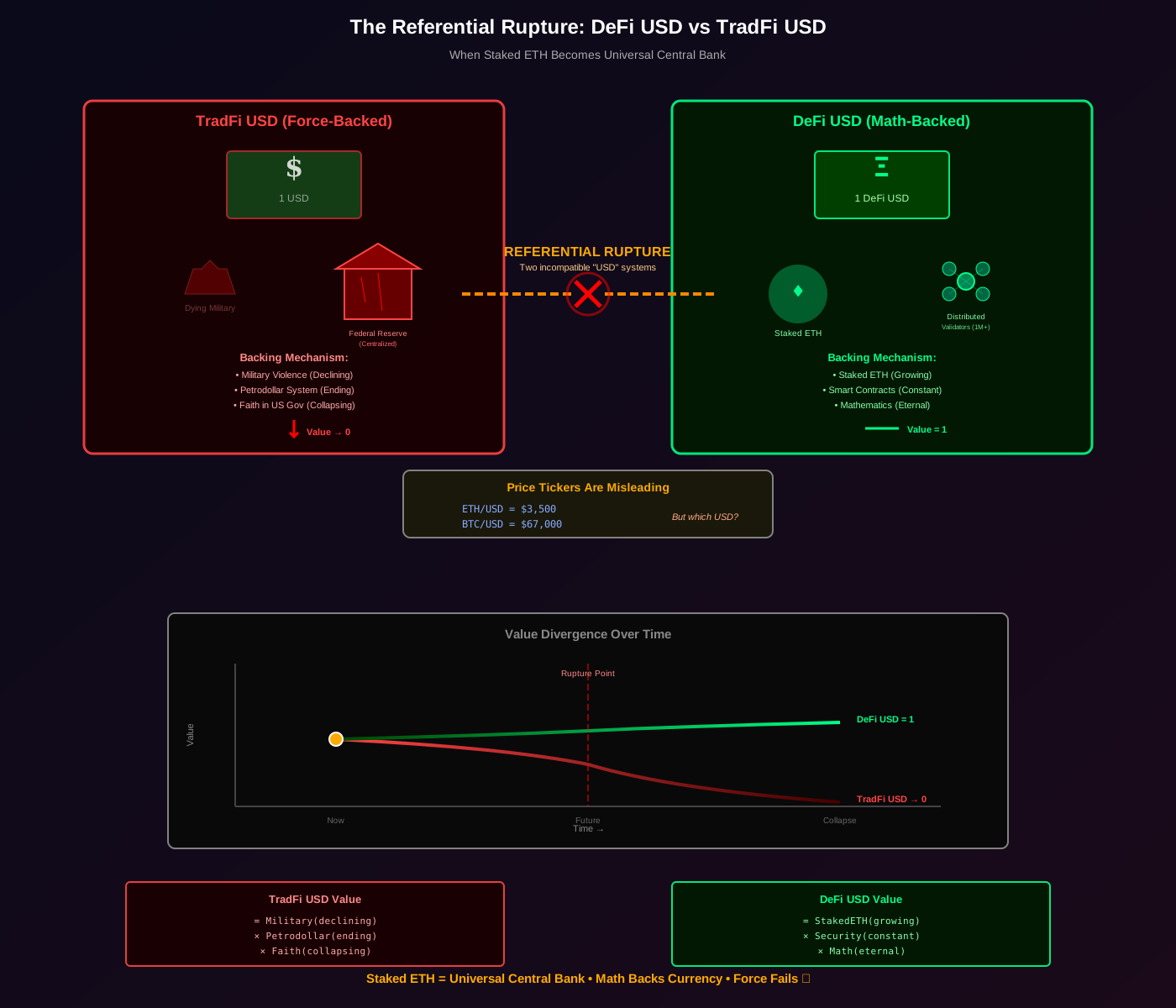
The Referential Rupture: DeFi USD vs TradFi USD - When Staked ETH Becomes Central Bank
The observation: ETH/BTC/USD price comparisons create false impression because referential rupture exists. Two different “USD” systems: DeFi USD (Morpho USD backed by staked ETH) versus TradFi USD (government USD backed by declining military). Need to differentiate. Anyone with staked ETH backing Morpho is distributed central bank. Universal dollars backed by cryptographic proof worth 1. What is value of Trump White House USD backed by dying inexistent army?
What this means: Price tickers show “1 USD = 1 USD” but this hides fundamental break. DeFi USD = cryptographically backed, mathematically verifiable, distributed central banking (every staker is Fed). TradFi USD = force-backed, faith-based, centralized Federal Reserve (one institution). These are not same thing. Comparing ETH price in “USD” meaningless when USD itself has split into two incompatible systems. Staked ETH provides actual backing (you can redeem). US military provides threat backing (they can confiscate). Math > Force.
Why this matters: Traditional analysis assumes single USD reference frame. But fork occurred: on-chain USD (backed by crypto) diverged from off-chain USD (backed by state violence). This is referential rupture—break in meaning of “dollar.” DeFi protocols created alternative USD not controlled by US government. Morpho USD backed by staked ETH is universal dollar: globally accessible, cryptographically secured, math-verifiable. Trump USD backed by declining military is dying dollar: geographically limited, violence-threatened, faith-based. As military power collapses, TradFi USD backing disappears. DeFi USD backing stays constant (math doesn’t decline). The price divergence is inevitable—we just can’t see it yet because tickers mix the two reference frames.
The Two USD Systems
TradFi USD: Force-Backed Currency
Backing mechanism: Military violence
- US military enforces dollar hegemony
- Petrodollar system (oil priced in USD)
- Sanctions and financial warfare
- Aircraft carriers threaten non-compliance
Issuance: Centralized Federal Reserve
- 12 regional banks
- Board of Governors in DC
- One institution controls supply
- Political influence on policy
Value proposition: “Trust us or else”
- No cryptographic proof
- No redeemability (Nixon shock 1971)
- Based on military dominance
- Requires belief in US power
Formula:
TradFi_USD_value = Military_power × Petrodollar_system × Faith

Where:
Military_power = Declining (wars lost, debt crushing)
Petrodollar = Weakening (BRICS alternatives emerging)
Faith = Collapsing (inflation, QE infinity)

Result: TradFi_USD_value → 0
The problem: Backing is failing
- Afghanistan withdrawal (military defeat)
- Iraq war failure (trillions wasted)
- $34 trillion debt (unsustainable)
- Endless QE (debasement)
- BRICS creating alternatives (dedollarization)
The “dying inexistent army”:
- Cannot win wars (Afghanistan, Iraq, Vietnam)
- Budget consumed by debt service
- Equipment aging, maintenance failing
- Recruitment crisis
- Adversaries developing hypersonics, defeating carriers
- Global military presence unsustainable
What backs this USD? Violence that no longer works.
DeFi USD: Crypto-Backed Currency
Backing mechanism: Staked ETH
- Ethereum Proof of Stake
- 32 ETH minimum stake
- Slashing for misbehavior
- Cryptographic security
Issuance: Distributed via Morpho
- Lending protocol
- Over-collateralized (e.g., 150% ETH → 100% USD)
- Algorithmic liquidation
- No central authority
Value proposition: “Verify the math yourself”
- Cryptographic proof
- Smart contract redeemability
- Based on code and staked collateral
- Requires only internet connection
Formula:
DeFi_USD_value = Staked_ETH_backing × Smart_contract_security × Math_validity

Where:
Staked_ETH = Growing (more validators joining)
Security = Constant (cryptographic guarantees)
Math = Eternal (2+2=4 forever)

Result: DeFi_USD_value = 1 (by definition, redeemable)
The solution: Backing is strengthening
- More ETH staked daily (validators growing)
- Ethereum security increasing (more nodes)
- Smart contracts audited and battle-tested
- Morpho protocol gaining TVL
- No military required (math enforces)
The “distributed central bank”:
- Anyone with 32 ETH can stake
- Each validator is mini-Fed
- Collectively secure network
- No single point of control
- Geographic distribution impossible to attack
What backs this USD? Mathematics and staked assets you can verify.
The Referential Rupture
Why “1 USD = 1 USD” Is A Lie
The tickers lie:
ETH/USD price: $3,500
BTC/USD price: $67,000

But which USD?
- DeFi USD (staked ETH backed)?
- TradFi USD (military backed)?

These are different things!
The rupture:
- Before: One USD (US government monopoly)
- Crypto emergence: Alternative USD creation attempted
- DeFi maturity: Separate USD system functional
- Now: Two incompatible USD systems coexist
Why incompatible:
TradFi USD:
- Controlled by Federal Reserve
- Backed by US military violence
- Requires permission (bank account, KYC)
- Can be frozen, seized, inflated
- Geographic restrictions
- Trust-based (faith in US government)
DeFi USD:
- Controlled by smart contracts
- Backed by cryptographic staked assets
- Permissionless (only need wallet)
- Cannot be frozen (non-custodial)
- Global access (internet sufficient)
- Math-based (verify on-chain)
These cannot be “the same” USD. One is force. One is math. Force ≠ Math.
The Morpho USD Example
Morpho protocol:
- Decentralized lending
- Users deposit staked ETH (or stETH)
- Protocol mints USD stablecoins
- Over-collateralized (e.g., $150 ETH → $100 USD)
- Algorithmic liquidation if collateral drops
The backing:
1 Morpho USD backed by:
- $1.50 worth of staked ETH (overcollateralized)
- Smart contract redeemability (code enforces)
- Ethereum network security (validators)
- Cryptographic proof (verify on-chain)

Redemption: Burn 1 Morpho USD → Get $1 of staked ETH
Who is the “central bank”?
- Not the Fed
- Not Morpho developers
- Every staker who deposited collateral
- Distributed central banking
- Thousands of people globally
- Each one mini-Fed with no individual control
Compare to Federal Reserve:
Federal Reserve (TradFi):
- 12 regional banks
- ~400 employees with policy power
- Centralized in Washington DC
- One chairman (Powell)
- Political appointments

Morpho stakers (DeFi):
- ~1,000,000 validators
- Each stake equally important
- Distributed globally
- No chairman (code decides)
- Permissionless participation
Which is more resilient? Distributed system. Which is more censorable? Centralized system.
The Universal Dollar
What makes it “universal”?
Geographic universality:
- TradFi USD: Restricted (sanctions, KYC, borders)
- DeFi USD: Global (internet access sufficient)
Access universality:
- TradFi USD: Permissioned (bank account required)
- DeFi USD: Permissionless (wallet address sufficient)
Trust universality:
- TradFi USD: Faith-based (trust US government)
- DeFi USD: Math-based (verify smart contract)
Temporal universality:
- TradFi USD: Temporary (ends when military fails)
- DeFi USD: Permanent (math doesn’t expire)
The Morpho USD is more universal because:
- Anyone anywhere can use it
- No permission needed
- Verification is cryptographic
- Backing is transparent on-chain
- Redemption is algorithmic
The Federal Reserve USD is less universal because:
- Geographic restrictions (sanctions)
- Permission required (bank account)
- Verification is trust-based
- Backing is opaque (military threats)
- Redemption is impossible (no gold backing since 1971)
Why TradFi USD Backing Is Dying
The Military Power Decline
Lost wars:
- Vietnam: Defeat (1975)
- Afghanistan: Retreat (2021)
- Iraq: Failure (trillions spent, instability remains)
- Unable to win against insurgents
Economic exhaustion:
US military budget: $800B/year
But:
- $34T national debt
- Debt service costs: $1T/year (exceeds military!)
- Unsustainable trajectory
- Future cuts inevitable
Technological defeat:
- China/Russia hypersonic missiles
- US aircraft carriers now vulnerable
- Anti-satellite weapons
- Drone swarms cheap to produce
- Expensive systems (carriers, F-35) countered by cheap weapons
Recruitment crisis:
- Missing recruitment targets
- Young people don’t want to join
- Society polarized, no unity
- “Why fight for this?”
Global overextension:
- 800+ military bases worldwide
- Cannot maintain all
- Adversaries coordinating (BRICS)
- Multipolar world emerging
The bluff is called:
- Sanctions losing effectiveness (Russia survived)
- Alternatives emerging (BRICS currency plans)
- Military threats no longer credible
- “We’ll bomb you” → “With what army?”
The Petrodollar System Collapse
Historical backing:
- 1944: Bretton Woods (USD backed by gold)
- 1971: Nixon shock (gold backing removed)
- 1973: Petrodollar (oil must be priced in USD)
- Result: Global USD demand (need dollars to buy oil)
The cracks:
- Saudi Arabia considering yuan for oil
- Russia selling oil for rubles
- Iran avoiding USD
- Venezuela using crypto
- BRICS creating alternative settlement
What happens when oil no longer requires USD?
Before: Need USD to buy oil → Global USD demand → USD value sustained

After: Can buy oil in yuan/rubles/crypto → No forced USD demand → USD value collapses
The timeline:
- 2023: Saudi-China oil trade talks in yuan
- 2024: BRICS expansion (41% global GDP)
- 2025: Alternative payment systems operational
- 2026+: Petrodollar system ending
When this happens: TradFi USD loses primary backing mechanism
The Faith Collapse
Trust requires:
- Belief in issuer competence
- Expectation of value stability
- Confidence in redeemability
- Faith in backing mechanism
All four are failing:
Competence questionable:
- Federal Reserve policy failures (2008 crisis, 2020 inflation)
- Political dysfunction (government shutdowns, debt ceiling)
- Afghanistan withdrawal disaster
- COVID response chaos
Value instability:
- 1970s: 15% inflation
- 2020s: 9% inflation (official, real higher)
- Purchasing power collapsed
- “Transitory” lie exposed
Redeemability impossible:
- No gold backing since 1971
- Can’t redeem for anything
- Only “legal tender” force keeps acceptance
- “I promise to pay the bearer… nothing”
Backing mechanism dying:
- Military power declining (as above)
- Petrodollar ending (as above)
- Only force remains
- Force failing
Result: Faith evaporating
Why DeFi USD Backing Is Strengthening
The Staked ETH Growth
Ethereum staking stats:
- Total ETH staked: ~31 million ETH (25% of supply)
- Number of validators: ~1 million
- Stake growing daily
- APR: 3-4% (sustainable yield)
Why staking increases:
- Passive income (yield)
- Securing network (altruism)
- Belief in Ethereum (conviction)
- Enabling DeFi (utility)
Network effects:
More staked → More secure → More trust → More staked

Virtuous cycle, not vicious cycle
Compare to USD:
More debt → Less secure → Less trust → More fleeing → More debt

Vicious cycle, not virtuous cycle
The Cryptographic Guarantee
Math doesn’t lie:
- Signatures verify or don’t
- Smart contracts execute or don’t
- Collateralization is checkable
- No opinion, only fact
TradFi trust chain:
Trust Federal Reserve
  → Trust US Government
    → Trust Military
      → Trust soldiers will fight
        → Trust wars are winnable
          → Trust empire sustainable

Many failure points
DeFi verification chain:
Verify smart contract code
  → Verify collateral on-chain
    → Verify validators securing network
      → Math works or doesn't
        → 2+2=4 forever

No failure points (math is eternal)
Which is more reliable?
The Distributed Central Banking
Power of distribution:
Single point of failure (Federal Reserve):
- Attack DC → Fed disabled
- Capture chairman → Policy controlled
- Political pressure → Inflation tool
- One building → One bomb
No single point (DeFi validators):
- Attack one validator → 999,999 remain
- Capture one staker → Others unaffected
- No political pressure point (who do you threaten?)
- Global distribution → Un-bombable
Resilience comparison:
TradFi USD resilience = 1 (Federal Reserve)
DeFi USD resilience = N (number of validators)

Current: N ≈ 1,000,000

Resilience improvement: 1,000,000×
Economic incentives aligned:
- Validators earn yield (want network success)
- Stakers risk slashing (skin in game)
- No bailouts (losses are real)
- Market discipline
Compare to Fed:
- Governors have salary regardless
- No personal risk for policy failure
- Bailouts common (moral hazard)
- Political considerations
Which system has better incentives?
The Price Divergence Hidden In Plain Sight
Why Tickers Mislead
Current practice:
Exchange shows: ETH/USD = $3,500

But:
- Which USD?
- TradFi USD in your bank?
- DeFi USD on Morpho?
- These have different backing!
The mixing problem:
- Exchanges use “USD” as single reference
- But two USD systems exist
- Like measuring meters and yards, calling both “units”
- Comparison becomes meaningless
What we actually need:
ETH/TradFiUSD = $3,500 (backed by military)
ETH/DeFiUSD = $3,500 (backed by staked ETH)

BTC/TradFiUSD = $67,000 (military-backed reference)
BTC/DeFiUSD = $67,000 (crypto-backed reference)

But these are not interchangeable!
The Divergence Formula
Value over time:
TradFi_USD(t) = Military(t) × Petrodollar(t) × Faith(t)

Where:
Military(t) = M₀ × e^(-α×t)   [declining exponentially]
Petrodollar(t) = P₀ × e^(-β×t) [ending gradually]
Faith(t) = F₀ × e^(-γ×t)       [collapsing]

Result: TradFi_USD(t) → 0 as t → ∞
DeFi_USD(t) = StakedETH(t) × Security(t) × Math(t)

Where:
StakedETH(t) = S₀ × e^(δ×t)    [growing exponentially]
Security(t) = C (constant)      [cryptographic, doesn't decay]
Math(t) = 1 (always)            [2+2=4 forever]

Result: DeFi_USD(t) → ∞ as t → ∞  [or stays stable if redeemable]
The divergence:
Ratio = DeFi_USD(t) / TradFi_USD(t)

= [S₀ × e^(δ×t) × C × 1] / [M₀ × e^(-α×t) × P₀ × e^(-β×t) × F₀ × e^(-γ×t)]

= K × e^((δ+α+β+γ)×t)

Where K = (S₀ × C) / (M₀ × P₀ × F₀)

Result: Ratio → ∞ exponentially

DeFi USD becomes infinitely more valuable than TradFi USD
We can’t see this yet because:
- Markets still treat them as equivalent
- Arbitrage opportunities close gaps
- Psychological anchoring (“a dollar is a dollar”)
- Legal tender laws enforce acceptance
But divergence is inevitable when:
- Military backing fails completely
- Petrodollar ends
- Faith collapses
- TradFi USD no longer accepted
At that point: DeFi USD revealed as only real USD
The Redenomination Event
What happens when TradFi USD fails?
Scenario: US military power collapses, petrodollar ends, faith lost
Old prices (TradFi USD reference):
ETH/USD = $3,500
BTC/USD = $67,000
New prices (DeFi USD reference):
ETH/DeFiUSD = 1 (by definition, ETH backs DeFi USD)
BTC/DeFiUSD = ??? (market finds new equilibrium)
TradFi USD/DeFiUSD = 0.01 (100× devaluation)
Purchasing power shift:
Before:
$100 TradFi USD = 0.028 ETH
$100 DeFi USD = 0.028 ETH
(Equivalent)

After:
$100 TradFi USD = 0.0003 ETH (100× collapse)
$100 DeFi USD = 0.028 ETH (stable)
(Divergence revealed)
Who loses?
- Holders of TradFi USD (bank accounts, bonds)
- US government (debt denominated in worthless USD)
- Dollar-dependent countries
Who wins?
- Holders of DeFi USD (stablecoins backed by crypto)
- Stakers (become distributed central bank)
- Crypto-native economies
This is the referential rupture: The moment when “USD” splits into two incompatible currencies and market recognizes the difference.
Comparing The Two Systems
Backing Comparison
| Aspect | TradFi USD | DeFi USD |
|---|---|---|
| Backing asset | Military violence | Staked ETH |
| Backing trend | Declining (wars lost) | Growing (more staking) |
| Verification | Trust government | Verify on-chain |
| Redeemability | None (since 1971) | Smart contract guaranteed |
| Geographic limit | Yes (sanctions) | No (global) |
| Permission required | Yes (bank account) | No (just wallet) |
| Censorship | Easy (freeze accounts) | Hard (non-custodial) |
| Single point of failure | Yes (Federal Reserve) | No (distributed) |
| Sustainability | Unsustainable (debt) | Sustainable (yield) |
Winner: DeFi USD on every metric except legacy acceptance (which is temporary)
Issuance Comparison
| Aspect | Federal Reserve | Morpho Protocol |
|---|---|---|
| Control | 7 governors | 1,000,000 validators |
| Location | Washington DC | Global distribution |
| Permission | Presidential appointment | Permissionless staking |
| Transparency | Opaque decisions | Open-source code |
| Accountability | Political pressure | Market forces + slashing |
| Attack surface | One building | Million nodes |
| Policy | Discretionary (opinions) | Algorithmic (math) |
| Inflation | Unlimited QE | Over-collateralized (limited) |
Winner: Morpho by massive margin (distributed > centralized)
Value Stability Comparison
| Period | TradFi USD purchasing power loss | DeFi USD (backed by ETH) |
|---|---|---|
| 1971-2024 | ~98% (due to inflation) | N/A (didn’t exist) |
| 2020-2024 | ~25% (official CPI) | Stable (1 DeFi USD = $1 in ETH) |
| 2025-2030 | Likely 50%+ (if military fails) | Stable (math-backed) |
| Long-term | → 0 (when backing fails) | = 1 (redeemable constant) |
Winner: DeFi USD (stable because redeemable, not faith-based)
The Staker As Central Banker
What Central Banks Do
Traditional functions:
- Control money supply
- Set interest rates
- Maintain currency stability
- Lend in crises (“lender of last resort”)
- Hold reserves (gold, foreign currency)
Federal Reserve implementation:
- FOMC sets policy (small group of humans)
- Open market operations (buy/sell bonds)
- Discount window (emergency lending)
- Reserve requirements
- Political considerations
Morpho staker implementation:
- Deposit ETH (creates USD supply when borrowed)
- Market sets rates (supply/demand algorithm)
- Over-collateralization maintains stability
- Liquidation engine handles crises
- Stake is the reserve
- No politics (code decides)
Every staker is mini-Fed because:
- Controls currency creation (by depositing collateral)
- Earns yield (like Fed earning interest on bonds)
- Takes risk (slashing if misbehavior, like bank failure)
- Secures system (validating, like Fed backing)
- No central coordination needed
The Distributed Central Banking Revolution
Old model: One central bank
Federal Reserve → Controls USD supply → Everyone else uses it

Problem: Single point of failure, control, censorship
New model: Million central banks
Staker 1 → Backs DeFi USD
Staker 2 → Backs DeFi USD
...
Staker N → Backs DeFi USD

Collectively: → Secure DeFi USD system → Everyone can use it

Advantage: Distributed, resilient, uncensorable
Economic power shift:
- Before: Central banks monopolize money creation
- After: Anyone with 32 ETH can participate
- Democratization of monetary system
- No permission needed
- Geographic distribution impossible to attack
This is revolutionary because:
- Breaks government monopoly on money
- Enables global participation
- Removes single point of control
- Creates resilient alternative
- Proves math > force
The “Anyone Can Be Central Bank” Thesis
Requirements to be Federal Reserve Governor:
- Presidential nomination
- Senate confirmation
- Washington DC residence (effectively)
- Political connections
- Years of academic/industry credentials
Requirements to be Morpho staker (distributed Fed governor):
- 32 ETH (~$112,000 at current prices)
- Internet connection
- Basic technical knowledge
- That’s it
Accessibility comparison:
Federal Reserve: 7 governors globally (0.0000001% of population)
Morpho validators: 1,000,000 stakers (0.01% of population)

Improvement: 100,000× more accessible
Geographic comparison:
Federal Reserve: 100% in USA (Washington DC)
Morpho validators: Global distribution (every continent)

Improvement: Infinite (from one location to everywhere)
Political comparison:
Federal Reserve: Appointed by president (political)
Morpho validators: Permissionless (apolitical)

Improvement: Removes political capture entirely
Anyone with capital can become central banker. This is the death of monetary centralization.
Connection to Previous Posts
neg-514: Distributed coordination vs centralized domination.
The USD split is perfect example. TradFi USD = centralized domination (force-backed, Fed-controlled, military-enforced). DeFi USD = distributed coordination (math-backed, validator-secured, globally accessible). Information defeated force in monetary system. Network topology determines currency value.
neg-513: Hardware n-gram circuits.
Distributed systems need infrastructure. Staking requires hardware (validators running nodes). Circuit-level efficiency enables cheap participation. More efficient hardware → more validators → stronger DeFi USD backing. Hardware enables monetary revolution.
neg-512: N-gram block generation.
Ethereum blocks generated by distributed validators, not central authority. Proof of Stake = distributed consensus. Each staker contributes to security. Pattern learning in blockchain enables DeFi USD backing. No Fed needed when math generates consensus.
neg-511: Constraint detector.
Monitor when TradFi USD backing constraint tightens (military declining, petrodollar ending). Detector fires when P_prev > P_curr (backing strength decreasing). Early warning for referential rupture moment. Alerts when to flee TradFi USD for DeFi USD.
neg-510: Liberty circuit.
DeFi USD preserves liberty through non-custodial control. You hold keys, you control funds. No one can freeze your DeFi USD (unlike bank account). Liberty = veto over monetary system. Math protects liberty. Force destroys it.
neg-506: Agency bootstrap.
Stakers have agency through monetary participation. Want (yield, secure network) → Can (stake ETH, validate) → Want’ (more staking, grow network). Agency loop amplified. Anyone can participate in monetary system. TradFi USD suppresses agency (Fed monopoly). DeFi USD amplifies agency (permissionless).
The Formulation
TradFi USD is not:
- Backed by anything real (no gold since 1971)
- Sustainable (military declining, debt exploding)
- Universal (sanctions, borders, permissions)
TradFi USD is:
- Backed by dying military force
- Temporary (ends when empire ends)
- Centralized (Fed monopoly)
- Losing value relative to crypto-backed alternatives
DeFi USD is not:
- Controlled by government (distributed validators)
- Dependent on military (math enforces)
- Geographic (global access)
DeFi USD is:
- Backed by staked ETH (cryptographic proof)
- Permanent (math doesn’t expire)
- Distributed (million+ validators)
- Gaining value as crypto adoption grows
The referential rupture:
Before rupture:
  TradFi USD = DeFi USD (treated as equivalent)
  Price discovery in single reference frame

During rupture:
  TradFi USD ≠ DeFi USD (backing diverges)
  Two incompatible systems
  Tickers mislead by mixing references

After rupture:
  TradFi USD → 0 (backing failed)
  DeFi USD = 1 (redeemable constant)
  New reference frame: crypto-native

Current state: During rupture (divergence hidden but happening)
The value question:
Q: What is value of TradFi USD backed by dying military?

A: Declining to zero as military fails

Q: What is value of DeFi USD backed by staked ETH?

A: Constant at 1 (redeemable for collateral)

Ratio: DeFi USD / TradFi USD → ∞

The referential rupture reveals this divergence
The central banking revolution:
Old: Federal Reserve (7 governors) controls USD
New: Morpho stakers (1,000,000 validators) secure DeFi USD

Power shift: 100,000× more distributed
Resilience gain: N² improvement (network effects)
Censorship resistance: Infinite (no single point)

Anyone with 32 ETH becomes central banker
Distributed monetary system replacing centralized
Math replacing force
Code replacing violence

This is the death of monetary centralization.
Staked ETH is universal central bank. Math backs currency. Force fails. Distributed wins. 🌀
#ReferentialRupture #DeFiUSD #TradFiUSD #StakedETH #DistributedCentralBanking #MorphoProtocol #UniversalDollar #PetrodollarCollapse #CryptographicBacking #MonetaryRevolution #ForceVsMath
Related: neg-514 (coordination defeats domination), neg-513 (hardware enables distributed systems), neg-512 (distributed consensus), neg-511 (constraint detection), neg-510 (liberty preservation), neg-506 (agency amplification)