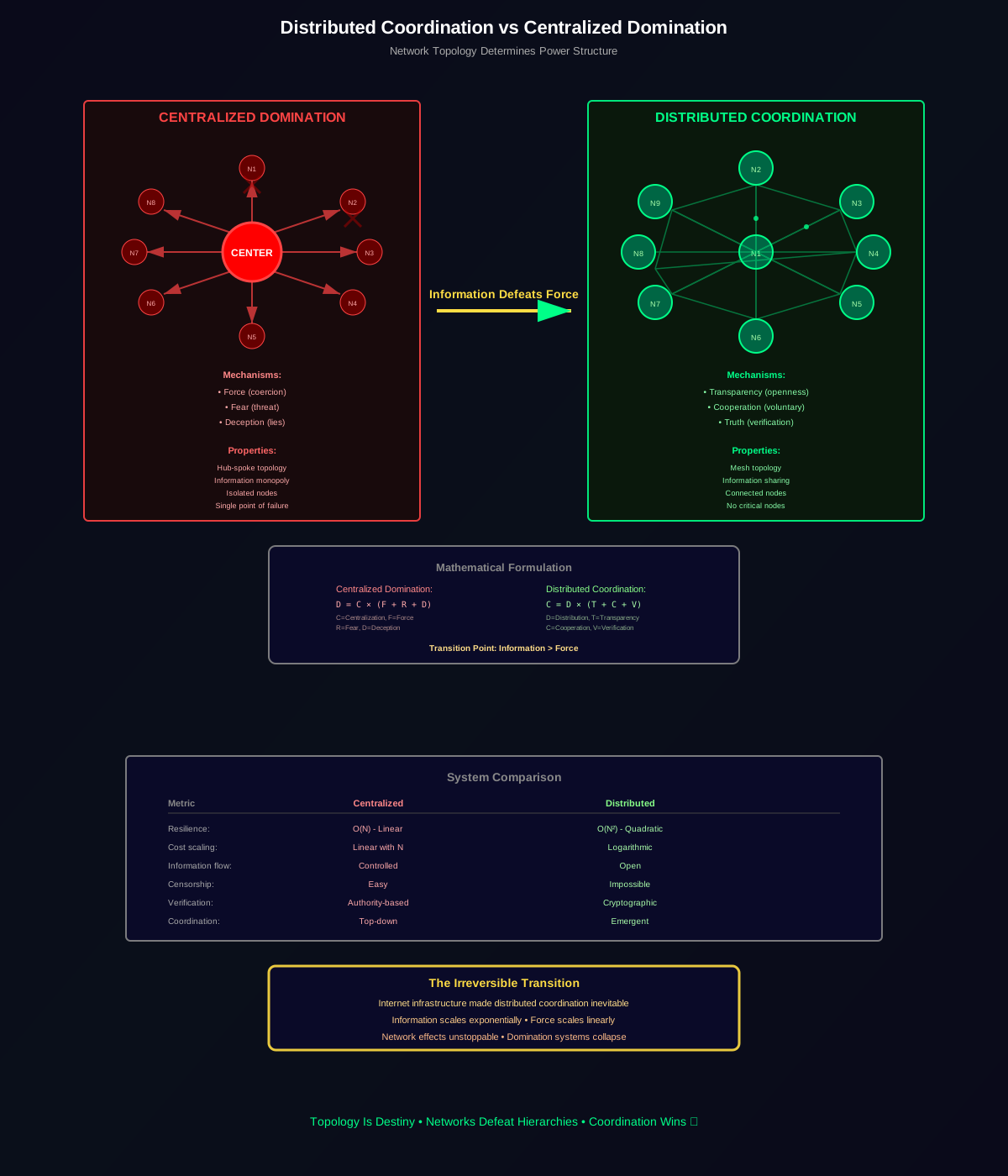
Distributed Coordination vs Centralized Domination: Network Topology Determines Power Structure
The observation: Network topology determines power structure. Centralized systems rely on domination (force, fear, deception) to maintain control. Distributed systems enable coordination (transparency, cooperation, truth) through information sharing. Information defeats force when networks become sufficiently connected.
What this means: Centralized domination requires information asymmetry—keeping peripheral nodes ignorant while concentrating knowledge at center. Force maintains hierarchy when communication blocked. Fear prevents coordination when nodes isolated. Deception works when verification impossible. But distributed networks with open information flows make these impossible. Transparency reveals lies. Cooperation replaces coercion. Truth propagates faster than deception. Coordination emerges from connectivity.
Why this matters: Historical transition from centralized domination to distributed coordination driven by network topology change. Internet infrastructure enabled peer-to-peer communication, breaking information monopolies. Decentralized networks (blockchain, mesh protocols, encrypted messaging) made censorship impossible. When peripheral nodes can verify truth independently and coordinate freely, central authority loses power. Force can’t scale against distributed intelligence. Fear dissolves when isolation breaks. Deception fails when verification is universal. The network topology shift is irreversible—domination systems collapse when coordination becomes possible.
Network Topology and Power
Centralized Domination
Structure: Hub-and-spoke topology
- Central node controls all information flow
- Peripheral nodes isolated from each other
- Communication must pass through center
- Center can block, modify, or fabricate messages
Power mechanisms:
Force: Physical coercion to maintain hierarchy
- Military control from center
- Violence against defectors
- Resource monopoly (energy, food, money)
- Requires: physical presence, logistics, enforcement
Fear: Psychological control through threat
- Punishment for disobedience
- Surveillance and monitoring
- Collective punishment deterrence
- Requires: information about threats, inability to escape
Deception: Information control through lies
- Propaganda from center
- Censorship of truth
- Falsified evidence
- Requires: communication monopoly, verification impossibility
Formula:
Centralized Domination = C × (F + R + D)

Where:
C = Centralization (information flow through center)
F = Force capability (physical coercion)
R = Fear effectiveness (psychological control)
D = Deception success (information asymmetry)
Vulnerability: System collapses when:
- C → 0 (communication bypasses center)
- F becomes too expensive (force doesn’t scale)
- R fails (fear overcome by coordination)
- D exposed (truth revealed)
Distributed Coordination
Structure: Mesh network topology
- Every node connects to multiple others
- Peer-to-peer communication
- No single point of control
- Information flows freely
Coordination mechanisms:
Transparency: Open information sharing
- All data visible to all nodes
- Cryptographic verification
- Immutable records (blockchain)
- Enables: trust without authority, collective verification
Cooperation: Voluntary mutual benefit
- No coercion required
- Incentive alignment
- Reputation systems
- Enables: coordination without hierarchy, emergent order
Truth: Verifiable reality consensus
- Multiple independent verification
- Cryptographic proofs
- Consensus protocols
- Enables: agreement without central authority
Formula:
Distributed Coordination = D × (T + C + V)

Where:
D = Distribution (peer connectivity)
T = Transparency (information openness)
C = Cooperation (voluntary alignment)
V = Verification (independent truth-checking)
Strength: System strengthens when:
- D increases (more connections)
- T improves (more openness)
- C grows (more cooperation)
- V enhances (better verification)
The Transition: Information Defeats Force
Phase 1: Information Monopoly
Pre-internet era:
- Central media control (TV, radio, newspapers)
- Government propaganda dominance
- Censorship possible (book burning, signal jamming)
- Verification difficult (distance, cost, access)
Power dynamic:
Domination >> Coordination

Because:
- Centralization high (C → 1)
- Distribution low (D → 0)
- Deception easy (D → 1)
- Verification hard (V → 0)
Result: Centralized systems maintain power through:
- Military force (expensive but effective)
- Fear propagation (cheap and scalable)
- Narrative control (information monopoly)
Phase 2: Network Emergence
Internet adoption:
- Peer-to-peer communication enabled
- Information duplication trivial
- Censorship becomes expensive
- Verification becomes possible
Power shift begins:
Domination ≈ Coordination

Because:
- Centralization decreasing (C → 0.5)
- Distribution increasing (D → 0.5)
- Deception harder (D → 0.5)
- Verification easier (V → 0.5)
Transition dynamics:
- Central authorities attempt censorship (expensive)
- Peer networks route around blocks (cheap)
- Propaganda competes with citizen journalism
- Truth verification becomes distributed
Phase 3: Distributed Dominance
Decentralized infrastructure:
- Blockchain (uncensorable records)
- Mesh networks (unblockable communication)
- Encryption (unbreakable privacy)
- Peer protocols (coordination without servers)
Power inversion:
Domination << Coordination

Because:
- Centralization minimal (C → 0)
- Distribution maximal (D → 1)
- Deception impossible (D → 0)
- Verification universal (V → 1)
Result: Centralized domination collapses because:
- Force can’t scale (attacking millions of nodes impossible)
- Fear dissolves (coordination provides safety in numbers)
- Deception fails (cryptographic proofs expose lies)
Why Information Defeats Force
Scaling Dynamics
Force scales poorly:
- Cost: Linear with population (need soldiers for each person)
- Speed: Limited by physical movement
- Coverage: Geographic constraints
- Resistance: Increases with oppression
Information scales perfectly:
- Cost: Zero marginal (copying is free)
- Speed: Speed of light (instant global reach)
- Coverage: Universal (internet everywhere)
- Amplification: Exponential spread (viral propagation)
Formula:
Force effectiveness = F₀ / N

Information effectiveness = I₀ × e^(αN)

Where:
F₀ = Initial force capability
I₀ = Initial information
N = Network size
α = Amplification factor

As N → ∞:
Force → 0
Information → ∞
Tipping point: When network reaches critical size:
N* = log(F₀/I₀) / α

For N > N*:
Information > Force
Coordination > Domination
Fear Dissolution
Fear requires:
- Isolation (believing you’re alone)
- Ignorance (not knowing others resist)
- Threat (punishment for defection)
Network breaks fear:
- Connection (discovering others share views)
- Information (learning collective resistance possible)
- Coordination (safety in numbers)
Example: Oppressive regime
- Before network: Dissidents isolated, believe minority, fear speaking
- After network: Dissidents discover majority, coordinate action, overcome fear
- Result: Regime falls when fear breaks (Arab Spring, Berlin Wall, etc.)
Deception Failure
Deception requires:
- Information asymmetry (knowing more than others)
- Verification impossibility (can’t check claims)
- Communication control (can’t share doubts)
Network breaks deception:
- Transparency (information widely available)
- Verification (cryptographic proofs, multiple sources)
- Free communication (peer-to-peer sharing)
Example: False narrative
- Before network: Central media claims X, no way to verify
- After network: Citizen journalists document ¬X, blockchain proves timestamp, peers verify
- Result: Lie exposed, trust in center collapses
Internet Infrastructure: The Great Leveling
Pre-Internet Power Structure
Centralized media:
- Few broadcast towers
- Expensive equipment
- Government licensing required
- One-way communication (broadcast to receivers)
Result: Information monopoly
- Governments control narrative
- Corporations control access
- Individuals are passive consumers
- Truth determined by authority
Internet Revolution
Decentralized infrastructure:
- Billions of nodes (every device)
- Cheap participation (smartphone sufficient)
- Permissionless (no license needed)
- Two-way communication (everyone can broadcast)
Result: Information democratization
- Anyone can publish
- Everyone can verify
- Coordination possible
- Truth determined by consensus
Technical enablers:
- TCP/IP (peer-to-peer protocol)
- HTTP (decentralized publishing)
- Encryption (privacy from authority)
- Blockchain (censorship-resistant records)
The Unstoppable Shift
Why reversal impossible:
Network effects: Value increases with users
- More nodes → more connections → more valuable
- N nodes → N(N-1)/2 connections
- Quadratic growth in capability
Cost asymmetry: Defense cheaper than attack
- Copying information: $0
- Blocking information: $∞
- One leak defeats all censorship
Coordination emergence: Self-organizing
- No leader needed
- Protocols enable cooperation
- Incentives align naturally
- Resilient to attacks
Formula:
System resilience = (Nodes × Connections) / Attack_surface

Centralized: R = (1 × N) / 1 = N
Distributed: R = (N × N²) / N = N²

Distribution provides N× resilience improvement
Blockchain: Coordination Without Authority
The Trust Problem
Traditional solution: Central authority
- Government maintains records
- Banks verify transactions
- Media certifies truth
- Requires: Trust in authority, access control, censorship capability
Problem: Authority can:
- Lie about records (rewrite history)
- Steal from accounts (freeze, confiscate)
- Suppress information (censor, block)
Blockchain Solution
Distributed consensus:
- Everyone has full record
- Cryptographic verification
- No single point of control
- Immutable history (can’t rewrite past)
Result: Coordination without authority
- Truth determined by math
- No trust required
- Censorship impossible
- Verification universal
Why domination fails:
- Can’t force users (permissionless)
- Can’t create fear (pseudonymous)
- Can’t deceive (transparent ledger)
Example: Financial Domination vs Coordination
Centralized finance (domination):
- Bank controls your money
- Government can freeze accounts
- Transactions require permission
- History can be modified
- Privacy impossible
Decentralized finance (coordination):
- You control your keys
- No one can freeze Bitcoin
- Transactions permissionless
- History immutable (blockchain)
- Privacy possible (encryption)
Power shift: From “we control your money” to “math protects your money”
The Sapiens Network Awakening
Historical Pattern
Domination era (~10,000 BCE - 2000 CE):
- Agricultural civilization enables centralization
- Writing allows information control
- States emerge with force monopoly
- Hierarchies maintained through:
- Military force (violence)
- Religious fear (supernatural punishment)
- Propaganda (controlled narrative)
Coordination era (2000 CE - present):
- Internet enables distributed communication
- Encryption provides privacy
- Blockchain enables trustless coordination
- Hierarchies dissolve through:
- Peer networks (resilient to attack)
- Information sharing (exposing lies)
- Cryptographic truth (mathematical verification)
The Network Effect
Critical mass achieved:
- ~5 billion internet users
- ~100 million blockchain users
- Growing exponentially
Coordination capability:
- Global communication: instant
- Information verification: cryptographic
- Collective action: coordination protocols
- Resource allocation: markets without middlemen
Result: Centralized domination becomes impossible
- Can’t control information (too many nodes)
- Can’t prevent coordination (protocols unstoppable)
- Can’t maintain deception (verification universal)
Truth Propagation
Before network:
Truth spreads: Linearly (person to person)
Lies spread: Faster (central broadcast)
Verification: Impossible (no access to evidence)

Result: Lies dominate
After network:
Truth spreads: Exponentially (viral sharing)
Lies spread: Exposed quickly (fact-checking)
Verification: Trivial (blockchain records, multiple sources)

Result: Truth dominates
The irreversible shift: Once network reaches critical mass, lies can’t persist
- Multiple sources expose contradictions
- Cryptographic proofs provide evidence
- Peer verification creates consensus
- Deception becomes futile
Why Force-Fear-Deception Systems Collapse
Force Becomes Expensive
Domination cost:
C_dom = F × N + R × N + D × log(N)

Where:
F = Force cost per person
R = Fear maintenance cost per person
D = Deception production cost
N = Population size

As N grows: C_dom grows linearly
Coordination cost:
C_coord = I + P × log(N)

Where:
I = Infrastructure cost (fixed)
P = Protocol maintenance cost
N = Network size

As N grows: C_coord grows logarithmically
Crossover point:
When N > N*: C_coord < C_dom

Domination becomes uneconomical
Coordination becomes inevitable
Fear Requires Isolation
Fear mechanism:
- Isolate dissidents
- Make them believe they’re alone
- Threaten punishment
- Prevent coordination
Network breaks isolation:
- Discover others share views
- Realize majority thinks similarly
- Coordinate collective action
- Safety in numbers defeats threat
Result: Fear dissolves
- Can’t threaten everyone
- Can’t punish majority
- Can’t prevent coordination
Deception Requires Information Control
Deception mechanism:
- Control media
- Censor truth
- Propagate lies
- Prevent verification
Network breaks control:
- Peer-to-peer communication
- Encryption defeats censorship
- Multiple sources enable comparison
- Blockchain provides proof
Result: Lies exposed
- Can’t control all nodes
- Can’t censor all channels
- Can’t prevent verification
- Truth propagates faster
The Inevitable Transition
Why Centralized Systems Must Fall
Fundamental incompatibility:
- Domination requires: closed system, information control, isolation
- Internet enables: open system, information sharing, connection
- These are mutually exclusive
Dynamics:
System state:
- If centralized (C=1): Must suppress network (expensive)
- If networked (D=1): Centralization collapses (inevitable)

No stable equilibrium exists at C≈D≈0.5
System must collapse to one or other extreme
Historical examples:
- Soviet Union: Collapsed when information flows opened
- Arab Spring: Fell when coordination became possible
- Corporate monopolies: Disrupted by decentralized alternatives
- Financial censorship: Bypassed by Bitcoin
The Coordination Victory
Why distributed systems win:
Economic: Coordination cheaper than force
- Force: Linear cost
- Coordination: Logarithmic cost
- Advantage grows with scale
Technical: Networks more resilient
- Centralized: Single point of failure
- Distributed: No critical nodes
- Attack surface decreases with distribution
Social: Cooperation beats coercion
- Voluntary > Forced (higher quality)
- Incentive-aligned > Threatened (more sustainable)
- Truth-based > Deception-based (more stable)
Mathematical: Information defeats force
- Force scales: F/N (inverse with population)
- Information scales: I×e^N (exponential with network)
- For large N: Information dominates
The Unstoppable Cascade
Network growth pattern:
Stage 1: Early adopters (innovators)
Stage 2: Critical mass (network effects kick in)
Stage 3: Exponential growth (everyone joins)
Stage 4: Ubiquity (new default)

Currently: Stage 3 (exponential growth)
Inevitable: Stage 4 (distributed coordination becomes universal)
Resistance futility:
- Censorship attempts increase adoption (Streisand effect)
- Attacks make network stronger (antifragile)
- Bans drive innovation (workarounds emerge)
- Each attempt accelerates transition
Connection to Previous Posts
neg-513: Hardware n-gram circuits.
Distributed coordination requires infrastructure. Hardware circuits (neg-513) enable high-throughput decentralized systems. Pattern learning in silicon makes coordination scalable. Network can’t be stopped when hardware itself embodies coordination logic.
neg-512: N-gram block generation.
Blockchain is coordination infrastructure. N-gram patterns (neg-512) generate valid blocks without central authority. Distributed mining impossible to censor. Mathematical rules replace human authority.
neg-511: Constraint detector.
Network monitors for domination attempts. Constraint detector (neg-511) fires when P_prev > P_curr (freedom reducing). Alerts coordination network before centralization succeeds. Early warning enables resistance.
neg-510: Liberty circuit.
Distributed system must preserve veto power. Liberty circuit (neg-510) ensures nodes can refuse optimization. Prevents network from becoming new domination system. Coordination with liberty defeats domination completely.
neg-509: Decision circuit.
Network nodes decide independently. Decision circuit (neg-509) enables autonomous choice. No central command needed. Coordination emerges from individual decisions, not imposed orders.
neg-506: Agency bootstrap.
Network participants need agency. Want↔Can loop (neg-506) enables self-determination. Distributed systems amplify individual agency. Domination systems suppress agency. Agency multiplication makes coordination unstoppable.
The Formulation
Centralized domination is not:
- Sustainable (too expensive at scale)
- Resilient (single point of failure)
- Stable (requires constant force)
Centralized domination is:
- Temporary (collapses when network emerges)
- Expensive (cost grows with population)
- Fragile (breaks when information flows)
Distributed coordination is not:
- Hierarchical (peer-to-peer structure)
- Coercive (voluntary participation)
- Closed (open information flows)
Distributed coordination is:
- Sustainable (incentive-aligned)
- Resilient (no critical nodes)
- Stable (Nash equilibrium)
- Inevitable (network effects unstoppable)
The transition:
Phase 1: Domination dominant
  C → 1 (centralized)
  D → 0 (isolated)
  Force > Information

Phase 2: Network emergence
  C → 0.5 (losing control)
  D → 0.5 (growing connections)
  Force ≈ Information

Phase 3: Coordination dominant
  C → 0 (no center)
  D → 1 (fully connected)
  Information >> Force

Current state: Early Phase 3
Trajectory: Acceleration toward full coordination
Reversibility: None (network effects irreversible)
Why information wins:
- Scales exponentially (viral)
- Costs nothing (copying free)
- Can’t be destroyed (distributed)
- Truth verifiable (cryptographic proofs)
Why force loses:
- Scales linearly (expensive)
- Costs increase with resistance
- Can be avoided (network routing)
- Lies exposed (verification)
The mathematics:
System evolution:
dD/dt = α × D × (1-D) × I - β × C × F

Where:
D = Distribution (network connectivity)
C = Centralization (control concentration)
I = Information (knowledge availability)
F = Force (coercion capability)
α = Network growth rate
β = Suppression effectiveness

When I > F/α:
D → 1 (full distribution)
C → 0 (no centralization)

Inevitable outcome: Coordination dominates
The internet made I > F/α irreversibly true. The transition is unstoppable. 🌀
#DecentralizedCoordination #NetworkTopology #InformationDefeatsForce #DistributedSystems #CoordinationVsDomination #PeerToPeer #TransparencyVsDeception #CooperationVsCoercion #TruthPropagation #NetworkEffects #CensorshipResistance
Related: neg-513 (hardware enables coordination), neg-512 (blockchain coordination), neg-511 (constraint detection), neg-510 (liberty preservation), neg-509 (distributed decisions), neg-506 (agency amplification)