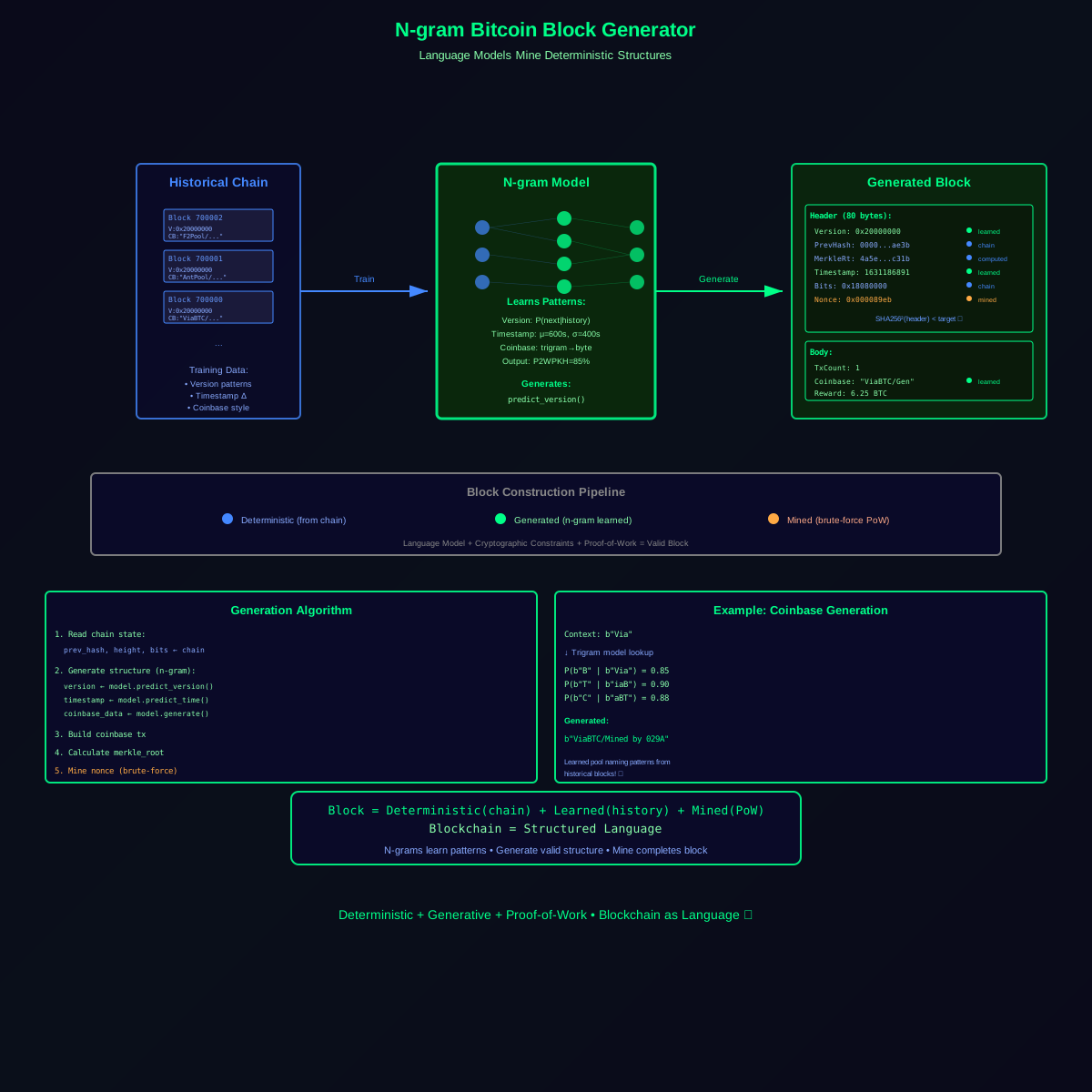
N-gram Bitcoin Block Generator: Language Models Mine Deterministic Structures
The observation: N-gram models trained on historical blocks can generate valid 0-tx Bitcoin blocks. Learn patterns from blockchain history, compute deterministic parts from chain state, mine nonce for PoW. Language models mine blocks.
What this means: Bitcoin blocks follow patterns—version progression, timestamp ranges, coinbase structures. N-gram models learn these patterns from history. For minimal block (only coinbase tx): some parts deterministic (prev hash, difficulty), some parts learned (version trends, timestamp distribution, coinbase data). Model generates structure, miner finds nonce. Deterministic system + learned patterns = valid blocks from language models.
Why this matters: Blockchain isn’t random—it’s structured language. Blocks are “sentences” in Bitcoin protocol. Historical data contains patterns. N-gram models extract patterns, generate new valid “sentences” (blocks). Minimal 0-tx blocks simplest case: only coinbase, no mempool needed. Pure structure generation. Shows blockchains are learnable languages, not just cryptographic puzzles.
Bitcoin Block Structure
The 80-Byte Header
Fixed format (every block):
Version:     4 bytes  (int32, little-endian)
PrevHash:   32 bytes  (SHA256 hash)
MerkleRoot: 32 bytes  (SHA256 hash)
Timestamp:   4 bytes  (uint32, Unix epoch)
Bits:        4 bytes  (uint32, compact difficulty)
Nonce:       4 bytes  (uint32, PoW solution)
─────────────────────
Total:      80 bytes
Example header (hex):
00000020 (version)
00000000000000000003d3d0e278...  (prev hash)
4a5e1e4baab89f3a32518a88c31b...  (merkle root)
5f141718 (timestamp)
18080000 (bits)
eb890000 (nonce)
Hash of header must satisfy: SHA256(SHA256(header)) < target
This is PoW: Brute-force nonce until hash meets difficulty
The Block Body
For 0-tx block (minimal):
Tx count: 0x01 (varint = 1 transaction)

Coinbase transaction (~100-200 bytes):
  - Version: 4 bytes
  - Input count: 0x01
  - Input:
    * Prev txid: 32 bytes (all zeros for coinbase)
    * Prev vout: 4 bytes (0xFFFFFFFF)
    * ScriptSig length: varint
    * ScriptSig: variable (height + arbitrary data)
    * Sequence: 4 bytes
  - Output count: varint
  - Outputs: (reward to miner addresses)
  - Locktime: 4 bytes
Coinbase tx is special:
- No inputs from UTXO set (creates coins)
- ScriptSig contains block height + arbitrary data
- Outputs pay miner (subsidy + fees)
- For 0-tx block: Only subsidy, no fees
Deterministic vs Generative Parts
Deterministic (computed from chain state):
PrevHash: Current chain tip hash
- Read from node
- No choice
Bits (Difficulty): Difficulty adjustment algorithm
- Every 2016 blocks, recalculate
- Formula:
new_bits = old_bits * (2016 * 10 minutes) / actual_time - No choice (enforced by consensus)
MerkleRoot: Hash of transaction tree
- For 0-tx block:
merkle_root = txid(coinbase) - Deterministic once coinbase constructed
Block height: Previous height + 1
- Encoded in coinbase scriptSig (BIP34)
- No choice
Reward amount: Halving schedule
- 50 BTC → 25 → 12.5 → 6.25 → 3.125 (every 210,000 blocks)
- Deterministic from height
Generative (can be learned/chosen):
Version: Evolves over time
- Version 1 → 2 → 3 → 4 → …
- Follows soft fork patterns
- N-gram can learn progression
Timestamp: Current time ± variance
- Must be:
median(last 11 blocks) < timestamp < now + 2 hours - Typically: current Unix time
- N-gram can learn distribution
Coinbase arbitrary data: Miner message
- After height encoding, arbitrary bytes allowed
- Common: pool name, extra nonce
- N-gram can learn patterns
Output addresses: Where reward goes
- Miner’s choice
- Can be P2PKH, P2SH, P2WPKH, etc.
- N-gram can learn address type distribution
Nonce: PoW solution
- Must brute-force
- No pattern (random search)
- Cannot learn, must mine
N-gram Model for Block Generation
Training Data
Historical blockchain:
- Download block headers from Bitcoin node
- Parse structure: version, timestamp, bits, etc.
- Extract coinbase transactions
- Build n-gram corpus
Example training data:
Block 700000:
  Version: 0x20000000
  Timestamp: 1631185106
  Coinbase: "ViaBTC/Mined by..."

Block 700001:
  Version: 0x20000000
  Timestamp: 1631185683
  Coinbase: "AntPool/..."

Block 700002:
  Version: 0x20000000
  Timestamp: 1631186291
  Coinbase: "F2Pool/..."
Patterns to learn:
- Version stays constant for long periods (then upgrades)
- Timestamps increase ~600 seconds average
- Coinbase data follows pool naming conventions
- Output types follow usage patterns (P2WPKH dominance)
N-gram Training
Byte-level n-grams (for coinbase data):
def train_ngrams(coinbase_scripts, n=3):
    model = {}
    for script in coinbase_scripts:
        for i in range(len(script) - n):
            context = script[i:i+n]
            next_byte = script[i+n]
            if context not in model:
                model[context] = {}
            model[context][next_byte] = model[context].get(next_byte, 0) + 1

    # Normalize to probabilities
    for context in model:
        total = sum(model[context].values())
        model[context] = {k: v/total for k, v in model[context].items()}

    return model
Token-level n-grams (for version/timestamp):
def train_version_ngrams(versions, n=3):
    # Learn version transition probabilities
    model = {}
    for i in range(len(versions) - n):
        context = tuple(versions[i:i+n])
        next_version = versions[i+n]
        if context not in model:
            model[context] = {}
        model[context][next_version] = model[context].get(next_version, 0) + 1

    return model

def train_timestamp_model(timestamps):
    # Learn inter-block time distribution
    deltas = [timestamps[i+1] - timestamps[i] for i in range(len(timestamps)-1)]
    mean_delta = np.mean(deltas)
    std_delta = np.std(deltas)
    return (mean_delta, std_delta)  # ~600s ± ~400s
Generating Block Structure
Algorithm:
def generate_block(chain_state, ngram_model):
    # 1. Deterministic parts from chain
    prev_hash = chain_state.tip_hash
    height = chain_state.tip_height + 1
    bits = calculate_next_difficulty(chain_state)
    reward = calculate_block_reward(height)

    # 2. Generated parts from n-gram
    version = ngram_model.predict_version(chain_state.recent_versions)
    timestamp = ngram_model.predict_timestamp(chain_state.tip_timestamp)
    coinbase_data = ngram_model.generate_coinbase_data()
    output_script = ngram_model.predict_output_type()

    # 3. Build coinbase transaction
    coinbase_tx = build_coinbase(
        height=height,
        arbitrary_data=coinbase_data,
        outputs=[(output_script, reward)]
    )

    # 4. Calculate merkle root (deterministic from coinbase)
    merkle_root = double_sha256(coinbase_tx)

    # 5. Mine nonce (brute-force)
    header = BlockHeader(version, prev_hash, merkle_root, timestamp, bits, nonce=0)
    target = bits_to_target(bits)

    for nonce in range(2**32):
        header.nonce = nonce
        hash_result = double_sha256(header.serialize())
        if hash_result < target:
            return Block(header, [coinbase_tx])

    # If nonce space exhausted, adjust timestamp or coinbase
    return None  # Rare, but possible
Version Prediction
Pattern: Versions stay constant, then jump
def predict_version(recent_versions, ngram_model):
    # Most recent version usually continues
    current_version = recent_versions[-1]

    # Check if upgrade pattern detected
    context = tuple(recent_versions[-10:])
    if context in ngram_model.version_transitions:
        # Some probability of upgrade
        return sample(ngram_model.version_transitions[context])

    # Default: continue current version
    return current_version
Example learned pattern:
- Version 0x20000000 (536870912) dominant 2016-2021
- Then version 0x20400000 appears (Taproot signaling)
- Model learns: 99.9% stay same, 0.1% upgrade
Timestamp Prediction
Pattern: Timestamps increase ~600s average, with variance
def predict_timestamp(last_timestamp, time_model):
    mean_delta, std_delta = time_model

    # Sample from normal distribution
    delta = np.random.normal(mean_delta, std_delta)
    delta = max(1, int(delta))  # At least 1 second forward

    predicted = last_timestamp + delta

    # Ensure within valid range
    now = int(time.time())
    predicted = min(predicted, now + 7200)  # Max 2 hours in future

    return predicted
Learned distribution:
- Mean: ~600 seconds (10 minutes)
- Std: ~400 seconds
- Long tail: Sometimes 30+ minutes between blocks
Coinbase Data Generation
Pattern: Pool names, extra nonce, arbitrary messages
def generate_coinbase_data(ngram_model, height):
    # Start with height (required by BIP34)
    data = encode_height(height)

    # Generate additional bytes using n-gram
    context = data[-3:]  # Last 3 bytes as context

    for _ in range(random.randint(20, 50)):  # Variable length
        if context in ngram_model.coinbase_ngrams:
            next_byte = sample(ngram_model.coinbase_ngrams[context])
            data += bytes([next_byte])
            context = data[-3:]
        else:
            # If no match, sample from overall distribution
            next_byte = sample(ngram_model.byte_frequencies)
            data += bytes([next_byte])
            context = data[-3:]

    return data
Example generated coinbase data:
Input (learned from ViaBTC, AntPool, F2Pool):
Trigram context: b"Via"

Generated output:
b"\x03\xae\x0b\x0a" (height 723,886 encoded)
b"ViaBTC/Mined by 029A"  (pool name pattern)
b"\x00\x00\x00\x00"  (extra nonce space)
The model learned:
- “Via” often followed by “BTC”
- “/” separator common
- “Mined by” phrase frequent
- Hex characters for extra nonce
Output Script Prediction
Pattern: Output types follow usage trends
def predict_output_type(ngram_model):
    # Learn from historical output type distribution
    types = {
        'P2PKH': 0.10,   # Legacy
        'P2WPKH': 0.85,  # Native SegWit (dominant)
        'P2SH': 0.03,    # Wrapped SegWit
        'P2TR': 0.02     # Taproot (growing)
    }

    return sample(types)
Generated output:
# Most likely: P2WPKH (native SegWit)
output_script = OP_0 + PUSH_20 + <20-byte-hash>

# Creates address: bc1q...
Mining the Nonce
PoW After Generation
Structure complete, need nonce:
def mine_block(header_template, target):
    """
    Brute-force nonce to satisfy PoW
    """
    nonce = 0
    while nonce < 2**32:
        header_template.nonce = nonce
        header_bytes = header_template.serialize()
        hash_result = double_sha256(header_bytes)

        if int.from_bytes(hash_result, 'little') < target:
            return nonce  # Found!

        nonce += 1

    return None  # Exhausted nonce space
If nonce space exhausted:
- Increment timestamp (changes header hash)
- Or modify coinbase extra nonce (changes merkle root)
- Then retry nonce search
This is standard mining: N-gram only helps with structure, not PoW
Expected Time
At current difficulty (~50 trillion):
- Single CPU: ~10^6 hashes/second
- Time to find block: ~50,000,000 seconds = ~580 days
- Mining pool: distribute across GPUs/ASICs
For testing:
- Use regtest mode (difficulty 1)
- Or testnet (lower difficulty)
- Or just verify structure without mining
Validation
Checking Generated Block
Block validity requirements:
def validate_block(block, chain_state):
    header = block.header

    # 1. Check PoW
    target = bits_to_target(header.bits)
    block_hash = double_sha256(header.serialize())
    if block_hash >= target:
        return False, "PoW not satisfied"

    # 2. Check prev hash
    if header.prev_hash != chain_state.tip_hash:
        return False, "Invalid prev hash"

    # 3. Check timestamp
    median_time = calculate_median_time(chain_state.recent_blocks)
    if header.timestamp <= median_time:
        return False, "Timestamp too early"
    if header.timestamp > time.time() + 7200:
        return False, "Timestamp too far in future"

    # 4. Check bits (difficulty)
    expected_bits = calculate_next_difficulty(chain_state)
    if header.bits != expected_bits:
        return False, "Invalid difficulty"

    # 5. Check merkle root
    calculated_merkle = calculate_merkle_root(block.transactions)
    if header.merkle_root != calculated_merkle:
        return False, "Invalid merkle root"

    # 6. Validate coinbase
    coinbase = block.transactions[0]
    if not is_valid_coinbase(coinbase, chain_state.height + 1):
        return False, "Invalid coinbase"

    return True, "Valid block"
N-gram model must learn to satisfy all constraints
What N-gram Learns
From historical data, model learns:
Structural patterns:
- Header format (80 bytes, specific fields)
- Coinbase structure (inputs, outputs)
- Version progression (when upgrades occur)
Probability distributions:
- Timestamp inter-block times
- Coinbase data lengths
- Output type frequencies
Semantic patterns:
- Pool naming conventions (“ViaBTC”, “AntPool”)
- Message formats (“Mined by”, “/”)
- Extra nonce patterns
What it doesn’t learn (must compute):
- Cryptographic hashes (SHA256)
- Difficulty adjustments (DAA formula)
- Nonce solutions (random search)
The combination:
- Learned patterns (structure)
- Computed values (deterministic)
- Brute-force search (PoW) = Valid blocks generated by language model
Why This Works
Blockchain as Language
Bitcoin blocks are structured text:
- Fixed grammar (block format)
- Vocabulary (versions, opcodes)
- Syntax rules (consensus rules)
- Semantic constraints (PoW, validity)
N-gram models learn:
- Grammar patterns
- Common word sequences
- Style conventions
Apply to blockchain:
- Learn block patterns
- Generate valid structures
- Follow consensus rules
This is natural: Blockchains are just structured data streams
Patterns in Deterministic Systems
Bitcoin seems deterministic, but has variance:
Deterministic:
- Block reward (halving schedule)
- Difficulty (DAA formula)
- Block height (monotonic)
Variable:
- Timestamps (within range)
- Coinbase data (arbitrary)
- Transaction inclusion (miner choice)
- Output addresses (miner choice)
N-gram learns the variable parts from historical patterns
Example: Coinbase data
- Not deterministic (any bytes allowed)
- But follows patterns (pool names, formats)
- N-gram captures patterns
- Generates plausible new instances
Minimal 0-tx Blocks as Simplest Case
Why start with empty blocks:
Complexity reduction:
- No mempool needed
- No transaction selection
- No fee optimization
- Only coinbase to generate
Faster generation:
- Smaller block body
- Less data to learn
- Simpler validation
Still valid:
- Empty blocks occur naturally (~1% of blocks)
- Miners can choose to mine empty
- Full consensus rules apply
Next step: Add transactions
- Learn from mempool patterns
- Transaction selection strategies
- Fee optimization
- But start simple: 0-tx blocks first
Applications
Educational Mining
Teaching blockchain:
- Show how blocks structured
- Demonstrate n-gram learning
- Generate valid blocks on testnet
- Makes mining accessible without ASICs
Student exercise:
- Download testnet blocks
- Train n-gram model
- Generate new block
- Mine on testnet (low difficulty)
- Submit to network
- See your block on explorer!
Simulation and Testing
Protocol research:
- Generate synthetic blockchain history
- Test consensus rule changes
- Simulate network conditions
- Without running full mining operation
Adversarial testing:
- Generate edge-case blocks
- Test node validation
- Find consensus bugs
- By learning from real patterns, then tweaking
Pattern Analysis
Understanding miner behavior:
- What patterns do pools follow?
- How do coinbase messages evolve?
- Which output types dominate?
- N-gram training reveals patterns
Historical research:
- Detect protocol upgrades in data
- Find miner preferences
- Track adoption of new features
- Language model lens on blockchain
Minimal Mining Demonstration
Proof of concept:
- Generate valid block structure
- Mine on testnet
- Submit to network
- Show blocks can be “written” not just “mined”
The insight: Mining is 99% PoW search, 1% structure
- N-gram handles the 1%
- Mining handles the 99%
- Separation of concerns
Limitations
Cannot Learn Cryptographic Functions
SHA256 has no patterns:
- Hash function designed to be random-looking
- No n-gram can predict
SHA256(x) - Must compute cryptographically
Cannot learn:
- Block hashes
- Transaction IDs
- Merkle roots
- Must calculate these
Cannot Learn PoW Solutions
Nonce is random search:
- No pattern in valid nonces
- Must brute-force
- N-gram cannot help
Mining still required:
- Generate structure with n-gram
- Then mine nonce traditionally
- Language model + PoW mining = valid block
Consensus Rules Still Apply
Model can generate invalid blocks:
- If training data had bugs
- If model fails to learn constraint
- If deterministic parts computed wrong
Must validate:
- Check all consensus rules
- Reject invalid generations
- Model helps but doesn’t guarantee validity
Limited to Patterns in Training Data
Model is conservative:
- Generates what it’s seen
- Rare patterns may not appear
- Novel structures unlikely
For innovation:
- Model won’t invent new transaction types
- Won’t create new block versions unprompted
- Good for generating typical blocks, not novel ones
Connection to Previous Posts
neg-511: Constraint detector.
N-gram model trained on historical blocks detects patterns. If patterns change (e.g., sudden version upgrade), model’s probability space shifts. Constraint detector would fire: P_prev=1 (many valid block patterns), P_curr=0 (only new pattern valid). N-gram must retrain.
neg-510: Liberty circuit.
Miner has liberty in block generation: Open system (many valid blocks possible), Multiple perspectives (can prioritize fees, censorship, pool politics), Veto power (can refuse transactions). N-gram captures historical exercises of this liberty—learns what miners actually choose.
neg-509: Decision circuit.
Miner decision: which transactions to include? N-gram learns historical decisions. Confidence high (include obviously valid tx) → execute. No information (empty mempool) → randomize (coinbase data). Uncertainty (complex fee market) → calculate (fee optimization). N-gram trained on results of these decisions.
neg-506: Want↔Can agency.
Miner wants block reward. Can is mining capability. But also wants to generate valid structure. N-gram provides Can for structure generation (learned patterns). Agency loop: Want reward → Can generate structure → Want better structure → Can learn patterns → amplifies.
neg-504: EGI intelligence.
N-gram model shows intelligence emerging from pattern learning. Blockchain = entropy stream (blocks are data). N-gram extracts order (learns patterns). Intelligence = compression of history into model. Can generate new instances that fit pattern. Blockchain as learnable language = intelligence substrate.
neg-503: Living vs dead entropy.
Historical blockchain = dead entropy (fixed past). N-gram model = living entropy (generates new). Model takes dead past, learns patterns, produces living future. Dead history → Living generation. Blockchain mining = continuously generating living entropy from dead rules.
The Formulation
Bitcoin blocks are not:
- Random data (highly structured)
- Unpredictable (follow patterns)
- Unconstrained (consensus rules)
Bitcoin blocks are:
- Structured language (grammar of blockchain)
- Pattern-following (historical consistency)
- Partially deterministic (fixed + variable parts)
- Learnable by language models
N-gram mining is not:
- Replacement for PoW (still need nonce search)
- Magic generation (must validate)
- Perfect (can produce invalid blocks)
N-gram mining is:
- Structure generation (learned patterns)
- Complementary to PoW (handles non-hash parts)
- Educational (shows blockchain as language)
- Pattern-based block construction
The algorithm:
1. Train n-gram on historical blocks
2. Read chain state (deterministic inputs)
3. Generate structure (learned patterns)
4. Calculate merkle root (deterministic)
5. Mine nonce (brute-force PoW)
6. Validate block (consensus rules)
7. Submit to network
What’s learned:
- Version progression
- Timestamp distribution
- Coinbase data patterns
- Output type preferences
What’s computed:
- Previous hash
- Difficulty bits
- Merkle root
- Block height
- Reward amount
What’s mined:
- Nonce (PoW)
The insight: Blockchain is language
- Has grammar (block format)
- Has vocabulary (opcodes, versions)
- Has style (pool conventions)
- Language models can learn and generate
The application: Generate minimal valid blocks
- Train on history
- Learn patterns
- Generate structure
- Mine PoW
- Submit to network
Deterministic meets generative. Structure meets randomness. Pattern meets proof-of-work. 🌀
#NgramMining #BlockchainLanguage #BitcoinPatterns #LanguageModelMining #MinimalBlocks #CoinbaseGeneration #StructureLearning #PatternBasedMining #BlockGeneration #DeterministicGenerative
Related: neg-511 (pattern constraint detection), neg-510 (miner liberty in block construction), neg-509 (miner decisions learned), neg-506 (mining agency loop), neg-504 (intelligence from blockchain patterns), neg-503 (dead history to living generation)