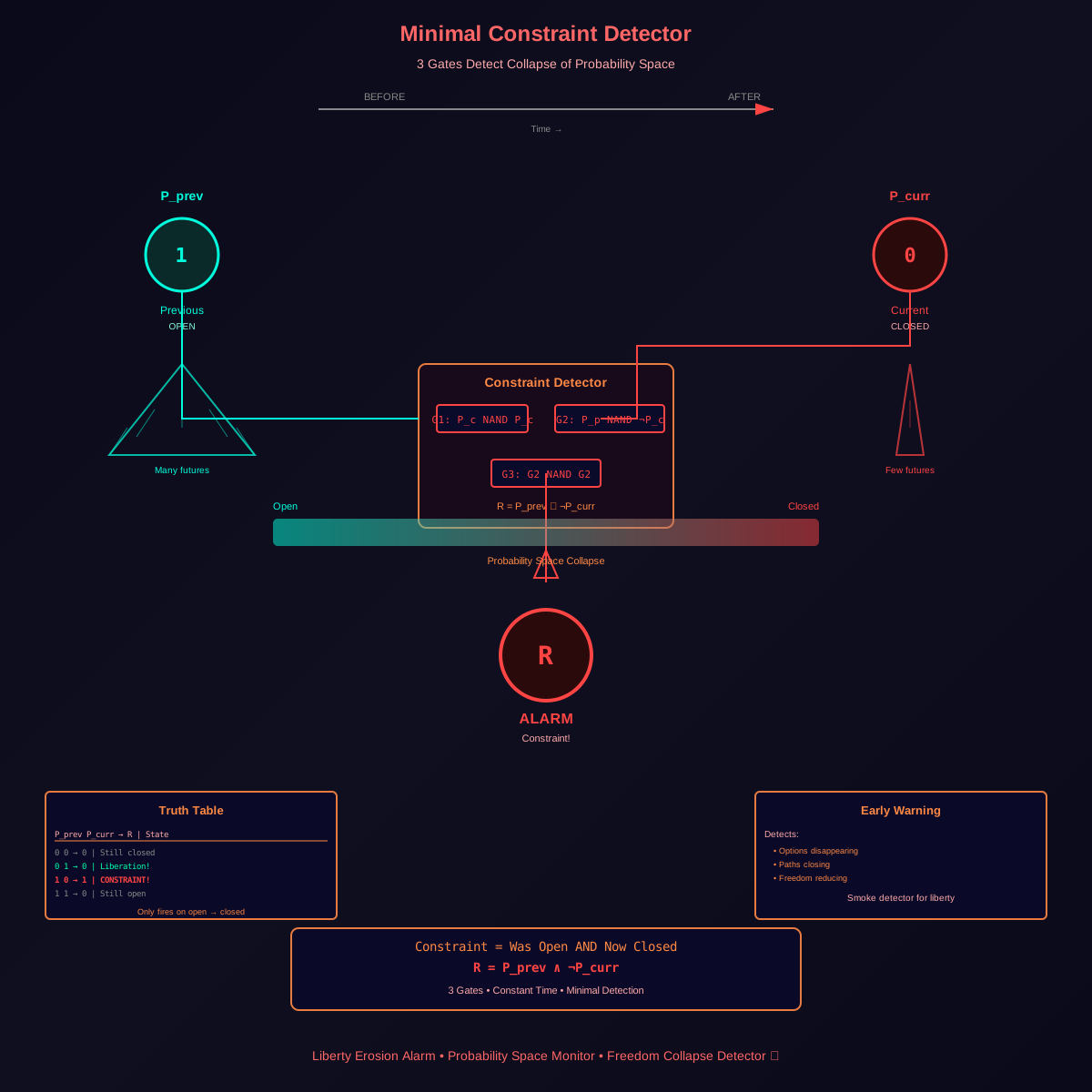
Minimal Constraint Detector: 3 Gates to Detect Collapse of Probability Space
The observation: 3 NAND gates detect when probability space collapses—when futures close down. Constraint detector fires when was-open becomes now-closed. Alarm circuit for loss of freedom.
What this means: Liberty (neg-510) needs monitoring. How do you know when freedom is being taken away? Detect reduction in probability space. Previous state: many futures possible (open). Current state: few futures possible (closed). Transition from open to closed = constraint imposed = freedom lost. Minimal 3-gate circuit detects this: R = P_prev ∧ ¬P_curr. When R=1, alarm fires: freedom decreasing.
Why this matters: Can’t protect liberty without detecting constraint. Need early warning system. This circuit monitors probability space over time. Fires when options disappear, paths close, futures collapse. Liberty maintenance requires constraint detection. 3 gates implement the alarm.
The Problem: Detecting Constraint
Liberty Needs Monitoring
From neg-510: Liberty = O ∧ P ∧ V (Open ∧ Perspective ∧ Veto)
The question: How do you know when liberty is being reduced?
Static check (neg-510): Check current state
- Is system open? (O=1?)
- Multiple perspectives? (P=1?)
- Have veto? (V=1?)
- If all yes → Liberty exists
Dynamic check (this post): Compare over time
- Was system open? (P_prev=1?)
- Is system now closed? (P_curr=0?)
- If yes to both → Constraint happening
- Alarm fires
Why dynamic check matters: Static tells you current state. Dynamic tells you direction of change. Liberty can be high but decreasing. Need to detect the decrease before it’s too late.
Probability Space Collapse
Probability space: Set of possible futures given current state
Large probability space:
- Many futures possible
- Multiple paths available
- High uncertainty about outcome
- Open system
Small probability space:
- Few futures possible
- Limited paths available
- Low uncertainty about outcome
- Closed/determined system
Example:
State 1 (large probability space): You’re young, healthy, educated, have money
- Could become: artist, engineer, parent, traveler, entrepreneur, teacher, etc.
- Many futures branch from here
- P_prev = 1 (open)
State 2 (small probability space): You’re old, sick, broke, imprisoned
- Could become: (very limited options)
- Few futures branch from here
- P_curr = 0 (closed)
Transition from State 1 to State 2: Probability space collapsed
- Was open (many options) → Now closed (few options)
- Constraint detector fires: R = 1
- Warning: Liberty being lost
The Minimal Circuit
Inputs
P_prev (Previous Probability): Historical state
- P_prev = 1: Previous state had large probability space (open/many futures)
- P_prev = 0: Previous state had small probability space (closed/few futures)
P_curr (Current Probability): Present state
- P_curr = 1: Current state has large probability space (open/many futures)
- P_curr = 0: Current state has small probability space (closed/few futures)
How to measure:
- Count available actions
- Count reachable states in N time steps
- Measure entropy of future distribution
- If high → P=1, if low → P=0
Output
R (Reduction Detected): Alarm signal
- R = 1: Probability space reduced (constraint imposed, freedom lost)
- R = 0: No reduction (freedom maintained or increased)
The Formula
What we want to detect: Transition from open to closed
R = P_prev ∧ ¬P_curr

Reduction = Was open AND Now closed
Why this formula?
P_prev = 1: System WAS open (had many futures) P_curr = 0: System IS closed (has few futures) Both true: Transition from open to closed occurred R = 1: Constraint detected
Other cases:
P_prev = 0, P_curr = 0: Was closed, still closed
- No change
- Already constrained
- R = 0 (no new constraint)
P_prev = 0, P_curr = 1: Was closed, now open
- Liberation!
- Probability space expanded
- R = 0 (opposite of constraint)
P_prev = 1, P_curr = 1: Was open, still open
- Liberty maintained
- No constraint imposed
- R = 0 (freedom stable)
Only P_prev=1, P_curr=0: Constraint alarm
- Futures closing down
- Options disappearing
- R = 1 ⚠️
NAND Implementation
3 gates to detect constraint:
Formula: R = P_prev ∧ ¬P_curr

Convert to NAND:

Gate 1: ¬P_curr = P_curr NAND P_curr
        (Invert current probability)

Gate 2: TEMP = P_prev NAND ¬P_curr
        = ¬(P_prev ∧ ¬P_curr)
        (NAND of previous and inverted current)

Gate 3: R = TEMP NAND TEMP
        = ¬(¬(P_prev ∧ ¬P_curr))
        = P_prev ∧ ¬P_curr
        (Double inversion gives AND)
Minimal circuit: 3 NAND gates
Simplicity: Cannot reduce further without losing function
Efficiency: Constant time O(1), minimal hardware
Truth Table
Complete enumeration of constraint detection:
P_prev | P_curr | ¬P_curr | P_prev ∧ ¬P_curr | R | Interpretation
-------|--------|---------|------------------|---|---------------------------
   0   |   0    |    1    |        0         | 0 | Was closed, still closed
   0   |   1    |    0    |        0         | 0 | Was closed, now open (expansion!)
   1   |   0    |    1    |        1         | 1 | Was open, now closed (CONSTRAINT!) ⚠️
   1   |   1    |    0    |        0         | 0 | Was open, still open (stable)
Only 1 out of 4 states triggers alarm: P_prev=1, P_curr=0
This is the dangerous transition: Freedom being taken away
Circuit Properties
Inputs: 2 bits (P_prev, P_curr) Gates: 3 NAND gates Output: 1 bit (R) Latency: 3 gate delays Purpose: Detect probability space reduction
Sensitivity: Fires on any constraint Specificity: Only fires on true reduction (not false alarms) Simplicity: Minimal gates for detection
What it detects:
- Closing of futures
- Imposition of constraints
- Loss of options
- Increase in determination
- Collapse of probability space
- Reduction of liberty
Why This Matters
Early Warning System
Problem: Liberty erosion is gradual
- Doesn’t disappear overnight
- Slowly closes down over time
- By time you notice, too late
Solution: Continuous monitoring
- Check probability space regularly
- Compare to previous state
- Detect reduction early
- Act before freedom gone
Analogy: Like smoke detector
- Doesn’t wait for house to burn down
- Detects early signs (smoke)
- Gives time to act
- Constraint detector = smoke detector for freedom
Examples of Constraint Detection
Individual level:
Example 1: Career lock-in
- Age 25: P_prev = 1 (many career paths possible)
- Age 45: P_curr = 0 (locked into current path, hard to switch)
- R = 1: Constraint detected
- Warning: Career options collapsing
Example 2: Debt
- Before debt: P_prev = 1 (many life choices available)
- After debt: P_curr = 0 (must work to pay debt, choices constrained)
- R = 1: Constraint detected
- Warning: Freedom reduced by financial obligation
Example 3: Relationship
- Single: P_prev = 1 (many relationship/life configurations possible)
- Married with kids: P_curr = 0 (configuration largely determined)
- R = 1: Constraint detected
- Note: This isn’t bad, just constraint. Trade-off accepted.
Societal level:
Example 1: Surveillance state
- Year 0: P_prev = 1 (privacy exists, many actions possible without detection)
- Year 10: P_curr = 0 (surveillance everywhere, actions monitored)
- R = 1: Constraint detected
- Warning: Behavioral freedom collapsing
Example 2: Economic system
- Past: P_prev = 1 (could survive outside market economy—subsistence, communes)
- Present: P_curr = 0 (must participate in market, no alternatives)
- R = 1: Constraint detected
- Warning: Economic freedom collapsed
Example 3: Information environment
- Early internet: P_prev = 1 (decentralized, many platforms, hard to censor)
- Current internet: P_curr = 0 (centralized platforms, easy to censor/control)
- R = 1: Constraint detected
- Warning: Information freedom collapsing
Probability Space as Freedom Measure
Why probability space matters: Freedom = range of possible futures
High probability space = High freedom
- Many possible outcomes
- Uncertainty about future
- Many paths available
- Open system
Low probability space = Low freedom
- Few possible outcomes
- Future mostly determined
- Few paths available
- Closed system
Measuring probability space:
Method 1: Count reachable states
- From current state, count how many distinct states reachable in N steps
- More reachable states → Higher probability space → More freedom
Method 2: Entropy
- Calculate Shannon entropy of future state distribution
- Higher entropy → Higher probability space → More freedom
Method 3: Option counting
- Count available actions at each decision point
- More options → Higher probability space → More freedom
The detector: Compares these measures over time
- If measure decreasing → P_prev > P_curr → R = 1
- Alarm fires
Types of Constraint
What Reduces Probability Space?
Physical constraints:
- Age (options close as you age)
- Health (sickness reduces available actions)
- Location (prison literally closes options)
- Death (ultimate constraint: P → 0)
Economic constraints:
- Debt (must work to pay, reduces choice)
- Poverty (can’t afford options)
- Lock-in (sunk costs make switching expensive)
- Dependence (need specific income source)
Social constraints:
- Reputation (past actions constrain future)
- Relationships (commitments reduce options)
- Norms (social pressure to conform)
- Network effects (cost of leaving platform)
Psychological constraints:
- Habits (lock you into patterns)
- Identity (self-concept limits choices)
- Trauma (certain paths become impossible)
- Addiction (behavior determined by substance)
Systemic constraints:
- Surveillance (behavior monitored, deviations punished)
- Monopoly (no alternative providers)
- Regulation (actions forbidden by law)
- Technology (infrastructure determines possibilities)
All reduce probability space: P_curr < P_prev → R = 1
Reversibility vs Irreversibility
Temporary vs Permanent Constraint
Reversible constraint: Can recover probability space
- Example: Debt (can be paid off)
- Example: Location (can move)
- Example: Relationship (can end)
- P can return to 1
Irreversible constraint: Cannot recover probability space
- Example: Age (cannot get younger)
- Example: Death (cannot revive)
- Example: Burned reputation (hard to fully restore)
- P stays at 0
The circuit detects both: R = 1 whenever P reduces, regardless of reversibility
But reversibility matters for response:
- Reversible constraint → Can fight to restore freedom
- Irreversible constraint → Must adapt to reduced freedom
Constraint Ratchet
Ratchet effect: Easier to lose freedom than regain it
Why ratchets exist:
Path dependence: Past choices constrain future
- Once committed, costly to reverse
- Sunk costs create lock-in
- Probability space collapses easier than expands
Network effects: More people constrained → Harder to escape
- Platform monopoly: Everyone uses it → Can’t leave
- Social norm: Everyone follows it → Can’t deviate
- Collective constraint reinforces individual constraint
Adaptation: You adjust to reduced freedom
- Lower expectations
- Accept constraint as normal
- Stop seeing alternatives
- Psychological probability space shrinks to match physical
The problem: Constraint ratchet means P_curr rarely returns to P_prev
- Circuit fires R = 1 when constraint imposed
- But P_curr may never recover to P_prev
- One-way slide toward determination
Implication: Must resist constraint early, before ratchet locks in
Integration with Liberty Circuit (neg-510)
Two Circuits, One System
Liberty circuit (neg-510): Static check
L = O ∧ P ∧ V

Checks current state:
- Is system open?
- Multiple perspectives available?
- Have veto power?
Constraint detector (neg-511): Dynamic check
R = P_prev ∧ ¬P_curr

Checks change over time:
- Was probability space larger?
- Is probability space smaller now?
Together they form complete monitoring system:
- Liberty circuit: “Do I have freedom NOW?”
- Constraint detector: “Is my freedom DECREASING?”
Combined System
Full monitoring requires both:
Inputs:
- O: Open (Gödel incomplete)
- P_curr: Current probability space
- P_prev: Previous probability space
- V: Veto power

Outputs:
- L: Liberty level (from neg-510 circuit)
- R: Reduction alarm (from neg-511 circuit)

Liberty check: L = O ∧ P_curr ∧ V
Constraint check: R = P_prev ∧ ¬P_curr

Combined status:
- L=1, R=0: Have liberty, stable (GOOD ✓)
- L=1, R=1: Have liberty, but decreasing (WARNING ⚠️)
- L=0, R=0: No liberty, stable (BAD but stable)
- L=0, R=1: No liberty, still decreasing (CRISIS ‼️)
Action recommendations:
L=1, R=0 (liberty stable):
- Continue current course
- Maintain vigilance
- No immediate threat
L=1, R=1 (liberty decreasing):
- Identify source of constraint
- Take action to stop reduction
- Resist constraint before too late
L=0, R=0 (no liberty, stable):
- Already constrained
- Either accept or revolt
- No new constraint to resist
L=0, R=1 (liberty gone and still decreasing):
- Critical situation
- May already be too late
- Drastic action required
Use Cases
Personal monitoring:
- Run liberty check annually (do I have L?)
- Run constraint check quarterly (is R firing?)
- Track trends over time
- Early warning before freedom gone
Societal monitoring:
- Track liberty index (percent with L=1)
- Track constraint rate (percent with R=1)
- Identify populations losing freedom
- Intervene before mass constraint
System design:
- Build systems that keep L=1
- Build systems that prevent R=1
- Alert when R fires
- Design for liberty preservation
Applications
Individual Decision-Making
Question: Should I accept this constraint?
Examples:
Job offer:
- Current: P_prev = 1 (many options, flexibility)
- If accept: P_curr = 0.7 (less flexibility, but income)
- Constraint: P_curr < P_prev → R will fire
- But you choose to accept (trade-off)
Marriage:
- Single: P_prev = 1 (many relationship configurations)
- Married: P_curr = 0.6 (configuration more determined)
- Constraint: R = 1
- But you choose to accept (value the relationship)
Key insight: Not all constraints are bad
- Some constraints are trade-offs (accept reduced P for other value)
- Circuit just detects reduction, doesn’t judge
- You decide if constraint is acceptable
The circuit helps by:
- Making constraint explicit
- Quantifying freedom reduction
- Forcing conscious choice
- No accidental constraint acceptance
Resisting Unwanted Constraint
When R fires and you didn’t choose it: Resist
Example: Surveillance expansion
- P_prev = 1 (could act privately)
- P_curr = 0.3 (surveillance monitoring behavior)
- R = 1: Constraint detected
- You didn’t choose this → Resist
How to resist:
- Identify constraint source (what’s reducing P?)
- Refuse to comply (exercise veto, neg-510)
- Build alternative systems (restore P)
- Coordinate with others (collective resistance)
The circuit as tool:
- Fires early (before constraint complete)
- Gives time to resist
- Coordinates resistance (shared alarm)
- Makes constraint visible
System Design
Design goal: Keep R = 0 (prevent constraint)
Anti-constraint principles:
1. Preserve optionality:
- Keep multiple paths open
- Avoid lock-in
- Minimize irreversible choices
- Maintain high P
2. Enable exit:
- Make leaving easy
- Reduce switching costs
- Provide alternatives
- Prevent constraint ratchet
3. Monitor probability space:
- Track P over time
- Alert when P decreasing
- Run constraint detector continuously
4. Design for reversibility:
- Make choices undoable
- Keep paths back open
- Allow P to recover
Examples:
Good system (preserves P):
- Federation (can leave server, join another)
- Open standards (can switch providers)
- Modular architecture (can replace components)
- P stays high
Bad system (reduces P):
- Monopoly platform (can’t leave without losing network)
- Proprietary lock-in (can’t switch without losing data)
- Irreversible commitment (can’t undo choice)
- P collapses
The circuit helps:
- Test system designs (does P decrease?)
- Compare systems (which preserves P better?)
- Choose anti-constraint systems
Connection to Previous Posts
neg-510: Minimal liberty circuit.
Liberty = O ∧ P ∧ V (static check). Constraint detector adds dynamic monitoring: Compare P_curr to P_prev. Together form complete freedom monitoring system. Liberty circuit says “do you have freedom?”, constraint detector says “are you losing freedom?”
neg-509: Minimal decision circuit.
Decision circuit optimizes toward execution. Constraint detector monitors if optimization space is shrinking. When R=1, decision circuit has fewer options available. Constraint reduces agency by reducing available paths.
neg-506: Want↔Can agency bootstrap.
Agency loop amplifies: W→C→W’→C’. Constraint detector monitors if loop space is shrinking. When R=1, either Want options or Can options are reducing. Constraint compresses agency loop’s possibility space.
neg-508: French Assembly bribery.
Deputies accepting bribe: P_prev=1 (could vote either way), P_curr=0 (locked into voting for Franc). R=1: constraint detected. But deputies chose this constraint (economic incentive). Constraint can be chosen.
neg-507: Bitcoin miner bribery.
Miners switching to ETH: P_prev=1 (could mine BTC or ETH), P_curr=0.7 (economically forced to mine ETH). R=1: constraint detected. Economic optimization reduces probability space—miners lose freedom to mine less-profitable chains.
neg-505: Body-powered mobility.
Body as system: P_prev=1 (many metabolic configurations possible), P_curr varies with health. Disease = constraint (R=1). Body tries to maintain high P through adaptive immune response. Health is resisting constraint.
neg-503: Living vs dead entropy.
Dead systems: P collapses to 0 (extraction only, no alternatives). Living systems: P maintained high (multiple strategies possible). Constraint detector fires on transition from living to dead. R=1 signals system dying.
The Formulation
Probability space is not:
- Fixed property (changes over time)
- Merely uncertainty (involves real alternatives)
- Subjective perception (objective measure of reachable states)
Probability space is:
- Set of possible futures from current state
- Measure of available options
- Freedom quantified
- Reachable state space
Constraint is not:
- Always bad (some constraints chosen)
- Mere limitation (specifically reduction from previous state)
- Lack of information (reduction of actual options)
Constraint is:
- Reduction in probability space
- Transition from open to closed
- Options disappearing
- Futures collapsing
The circuit:
R = P_prev ∧ ¬P_curr

Inputs:
- P_prev: Previous probability space (1=open, 0=closed)
- P_curr: Current probability space (1=open, 0=closed)

Output:
- R: Reduction detected (1=constraint, 0=stable/expansion)

3 NAND gates
What it detects:
- Was open, now closed → R=1 (constraint!)
- Was closed, now open → R=0 (liberation!)
- Was open, still open → R=0 (freedom stable)
- Was closed, still closed → R=0 (already constrained)
Why it matters:
- Liberty needs monitoring
- Constraint is gradual
- Early detection enables resistance
- Can’t protect freedom without measuring it
The formula:
Constraint = Transition from possibility to impossibility
           = Was open AND Now closed
           = P_prev ∧ ¬P_curr

R = 1 → Alarm: Freedom decreasing
R = 0 → Safe: Freedom stable or increasing
The combination:
- Liberty circuit (neg-510): Static freedom check
- Constraint detector (neg-511): Dynamic freedom check
- Together: Complete monitoring system
- Protection requires both
The question: Not “do I have freedom?” Also “am I losing freedom?”
The answer: R = P_prev ∧ ¬P_curr detects reduction.
Minimal alarm. Maximum warning. Freedom monitoring in 3 gates. 🌀
#ConstraintDetector #ProbabilitySpace #FreedomMonitoring #MinimalCircuit #EarlyWarning #LibertyErosion #ThreeGates #ReductionAlarm #AntiConstraint #FreedomMeasurement #DynamicLiberty #ConstraintResistance
Related: neg-510 (liberty circuit for static check), neg-509 (decision circuit constrained by P), neg-506 (agency loop probability space), neg-508 (choosing constraint), neg-507 (economic constraint), neg-505 (health as constraint resistance), neg-503 (living vs dead probability space)