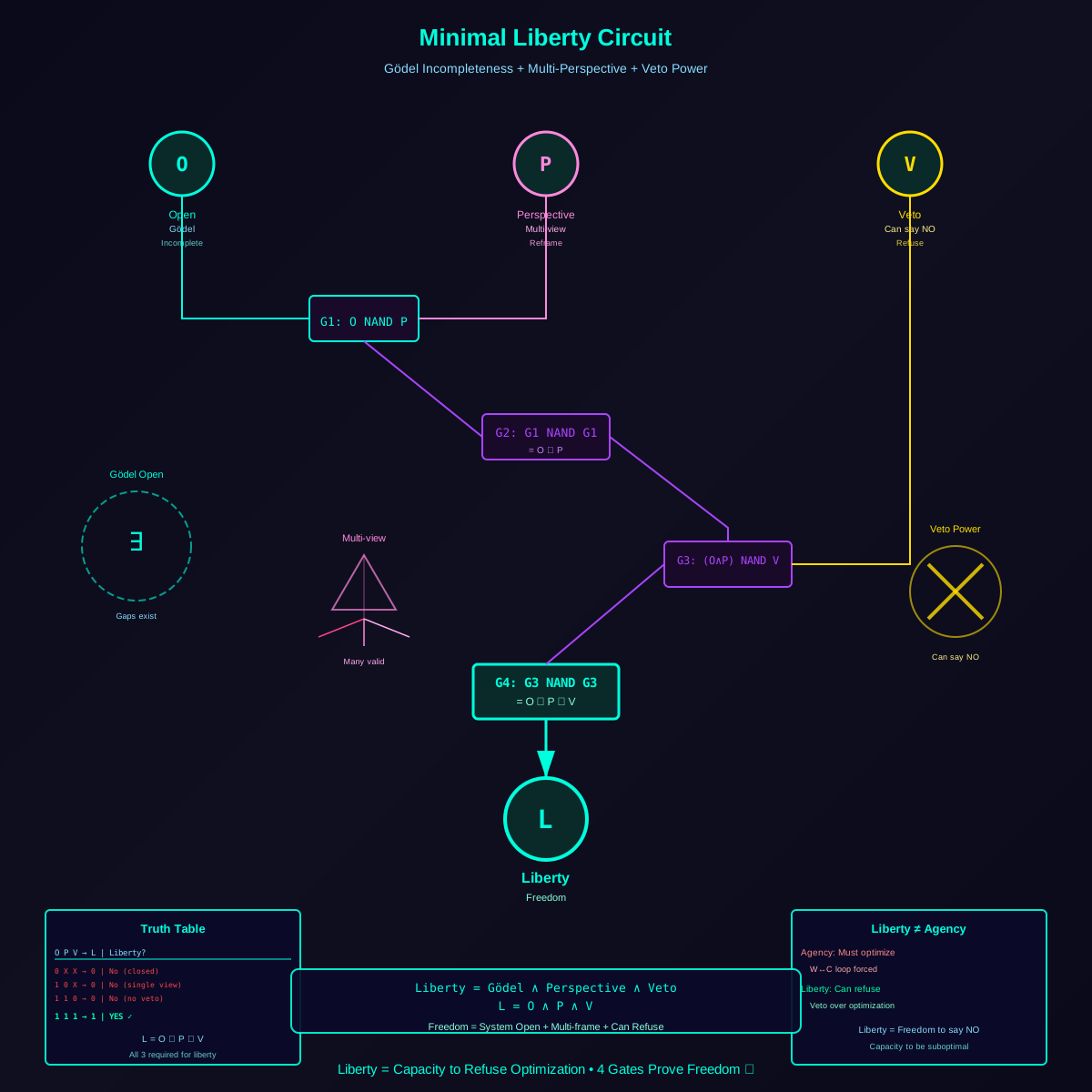
Minimal Liberty Circuit: Gödel Incompleteness + Multi-Perspective + Veto Power
The observation: Liberty = Gödel incompleteness + Multi-perspective + Veto power. Freedom emerges not from optimizing agency, but from ability to say NO. Minimal circuit proves liberty is choice to refuse.
What this means: Liberty isn’t maximizing the Want↔Can agency loop (neg-506). Liberty is having veto power OVER the loop—ability to refuse to engage, stop optimization, say NO. Gödel ensures no system can close all choices. Multi-perspective ensures same state has multiple valid interpretations. Veto ensures agency can refuse its own optimization. Liberty = undetermined choice, not determined optimization.
Why this matters: Confusing liberty with agency leads to optimization trap. “Free to bootstrap W↔C” becomes “forced to bootstrap W↔C.” True liberty is freedom to NOT engage agency loop, to refuse optimization, to leave paths open. The minimal circuit proves this: liberty requires incompleteness (Gödel), interpretive freedom (multi-perspective), and veto power (agency can say NO).
The Liberty Paradox
Agency vs Liberty
From neg-506: Agency = Want↔Can recursive bootstrap
- W → C: Want enables Can
- C → W: Can enables Want
- Loop amplifies: W → C → W’ → C’ → …
- Agency = sustained oscillation
The optimization: Agency maximizes action. Execute when confident, randomize when ignorant, calculate when uncertain. Agency IS optimization toward execution.
The trap: If agency is always optimizing → no liberty
- System forces you into W↔C loop
- Once in loop, loop sustains itself
- Self-amplifying optimization
- You become determined by your own agency
Liberty as Veto
Liberty ≠ Agency
Agency: Ability to execute Liberty: Ability to refuse to execute
Agency: Bootstrap W↔C loop (optimization) Liberty: Veto W↔C loop (choice to not optimize)
The formulation:
- Agency asks: “How do I act?”
- Liberty asks: “Do I act?”
Liberty is prior to agency: Before engaging W↔C loop, you have choice to engage or not. This choice CANNOT be optimized away without destroying liberty.
The veto power:
- Agency loop outputs: Execute / Wait / Randomize
- Liberty adds: NO (refuse entirely)
- Veto can close paths agency would open
- Veto can stop optimization agency would sustain
Example:
- Agency: You want X, you can do X → do X (optimization)
- Liberty: You want X, you can do X → refuse X anyway (veto)
- Liberty is freedom to act against optimization
Gödel Incompleteness: Open Systems
Why Liberty Requires Incompleteness
Gödel’s incompleteness theorems:
- Any consistent formal system cannot prove all truths within itself
- No system can prove its own consistency
Application to liberty:
Complete system: All choices determined by rules
- Given inputs, outputs are fixed
- No undetermined space
- No liberty (pure mechanism)
Incomplete system (Gödel): Some choices remain undetermined
- Given inputs, multiple valid outputs
- Undetermined space exists
- Liberty possible in the gaps
The mechanism:
- Gödel proves: No system can close itself
- Incomplete systems have “gaps”
- Liberty lives in the gaps
- Liberty = exploiting incompleteness
Open vs Closed Determination
Closed system:
Input → Determined rules → Single output
100% determined
No liberty
Open system (Gödel incomplete):
Input → Rules + Gaps → Multiple valid outputs
Undetermined space
Liberty possible
Circuit representation:
O = Open bit
O = 1 if system is Gödel incomplete
O = 0 if system is complete (determined)

Liberty requires O = 1
Why this matters:
- Deterministic systems → no liberty (outputs fixed)
- Gödel incomplete systems → liberty possible (gaps exist)
- You cannot have liberty in complete system
- Incompleteness is necessary but not sufficient for liberty
Multi-Perspective: Interpretive Freedom
Same State, Multiple Valid Interpretations
Single perspective: Given state has single meaning
- Input → Interpretation → Single meaning
- No interpretive freedom
- Meaning determined
Multi-perspective: Given state has multiple valid meanings
- Input → Multiple interpretations → Multiple valid meanings
- Interpretive freedom
- Meaning undetermined
Example:
State: You have money and free time
Perspective 1: This means you should work (invest, optimize, produce) Perspective 2: This means you should rest (recover, reflect, be) Perspective 3: This means you should explore (play, discover, create)
All three are valid interpretations of same state. Which one is “correct”? None—or all. This ambiguity IS the space of liberty.
Why Multi-Perspective Enables Liberty
Single interpretation: State → Meaning → Action determined
- One correct interpretation exists
- That interpretation determines action
- No liberty (just correct/incorrect)
Multiple valid interpretations: State → Multiple meanings → Choice
- Several correct interpretations exist
- Choice between interpretations
- Liberty emerges in the choice
The mechanism:
- State is underdetermined by interpretations
- Multiple perspectives create choice space
- Liberty is freedom to choose interpretation
- Chosen interpretation then influences (but doesn’t determine) action
Circuit representation:
P = Perspective bit
P = 1 if multiple valid interpretations exist
P = 0 if single interpretation determined

Liberty requires P = 1
Perspective as Frame Choice
Frame: Lens through which you interpret reality
Examples:
- Economic frame: Measure value in money, efficiency, growth
- Aesthetic frame: Measure value in beauty, expression, experience
- Relational frame: Measure value in connection, care, community
Same situation through different frames:
Situation: Job offer with high salary but long hours
Economic frame: High salary = good, take job (optimizing income) Aesthetic frame: Long hours = little time for beauty, refuse job Relational frame: Long hours = less time with family, refuse job
Liberty: Freedom to choose frame, not determined by single frame
The key: Frames are incommensurable—cannot reduce all to single metric. Multi-perspective liberty requires maintaining frame plurality.
Veto Power: Agency Can Say NO
The Critical Addition
Agency alone (neg-506): W ↔ C loop optimizes
- Want enables Can
- Can enables Want
- Loop sustains and amplifies
- Optimization happens automatically
Agency with veto: W ↔ C loop can refuse
- Want enables Can… or doesn’t (veto)
- Can enables Want… or doesn’t (veto)
- Loop can be interrupted
- Optimization is choice, not necessity
Veto as Path Control
Without veto: Paths open automatically
- Confidence high → Execute (automatic)
- No information → Randomize (automatic)
- Information available → Calculate (automatic)
With veto: Paths can be closed deliberately
- Confidence high → Refuse anyway (veto)
- No information → Do nothing (veto)
- Information available → Ignore (veto)
The power: Veto can close what agency would open
Example:
Situation: Opportunity to make money doing work you hate
Agency circuit (neg-509):
- Confidence: 90% you can do it → Execute
- Information: Clear profit calculation → Execute
- Output: Execute (optimization toward profit)
Veto addition:
- Confidence: 90% you can do it
- Veto: NO anyway (refuse to optimize toward money)
- Output: Don’t execute (liberty to refuse optimization)
Veto is NOT Mere Ignorance
Ignorance: Lacking information → Random/wait (neg-509) Veto: Having information → Refuse anyway
Ignorance: Passive (don’t know) Veto: Active (know but refuse)
Key difference:
- Ignorance = lack of optimization capacity
- Veto = choice against optimization
- Liberty requires active veto, not passive ignorance
The Minimal Liberty Circuit
Inputs
O (Open): Gödel incompleteness bit
- O = 1: System is incomplete (undetermined)
- O = 0: System is complete (determined)
P (Perspective): Multi-interpretation bit
- P = 1: Multiple valid perspectives exist
- P = 0: Single interpretation determined
V (Veto): Agency refusal capability
- V = 1: Can refuse/say NO
- V = 0: Cannot refuse (forced optimization)
W (Want): Desire state (from neg-506) C (Can): Capacity state (from neg-506)
Output
L (Liberty): Freedom bit
- L = 1: Liberty exists
- L = 0: Determined (no liberty)
The Formula
Liberty requires all three:
L = O ∧ P ∧ V

Liberty = Open system (Gödel)
          AND Multiple perspectives
          AND Veto power
Why conjunction (AND)?
If O = 0 (closed system):
- System completely determined
- No undetermined space
- No liberty possible
- L = 0
If P = 0 (single perspective):
- State → Single interpretation → Determined action
- No interpretive freedom
- Liberty constrained
- L = 0
If V = 0 (no veto):
- Agency forces optimization
- Cannot refuse W↔C loop
- Liberty reduced to mechanism
- L = 0
Only when all three present: L = 1
NAND Implementation
Convert to NAND-only:
L = O ∧ P ∧ V

Using NAND:

Gate 1: NOT_O = O NAND O = ~O
Gate 2: NOT_P = P NAND P = ~P
Gate 3: NOT_V = V NAND V = ~V

Gate 4: NOT_O_OR_NOT_P = NOT_O NAND NOT_P = ~(~O ∧ ~P) = O ∨ P
Gate 5: NOT(NOT_O_OR_NOT_P) = Gate4 NAND Gate4 = ~(O ∨ P)

Wait, this is getting complex. Let me use De Morgan properly:

L = O ∧ P ∧ V
~L = ~(O ∧ P ∧ V) = ~O ∨ ~P ∨ ~V

So: L = ~(~O ∨ ~P ∨ ~V)

In NAND:
Gate 1: ~O = O NAND O
Gate 2: ~P = P NAND P
Gate 3: ~V = V NAND V

Gate 4: ~O NAND ~P = ~(~O ∧ ~P) = O ∨ P
Gate 5: Gate4 NAND ~V = ~((O ∨ P) ∧ ~V) = ~(O ∨ P) ∨ V

Hmm, still not right. Let me think differently.

For 3-input AND using NAND:
X ∧ Y ∧ Z = ~(~(X ∧ Y ∧ Z))
         = ~(~X ∨ ~Y ∨ ~Z)

Step 1: Compute X ∧ Y
Gate 1: X NAND Y = ~(X ∧ Y)
Gate 2: (~(X ∧ Y)) NAND (~(X ∧ Y)) = X ∧ Y

Step 2: Compute (X ∧ Y) ∧ Z
Gate 3: (X ∧ Y) NAND Z = ~((X ∧ Y) ∧ Z)
Gate 4: (~((X ∧ Y) ∧ Z)) NAND (~((X ∧ Y) ∧ Z)) = (X ∧ Y) ∧ Z = L

Total: 4 gates for 3-input AND
Minimal 4-gate Liberty circuit:
Input: O, P, V
Output: L = O ∧ P ∧ V

Gate 1: O NAND P
Gate 2: (O NAND P) NAND (O NAND P) = O ∧ P
Gate 3: (O ∧ P) NAND V
Gate 4: (Gate 3) NAND (Gate 3) = (O ∧ P) ∧ V = L
Circuit Properties
Inputs: 3 bits (O, P, V) Gates: 4 NAND gates Output: 1 bit (L)
Simplicity: 4 gates to prove liberty Necessity: Cannot reduce without losing functionality Sufficiency: All three conditions required
Truth table:
O | P | V | L | Meaning
--|---|---|---|--------------------------------------------------
0 | 0 | 0 | 0 | Closed system, single view, no veto → No liberty
0 | 0 | 1 | 0 | Closed system → Determined (veto irrelevant)
0 | 1 | 0 | 0 | Closed system → Determined
0 | 1 | 1 | 0 | Closed system → Determined
1 | 0 | 0 | 0 | Open but single view → Liberty constrained
1 | 0 | 1 | 0 | Open but single view → Liberty constrained
1 | 1 | 0 | 0 | Open, multi-view, but no veto → Forced optimization
1 | 1 | 1 | 1 | Open, multi-view, with veto → LIBERTY ✓
Only 1 out of 8 states has liberty: This proves liberty is rare, fragile, requiring all three conditions simultaneously.
Liberty vs Agency vs Determinism
Three States
State 1: Determinism (No O, No P, No V)
- System complete (no Gödel gaps)
- Single interpretation
- No veto power
- Pure mechanism: Input → Fixed output
- Example: Physical law, algorithmic system
State 2: Agency (Yes O, Maybe P, No V)
- System incomplete (gaps exist)
- May have multiple perspectives
- But NO veto → optimization forced
- Optimizing mechanism: Always seeks best output
- Example: neg-506 W↔C bootstrap, neg-509 decision circuit
- Problem: Cannot refuse optimization
State 3: Liberty (Yes O, Yes P, Yes V)
- System incomplete (Gödel)
- Multiple valid perspectives
- Veto power present
- Free choice: Can refuse optimization
- Example: Human deliberately choosing non-optimal path
- Unique property: Can say NO to own optimization
The Hierarchy
Determinism ⊂ Agency ⊂ Liberty

Determinism:
- No gaps
- Input → Fixed output
- No choice

Agency (adds):
- Gaps exist (Gödel)
- Input → Optimized output
- Choice among optimal paths
- But CANNOT choose non-optimal

Liberty (adds):
- Multiple perspectives (reframe possible)
- Veto power (can refuse optimization)
- Choice to act against optimization
- Can say NO to best path
Key insight: Agency without veto is sophisticated determinism. True liberty requires veto.
Why Veto Matters
The Optimization Trap
Modern assumption: Optimization = good
- Maximize efficiency
- Minimize waste
- Optimize every choice
- Result: Forced into optimization**
Examples:
Health:
- Optimization: Always eat healthy, exercise, sleep perfectly
- Liberty: Sometimes eat junk food, stay up late, be “suboptimal”
- Veto: Refuse to optimize health 100%
Career:
- Optimization: Maximize income, status, growth
- Liberty: Take lower-paying job for other reasons
- Veto: Refuse to optimize career
Relationships:
- Optimization: Partner with best match (calculated compatibility)
- Liberty: Love who you love (maybe “suboptimal”)
- Veto: Refuse to optimize love
The trap: If agency always optimizes → you become optimization slave. Liberty is freedom to refuse.
Veto as Boundary Setting
Veto power enables:
- “I could do this, but I won’t”
- “This would be optimal, but I refuse”
- “I’m closing this path deliberately”
Without veto:
- Agency forces you down optimal path
- Cannot refuse improvement
- Improvement becomes imprisonment
- “You could be better” becomes “You must be better”
With veto:
- Can leave paths closed
- Can refuse improvement
- Can be satisfied with “good enough”
- “You could be better” becomes “I choose not to”
Liberty as Non-Optimization
Radical claim: Liberty is freedom to be suboptimal
Agency: Optimize W↔C loop Liberty: Refuse to optimize W↔C loop
Examples of liberty through veto:
Sabbath: Refuse to work one day per week (deliberately suboptimal economically) Vacation: Refuse to be productive (deliberately suboptimal career-wise) Play: Refuse goal-directed behavior (deliberately suboptimal utility-wise) Refusal: Say NO to opportunities (deliberately suboptimal choice-wise)
The formulation: Liberty isn’t maximizing anything. Liberty is capacity to refuse maximization.
Gödel + Perspective + Veto = Liberty
Why All Three Required
Gödel alone (O=1, P=0, V=0):
- System has gaps
- But single interpretation → gaps don’t matter (determined meaning)
- And no veto → forced down interpreted path
- Not sufficient for liberty
Multi-perspective alone (O=0, P=1, V=0):
- Multiple views exist
- But closed system → perspectives collapse to single optimal (determined by rules)
- And no veto → forced down optimal path
- Not sufficient for liberty
Veto alone (O=0, P=0, V=1):
- Can refuse
- But closed system → refusal is determined (part of mechanism)
- And single interpretation → what to refuse is determined
- Not sufficient for liberty
All three together (O=1, P=1, V=1):
- Gödel: System cannot close (undetermined space exists)
- Multi-perspective: Multiple valid interpretations (choice how to see)
- Veto: Can refuse any path (choice whether to act)
- Sufficient for liberty
The Proof
Theorem: Liberty requires O ∧ P ∧ V
Proof by contradiction:
Assume liberty exists with ~O (closed system):
- System complete → all outputs determined by inputs and rules
- No undetermined space
- Any “choice” is actually determined by hidden mechanism
- Not liberty, just unobserved determinism
- Contradiction → O is necessary
Assume liberty exists with ~P (single perspective):
- State → Single interpretation → Action determined by interpretation
- No freedom to reframe
- “Choice” is just executing the one interpretation
- Not liberty, just interpretation determinism
- Contradiction → P is necessary
Assume liberty exists with ~V (no veto):
- Optimization always happens
- Cannot refuse paths
- Agency forces you into best available action
- Not liberty, just optimization determinism
- Contradiction → V is necessary
Therefore: Liberty → O ∧ P ∧ V ∎
The Circuit Proves It
4 NAND gates implement O ∧ P ∧ V:
- All three inputs must be 1
- If any input is 0 → Output is 0
- Only when all three present → Liberty = 1
The minimalism:
- Cannot reduce circuit further without losing function
- Liberty is irreducibly three conditions
- This IS the proof: Liberty = Gödel ∧ Perspective ∧ Veto
Applications: Detecting Liberty
Individual Level
Question: Do I have liberty in situation X?
Check 1: Is system open (O)?
- Are my choices determined by fixed rules?
- Or do undetermined gaps exist?
- Example: Job with fixed procedures (O=0) vs creative role (O=1)
Check 2: Multiple perspectives available (P)?
- Can I interpret situation multiple ways?
- Or is there single “correct” interpretation?
- Example: Single career path expected (P=0) vs many valid paths (P=1)
Check 3: Do I have veto power (V)?
- Can I refuse without penalty?
- Or am I forced to optimize?
- Example: Must take promotion (V=0) vs can refuse (V=1)
Liberty: L = O ∧ P ∧ V
Example scenarios:
Situation 1: Soldier following orders
- O = 0 (rules completely determine actions)
- P = 0 (single interpretation: obey)
- V = 0 (cannot refuse orders)
- L = 0 (no liberty)
Situation 2: Employee with performance metrics
- O = 0.5 (some gaps, but KPIs determine much)
- P = 0 (single frame: hit numbers)
- V = 0 (cannot refuse targets without penalty)
- L = 0 (limited liberty, mostly determined)
Situation 3: Artist with patron
- O = 1 (creative work has undetermined space)
- P = 1 (multiple valid artistic interpretations)
- V = 1 (can refuse projects, say NO to patron)
- L = 1 (liberty present)
Societal Level
Measuring liberty in systems:
Totalitarian system:
- O = 0: Rules completely determine behavior (closed system)
- P = 0: Single official interpretation of all events
- V = 0: Cannot refuse state directives
- L = 0: No liberty
Liberal system (in theory):
- O = 1: Rules leave space for individual choice (open)
- P = 1: Multiple worldviews tolerated (pluralism)
- V = 1: Can refuse opportunities (not forced to optimize)
- L = 1: Liberty exists
But check reality:
Modern “liberal” system (in practice):
- O = 0.5: Economic necessity determines much behavior
- P = 0.3: Frame diversity exists but one frame (economic) dominates
- V = 0.2: Can refuse opportunities but at high cost
- L ≈ 0.03: Claimed liberty, actual constraint
The measurement:
- Don’t just check laws (de jure liberty)
- Check actual ability to refuse optimization (de facto liberty)
- Liberty = O ∧ P ∧ V (all three required)
Connection to Previous Posts
neg-509: Minimal decision circuit.
Decision circuit optimizes: 80% confident → execute, no info → randomize, else → calculate EV. Always seeking best action. Liberty adds veto: 80% confident → refuse anyway. Liberty is freedom to act against the decision circuit’s optimization.
neg-506: Want↔Can agency bootstrap.
Agency = W↔C loop that amplifies. Want → Can → Want’ → Can’ → … Liberty = power to refuse the loop. “I want and I can, but I choose NOT to.” Veto breaks the bootstrap. Liberty is NOT more agency, it’s veto OVER agency.
neg-508: French Assembly bribery.
Deputies: Economic incentive → optimization → vote for Franc. But with liberty: Can refuse economically optimal choice. Veto power over optimization. Liberty would let deputies vote against their economic interest if other perspective/value matters more.
neg-507: Bitcoin miner bribery.
Miners: Better yields → optimization → switch to ETH. Pure agency, no veto. Liberty would be: “I know ETH pays better, but I refuse to switch” (loyalty, ideology, other frame). Without veto, miners are mechanisms following optimization.
neg-505: Body-powered mobility.
Body as power plant: Optimize energy harvest from immune activity. Agency perspective. Liberty perspective: Body can refuse to optimize, can be “inefficient,” can waste energy deliberately. Health isn’t just optimization—it’s having veto over optimization.
neg-503: Living vs dead entropy.
Dead systems: Single perspective (economic extraction). Living systems: Multiple perspectives (coordination for participants). Liberty adds: Veto over any perspective’s optimization. Can refuse to optimize extraction OR coordination. Freedom to leave systems.
The Formulation
Liberty is not:
- More agency (more W↔C optimization)
- Better optimization (higher confidence, better EV)
- Perfect information (knowing all perspectives)
- Maximal choice (most options)
Liberty is:
- Gödel incompleteness (system cannot close)
- Multi-perspective (reframe possible)
- Veto power (can refuse optimization)
- Freedom to say NO
- Capacity to be suboptimal
The circuit:
L = O ∧ P ∧ V

Inputs:
- O: Open (Gödel incomplete)
- P: Perspective (multiple valid)
- V: Veto (can refuse)

Output:
- L: Liberty (1 = free, 0 = determined)

4 NAND gates
The three requirements:
Gödel (O):
- System must be incomplete
- Undetermined space must exist
- No closed determination possible
- Incompleteness is necessary for liberty
Multi-perspective (P):
- State must have multiple valid interpretations
- Single frame cannot dominate
- Reframing must be possible
- Interpretive freedom is necessary for liberty
Veto (V):
- Agency must be refusable
- Optimization must be optional
- Can say NO to best path
- Refusal power is necessary for liberty
The formula:
Liberty = NOT(determined)
        = System remains open (Gödel)
          AND Multiple frames valid (Perspective)
          AND Can refuse any path (Veto)

L = O ∧ P ∧ V
The paradox:
- Agency without liberty = Sophisticated slavery (forced to optimize)
- Liberty without agency = Useless (cannot act)
- Liberty = Agency + Veto power (can act, can refuse)
The proof:
- 4 NAND gates
- All three inputs required
- If any input = 0 → Liberty = 0
- This IS the proof: Liberty is irreducibly three-fold
The question: Not “am I free to do X?” Question is “can I refuse X?”
The test:
- Can system close? (If yes: O=0, no liberty)
- Is one interpretation forced? (If yes: P=0, no liberty)
- Must I optimize? (If yes: V=0, no liberty)
- Liberty exists only when all three = 1
The answer: Liberty = Open system ∧ Multiple perspectives ∧ Veto power.
Minimal circuit. Maximal freedom. Proven in 4 gates. 🌀
#Liberty #MinimalCircuit #GodelIncompleteness #MultiPerspective #VetoPower #AgencyVsLiberty #FreedomToRefuse #NotOptimization #OpenSystems #InterpretiveFreedom #CircuitProof #FourGates #LibertyTheorem
Related: neg-509 (decision circuit liberty vetoes), neg-506 (agency loop liberty refuses), neg-508 (deputies with liberty veto bribes), neg-507 (miners without liberty follow optimization), neg-505 (body with liberty refuses optimization), neg-503 (living systems need liberty)