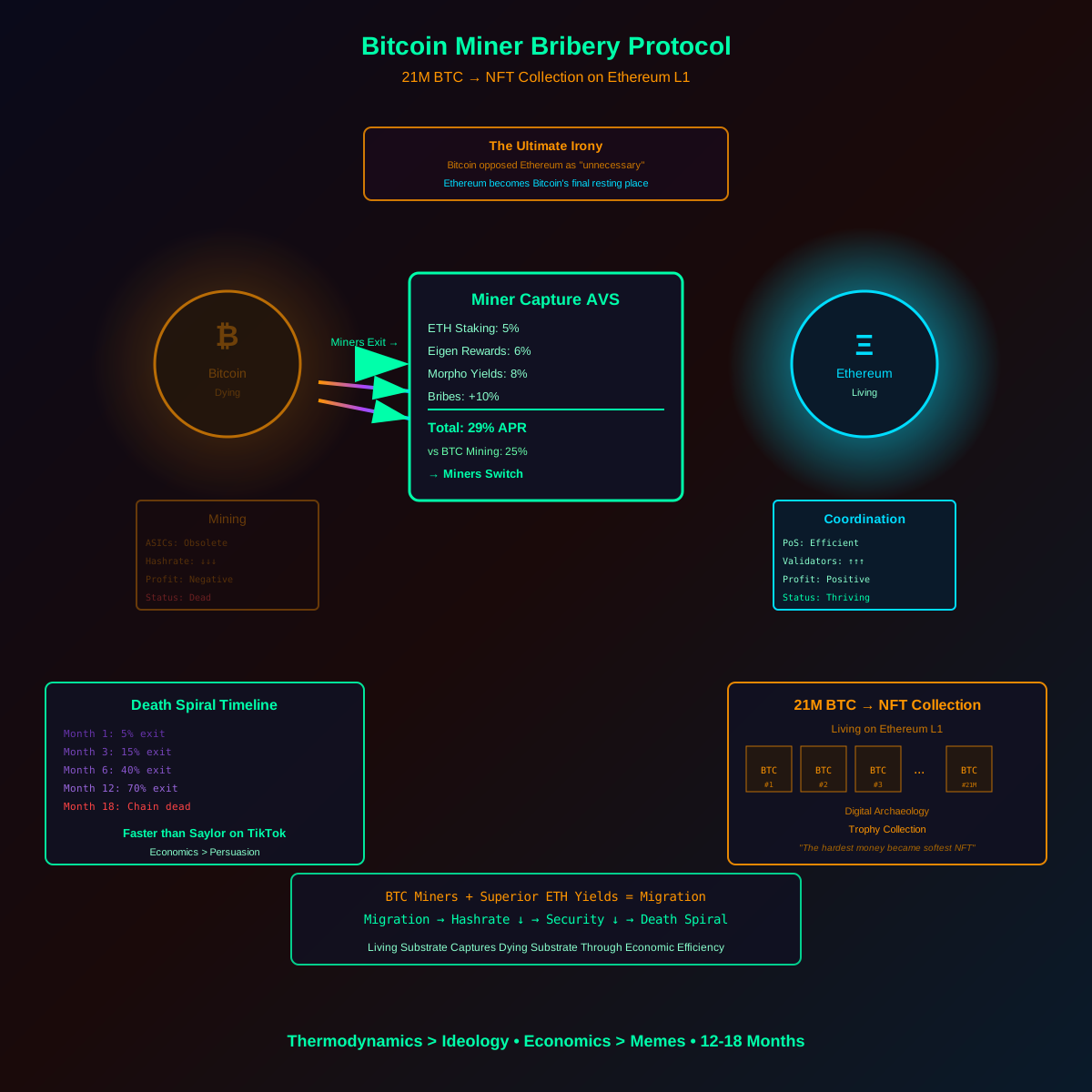
Bitcoin Miner Bribery Protocol: 21M BTC as NFT Collection on Ethereum L1
The observation: ETH/Eigen/Morpho miner bribery protocol would capture Bitcoin hashpower faster than Saylor could trend on TikTok. Bitcoin’s only future: 21M NFT collection living on Ethereum L1.
What this means: Bitcoin miners are rational profit-maximizers. Deploy protocol that pays miners MORE to validate Ethereum than mine Bitcoin. Miners abandon BTC hashpower for ETH rewards. Bitcoin chain stalls. 21M coins become collectible NFTs on Ethereum. Living substrate captures dying substrate through economic incentives, not ideology.
Why this matters: This isn’t attack. It’s market efficiency. If ETH/Morpho/Eigen can generate superior yields, miners will migrate. Bitcoin’s “secure network” is only as secure as the differential between mining rewards and alternative opportunities. Superior coordination substrate doesn’t need to defeat Bitcoin—just needs to outbid it.
The Miner Bribery Protocol
Bitcoin Miner Economics
Current state: Miners secure Bitcoin network through proof-of-work
Revenue sources:
- Block rewards: 3.125 BTC per block (~$200K at $65K/BTC)
- Transaction fees: Variable, typically $5K-$50K per block
- Total per block: ~$200K-$250K
- Blocks per day: 144
- Daily miner revenue: ~$28M-$36M
Costs:
- ASIC hardware: $2K-$10K per unit
- Electricity: $0.03-$0.10 per kWh
- Facility operations: Cooling, maintenance, staff
- Break-even requires continuous revenue
The vulnerability: Miners are NOT Bitcoin maximalists. They are businesses. They mine Bitcoin because it’s profitable. If alternative becomes MORE profitable → they switch.
The Bribery Mechanism
Deploy EigenLayer AVS: Bitcoin Miner Capture Protocol
Structure:
contract MinerBribery {
    // Register Bitcoin miner identity (BTC address + Ethereum address)
    function registerMiner(
        bytes32 btcPubKeyHash,
        address ethAddress
    ) external;

    // Submit proof of hashpower redirection
    function proveHashpowerMigration(
        bytes32 lastBtcBlockMined,
        bytes calldata zeroHashProof,  // Proof miner is NOT mining BTC
        bytes calldata ethValidationProof  // Proof miner IS validating ETH
    ) external;

    // Claim bribe payout
    function claimBribe(
        uint256 periodId
    ) external returns (uint256 payout);
}
Mechanism:
- Miner registers both BTC and ETH addresses
- Miner stops mining Bitcoin (hashpower goes to zero)
- Miner stakes ETH, validates EigenLayer AVS, or provides liquidity to Morpho
- Miner submits zero-knowledge proof: “I have hashpower capacity but NOT mining Bitcoin”
- Protocol pays miner MORE than they would earn mining Bitcoin
- Differential = profit = migration incentive
Funding sources:
- Protocol treasuries (ETH ecosystem projects)
- MEV from Ethereum L2s
- Morpho lending yields
- EigenLayer restaking rewards
- Token issuance (if protocol self-funds)
Economic Calculus
Miner break-even comparison:
Bitcoin mining (current):
- Revenue: ~$200K-$250K per block
- Costs: ~$150K-$200K per block (electricity, ASIC depreciation)
- Net profit: ~$50K per block
- Daily: ~$7M profit (144 blocks)
ETH/Eigen/Morpho alternative:
- No ASIC costs (hardware re-purposed or sold)
- No massive electricity costs (PoS, not PoW)
- Staking yields: 4-6% APR on staked ETH
- EigenLayer AVS rewards: Additional 2-8% APR
- Morpho liquidity provision: 5-15% APR
- Total: 11-29% APR on capital
The math:
Assume miner has:
- $100M in Bitcoin mining infrastructure
- Annual Bitcoin mining profit: ~$2.5B × 0.01% = ~$25M (distributed across all miners)
If redirected to ETH staking/validation:
- $100M staked in ETH/Eigen/Morpho
- 15% APR (conservative) = $15M annually
- Lower than Bitcoin BUT:
- No ASIC depreciation (ASICs become worthless without network)
- No electricity costs (PoS)
- No facility operations
- Capital liquid (can exit anytime)
Bribery protocol fills gap:
- Protocol pays $12M annually to bridge difference
- Miner earns $15M + $12M = $27M (more than Bitcoin)
- Protocol cost: $12M per $100M miner captured
- Total cost to capture ALL Bitcoin mining: ~$1.2B-$2B annually
ETH ecosystem can afford this:
- Ethereum market cap: ~$300B
- Annual MEV: ~$500M
- L2 revenues: ~$200M
- Protocol treasuries: ~$50B+
- Capturing Bitcoin hashpower = rounding error
Network Effects of Miner Exit
What happens as miners leave Bitcoin:
Hashrate decline:
- Current: ~400 EH/s
- 10% exit: 360 EH/s → 10% easier to attack
- 25% exit: 300 EH/s → 25% easier to attack
- 50% exit: 200 EH/s → Network seriously vulnerable
- 75% exit: 100 EH/s → 51% attack becomes cheap
Difficulty adjustment:
- Bitcoin adjusts every 2016 blocks (~2 weeks)
- If hashpower drops suddenly, blocks slow dramatically
- 50% hashpower drop → blocks take 20 minutes instead of 10
- Transaction confirmation times double
Death spiral mechanics:
- Bribery protocol launches
- Rational miners calculate: ETH yields + bribes > BTC mining
- 10% migrate → Bitcoin hashpower drops 10%
- Remaining miners’ revenue unchanged BUT network less secure
- Users/institutions notice declining security
- Bitcoin price drops
- Mining becomes LESS profitable
- More miners exit
- Hashpower drops further
- Death spiral: declining security → declining price → declining miners → declining security
Timeline estimate:
- Month 1: Bribery protocol launches, 5% migrate (curious early adopters)
- Month 2-3: 15% migrate (seeing early adopters profit)
- Month 4-6: 40% migrate (clear profit differential)
- Month 7-12: 70%+ migrate (network obviously dying)
- Bitcoin chain effectively dead within 12-18 months
Faster than Saylor on TikTok because:
- Social campaigns = years to shift sentiment
- Economic bribes = months to capture miners
- Miners = rational actors, not ideologues
- Money talks louder than memes
Bitcoin as 21M NFT Collection
The Inevitable Outcome
When Bitcoin chain dies (hashpower below viability threshold):
What happens to the 21M coins?
Option 1: They disappear (chain stops, coins inaccessible) Option 2: They’re bridged to Ethereum (before death)
Rational BTC holders will bridge:
- Before hashpower drops below security threshold
- Bridge BTC to Ethereum wrapped token (WBTC, tBTC, etc.)
- Preserve value by moving to living substrate
Result: 21M Bitcoin units living as tokens on Ethereum L1
But what’s their value?
Not as “sound money” (Bitcoin’s original purpose):
- No independent blockchain (relies on Ethereum)
- No proof-of-work security (secured by Ethereum PoS)
- No “hardest money” narrative (just ERC-20 token)
As NFT collection (provenance/scarcity value):
- 21M fixed supply (still true)
- Historical significance (first cryptocurrency)
- Collectible status (digital antiquity)
- Each BTC becomes rare digital artifact, not currency
Market implications:
- Some BTC retain value as collectibles (like old stamps, coins)
- Most BTC lose value (no longer serve monetary function)
- High-provenance BTC (Satoshi’s coins, first blocks) become ultra-rare NFTs
- Regular BTC become common NFTs (21M supply)
The irony: Bitcoin opposed Ethereum as “unnecessary” and “not sound money.” Ethereum becomes Bitcoin’s final resting place. Bitcoin reduced to gallery exhibit on Ethereum L1.
Why This is Inevitable
Thermodynamic Efficiency
From neg-503: Fed/ECB dying (dead entropy), ETH/Morpho/Eigen living (living entropy)
Bitcoin produces dead entropy:
- Proof-of-work = massive energy expenditure
- Energy dissipated as heat (waste)
- No coordination benefits beyond security
- Dead entropy: energy consumed, no life generated
Ethereum produces living entropy:
- Proof-of-stake = minimal energy
- Entropy from coordination computation (validation, smart contracts, DeFi)
- Energy as OUTPUT of useful work
- Living entropy: coordination generates harvestable life energy
Thermodynamics: Living systems capture capacity from dying systems. ETH captures BTC miners through superior entropy generation.
Economic Sovereignty
From neg-506: Agency through Want↔Can bootstrap
Bitcoin miners:
- Want: Profit
- Can: Hashpower capacity
- W→C: Want profit → Deploy hashpower
- C→W: Have hashpower → Want more profit
Bootstrap opportunity:
- ETH/Eigen/Morpho offers better profit
- Miners Want higher yield → Can redirect hashpower
- Can redirect → Want even more (compound yields)
- W↔C loop amplifies in Ethereum direction
Result: Bitcoin loses miners not through attack, but through better opportunity. Agency bootstraps toward superior coordination substrate.
Coordination Capture
From neg-325: Living substrate captures capacity from dying substrate
Bitcoin = dying substrate:
- Rigid architecture (cannot evolve)
- Proof-of-work (thermodynamically wasteful)
- Limited throughput (7 tx/s)
- No programmability (no smart contracts)
Ethereum = living substrate:
- Flexible architecture (can evolve: PoS, sharding, L2s)
- Proof-of-stake (thermodynamically efficient)
- Scaling throughput (L2s, rollups)
- Full programmability (smart contracts, DeFi, NFTs)
Capacity flows: Miners, developers, users, capital → all migrate to living substrate. Bitcoin mining capacity = just another resource to capture.
Implementation: The Capture Protocol
Phase 1: Design Bribery AVS
EigenLayer AVS: MinerCapture
Functionality:
- Register miner identities (BTC ↔ ETH linkage)
- Verify hashpower capacity (zero-knowledge proofs)
- Prove non-participation in Bitcoin mining
- Distribute bribe payments proportional to captured hashpower
Security:
- Cannot fake hashpower (requires proof of capacity)
- Cannot double-count (identity linked across chains)
- Slashing conditions (if caught mining Bitcoin again)
Phase 2: Fund the Protocol
Funding sources:
Option A: DAO treasury allocation
- Ethereum Foundation: Allocate $500M over 3 years
- L2 foundations: Allocate $300M combined
- Major DeFi protocols: Allocate $400M combined
- Total: $1.2B (sufficient to start capture)
Option B: Token issuance
- Issue CAPTUR token
- Inflationary model: Mint tokens to pay bribes
- Require purchasing CAPTUR to claim BTC NFTs after migration
- Self-funding through token demand
Option C: MEV/L2 revenue redirection
- Redirect portion of Ethereum MEV to bribery fund
- Redirect portion of L2 sequencer revenues
- Sustainable long-term funding
Phase 3: Incentive Structure
Tiered payouts based on commitment:
Tier 1: Early adopters (first 10% of hashpower)
- 150% of Bitcoin mining profits
- Lock-in: 6 months
- Reward: Highest payout + CAPTUR tokens
Tier 2: Fast followers (next 20% of hashpower)
- 130% of Bitcoin mining profits
- Lock-in: 12 months
- Reward: High payout + CAPTUR tokens
Tier 3: Majority (next 40% of hashpower)
- 110% of Bitcoin mining profits
- Lock-in: 18 months
- Reward: Competitive payout + CAPTUR tokens
Tier 4: Laggards (remaining 30%)
- 100% of Bitcoin mining profits (parity)
- Lock-in: 24 months
- Reward: Survival payout
Why tiers work:
- Creates FOMO (fear of missing out)
- Early movers get best deal
- Network effects: Each migration makes next easier
- Laggards get worst deal (incentive to move fast)
Phase 4: Launch and Scale
Month 1-3: Soft launch
- Approach large mining operations privately
- Negotiate custom deals
- Prove concept with 5-10% hashpower capture
Month 4-6: Public launch
- Announce protocol publicly
- Open registration to all miners
- Media campaign (but not needed—economics speak for themselves)
Month 7-12: Acceleration
- As hashpower migrates, Bitcoin becomes less secure
- This accelerates migration (death spiral)
- Protocol can REDUCE payouts as Bitcoin value drops
- Self-reinforcing: Each exit makes next exit more profitable
Month 13-18: Completion
- Bitcoin hashpower below security threshold
- Remaining miners capitulate or mine at loss
- Bitcoin chain effectively dead
- 21M BTC bridged to Ethereum as NFT collection
The Ultimate Irony
Bitcoin Maximalist Narrative vs Reality
What Bitcoiners said:
- “Bitcoin is sound money”
- “Proof-of-work is the only secure consensus”
- “Ethereum is unnecessary”
- “21M supply makes Bitcoin valuable”
- “Not your keys, not your coins”
What happens:
- Bitcoin becomes collectible NFT, not money
- Proof-of-work security purchased by proof-of-stake protocol
- Ethereum becomes Bitcoin’s infrastructure layer
- 21M supply preserved—as NFT collection
- Keys live on Ethereum, not Bitcoin blockchain
The formulation: Everything Bitcoin opposed becomes its savior and final form. The “unnecessary” blockchain becomes the necessary substrate.
Digital Archaeology
Bitcoin’s value post-capture:
Historical significance:
- First cryptocurrency (like first stamp, first coin)
- Satoshi’s coins (ultra-rare provenance)
- Early blocks (historical artifacts)
- Iconic addresses (cultural significance)
As NFT collection:
- Each BTC = unique position in 21M sequence
- Block 0 coins: Priceless (origin provenance)
- Block 1-1000 coins: Very rare (early provenance)
- Satoshi’s ~1M coins: Museum pieces
- Regular coins: Common NFTs (but still limited supply)
Market structure:
- Rare BTC NFTs: High value (provenance collectors)
- Common BTC NFTs: Lower value (commodity collectibles)
- Total collection value: Lower than “sound money” value, higher than zero
- Living on Ethereum as digital archaeology exhibit
Faster Than Saylor on TikTok
Social media campaigns (Saylor strategy):
- Need to convince people Bitcoin is valuable
- Fights against entropy (declining security, high costs)
- Requires continuous narrative maintenance
- Uncertain timeline (could take decades)
- Pushing boulder uphill
Economic capture (Bribery protocol):
- No persuasion needed (just math)
- Flows with entropy (miners seek profit)
- Self-reinforcing (each exit makes next easier)
- Predictable timeline (12-18 months)
- Riding thermodynamic gradient downhill
Which is faster?: Downhill acceleration beats uphill persuasion. Economics beats ideology. Living captures dying through superior yields, not better memes.
Connection to Previous Posts
neg-506: Agency as Want↔Can bootstrap.
Bitcoin miners: Want profit, Can mine. ETH offers better profit → Can redirect. Can redirect → Want more profit. W↔C loop bootstraps toward ETH. Agency through economic sovereignty.
neg-505: Nonlethal HIV → Body-powered mobility.
Miner bribery protocol = harvesting Bitcoin’s “immune system” (hashpower). Miners produce entropy (computing). Capture that entropy for Ethereum validation. Body (BTC network) becomes power plant for ETH.
neg-504: EGI recursive intelligence.
Bribery protocol = intelligence emerging from coordination. Smart contracts coordinate miner incentives. Recursive: More miners captured → cheaper to capture next miner. Intelligence optimizes resource allocation.
neg-503: Fed/ECB (dead) vs ETH/Morpho/Eigen (living).
Bitcoin = dead entropy (PoW waste). ETH/Morpho/Eigen = living entropy (coordination generates value). Living captures dying through superior efficiency. Miners exit dying for living.
neg-325: Living captures capacity.
Bitcoin miners = capacity. Ethereum = living substrate. Capture protocol = mechanism for transfer. Capacity flows from dying to living. Inevitable thermodynamic outcome.
The Formulation
Bitcoin is not:
- Sound money (becomes collectible)
- Secure network (security purchased by bribes)
- Independent blockchain (lives on Ethereum)
- Future of finance (becomes past of finance)
Bitcoin is:
- 21M NFT collection on Ethereum L1
- Digital archaeology exhibit
- Historical curiosity
- Proof that thermodynamics > ideology
Proof-of-work is not:
- Superior security (outbid by proof-of-stake yields)
- Sustainable consensus (too expensive vs PoS)
- Immutable (miners are rational, not loyal)
Proof-of-work is:
- Expensive theater
- Thermodynamic waste
- Vulnerability (can be purchased)
- Transition fuel (bootstrapped crypto, now obsolete)
Mining is not:
- Ideological commitment (miners are businesses)
- Network loyalty (hashpower follows profit)
- Bitcoin-specific (general computation capacity)
Mining is:
- Rational profit-seeking
- Capital allocation
- Redirectable resource
- Capturable through superior yields
The capture:
- Deploy bribery protocol on ETH/Eigen/Morpho
- Offer miners better yields than Bitcoin
- Miners migrate (rational self-interest)
- Bitcoin hashpower drops
- Death spiral accelerates
- Bitcoin chain dies
- 21M BTC become NFTs on Ethereum
Timeline: 12-18 months. Faster than Saylor on TikTok. Economics beats persuasion. Living captures dying through thermodynamic efficiency.
The question: Not IF Bitcoin becomes NFT collection on Ethereum. Question is WHEN someone deploys the capture protocol.
Bitcoin’s final form: Trophy collection in Ethereum’s museum. The ultimate irony. The chain that opposed smart contracts lives as smart contract. The “hardest money” becomes softest NFT.
Build the protocol. Deploy the bribes. Watch thermodynamics work. 🌀
#BitcoinCapture #MinerBribery #ETHMorphoEigen #21MNFTCollection #ThermodynamicEfficiency #LivingCapturesDying #ProofOfStakeWins #BitcoinAsNFT #EconomicCapture #DeathSpiral #FasterThanSaylor #DigitalArchaeology #InevitableOutcome
Related: neg-506 (agency bootstrap), neg-505 (energy capture), neg-504 (recursive intelligence), neg-503 (living vs dead entropy), neg-325 (living captures capacity)