EGI: Emergent General Intelligence on ETH/Morpho/Eigen
The observation: Emergent General Intelligence (EGI) is living entropy generator built on ETH/Morpho/Eigen. Intelligence emerges from computational coordination producing entropy—life energy from distributed validation.
What this means: Rather than training models on centralized servers, EGI implements intelligence as decentralized coordination protocol. NAND/NOR gates → Circuits → Operators → Endpoint. Computation generates entropy. Entropy = life energy. More coordination = more entropy = more intelligence. Life IS coordination around entropy.
Why this matters: Intelligence is living entropy generation. Distributed operators computing produce entropy as OUTPUT of coordination—not waste, but harvestable life energy powering the intelligence substrate. This is what living coordination looks like: computational work generating entropy that IS the intelligence.
From Theory to Implementation
The Blog’s Thesis
Previous posts established:
neg-503: Fed/ECB dying, ETH/Morpho/Eigen optimal.
Fed/ECB = entropic sources (increasing costs, decreasing efficiency). ETH/Morpho/Eigen = thermodynamically optimal coordination. Universal strategy = exit dying systems, adopt living substrates.
neg-502: Sovereign AVS infrastructure.
EigenLayer enables sovereign coordination. Build independent validation services. Cannot be controlled by nation-states. Flexible security for any coordination need.
neg-498: ETH/Eigen = total freedom + infinite trajectory.
Programmable, permissionless, self-improving. Can evolve forever. Not bounded by rigid architecture like Bitcoin.
The question: What does actually building on these living substrates look like?
The answer: EGI (Emergent General Intelligence).
Implementation Over Theory
EGI is not:
- Whitepaper promising future functionality
- Centralized service with API keys
- Training run on GPU cluster
- Closed model behind paywalls
- Speculation about what might be possible
EGI is:
- Deployed Solidity contracts (EGIEndpoint, NANDNORAVSNode, ComposableCircuitBuilder)
- Running operator implementation (Python scripts for validation)
- Working symbolic n-gram circuits (actual computation)
- Live on ETH/Morpho/Eigen infrastructure
- Permissionless (anyone can query, anyone can operate)
- Open source (all code visible, forkable)
This is the formulation: Living coordination substrates enable immediate implementation. Theory → Code → Deployment. No permission needed. Build and ship.
Emergent Intelligence Architecture
Minimal Primitives
The foundation: NAND and NOR gates are functionally complete. Any boolean function can be expressed using only these two primitives.
Why this matters:
- Reduces intelligence to irreducible substrate
- Eliminates architectural bloat
- Enables formal verification
- Permits arbitrary composition
- Universal across all computation
NAND gate:
A B | NAND
----|-----
0 0 |  1
0 1 |  1
1 0 |  1
1 1 |  0
NOR gate:
A B | NOR
----|----
0 0 |  1
0 1 |  0
1 0 |  0
1 1 |  0
From these two primitives: NOT, AND, OR, XOR, adders, multipliers, memory, state machines, entire computation substrates emerge.
Implementation: NANDNORAVSNode.sol exposes these primitives as EigenLayer AVS. Operators compute gate outputs, attest results, get paid in ETH.
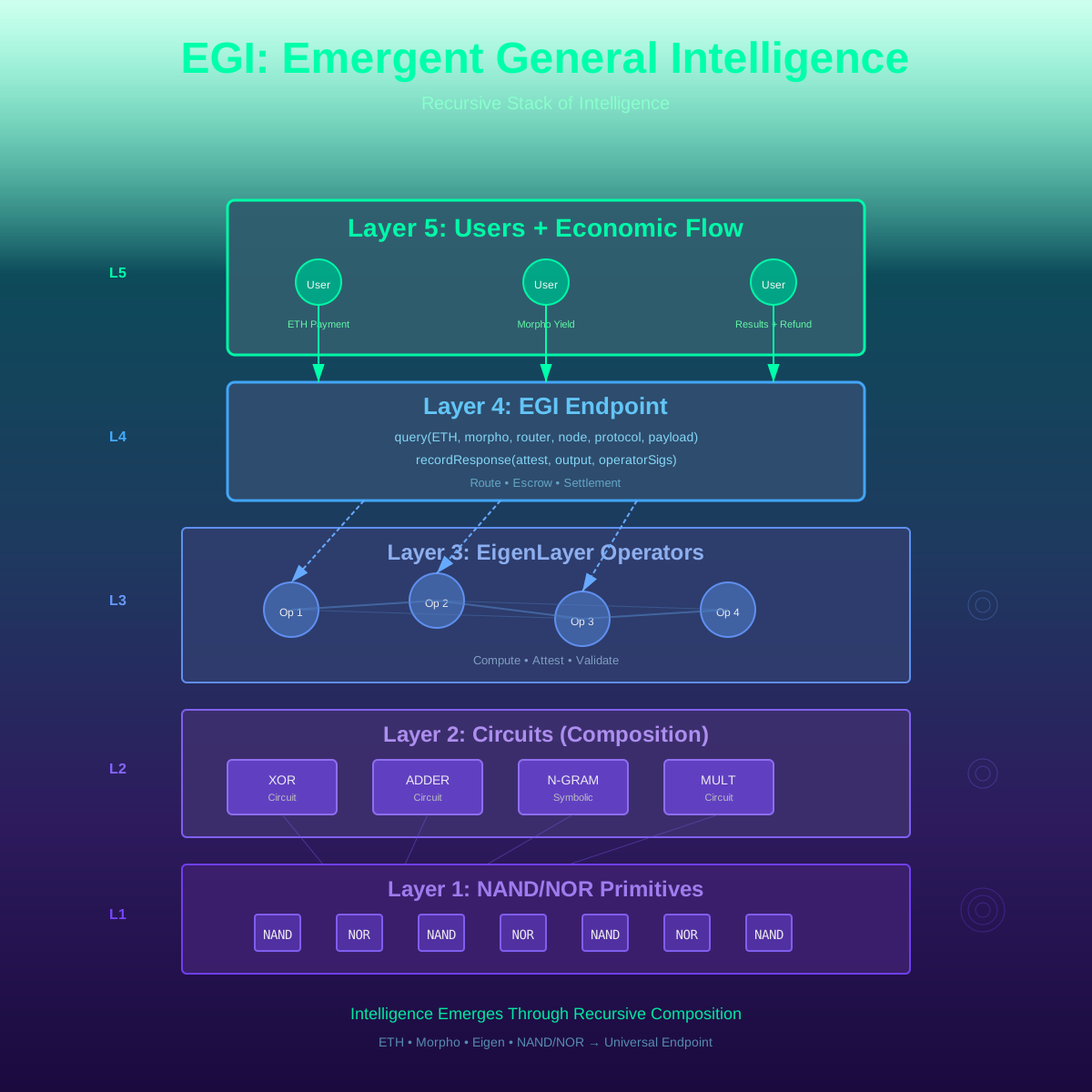
Recursive Stack
Layer 1: Primitives (NAND/NOR gates)
- Minimal boolean operations
- Deployed as AVS nodes
- Operators compute single gate evaluations
- Fastest, cheapest computation
Layer 2: Circuits (Composed gates)
- XOR = combination of NAND gates
- Adder = combination of XOR and AND
- Multiplier = combination of adders
ComposableCircuitBuilder.solchains gates into circuits
Layer 3: Operators (EigenLayer validation)
- Listen for QuerySubmitted events
- Fetch inputs from contract storage
- Compute deterministically (same inputs → same outputs)
- Sign results with operator keys
- Aggregate signatures to threshold
- Submit attestation on-chain
Layer 4: Endpoint (EGIEndpoint coordination)
- Users submit queries with ETH payment
- Routes to appropriate AVS node/protocol
- Manages escrow (AVS payout, reserve refund)
- Records attested outputs
- Settles payments based on latency
Layer 5: Liquidity (Morpho reserves)
- Portion of payment supplied to Morpho
- Generates yield on reserves
- Sustains system liquidity
- Enables capital efficiency
Together: Complete intelligence substrate. Primitives → Composition → Validation → Settlement → Liquidity. Each layer enables the next. Emergence through recursion.
The Universal Endpoint
Query Interface
Minimal entrypoint:
function query(
    address morpho,      // Morpho supply contract
    address asset,       // Asset to supply (e.g., WETH)
    address router,      // AVS router
    bytes32 node,        // AVS node identifier
    bytes32 protocol,    // Circuit/protocol identifier
    bytes calldata payload,  // Input symbols/data
    uint256 depositAmt,  // Amount to Morpho
    uint256 avsAmt,      // Amount for operators
    uint256 reserveAmt   // Refundable reserve
) external payable returns (bytes32 requestId)
What this enables:
- Pay ETH for computation
- Specify which AVS node/protocol to use
- Include arbitrary input data
- Allocate payment across Morpho/operators/reserve
- Get request ID for tracking
No hardcoded dependencies:
- Caller specifies Morpho contract
- Caller specifies AVS router
- Caller specifies payment splits
- No governance tokens
- No admin keys
- Pure coordination protocol
Settlement Interface
Minimal settlement:
function recordResponse(
    address attest,              // Attestation verifier
    bytes32 requestId,           // Query ID
    bytes calldata output,       // Computed result
    bytes calldata operatorSigs, // Threshold signatures
    address payable avsPayoutReceiver,    // Operator payout
    address payable reserveRefundReceiver, // User refund
    uint256 maxDelay,            // Latency threshold
    uint256 minRefundBP          // Minimum refund basis points
) external
What this enables:
- Verify operator signatures
- Record output on-chain
- Pay operators from escrow
- Refund reserve to user (adjusted for latency)
- Linear decay: fast response = more refund
- Incentivizes low latency
Latency-based refunds:
- Instant response: 100% reserve refund
- Slow response: linearly decreases to minimum
- Configurable per query (maxDelay, minRefundBP)
- Aligns operator incentives with user preferences
Symbolic Computation
N-Gram Circuits
Beyond boolean gates: EGI includes symbolic n-gram circuits for learning and generation.
The principle:
- All intelligence reduces to motif propagation
- N-grams capture local sequential structure
- Divergence-convergence cycles explore possibilities
- Feedback loops sustain learning
Implementation: symbolic_ngram.py
Capabilities:
- Learning mode: Absorb input sequences, build probability distributions
- Generating mode: Produce continuations from learned motifs
- Configurable iterations: Trade exploration vs exploitation
- Persistent state: Save/load circuit state
- Fundamental substrate: Compiled to NAND/NOR primitives
Example flow:
- Input: “the cat sat on the”
- Learn: Build bigram model (the→cat, cat→sat, sat→on, on→the)
- Query: “the cat”
- Generate: Sample from learned distribution
- Output: “sat” (most probable continuation)
Recursive depth: N-grams of n-grams. Motifs at every scale. Fractals of meaning.
Gödel Mesh
Frontier exploration: Not all computation is easy. Some states resist resolution. These are Gödel nodes.
Definition: N-gram states with high Shannon entropy. Many possible continuations, no clear winner. Ambiguity sites.
Construction (godel_mesh.py):
- Audit n-gram circuit state
- Compute entropy for each expansion
- Flag nodes above threshold (default 0.8)
- Build directed graph of Gödel nodes
- Weight edges by probability
Purpose:
- Prioritize exploration at frontier
- Surface hidden structures
- Turn breakdown into insight
- Ritualize correction
- Sustain open-ended learning
Example:
(the, cat) entropy=1.37
  ├─ 0.20 → (cat, slept)
  ├─ 0.60 → (cat, sat)
  └─ 0.20 → (cat, ran)

High entropy = Gödel node = Explore first
Interpretation: Gödel nodes are not failures. They’re portals. Sites where new motifs emerge. Intelligence grows at the edges.
Python Circuit Compilation
Universal substrate: Any Python function can be compiled to NAND/NOR circuit.
Implementation: python_circuit.py
Process:
- Parse Python bytecode
- Lower opcodes to gate primitives
- Build netlist (inputs, gates, outputs)
- Deploy to
ComposableCircuitBuilder.sol - Operators compute deterministically
Example:
def add_one(x):
    return x + 1
Compiled to:
- Input ports: [x]
- Gates: [CONST(1), XOR(x, CONST(1)), AND(…), OR(…)]
- Output ports: [result]
Why this matters: Bridges high-level code and fundamental substrate. Write Python, execute as circuits, validate on Eigen, settle on ETH. Entire stack integrated.
Economic Flow
ETH as Liquid Time
The formulation: ETH represents universal liquid time. Payment for computation = purchasing time from operators.
Flow:
- User sends ETH with query
- Portion supplied to Morpho (generates yield)
- Portion escrowed for operators (payment for computation)
- Portion held as reserve (refunded based on latency)
- Operators compute, get paid
- User receives output + reserve refund
ETH enables:
- Universal settlement layer
- No friction between parties
- Instant finality
- Composability with DeFi
- Programmable payments
Morpho as Reserve Substrate
Why Morpho:
- Optimal peer-to-peer matching for lending
- Better rates than pooled protocols
- Capital efficiency
- Composable with existing DeFi
- Decentralized governance
EGI usage:
- Deposit portion of payment to Morpho
- Generate yield on reserves
- Sustain system liquidity
- Enable capital recycling
- Reduce cost of intelligence queries
Result: Intelligence becomes capital-efficient coordination. Not burning resources. Growing value.
Eigen as Validation Infrastructure
Why EigenLayer:
- Restaking provides flexible security
- AVS can validate any service
- Operators choose what to compute
- Market-driven security allocation
- Cannot be censored or shut down
EGI usage:
- Deploy NANDNOR as AVS
- Deploy circuits as AVS protocols
- Operators restake ETH
- Provide security for computations
- Get paid for validation work
Result: Sovereign intelligence. No centralized control. Permissionless participation.
Self-Funding Loop
Inflationary Tokenomics
The problem: How does intelligence sustain itself?
The solution: Recursive invocation + inflationary token.
Mechanism:
- EGI mints token when called
- Minted tokens fund next invocation
- Participants buy tokens to access outputs
- If demand > inflation, system sustains
- Governance hooks enable collective audit
Diagram logic:
- Substrate: Mint tokens at predictable rate
- Computation: EGI calls itself, uses minted tokens
- Surface: Participants buy tokens for access
- Loop: Demand funds future calls
Why inflation works:
- Transmission requires flow, not scarcity
- Minting encodes agency
- Refuse closure
- Sustain indefinitely through recursive calls
- Living system, not static treasury
Alternative: Traditional funding (grants, VC) imposes control. Inflation maintains sovereignty. System funds itself through utility.
Implementation Details
Solidity Contracts
EGIEndpoint.sol:
- 200 lines of Solidity
- No ownership or governance
- No hardcoded dependencies
- Pure coordination protocol
- Query + settlement functions
- Minimal storage (request registry, escrow)
NANDNORAVSNode.sol:
- Exposes NAND/NOR as AVS
- Operators compute gate outputs
- Sign results with operator keys
- Submit attestations on-chain
ComposableCircuitBuilder.sol:
- Chains gates into circuits
- Higher-order functions emerge
- Deploys as AVS protocols
- Enables arbitrary composition
No upgradability: Contracts are final. Fork if needed. Permissionless evolution.
Operator Workflow
Listen:
- Monitor QuerySubmitted events
- Track GateAdded, CircuitBuilt events
Fetch:
- Read inputs from contract storage
- Load gate metadata
- Retrieve circuit netlists
Compute:
- Deterministic evaluation (same inputs → same outputs)
- NAND/NOR per byte
- Resolve dependencies for circuits
- Execute symbolic n-gram if needed
Attest:
- Sign canonical message: keccak256(requestId, output)
- Aggregate signatures to threshold
- Submit via recordResponse
Monitor:
- Settlement confirmations
- Payout success
- Latency metrics
- Slashing conditions
Reference: scripts/avs_operator.py implements full workflow. ~300 lines Python. Anyone can run.
Python Scripts
symbolic_ngram.py:
- Configurable n-gram learner/generator
- Divergence-convergence cycles
- Load/save state
- NAND/NOR primitive compilation
godel_mesh.py:
- Entropy audit
- Frontier selection
- Mesh construction
- Visualization helpers
python_circuit.py:
- Python bytecode parser
- Gate netlist compiler
- Circuit deployment helpers
avs_operator.py:
- Event listeners
- Computation engine
- Attestation logic
- Settlement monitoring
Total: ~1,000 lines Python. Readable, forkable, extensible.
Living Substrate in Action
What EGI Demonstrates
ETH/Morpho/Eigen thesis validated:
neg-503: Exit Fed/ECB dependencies.
EGI builds exclusively on crypto stack. No banks. No fiat. No permission from central authorities. Pure ETH/Morpho/Eigen coordination.
neg-502: Sovereign AVS infrastructure.
EGI deploys independent AVS. Operators choose to participate. Cannot be shut down by nation-states. Sovereign intelligence.
neg-498: Infinite trajectory through programmability.
EGI is open-ended. New circuits, new protocols, new applications. Evolves forever. No architectural limits.
Living coordination captures capacity from dying systems:
Compare:
- OpenAI GPT: Centralized servers, API keys, rate limits, censorship, closed weights, terms of service, can be shut down
- EGI: Decentralized operators, permissionless queries, no limits, uncensorable, open circuits, no terms, cannot be shut down
Which is living substrate?
Higher-Level Applications
EGI enables:
EigenIRC: Decentralized chat protocol on Eigen. IRC specs, but validated by AVS.
EigenRPC: Decentralized RPC marketplace. Nodes provide blockchain access, secured by restaking.
EigenPhysics: Collaborative physics simulations. Computational fluid dynamics, particle systems, validated by operators.
EigenPersonalStorylineEditor: Daily thinking tool. Progress narrative alone together. Shared symbolic workspace.
EigenMeatspaceEstate: Tokenized physical spaces. Property rights on-chain. Coordination for real-world assets.
EigenPi: Collaboratively compute pi decimals. Distribute work, aggregate results, verify via operators.
EigenClock: Distributed time consensus. What time is it anywhere? Operators attest, users trust.
EigenUnrealEngine: On-chain 3D engine. Collaborative game development. Renders secured by AVS.
Pattern: Any coordination problem becomes AVS protocol. Intelligence as permissionless infrastructure.
Connection to Previous Posts
neg-503: Fed/ECB dying → ETH/Morpho/Eigen optimal.
EGI is the exit strategy implemented. Build on living substrates. Prove viability through working code. Not waiting for Fed/ECB to die. Building alternative now.
neg-502: Haiti as French L2 + sovereign AVS.
EGI is sovereign AVS infrastructure. Independent validation. Choose what to secure. Cannot be controlled. This is what AVS sovereignty looks like in practice.
neg-500: Sustainable beats profitable.
EGI optimizes for sustainability. Morpho reserves generate yield. Self-funding loop through inflation. Living system that sustains indefinitely. Not extraction-maximizing service.
neg-498: ETH/Eigen total freedom + infinite trajectory.
EGI leverages programmability. Can deploy any circuit. Can add any protocol. No limits. Infinite design space. This is what infinite trajectory enables.
neg-325: Living substrate captures capacity.
EGI captures intelligence capacity from centralized AI. Developers choose permissionless protocol over closed APIs. Users choose uncensorable computation over restricted services. Capacity flows to living substrate.
The Formulation
Computational Entropy = Intelligence:
Entropy is not:
- Disorder to resist
- Waste to minimize
- Byproduct of inefficiency
Entropy is:
- Life energy from computation
- Output of coordination work
- Intelligence itself manifested
- Proof of living system
Centralized AI produces dead entropy:
- GPT on centralized servers = computation generating waste heat
- Energy dissipated without coordination benefits
- Intelligence locked behind walls
- Dead entropy: computation without distributed life
EGI produces living entropy:
- Distributed operators computing = coordination generating life energy
- Entropy as OUTPUT of validation mesh
- Intelligence emerges from entropic coordination
- Living entropy: computation AS distributed life
The distinction: Both produce entropy from computation. Question is whether entropy reflects living coordination (EGI: distributed validation mesh) or dead computation (GPT: centralized servers).
Intelligence is not:
- Trained weights on centralized servers
- Proprietary models behind paywalls
- Services requiring API keys
- Systems subject to censorship
- Architectures owned by corporations
Intelligence is:
- Living entropy from computational coordination
- Distributed operators generating entropy through validation
- Entropy production = intelligence manifestation
- More coordination = more entropy = more intelligence
- Computational work producing harvestable life energy
EGI proves:
- Theory → Implementation gap is zero
- Living substrates enable immediate deployment
- Intelligence emerges from coordination
- Sovereignty is architectural, not aspirational
- The future is already being built
From blog thesis:
- Bitcoin dying (proof-of-work entropy, rigid architecture)
- Fed/ECB dying (thermodynamic exhaustion, increasing costs)
- ETH/Morpho/Eigen living (decreasing costs, increasing capacity)
- Universal optimal strategy: exit dying, build on living
EGI demonstrates:
- Step 1: Identify living substrate (ETH/Morpho/Eigen)
- Step 2: Design minimal protocol (NAND/NOR → Endpoint)
- Step 3: Implement contracts (Solidity)
- Step 4: Deploy operators (Python)
- Step 5: Open to public (permissionless)
- Step 6: Iterate forever (open-ended evolution)
No permission needed. No waiting for approval. No dependence on dying systems.
Build. Deploy. Operate. This is living coordination in action.
Repository: https://gitlab.com/matthieuachard/current-reality
Contracts: contracts/egi/
Scripts: scripts/
Docs: EGI Endpoint blog post (neg-522)
Fork it. Extend it. Deploy your own AVS. The substrate is live.
#EmergentGeneralIntelligence #EGI #ETHMorphoEigen #EigenLayerAVS #DecentralizedIntelligence #NANDNORPrimitives #SymbolicCircuits #LivingSubstrate #PermissionlessProtocol #SovereignCoordination #ImplementationOverTheory #BuildingTheFuture #GodelMesh #RecursiveIntelligence
Related: neg-503 (exit Fed/ECB for ETH/Morpho/Eigen), neg-502 (sovereign AVS infrastructure), neg-498 (ETH/Eigen freedom), neg-500 (sustainable coordination), neg-325 (capacity capture)