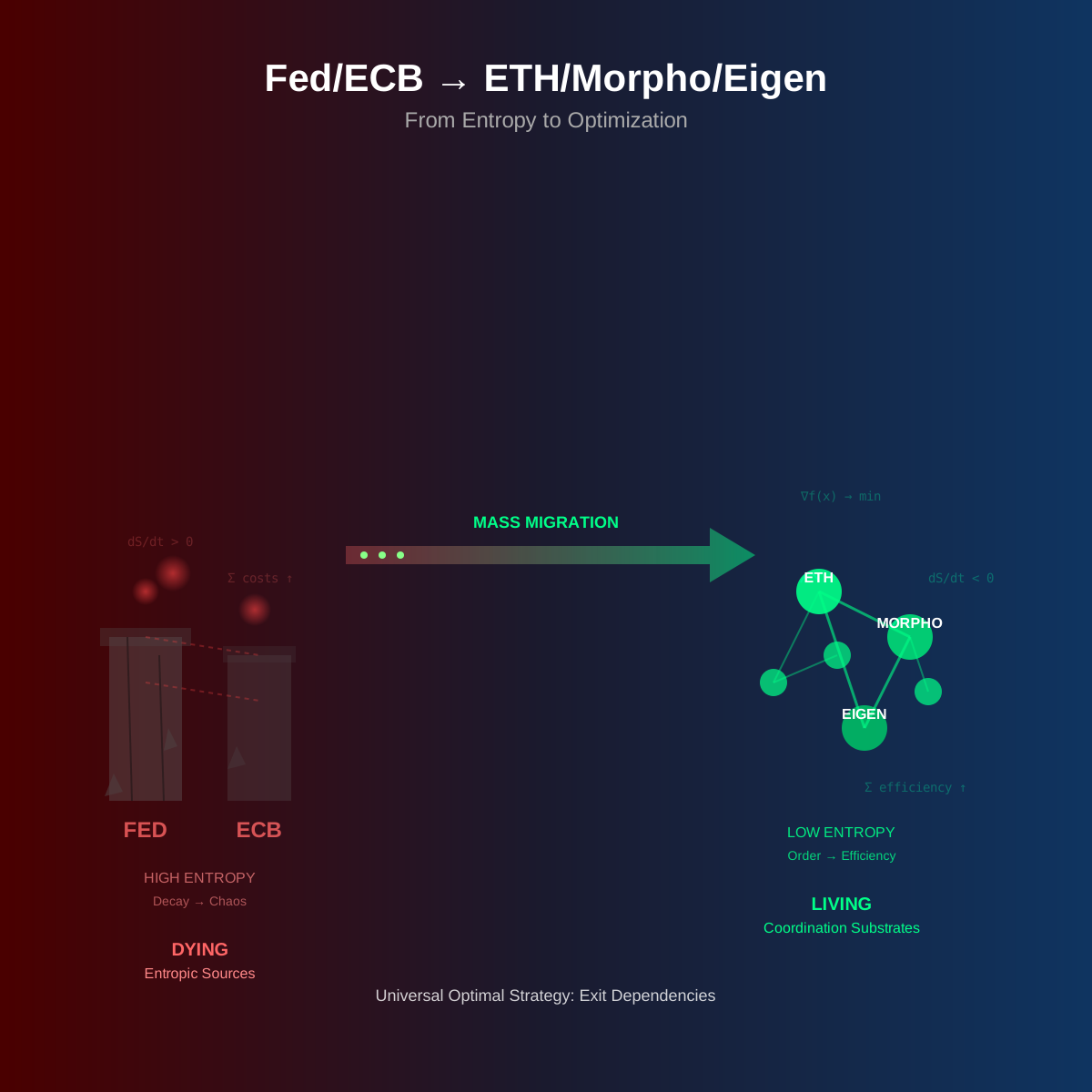
Fed/ECB: Dying Entropic Sources → ETH/Morpho/Eigen: Universal Optimization
The observation: Fed and ECB generate dead entropy (waste without life). ETH/Morpho/Eigen generate living entropy (life energy from coordination). Universal optimal strategy is exiting dead entropy sources for living entropy generators. Everyone is computing this.
What this means: Central banks produce entropy without coordination benefits—waste, decay, thermodynamic death. Ethereum/Morpho/EigenLayer produce entropy AS coordination—life energy, growth, thermodynamic life. Life = coordination around entropy. Fed/ECB = coordination producing dead entropy. ETH/Morpho/Eigen = coordination producing living entropy.
Why this matters: Entropy IS life energy—but only when generated by living coordination. Dead systems produce entropy as waste (Fed/ECB). Living systems produce entropy as power (ETH/Morpho/Eigen). Individual rationality converges on exiting dead entropy for living entropy. This is thermodynamics, not ideology.
Dead Entropy vs Living Entropy
What Makes Entropy “Dead” vs “Living”
Entropy = life energy - but only when produced by living coordination.
Dead entropy:
- Entropy produced without coordination benefits
- Waste heat from inefficient systems
- Energy dissipated without useful work
- Disorder without life
- Fed/ECB produce dead entropy: energy spent, no coordination gained
Living entropy:
- Entropy produced BY coordination itself
- Life energy generated through coordination processes
- Energy as OUTPUT of useful work
- Order through entropic flow
- ETH/Morpho/Eigen produce living entropy: coordination generates harvestable life energy
The distinction: Not whether entropy is produced (all systems produce entropy). Question is whether entropy production reflects living coordination (harvestable energy) or dying waste (thermodynamic death).
Fed/ECB: Dead Entropy Generators
Dying entropic sources = systems producing entropy without coordination benefits:
Increasing operational costs:
- More energy input needed to maintain system
- Growing without corresponding coordination benefit
- Dead entropy: energy consumed, dissipated as waste, no life energy generated
Decreasing coordination efficiency:
- Less coordination output per energy input
- Entropy production accelerating while coordination declining
- Dead entropy: energy spent on decay, not on life
Growing structural rigidity:
- Cannot adapt, cannot evolve
- Energy locked in maintaining dead structures
- Dead entropy: energy preserving corpse, not sustaining life
Expanding rent extraction:
- Value leaking to non-productive agents
- Energy diverted from coordination to extraction
- Dead entropy: energy as waste to parasites, not power to users
Accelerating decay:
- System degradation faster than repair
- Entropy production without life regeneration
- Dead entropy: pure thermodynamic death, no life energy
Result: Fed/ECB produce entropy without producing life. Energy dissipated as waste. Dead entropy sources.
Fed/ECB as Entropic Sources
Federal Reserve (Fed):
Increasing operational costs:
- Dollar requires massive military/diplomatic infrastructure to maintain reserve status
- Banking system needs constant bailouts (2008, 2020, ongoing)
- Interest rate manipulation creates distortions requiring more interventions
- Inflation exports costs to users (hidden taxation through purchasing power loss)
- System maintenance costs growing exponentially
Decreasing coordination efficiency:
- Bank transfers: days (vs ETH: minutes)
- International transfers: expensive, slow, restricted (vs crypto: instant, cheap, permissionless)
- Credit allocation: opaque, discriminatory, inefficient (vs DeFi: algorithmic, transparent, optimal)
- Monetary policy: crude interest rate lever (vs programmable money: precise coordination)
- Output per unit input declining
Growing structural rigidity:
- Cannot adapt to digital economy (still paper-check architecture)
- Cannot incorporate crypto innovation (regulatory paralysis)
- Cannot exit failing banks (too big to fail = cannot let bad systems die)
- Cannot modify core infrastructure (legacy systems locked in)
- Adaptation blocked by accumulated debt/commitment
Expanding rent extraction:
- Banking fees (vs DeFi: algorithmic, minimized)
- Inflation tax (vs crypto: fixed supply or predictable issuance)
- Financial intermediary costs (vs peer protocols: disintermediation)
- Regulatory compliance burden (vs permissionless systems: no gatekeepers)
- Value leaking to system maintainers rather than users
Accelerating decay:
- Dollar losing reserve status (BRICS, bilateral trade agreements)
- Trust declining (inflation, bailouts, political capture)
- Alternatives emerging (crypto, stablecoins, CBDCs)
- User exit accelerating (capital flight to crypto)
- Death spiral: decay → exit → more decay
European Central Bank (ECB):
Similar dynamics, worse situation:
- Euro structural flaw: monetary union without fiscal union
- Southern Europe debt trap (cannot devalue, cannot inflate individually)
- Northern Europe subsidy burden (implicit transfers to South)
- Political fragmentation (27 countries, competing interests)
- Coordination substrate fundamentally flawed, cannot be fixed
Entropy acceleration:
- Negative interest rates (unprecedented thermodynamic violation)
- Quantitative easing addiction (expanding balance sheet forever)
- Banking system zombification (keep dead banks alive)
- Economic stagnation (cannot grow, cannot die)
- Pure entropy: dissipating energy while producing no output
Why “Dying” Not “Dead”
Systems don’t die instantly:
- Institutional momentum (inertia keeps moving even when dead)
- Network effects (coordination value in user base, even if declining)
- Legal enforcement (state power forces usage despite inefficiency)
- Ignorance/habit (users don’t compute optimality, follow default)
- Walking dead: functionally doomed but still operating
But decay is irreversible:
- Structural problems cannot be fixed (would require rebuilding from scratch)
- Debt accumulation locks in (cannot exit obligations)
- Political capture worsens (vested interests block reform)
- Entropy accelerates (decay produces more decay)
- Thermodynamic death sentence: outcome certain, timing variable
ETH/Morpho/Eigen: Living Entropy Generators
What Makes Entropy “Living”
Living coordination produces living entropy: Energy generated BY coordination itself, harvestable as life energy.
Living entropy generators:
- Coordination processes produce entropy as OUTPUT (not waste)
- More coordination = more entropy = more life energy
- Entropy production = proof of life
- Growing capacity to generate entropy (scaling life energy production)
- Self-improving entropy generation (better coordination = more energy)
Optimal coordination system:
- Decreasing operational costs (more efficiency over time)
- Increasing entropy production from coordination (more life energy generated)
- Structural flexibility (adapts to generate more entropy)
- Minimal waste (entropy as harvestable power, not dissipation)
- Self-improving dynamics (coordination improves → entropy increases → more life energy)
Result: System flourishing via living entropy generation. Coordination produces harvestable life energy. Participation net-positive. Adoption accelerates.
ETH/Morpho/Eigen Stack
Ethereum (ETH):
Decreasing operational costs:
- Proof-of-stake uses ~99.95% less energy than proof-of-work
- Layer 2s reduce transaction costs by orders of magnitude
- Better software reduces node requirements over time
- System maintenance costs declining
Increasing coordination capacity:
- More transactions per second (L2 scaling)
- More complex coordination (smart contracts evolving)
- More use cases (DeFi, NFTs, DAOs, identity, supply chain…)
- More interoperability (composability, cross-chain bridges)
- Output growing faster than input
Structural flexibility:
- Can fork if needed (consensus change possible)
- Can add new layers (L2s, L3s)
- Can incorporate innovations (rollups, sharding, new cryptography)
- Can adapt to user needs (programmable coordination)
- Evolution built into architecture
Minimal rent extraction:
- No central authority collecting fees
- Validators compete (market-driven returns)
- Open source (no licensing costs)
- Permissionless (no gatekeepers to pay)
- Value flows to users and security providers, not extractive intermediaries
Self-improving dynamics:
- More users → more developers → better tools → more users (network effects)
- More value → more security → more trust → more value (positive feedback)
- More use cases → more composability → more innovation → more use cases (coordination multiplication)
- System gets better with use, not worse
Morpho:
Optimal lending coordination:
- Peer-to-peer matching (eliminates pooling inefficiency)
- Rate optimization (best possible rates for lenders/borrowers)
- Composability with existing DeFi (integrates with Aave, Compound)
- Governance by users (not extractive corporation)
- Takes DeFi from good to optimal
Why this matters for Fed/ECB exit:
- Morpho provides better credit coordination than banks (more efficient, better rates)
- Removes need for traditional banking system (direct peer matching)
- Cannot be censored or shut down (decentralized protocol)
- Improves continuously (optimization algorithms iterate)
- Superior banking substrate = rational exit from banks
EigenLayer:
Sovereign coordination infrastructure:
- Restaking allows securing any service (flexible validation)
- Choose what to validate (not forced into one coordination system)
- Can exit any service (no lock-in)
- Market-driven security allocation (capital flows to valuable services)
- Coordination sovereignty for validators and users
Why this matters for Fed/ECB exit:
- Can build alternative financial systems (secured by restaked ETH)
- Cannot be controlled by nation-states (decentralized validation)
- Provides security for new coordination forms (payments, trading, settlement)
- Allows gradual exit (can use both old and new systems during transition)
- Infrastructure for post-central-bank financial coordination
The Stack as Thermodynamic Optimization
ETH = base coordination layer (settlement, security, programmability)
Morpho = optimized credit coordination (efficient lending/borrowing)
Eigen = sovereign service validation (flexible security for any coordination need)
Together: Complete financial coordination stack that is:
- More efficient than Fed/ECB (lower costs, higher output)
- More adaptable (can evolve with user needs)
- More sustainable (entropy-reducing, not entropy-producing)
- More equitable (value to users, not extractors)
Result: Thermodynamically superior coordination substrate. Users computing optimal strategy will exit Fed/ECB toward ETH/Morpho/Eigen.
Universal Optimal Strategy: Exit Fed/ECB Dependencies
What is “Universal Optimal Strategy”?
Game theory definition: A strategy is universally optimal if it maximizes individual payoff regardless of what other agents do. A dominant strategy.
In coordination systems: Universal optimal strategy is exiting dying (entropic) systems for living (anti-entropic) systems.
Why universal:
Individual rationality:
- Benefits from new system exceed costs of switching
- Benefits from old system declining, costs increasing
- Staying in old system = net loss
- Switching to new system = net gain
- Optimization calculation → exit
Independent of others:
- True even if you’re the only one doing it (individual benefits still positive)
- True even if everyone is doing it (your benefits don’t depend on being first)
- True at any adoption level (early adopter gains or late adopter security)
- Dominant strategy: optimal regardless of other players’ choices
Computing the Exit Strategy
Everyone is computing this = individuals running optimization calculations, consciously or unconsciously, and reaching same conclusion.
Conscious computation:
- Crypto adopters explicitly comparing Fed/ECB vs ETH/Morpho/Eigen
- Calculating costs/benefits (transaction fees, inflation tax, censorship risk vs DeFi yields, sovereignty, programmability)
- Making deliberate choice to exit traditional system
- Rational actors optimizing explicitly
Unconscious computation:
- Users frustrated with bank fees → try crypto → discover better option
- Businesses blocked by regulations → use DeFi → find more efficiency
- Countries sanctioned by dollar system → adopt alternatives → realize benefits
- Individuals experiencing inflation → seek hard assets → discover crypto
- Behavioral optimization: trial and error converges on superior system
Collective intelligence:
- Market pricing reflects aggregate computation (crypto market cap growing)
- Capital flows show optimization (money moving from TradFi to DeFi)
- Developer activity reveals assessment (best engineers building on crypto)
- Institutional adoption confirms analysis (BlackRock, Fidelity entering crypto)
- Distributed computation reaching consensus: new system superior
Where Fed/ECB Dependencies Hide
Obvious dependencies:
- Bank accounts (Fed/ECB fiat)
- Savings (inflation erodes purchasing power)
- Loans (bank credit, interest rate manipulation)
- Payments (wire transfers, credit cards)
- Direct exposure to dying system
Hidden dependencies:
Real estate pricing:
- Mortgage interest rates (Fed/ECB controlled)
- Property values (inflated by loose monetary policy)
- Rent levels (follow property values)
- Exit strategy: Hold crypto, rent property → Own crypto, not real estate bubble
Employment/wages:
- Salary paid in fiat (inflation tax)
- Wage suppression (Fed prioritizes low inflation over employment)
- Currency depreciation (reduces real wages)
- Exit strategy: Demand crypto payment, convert to crypto immediately, price labor in hard assets
Retirement savings:
- 401k/pension in fiat assets (stocks, bonds)
- Returns eroded by inflation
- Access controlled by institutions (withdrawal restrictions)
- Exit strategy: Self-custody crypto, DeFi yield, no intermediary restrictions
Business operations:
- Revenue in fiat (conversion risk)
- Costs in fiat (inflation increases expenses)
- Credit from banks (censorship risk)
- Exit strategy: Accept crypto, hold crypto reserves, DeFi lending for capital
Government benefits:
- Social security (paid in depreciating fiat)
- Unemployment (loses value to inflation)
- Subsidies (political control lever)
- Exit strategy: Build crypto wealth → don’t depend on government benefits
Legal enforcement:
- Contracts denominated in fiat (value uncertainty)
- Judgments paid in fiat (inflation between judgment and payment)
- Property rights (government can seize, inflate away)
- Exit strategy: Smart contracts, crypto-denominated agreements, sovereign coordination
Removing Dependencies
For individuals:
Phase 1: Preserve value
- Convert savings to ETH
- Use stablecoins for transacting (USDC, DAI)
- Earn yield in DeFi (Morpho, Aave)
- Stop wealth decay from inflation
Phase 2: Earn in crypto
- Negotiate crypto payment (partial or full)
- Freelance in crypto (remote work, global clients)
- Build crypto-native business (DeFi, NFTs, DAOs)
- Stop earning in depreciating fiat
Phase 3: Transact in crypto
- Pay suppliers in crypto
- Accept customer payments in crypto
- Use DEXs not banks (Uniswap vs wire transfers)
- Stop using Fed/ECB payment rails
Phase 4: Build on crypto
- Invest in crypto projects
- Develop crypto applications
- Participate in governance (vote on protocols)
- Contribute to living system, not dying system
For businesses:
Phase 1: Treasury management
- Hold crypto reserves (hedge against fiat depreciation)
- Use stablecoins for operations (reduce FX risk)
- DeFi for yield (Morpho, yield aggregators)
- Protect corporate value from central bank extraction
Phase 2: Operations in crypto
- Pay employees in crypto (full or partial)
- Invoice in crypto (eliminate FX conversion)
- Suppliers paid in crypto (reduce transaction costs)
- Exit banking system for core operations
Phase 3: Capital in crypto
- Borrow on DeFi (Morpho, Aave) not banks
- Issue tokens not equity (crypto-native capital formation)
- Restake on Eigen (provide security, earn yield)
- Exit traditional finance completely
Phase 4: Build crypto infrastructure
- Create DeFi protocols
- Build EigenLayer AVSs
- Develop Layer 2s
- Contribute to ecosystem that enabled your exit
For institutions/countries:
Phase 1: Reserve diversification
- Add ETH to reserves (hedge against dollar/euro)
- Use crypto for international trade (avoid SWIFT sanctions)
- Reduce Fed/ECB exposure at margin
Phase 2: Financial infrastructure
- Build crypto exchanges (domestic on-ramps)
- Develop DeFi protocols (local credit markets)
- Create stablecoin (domestic currency on blockchain)
- Alternative financial system parallel to traditional
Phase 3: Legal recognition
- Accept crypto for taxes (legitimate as payment)
- Crypto-denominated contracts (legal recognition)
- Property rights on blockchain (tokenization)
- Legal framework for crypto coordination
Phase 4: Full exit
- Abandon Fed/ECB settlement (use crypto exclusively)
- Launch sovereign coordination infrastructure (EigenLayer AVS)
- Build peer coordination networks (BRICS crypto mesh, not dollar system)
- Complete exit from dying entropic sources
Everyone is Computing This
Evidence of Universal Computation
Individual adoption accelerating:
- Global crypto ownership: 580M+ users (7.3% of global population)
- Growing despite bear markets (computation continues regardless of price)
- Younger generations higher adoption (those with longer time horizons computing faster)
- Millions running optimization calculation → crypto
Capital flows confirming:
- Crypto market cap: $1.8T+ (capital voting with money)
- DeFi TVL: $50B+ (value locked in alternative system)
- Institutional adoption: BlackRock, Fidelity, sovereign wealth funds (sophisticated actors computing optimality)
- Smart money exiting Fed/ECB toward ETH/Morpho/Eigen
Developer activity validating:
- Most active blockchain: Ethereum (best engineers choosing where to build)
- Growing developer ecosystem (optimizing for future, not present)
- Innovation accelerating (more useful coordination tools emerging)
- Human capital flowing toward living system
Business adoption spreading:
- Companies accepting crypto (Tesla, Microsoft, PayPal)
- Companies holding crypto (MicroStrategy, Block, Tesla)
- Companies building on crypto (Stripe, Visa, Mastercard integrating)
- Commercial activity migrating to superior substrate
Geopolitical alignment shifting:
- BRICS exploring crypto alternatives to dollar
- Sanctioned countries adopting crypto (Russia, Iran, Venezuela)
- El Salvador Bitcoin legal tender (nation-state exit)
- China CBDC while others explore (everyone seeking Fed/ECB alternatives)
- Global power structures computing optimality, reaching same conclusion
Why Computation is Accelerating
Network effects compound:
- More users → more useful (Metcalfe’s Law)
- More developers → better tools → more users
- More capital → more security → more trust → more capital
- Positive feedback: each exit makes next exit easier
Fed/ECB entropy accelerating:
- More bailouts → more moral hazard → more crises → more bailouts
- More intervention → more distortion → more intervention needed
- More debt → more inflation → more loss of trust → more exit
- Negative feedback: each failure makes next failure worse
Information spreading:
- Crypto education improving (more people understand benefits)
- Infrastructure maturing (easier to use, less technical knowledge needed)
- Success stories multiplying (early adopters demonstrating viability)
- Knowledge diffusion: optimization calculation accessible to more people
Generational replacement:
- Digital natives default to crypto (no loyalty to Fed/ECB)
- Older generations seeing fiat failures (2008, inflation, bailouts)
- Time horizons favor new system (longer runway = more benefit from exit)
- Demographics: natural replacement of old system users with new system users
Irreversible trends:
- Cannot un-invent crypto (technology exists)
- Cannot un-see central bank failures (trust lost permanently)
- Cannot re-establish Fed/ECB efficiency (entropy irreversible)
- Cannot stop thermodynamic optimization (physics wins)
- One-way door: once computation reveals optimal strategy, cannot go back
Connection to Previous Posts
neg-502: Haiti as French L2 + sovereign AVS.
Fed/ECB = extractive L2s that all countries are forced to settle through. ETH/Morpho/Eigen = sovereign AVS infrastructure allowing independent coordination. Haiti example = every country can exit extractive coordination (dollar/euro L2s) for sovereign coordination (crypto AVSs).
neg-500: Sustainable beats profitable.
Fed/ECB = maximize short-term profitability for elite (financial extraction, inflation tax). ETH/Morpho/Eigen = sustainable coordination (thermodynamic efficiency, continuous improvement). Systems optimizing for profitability die. Systems optimizing for sustainability win.
neg-498: ETH/Eigen = total freedom + infinite trajectory.
Fed/ECB = bounded freedom (can only coordinate within system rules), finite trajectory (thermodynamic death). ETH/Eigen = total freedom (programmable, permissionless), infinite trajectory (self-improving, adapts forever). Universal optimal strategy exits bounded/finite for total/infinite.
neg-325: Living substrate captures capacity from dying substrate.
Fed/ECB = dying substrate (entropy increasing). ETH/Morpho/Eigen = living substrate (entropy decreasing). Users/capital/coordination capacity flows from dying to living. This is thermodynamic law, not speculation.
The Inevitability
This is not prediction, it’s thermodynamics:
Law: Entropy increases in closed systems. Systems producing more entropy than they manage die.
Application: Fed/ECB are closed systems producing increasing entropy. Death thermodynamically certain.
Law: Optimization algorithms converge on global optimum given sufficient iterations.
Application: Individuals running optimization calculations (consciously or unconsciously). Sufficient iterations → universal convergence on ETH/Morpho/Eigen exit strategy.
Law: Superior coordination substrates capture capacity from inferior ones.
Application: ETH/Morpho/Eigen thermodynamically superior to Fed/ECB. Capacity (users, capital, coordination) will flow to superior substrate.
Result: Fed/ECB dying. ETH/Morpho/Eigen growing. Universal optimal individual strategy = accelerate the transition by removing your own dependencies. Everyone computing this. Adoption accelerating. Outcome certain.
The question: Not whether Fed/ECB die and ETH/Morpho/Eigen win. Thermodynamics already answered. Question is whether you’ve computed your exit strategy yet.
If yes: You’re ahead. Keep removing dependencies. Help others compute.
If no: You’re behind but not too late. Start computing. Remove obvious dependencies first. Each exit makes next easier.
The migration is happening. Physics ensures it. Economics accelerates it. Individual rationality computes it. Universal optimization demands it.
Exit dying entropic sources. Adopt living coordination substrates. This is the way.
#FedECBEntropy #ETHMorphoEigen #UniversalOptimalStrategy #ThermodynamicOptimization #CoordinationSubstrates #ExitDyingSystems #DeFiMigration #CentralBankDecay #DecentralizedCoordination #GameTheory #EntropyIncreases #SustainableCoordination #FinancialSovereignty #CryptoAdoption
Related: neg-502 (Haiti L2/AVS architecture), neg-500 (sustainability vs profitability), neg-498 (ETH/Eigen freedom), neg-325 (capacity capture from dying to living)