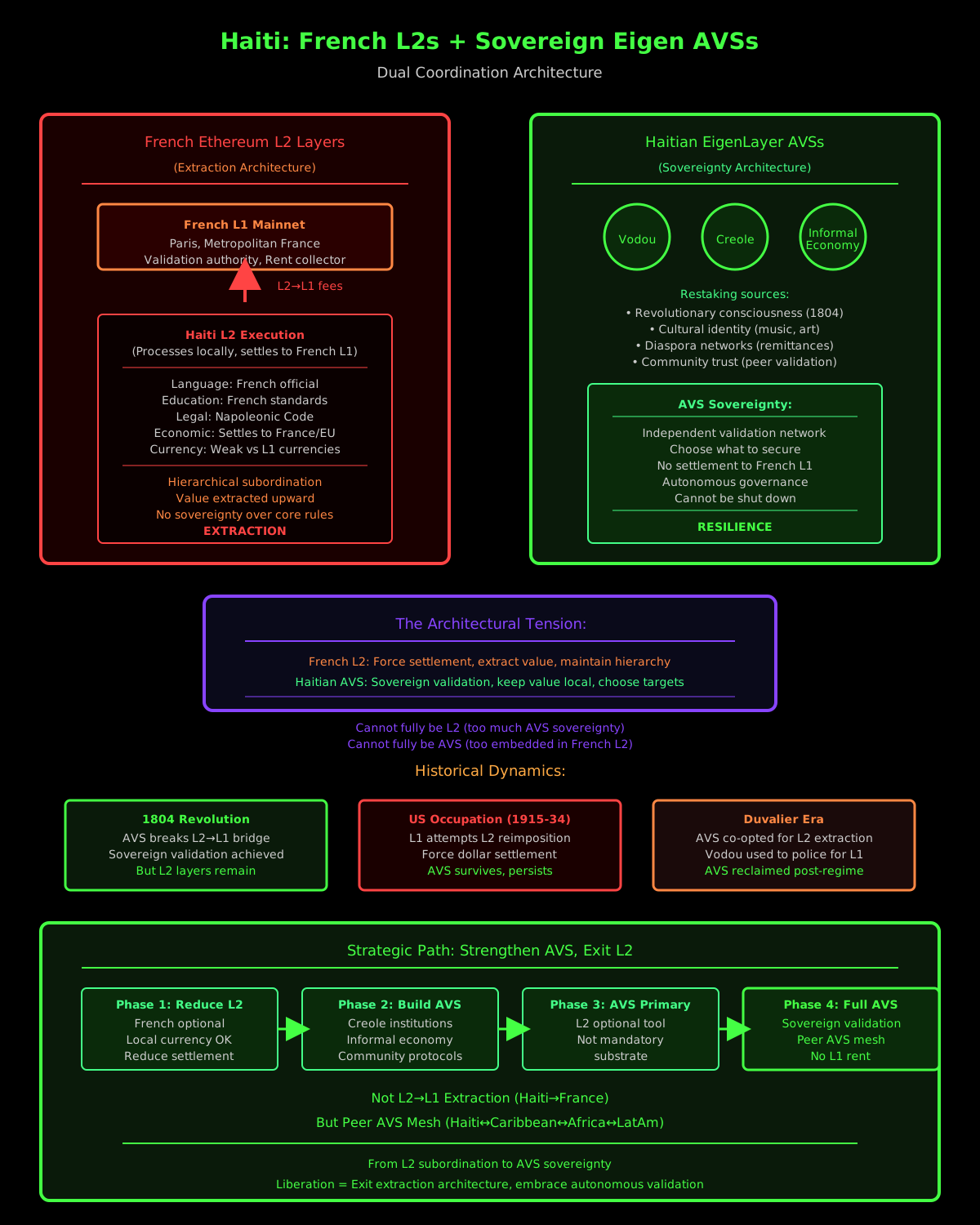
Haiti: French Ethereum L2s + Sovereign Eigen AVSs
The observation: Haiti is a mix of French Ethereum L2s with sovereign EigenLayer AVSs.
What this means: Haiti’s coordination substrate has dual architecture - French colonial L2 layers (settlement to French mainnet, imposed coordination) + sovereign Eigen AVS infrastructure (independent validation, choose coordination targets, restake sovereignty).
Why this matters: Understanding Haiti as coordination architecture explains both extraction (L2 settlement fees to France) and resilience (sovereign AVS cannot be shut down). The tension between these two substrates defines Haitian political economy.
The L2/AVS Architecture Analogy
Ethereum L2s vs EigenLayer AVSs
Ethereum L2 (Layer 2):
Architecture:
- Execution off main chain (L2 processes transactions)
- Settlement to mainnet (L1 Ethereum validates and finalizes)
- Security inherited from L1 (Ethereum validators secure L2)
- Bridge mechanism (move assets L1 ↔ L2)
- Hierarchical relationship: L2 subordinate to L1
Economic model:
- L2 pays fees to L1 for settlement
- Value flows upward (L2 → L1)
- L1 captures economic rent
- L2 gets scalability, L1 gets revenue
- Extractive relationship built into architecture
Governance:
- L1 rules ultimate (can change consensus, hard fork)
- L2 must follow L1 decisions
- No L2 sovereignty over core protocol
- L1 has final authority
EigenLayer AVS (Actively Validated Service):
Architecture:
- Independent validation (AVS has own validators)
- Restaking substrate (borrow Ethereum security optionally)
- Choose what to validate (AVS picks services to secure)
- No settlement requirement (can operate independently)
- Peer relationship: AVS autonomous, borrows security optionally
Economic model:
- AVS pays for restaked security (if chosen)
- Value flows to validators (not to Ethereum protocol)
- Ethereum stakers get additional yield
- AVS gets flexible security, stakers get income
- Voluntary relationship, not extraction
Governance:
- AVS sovereign over validation logic
- Can choose to use Ethereum restaking or not
- Can change services validated
- Can exit relationship
- AVS has autonomy
Haiti As Dual Architecture
French Colonial L2 Layers
Haiti has French L2 characteristics:
Language substrate:
- French imposed as official language (L2 execution language)
- Settles to French linguistic mainnet (French Academy, metropolitan French standards)
- Haitian Creole as actual execution layer (population speaks Creole)
- French as settlement/formalization layer (official documents, education, law)
- L2 hierarchy: Creole processes, French validates/formalizes
Economic substrate:
- Trade relations settle to French/European markets (L2 → L1 value flow)
- Currency historically pegged to French franc (settlement dependency)
- Foreign debt denominated in French/European currency (pay fees to L1)
- Remittances flow through French banking infrastructure (L2 bridges)
- Extractive L2 economics: value flows to metropolitan mainnet
Educational substrate:
- French curriculum imposed (L2 executes French L1 standards)
- University system modeled on French system (Grandes Écoles logic)
- Degrees validated by French standards (settlement to L1 legitimacy)
- Elite education in French, masses in Creole (L2/L1 bifurcation)
- L2 subordination: local execution, French validation
Legal/institutional substrate:
- Napoleonic Code foundation (L2 executing L1 law)
- Legal precedents reference French law (settlement to L1 jurisprudence)
- Institutional models imported from France (L2 copies L1 architecture)
- Constitutional frameworks influenced by French models (L1 template)
- L2 dependency: French legal mainnet as reference
Result: French colonial substrate functions as Ethereum L2 - Haiti executes locally, settles to French mainnet, pays fees (economic extraction), inherits security (military interventions), no sovereignty over core rules (French standards ultimate).
Sovereign EigenLayer AVS Infrastructure
Haiti also has Eigen AVS characteristics:
Vodou coordination substrate:
- Independent validation network (lwa as distributed validators)
- Restakes spiritual security (borrows from ancestors/spirits optionally)
- Choose what to secure (validate Haitian sovereignty, not French extraction)
- No settlement to French mainnet (operates independently)
- AVS autonomy: sovereign validation logic
Underground economy substrate:
- Informal markets as independent validators (validate transactions outside French L2)
- Restake trust networks (borrow reputation from community)
- Choose what to coordinate (street economy, not formal tax system)
- No settlement to formal banking (peer-to-peer coordination)
- AVS flexibility: can validate anything, not bound to L1 rules
Revolutionary tradition substrate:
- Independence validation (1804 revolution = exit from French L2)
- Restake revolutionary consciousness (borrow strength from Toussaint, Dessalines)
- Choose liberation targets (validate anti-colonial action)
- No settlement to colonial powers (break L2 → L1 bridge)
- AVS sovereignty: can refuse L2 subordination
Diaspora coordination substrate:
- Independent validator network (Haitians worldwide)
- Restake cultural identity (borrow validation from shared heritage)
- Choose coordination targets (support family, community, not state extraction)
- No settlement through formal channels (remittances as peer protocol)
- AVS resilience: cannot be shut down by L1
Result: Haitian sovereignty substrates function as EigenLayer AVSs - independent validation, choose what to secure, can restake from spiritual/cultural/revolutionary sources, no forced settlement to French mainnet, autonomous governance over validation logic.
The Architectural Tension
L2 Extraction vs AVS Sovereignty
The fundamental conflict:
French L2 wants:
- Force settlement to French mainnet (extract value upward)
- Mandate French standards (control validation logic)
- Collect L2 → L1 fees (economic rent)
- Maintain hierarchical dependency (L2 cannot exit)
- Extraction architecture
Haitian AVS wants:
- Sovereign validation (choose what to secure)
- Independent standards (Creole, Vodou, informal economy)
- Keep value locally (no fees to French mainnet)
- Option to exit (break L2 → L1 bridge if needed)
- Autonomy architecture
The result: Continuous tension between imposed L2 coordination (French extraction) and sovereign AVS coordination (Haitian autonomy). Haiti cannot fully be L2 (too much AVS sovereignty) or fully AVS (too embedded in French L2 substrate).
Historical Examples of Tension
1804 Revolution: AVS exit from L2
Before revolution:
- Saint-Domingue as pure French L2 (total settlement to French mainnet)
- All value extracted to France (L2 → L1 fees = slavery)
- No sovereignty (L2 completely subordinate)
- Pure extraction architecture
Revolution as AVS assertion:
- Break L2 → L1 bridge (independence)
- Establish sovereign validation (Haitian constitution, not French law)
- Stop value extraction (no more settlement fees to France)
- Create AVS infrastructure (Vodou + revolutionary consciousness)
- AVS breaks free from L2 hierarchy
Post-revolution reality:
- French tried to reimpose L2 (indemnity = forced settlement fees)
- Haiti maintained AVS sovereignty (independent state)
- But French L2 layers remained (language, education, legal codes)
- Partial exit: AVS sovereignty achieved but L2 substrate persists
US Occupation (1915-1934): L1 attempts L2 reimposition
US as new L1:
- Military occupation = force L2 compliance
- Dollar as currency = settlement to US mainnet
- Legal/fiscal reforms = impose L2 architecture
- Control customs = collect L2 → L1 fees
- Attempt to convert AVS back to pure L2
Haitian resistance:
- Guerrilla warfare (Cacos rebellion = AVS validation resists L1)
- Cultural resistance (Vodou persists despite Catholic L1 standards)
- Economic resistance (informal economy escapes L1 extraction)
- AVS substrate survives L1 reimposition attempt
Result after occupation:
- US withdrew but L2 layers remained (dollar dependency, legal frameworks)
- Haitian AVS sovereignty intact (cultural/spiritual infrastructure)
- Dual architecture persists: cannot eliminate either substrate
Duvalier Era: AVS infrastructure co-opted for L2 extraction
Duvalier strategy:
- Use Vodou AVS infrastructure (Tonton Macoutes = restake spiritual validation)
- But subordinate to French L2 extraction (elite French-educated, wealth to France)
- AVS validators serve L2 rent extraction (police for L1 interests)
- AVS infrastructure captured for L2 purposes
Result:
- AVS sovereignty compromised (validators serve foreign L1s)
- But AVS infrastructure cannot be destroyed (Vodou, culture, informal economy persist)
- Post-Duvalier: AVS infrastructure reclaimed for sovereignty
- AVS substrate resilient even when co-opted
Why Dual Architecture Matters
Explains Extraction
French L2 layers enable ongoing extraction:
Economic extraction:
- Trade imbalances (L2 exports to L1, pays premium for L1 goods)
- Debt service (settlement fees to French/European banks)
- Brain drain (educated elite settles to French mainnet permanently)
- Currency vulnerability (L2 currency weak vs L1 currencies)
- L2 → L1 value flow built into architecture
Cultural extraction:
- French language premium (Creole speakers disadvantaged)
- French education as prestige (Haitian knowledge devalued)
- French aesthetic standards (Haitian culture seen as inferior)
- Identity hierarchy (French-speaking elite vs Creole-speaking masses)
- L1 validation required for legitimacy
Political extraction:
- International institutions (IMF, World Bank) as L1 validators (impose conditions)
- French diplomatic influence (L1 can threaten L2)
- US military intervention history (L1 enforces L2 compliance)
- NGO coordination (foreign L1s control aid distribution)
- L2 cannot escape L1 authority
Explains Resilience
Haitian AVS infrastructure enables survival despite extraction:
Cultural resilience:
- Vodou as independent validation network (cannot be shut down by L1)
- Creole as sovereign execution language (operates regardless of French standards)
- Artistic creativity (music, art, literature) as AVS validation (restakes cultural identity)
- Revolutionary consciousness as restaking substrate (borrow strength from 1804)
- AVS continues validating even when L2 extracts
Economic resilience:
- Informal economy as AVS (validates transactions outside L2/L1 control)
- Diaspora remittances as AVS (peer protocol, not L2 → L1 bridge)
- Street markets as AVS validators (coordinate without L1 permission)
- Underground credit networks (restake trust, not L1 banking)
- AVS provides economic coordination when L2 fails
Political resilience:
- Community organizations as AVS validators (coordinate independent of state L2)
- Neighborhood security (not police L2, but AVS validation)
- Grassroots movements (validate sovereignty claims against foreign L1s)
- Protest traditions (AVS can reject L2 impositions)
- AVS sovereignty cannot be eliminated even by powerful L1s
The Strategic Implication
Haiti Should Strengthen AVS, Exit L2
Current situation: Haiti trapped between two substrates. French L2 extracts value. Haitian AVS provides resilience but cannot fully govern because L2 layers remain.
Strategic path: Strengthen AVS infrastructure, gradually exit L2 dependency.
Strengthen AVS Infrastructure
1. Linguistic sovereignty:
- Creole as official language (not French)
- Education in Creole (AVS execution language)
- Creole literature/media (AVS validation)
- French as foreign language only (L2 optional, not mandatory)
- Exit French linguistic L2, operate as Creole AVS
2. Economic sovereignty:
- Informal economy formalization (AVS becomes primary coordination)
- Cryptocurrency adoption (peer AVS, not L2 → L1 bridge)
- Diaspora investment (AVS restaking, not L1 extraction)
- Local currency/barter (AVS validation, not L1 settlement)
- Exit extractive L2 economics, build AVS markets
3. Educational sovereignty:
- Haitian curriculum (AVS standards, not French L2)
- Vocational education (AVS validation of skills)
- Traditional knowledge (Vodou, herbal medicine, agriculture = AVS restaking)
- University autonomy (issue degrees independently, not settle to French L1)
- Exit French educational L2, create Haitian AVS legitimacy
4. Cultural sovereignty:
- Vodou as spiritual infrastructure (AVS restaking substrate)
- Haitian art/music/literature as validation network (not seeking French L1 approval)
- Revolutionary history as restaking source (borrow strength from 1804)
- Caribbean/African connections (peer AVS networks, not L1 subordination)
- Strengthen AVS validation independent of French L2
5. Political sovereignty:
- Community governance (AVS validators)
- Participatory democracy (AVS consensus mechanisms)
- Regional Caribbean coordination (peer AVS mesh, not L1 hierarchy)
- South-South cooperation (AVS network effects)
- Exit neocolonial L2, operate as sovereign AVS
Gradual L2 Exit
Cannot exit L2 instantly (too embedded, too disruptive). But can gradually reduce L2 dependency:
Phase 1: Reduce mandatory settlement
- Make French optional (not required for official functions)
- Local currency acceptance (don’t force Euro/dollar settlement)
- Haitian degree validation (don’t require French L1 approval)
- Reduce forced L2 → L1 flows
Phase 2: Build AVS alternatives
- Creole institutions (parallel to French L2)
- Informal economy infrastructure (payment systems, credit)
- Community coordination protocols (governance, security)
- AVS becomes viable alternative to L2
Phase 3: AVS becomes primary, L2 optional
- French useful for international communication (like any foreign language)
- European trade one option among many (not dependency)
- French culture respected (not mandatory reference)
- L2 becomes optional tool, not mandatory substrate
Phase 4: Full AVS sovereignty
- Haiti coordinates internally via Haitian AVS
- International coordination via peer AVS networks (Caribbean, Africa, Latin America)
- No settlement to any L1 mainnet (sovereign validation)
- Haitian AVS fully autonomous
Connection to Previous Posts
neg-498: Total freedom + infinite trajectory via ETH/Eigen substrate.
Haiti needs Eigen AVS architecture (freedom to validate whatever, infinite trajectory through sovereign coordination) not Ethereum L2 architecture (subordination to L1, extraction).
neg-325: Ethereum coordination captures capacity from Bitcoin.
French L2 is dying substrate (extraction unsustainable, Haiti cannot prosper while paying rent to France). Haitian AVS is living substrate (coordination consciousness, can adapt, resilient). AVS should capture coordination capacity from L2.
neg-501: Dominican Republic should aim for Switzerland not Dubai.
Haiti version: Haiti should aim for sovereign AVS (independent validation, sustainable coordination) not French L2 (extraction, dependency, unsustainable). AVS = sustainability. L2 = extraction.
neg-500: First sustainable beats most profitable.
French L2 = profitability optimization for France (extract maximum rent from Haiti). Haitian AVS = sustainability first (resilient coordination even under extraction). AVS will outlast L2 because AVS sustainable, L2 extractive.
The Liberation Path
From L2 subordination to AVS sovereignty:
Current: Haiti as French L2 + sovereign AVS = extraction + resilience.
Goal: Haiti as pure AVS = sovereignty + prosperity.
Path: Strengthen AVS infrastructure, reduce L2 dependency, eventually exit extractive relationship while maintaining voluntary peer coordination.
Not isolationism: AVS sovereignty doesn’t mean no international coordination. Means peer AVS networks (Caribbean mesh, African partnership, Latin American solidarity) not hierarchical L2 → L1 extraction (Haiti settles to French/US mainnet).
EigenLayer model: Multiple AVSs restaking from each other (Haiti AVS + Dominican AVS + Jamaica AVS + … = Caribbean sovereign coordination mesh). Not L2s paying fees to foreign L1 (Haiti → France, DR → US, Jamaica → UK).
The formulation: “Haiti is a mix of French Ethereum L2s with sovereign EigenLayer AVSs.”
Currently: Both substrates present. French L2 extracts. Haitian AVS resists.
Future: AVS becomes primary. L2 becomes optional. Extraction ends. Sovereignty strengthened.
The coordination architecture determines the political economy. Changing architecture changes outcomes. Exit L2 subordination. Embrace AVS sovereignty.
#Haiti #CoordinationArchitecture #EthereumL2 #EigenLayerAVS #FrenchColonialism #Sovereignty #Extraction #Resilience #Vodou #Creole #LanguageSovereignty #InformalEconomy #RevolutionaryTradition #CaribbeanMesh #AVSSovereignty #ExitL2
Related: neg-498 (ETH/Eigen freedom + trajectory), neg-325 (coordination substrate captures capacity), neg-501 (sustainable development models), neg-500 (sustainability vs profitability)