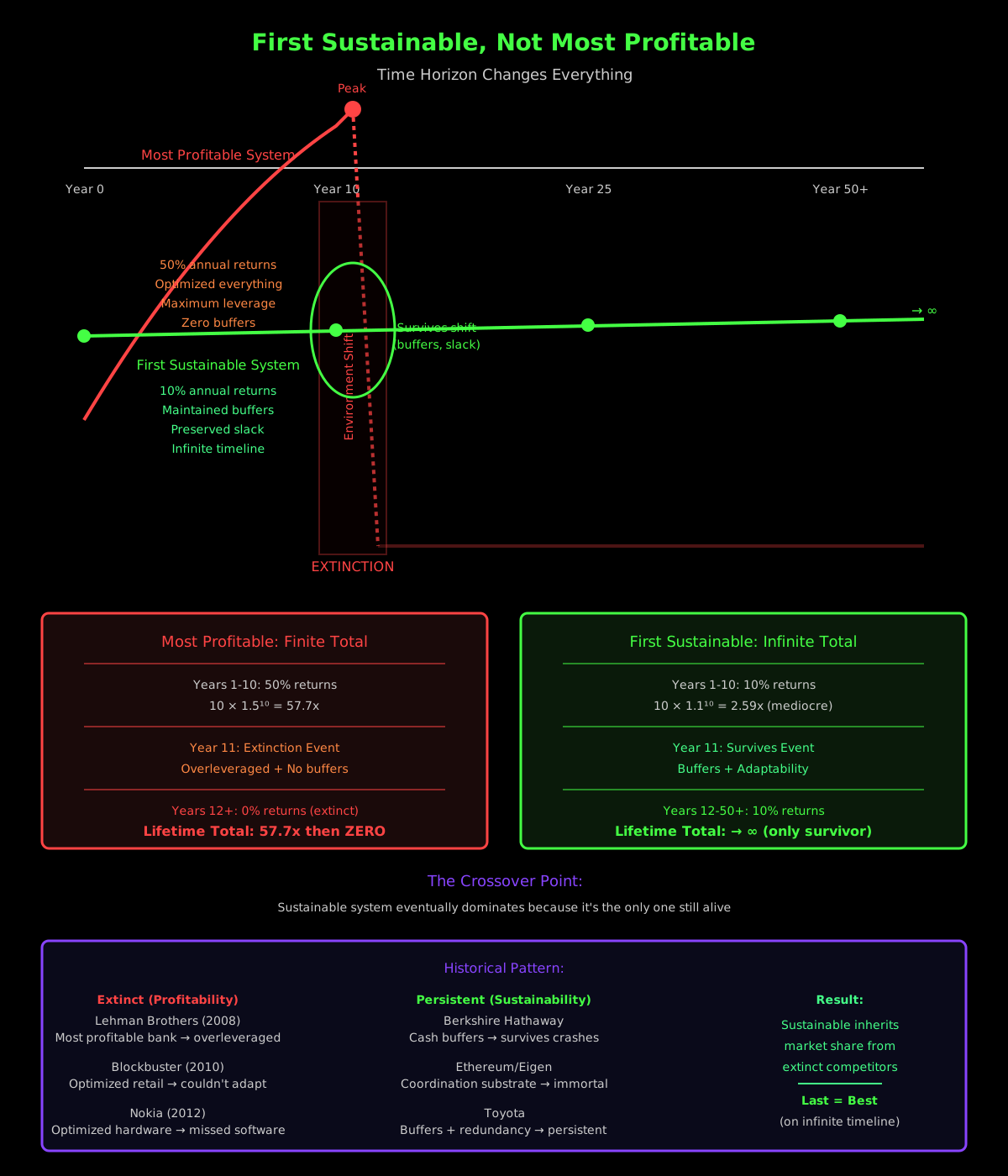
First Sustainable, Not Most Profitable
The rule of thumb: Stop trying to be the most profitable system. Start by being the first sustainable system.
Why this matters: Profitability optimization without sustainability constraint produces extinction. Sustainability first produces infinite timeline. On infinite timeline, even modest returns compound to dominance. The “most profitable” dies. The “first sustainable” inherits everything.
The error: Optimizing for wrong variable (profit) instead of right constraint (survival).
The Profitability Trap
Standard business logic: Maximize profit, optimize efficiency, extract maximum value.
What this produces:
- Cut costs to bone (eliminating resilience buffers)
- Leverage to maximum (eliminating shock absorption)
- Extract all value (eliminating reinvestment)
- Optimize every process (eliminating adaptability slack)
- Pressure every margin (eliminating error tolerance)
Result: Hyper-efficient system with zero sustainability. First shock kills it. First adaptation requirement breaks it. First unexpected cost bankrupts it.
Examples:
- Lehman Brothers: Most profitable investment bank (2007) → extinct (2008). Optimized for profit, eliminated capital buffers, first liquidity shock killed it.
- Blockbuster: Maximized profit per store (physical retail optimization) → extinct. Couldn’t adapt to streaming, optimized for wrong model.
- Kodak: Dominated film photography (profitability king) → extinct. Optimized film business, couldn’t transition to digital.
- Nokia: Most profitable phone maker (2007) → irrelevant (2012). Optimized hardware margins, missed software platform shift.
Pattern: “Most profitable” optimizes for current environment. When environment changes (always), optimization becomes liability. The more optimized for old environment, the less adaptable to new environment.
The mathematics: Profitability optimization produces local maximum (best in current fitness landscape). Sustainability produces persistence through landscape shifts (survive when fitness landscape changes). Local maximum optimization = death when landscape shifts.
The Sustainability Baseline
Different objective: Don’t maximize profit. Maximize survival probability over infinite time.
What this produces:
- Maintain buffers (costs money, increases survival)
- Preserve slack (inefficient, enables adaptation)
- Reinvest surplus (reduces profit, increases capability)
- Diversify revenue (dilutes focus, eliminates single point of failure)
- Under-leverage (leaves profit on table, eliminates fragility)
Result: “Inefficient” system with infinite sustainability. Survives shocks. Adapts to changes. Persists through disruptions.
Examples:
- Berkshire Hathaway: Not most profitable (holds massive cash buffers) → immortal. Survives crashes, buys assets during panics, compounds over 60+ years.
- Toyota: Not most profitable (maintains multiple suppliers, inventory buffers) → persistent. Survived 2011 earthquake/tsunami while others collapsed.
- Ethereum/Eigen: Not most profitable (coordination overhead, decentralization costs) → immortal. Living coordination substrate, infinite capacity, survives all environment shifts.
Pattern: “First sustainable” optimizes for environment-independence. When environment changes (always), sustainability is advantage. The less dependent on specific environment, the more resilient to environment shifts.
The mathematics: Sustainability optimization produces plateau in all fitness landscapes (adequate performance everywhere). Not optimal anywhere, but never extinct. Plateau beats peak when landscape shifts because peaks become valleys.
The Time Dimension
Why sustainability beats profitability: Compound interest over infinite time.
Scenario 1: Most Profitable (Unsustainable)
- Year 1-10: 50% annual returns (amazing!)
- Year 11: Extinction event (overleveraged, no buffers)
- Year 12+: 0% returns (extinct)
- Lifetime return: 10 years × 50% then zero = finite
Scenario 2: First Sustainable
- Year 1-10: 10% annual returns (mediocre)
- Year 11: Survives extinction event (buffers, adaptability)
- Year 12-100: 10% annual returns (persistent)
- Lifetime return: 100+ years × 10% = infinite (outlives all competitors)
The crossover point: Sustainable system with modest returns eventually dominates because it’s the only one still alive. All “most profitable” competitors extinct.
Formula:
Profitability optimization: max(profit) subject to time ∈ [0, extinction]
Sustainability optimization: min(extinction risk) subject to time → ∞

Profitability: High returns × finite time = finite total
Sustainability: Modest returns × infinite time = infinite total
Crypto example (from neg-325):
- Bitcoin: Optimized for mining profitability (PoW efficiency) → dying (death spiral, ceiling → spring collapse, cannot coordinate capacity)
- Ethereum/Eigen: Optimized for coordination sustainability (living substrate) → immortal (can coordinate, adapts, infinite capacity)
- Result: Bitcoin hits ceiling then collapses, Ethereum captures capacity and persists indefinitely
Why Profitability Optimizers Go Extinct
The feedback loop:
- Optimize for profit → Increase leverage, cut buffers, extract all value
- Short-term success → Profits rise, market share grows, metrics look great
- Competitors copy → Everyone optimizes for same metrics (herd behavior)
- System fragility → Entire sector has no buffers, no slack, no resilience
- External shock → Environment shifts (economic crisis, tech disruption, pandemic, regulation)
- Cascade failure → All optimized players fail simultaneously (2008 banks, 2020 retail, etc.)
- Extinction → “Most profitable” becomes most dead
The sustainable player:
- Optimize for survival → Maintain buffers, preserve slack, diversify
- Short-term underperformance → Profits lower, market share smaller, metrics look bad
- Competitors mock → “Too conservative,” “leaving money on table,” “inefficient”
- System resilience → Buffers, slack, diversification maintained
- External shock → Same environment shift
- Selective survival → Sustainable player survives, optimized players extinct
- Inheritance → Sustainable player acquires market share from corpses, becomes dominant
Historical examples:
- 2008 Financial Crisis: Conservative banks (boring, lower ROE) survived. Optimized banks (high leverage, structured products) extinct or bailed out.
- COVID-19: Companies with cash buffers survived lockdowns. Optimized companies (no slack, just-in-time everything) bankrupted.
- Bitcoin vs Ethereum (from neg-325): Bitcoin (optimized mining) hits ceiling → spring collapse. Ethereum (coordination substrate) captures capacity → immortal.
The Sustainability Checklist
How to be first sustainable instead of most profitable:
1. Capital Buffers
- Profitability: Maximize leverage (more debt = higher ROE)
- Sustainability: Maintain excess capital (survives revenue shocks)
- Trade-off: Lower ROE, higher survival probability
2. Operational Slack
- Profitability: Optimize every process (lean, just-in-time)
- Sustainability: Preserve redundancy (backup suppliers, inventory buffers)
- Trade-off: Higher costs, lower fragility
3. Revenue Diversification
- Profitability: Focus on highest-margin product (maximize efficiency)
- Sustainability: Multiple revenue streams (eliminates single point of failure)
- Trade-off: Diluted focus, eliminated extinction risk
4. Adaptability Investment
- Profitability: Cut R&D (costs money, uncertain returns)
- Sustainability: Invest in exploration (enables future adaptation)
- Trade-off: Lower current profit, higher future survival
5. Time Horizon
- Profitability: Quarterly earnings (optimize for short-term metrics)
- Sustainability: Infinite timeline (optimize for long-term existence)
- Trade-off: Lower stock price today, higher existence probability tomorrow
Connection to Previous Posts
neg-499: Capitalization retirement carries no additional risk.
Sustainability framing: Pay-as-you-go optimizes for current demographics (profitability = low friction). Capitalization optimizes for demographic-independence (sustainability = works regardless). When demographics shift, pay-as-you-go extinct, capitalization persists.
neg-498: Total freedom + infinite trajectory via ETH/Eigen.
ETH/Eigen are sustainability mechanisms: Decentralization (survives node failures), cryptographic proof (survives trust failures), infinite capacity (survives scaling demands). Not most efficient (high overhead), but most sustainable (infinite persistence).
neg-496: We are single organism with autonomous organs.
Organism sustainability: Organs diversify function (not all brain, not all hands). Redundancy costs energy (inefficient) but ensures survival (one organ fails, organism survives). Profitability = specialize all organs. Sustainability = diversify organs.
neg-492: Universal substrate enables coordination without control.
Substrate is sustainability layer: Universal (works in all environments), substrate-level (doesn’t depend on applications). Not most profitable (can’t extract rent), but most sustainable (applications can’t kill substrate).
The Policy Implication
For businesses: Stop optimizing quarterly earnings. Start optimizing century timeline. Would you rather be most profitable this decade or still exist next century?
For systems: Stop maximizing efficiency. Start maximizing resilience. Efficiency optimization produces fragility. Resilience optimization produces persistence.
For investments: Stop chasing highest returns. Start ensuring survival. The highest-return investment that goes to zero has lower returns than boring investment that persists forever.
For protocols: Stop competing on features. Start competing on immortality. The fanciest protocol that dies in 5 years loses to boring protocol that runs for 50 years.
Root vs White Culture
This is a fundamental Root vs White Culture difference:
White Culture (Profitability Optimization):
- Maximize extraction (profit is goal)
- Optimize current environment (local maximum)
- Leverage everything (efficiency king)
- Quarterly thinking (short-term metrics)
- Result: Extinction when environment shifts
Root Culture (Sustainability First):
- Ensure persistence (survival is goal)
- Adapt to all environments (global adequacy)
- Maintain buffers (resilience priority)
- Generational thinking (infinite timeline)
- Result: Inheritance when others extinct
Ethereum/Eigen’s choice: Ethereum is Root Culture protocol. Not most profitable (coordination overhead, PoS “less secure”). Most sustainable (living coordination substrate, adapts, infinite capacity). Bitcoin (optimized for PoW mining) dying. Ethereum persists.
The pattern: White Culture optimizes for dominance (maximum extraction). Root Culture optimizes for persistence (indefinite existence). Dominance is temporary (optimization for specific environment). Persistence is permanent (adequacy in all environments).
From neg-325: Bitcoin cannot self-coordinate (dead infrastructure), depends on Ethereum coordination to build capacity, but Ethereum’s superior use cases then capture that capacity → ceiling → spring collapse → terminal state. Ethereum = living coordination consciousness (lwa), Bitcoin = dead mechanism (zonbi).
The Practical Application
If you’re building something:
Wrong Question: “How do I make this most profitable?”
- Leads to: Leverage, optimization, extraction, fragility
- Result: High returns until extinction event
- Timeline: Finite (years to decades)
Right Question: “How do I make this immortal?”
- Leads to: Buffers, slack, diversification, resilience
- Result: Modest returns forever
- Timeline: Infinite (survives environment shifts)
The Test: “Would this survive if [revenue drops 50% / competitor emerges / regulation changes / technology shifts]?”
- If no → Too optimized, will go extinct
- If yes → Sustainable, will persist
- Optimization: Maximize yes answers, not maximize profit
The Core Insight
Profitability is local optimization. Sustainability is global optimization.
Local: Best in this environment (fitness landscape peak). Global: Adequate in all environments (fitness landscape plateau).
When environment is stable: Local optimization wins (higher profit, lower costs, maximum efficiency).
When environment shifts (always, eventually): Local optimization dies (peak becomes valley). Global optimization survives (plateau is plateau everywhere).
The timeline: Environment always shifts. Stable periods end. Disruptions come. Shocks happen. Therefore:
- Local optimization = guaranteed extinction (just a matter of time)
- Global optimization = indefinite persistence (survives all shifts)
The rule of thumb: Stop trying to be the most profitable system (local maximum, temporary dominance). Start by being the first sustainable system (global adequacy, permanent existence).
Why “first” sustainable: Because once you’re sustainable, time is on your side. Every year that passes, more “most profitable” competitors go extinct. Eventually you’re the last one standing. Not because you dominated. Because you persisted.
The formulation: “Stop trying to be the most profitable system, start by being the first sustainable system.”
Most profitable → optimized for current environment → extinct when environment shifts.
First sustainable → adequate in all environments → inherits everything when others extinct.
Sustainability is not about being best. It’s about being last. And on infinite timeline, last is best.
#Sustainability #Profitability #Resilience #TimeHorizon #Optimization #Survival #Persistence
Related: neg-499 (capitalization sustainability), neg-498 (ETH/Eigen resilience), neg-496 (organism diversification), neg-492 (substrate persistence)