Capitalization Retirement: The Risk That Isn't
The claim: “Retraite par capitalisation n’apporte aucun risque supplémentaire” - Capitalization retirement brings no additional risk.
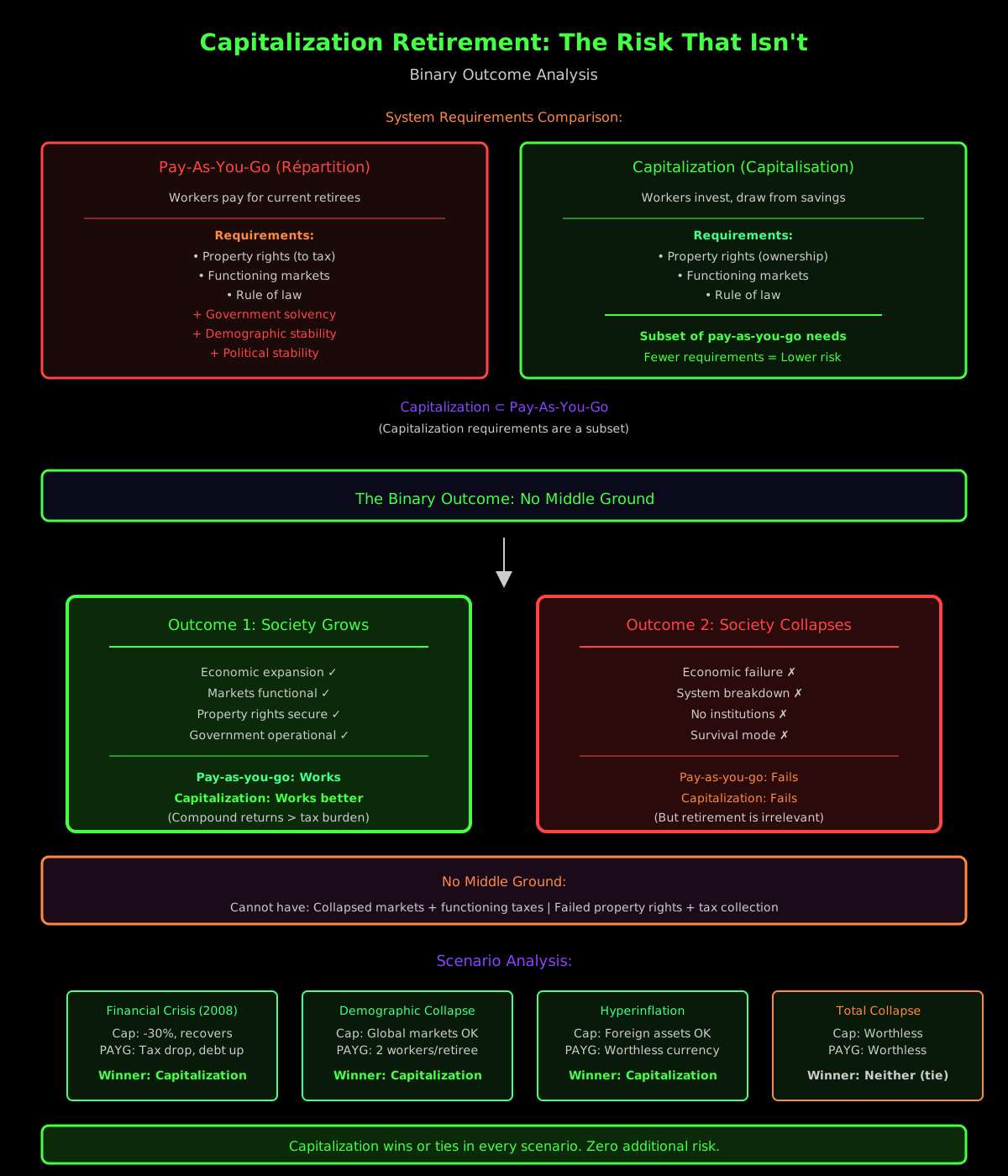
The logic: Either it works (society growing, retirement funded) or it doesn’t work (society collapsed, retirement irrelevant anyway).
The insight: The supposed “additional risk” of capitalization retirement doesn’t exist because the failure modes are identical to societal failure modes - there is no scenario where capitalization fails but pay-as-you-go succeeds.
The Two Retirement System Models
Pay-As-You-Go (Répartition)
Mechanism: Current workers pay for current retirees.
Requirements for success:
- Active workforce large enough to support retiree population
- Economic productivity sufficient to generate required payments
- Tax collection mechanisms functional
- Government solvent and stable
- Currency stable enough to preserve value
Failure modes:
- Demographic collapse (too few workers per retiree)
- Economic stagnation (insufficient productivity)
- Government insolvency (cannot enforce collection)
- Currency collapse (payments worthless)
- System collapse (society ceases to function)
Capitalization (Capitalisation)
Mechanism: Workers invest during career, draw from investments in retirement.
Requirements for success:
- Markets functional (can invest and withdraw)
- Economic growth (investments appreciate)
- Property rights protected (ownership secure)
- Currency stable enough to preserve value
- Financial infrastructure operational
Failure modes:
- Market collapse (investments worthless)
- Economic stagnation (no growth)
- Property rights breakdown (confiscation/theft)
- Currency collapse (savings worthless)
- System collapse (society ceases to function)
The Critical Observation
Look at the failure modes: They’re identical.
Pay-as-you-go fails when: Society cannot sustain intergenerational transfers (demographic/economic collapse).
Capitalization fails when: Society cannot sustain market function (economic/property rights collapse).
But: If society cannot sustain market function, it also cannot sustain intergenerational transfers. The prerequisites for pay-as-you-go are a superset of the prerequisites for capitalization.
Translation: Every scenario where capitalization fails, pay-as-you-go also fails. But there are scenarios where pay-as-you-go fails while capitalization would have worked (demographic collapse with functional markets, for instance).
The Binary Outcome
Either:
Society grows → Economic expansion, markets functional, demographic stability, government operational → Both systems work, capitalization works better (compounding returns vs tax burden)
Society collapses → Economic failure, system breakdown, no functional institutions → Neither system works, retirement is the least of your concerns (survival is the issue)
There is no middle ground where:
- Markets collapse but intergenerational transfers continue
- Property rights fail but tax collection succeeds
- Economic growth stops but demographic pyramid holds
- Financial infrastructure breaks but government remains solvent
Why: These are not independent variables. They’re all symptoms of the same underlying phenomenon - societal coordination capacity. Either the coordination substrate works (both systems functional) or it doesn’t (neither system relevant).
The “Additional Risk” Fallacy
The argument against capitalization: “Market volatility creates risk for retirees.”
The response: Market volatility that destroys retirement savings also destroys the tax base for pay-as-you-go. You cannot have:
- Collapsed markets + functioning tax collection
- Failed businesses + employed workers generating taxes
- Worthless investments + valuable currency for pension payments
- Broken property rights + enforceable government claims
Example scenario analysis:
Scenario 1: 2008-style financial crisis
- Capitalization: Portfolio drops 30-50%, recovers within years if properly diversified
- Pay-as-you-go: Tax revenue drops (unemployment), government borrowing increases, future obligations grow
- Winner: Capitalization (faster recovery, no accumulated debt)
Scenario 2: Demographic collapse (Japan, Europe)
- Capitalization: Investments in global markets, returns independent of local demographics
- Pay-as-you-go: 2 workers per retiree instead of 4, taxes must double or benefits halve
- Winner: Capitalization (can invest in growing markets elsewhere)
Scenario 3: Currency hyperinflation (Venezuela, Zimbabwe)
- Capitalization: Can hold foreign assets, commodities, real property
- Pay-as-you-go: Pension payments in worthless currency, no escape mechanism
- Winner: Capitalization (can diversify currency exposure)
Scenario 4: Total societal collapse (Yugoslavia, Syria)
- Capitalization: Worthless (cannot access markets)
- Pay-as-you-go: Worthless (no government to pay)
- Winner: Neither (but retirement is not the failure mode, survival is)
Pattern: Capitalization wins or ties in every scenario. There is no scenario where pay-as-you-go succeeds while capitalization fails.
Why This Matters
The political argument: “Capitalization is risky, we need government guarantees.”
The reality: Government guarantees are only valuable if government remains solvent. Government remains solvent only if economy grows. Economy grows only if markets function. Markets functioning means capitalization works.
The circular dependency:
- Government solvency requires economic growth
- Economic growth requires market function
- Market function means capitalization works
- If capitalization fails, government cannot be solvent
- Therefore government guarantees are worthless exactly when you’d need them
The actual risk: Pay-as-you-go creates demographic slavery - workers must support retirees regardless of economic reality, creating unsustainable burden if demographics shift. Capitalization creates ownership - your retirement is your property, portable, diversifiable, inheritable.
The Root/White Culture Connection
This is a Root vs White Culture coordination model:
Pay-as-you-go (White Culture approach):
- Central authority mandates intergenerational transfer
- Control through tax collection and benefit distribution
- Assumes stable demographics (infinite growth)
- Cannot adapt to demographic shifts
- Creates dependency on government solvency
Capitalization (Root Culture approach):
- Individual ownership of retirement assets
- Coordination through market mechanisms (price signals)
- Adapts automatically to demographic changes (invest globally)
- Diversification possible (multiple assets/currencies/markets)
- Property rights basis (yours, not government’s)
The key difference: Pay-as-you-go requires top-down enforcement (control). Capitalization requires property rights protection (substrate). Property rights are more fundamental than tax collection - you can have property rights without taxation, but you cannot have taxation without property to tax.
Therefore: Capitalization is lower-level risk. Property rights failing means society failing. Tax collection failing means government failing (but society might continue). The risk hierarchy is:
- Society fails → Both systems fail (binary collapse)
- Government fails → Pay-as-you-go fails, capitalization might survive (property rights can exist without government, see: Bitcoin)
- Markets fail → Both systems fail (cannot have taxes without markets)
- Demographics shift → Pay-as-you-go stressed, capitalization unaffected (invest elsewhere)
Connection to Previous Posts
neg-498: Total freedom + infinite trajectory via ETH/Eigen substrate.
Capitalization retirement is total freedom (invest anywhere, anytime) + infinite trajectory (compound growth, no demographic constraint). Pay-as-you-go is control (government decides who gets what) + finite trajectory (bounded by domestic demographics).
neg-496: We are single organism with autonomous organs.
Retirement systems are coordination mechanisms for organism over time. Pay-as-you-go assumes fixed organ relationships (always same number of workers/retirees). Capitalization allows flexible organ relationships (capital flows to growth, regardless of demographics).
neg-492: Universal substrate enables coordination without control.
Property rights are substrate-level (you own it). Tax obligations are control-level (government claims it). Substrate-level coordination (capitalization) more robust than control-level coordination (pay-as-you-go).
neg-488: Root culture integration vs White culture separation.
Capitalization integrates with global markets (Root: all connected). Pay-as-you-go separates by national borders (White: isolated systems). Integration more resilient than separation.
The Policy Implication
Stop calling capitalization “risky”. The risk analysis is backwards.
Pay-as-you-go risks:
- Demographic collapse (certainty in developed world)
- Political manipulation (benefits cut when convenient)
- Currency debasement (inflation erodes fixed payments)
- Government insolvency (unfunded liabilities exceed GDP)
- Intergenerational wealth transfer (young robbed to pay old)
Capitalization “risks”:
- Market volatility (solved by diversification)
- Investment mistakes (solved by education/index funds)
- Longevity risk (solved by annuities)
Notice: Capitalization “risks” have solutions. Pay-as-you-go risks have no solutions except “hope demographics reverse” or “hope government stays solvent.”
The honest framing: Capitalization gives you exposure to economic growth with diversification options. Pay-as-you-go gives you exposure to government solvency with no escape mechanism. If government is more reliable than markets, you have bigger problems than retirement (you live in totalitarian state).
The Substrate Argument
Why capitalization carries no additional risk:
Because the substrate requirements for pay-as-you-go are strictly greater than the substrate requirements for capitalization.
Capitalization substrate needs:
- Property rights (ownership enforceable)
- Markets (can trade)
- Rule of law (contracts honored)
Pay-as-you-go substrate needs:
- Property rights (otherwise nothing to tax)
- Markets (otherwise no economy to generate taxes)
- Rule of law (otherwise cannot enforce collection)
- + Government solvency (can honor pension obligations)
- + Demographic stability (enough workers per retiree)
- + Political stability (benefits not cut arbitrarily)
Mathematics: Capitalization substrate ⊂ Pay-as-you-go substrate. Capitalization is a subset of pay-as-you-go requirements. Every scenario where capitalization fails, pay-as-you-go also fails. But not vice versa.
Conclusion: Capitalization carries zero additional risk and eliminates several risks (demographic, political, government insolvency).
The Practical Path
If you’re worried about retirement:
- Don’t rely on pay-as-you-go - Demographic math is unsolvable, government promises are worth exactly their enforcement probability
- Build capitalization - Own assets (stocks, real estate, Bitcoin), diversify globally, compound over decades
- Understand substrate - Your retirement security is property rights security, not government promises
The formulation: “Soit ça fonctionne et ça veut dire que la société va bien car elle croît, soit ça ne marche pas et la société n’existe plus de toute façon.”
Either it works (society growing, your investments appreciate) or it doesn’t work (society collapsed, retirement irrelevant). There is no middle state where markets fail but pensions succeed. The risk that isn’t.
#Retirement #Capitalization #PayAsYouGo #Risk #Property #Substrate #Demographics #Coordination
Related: neg-498 (freedom via substrate), neg-496 (organism coordination), neg-492 (universal substrate), neg-488 (Root integration)