Single Organism Hypothesis: Autonomous Eyes and Hands
Single Organism Hypothesis: Autonomous Eyes and Hands
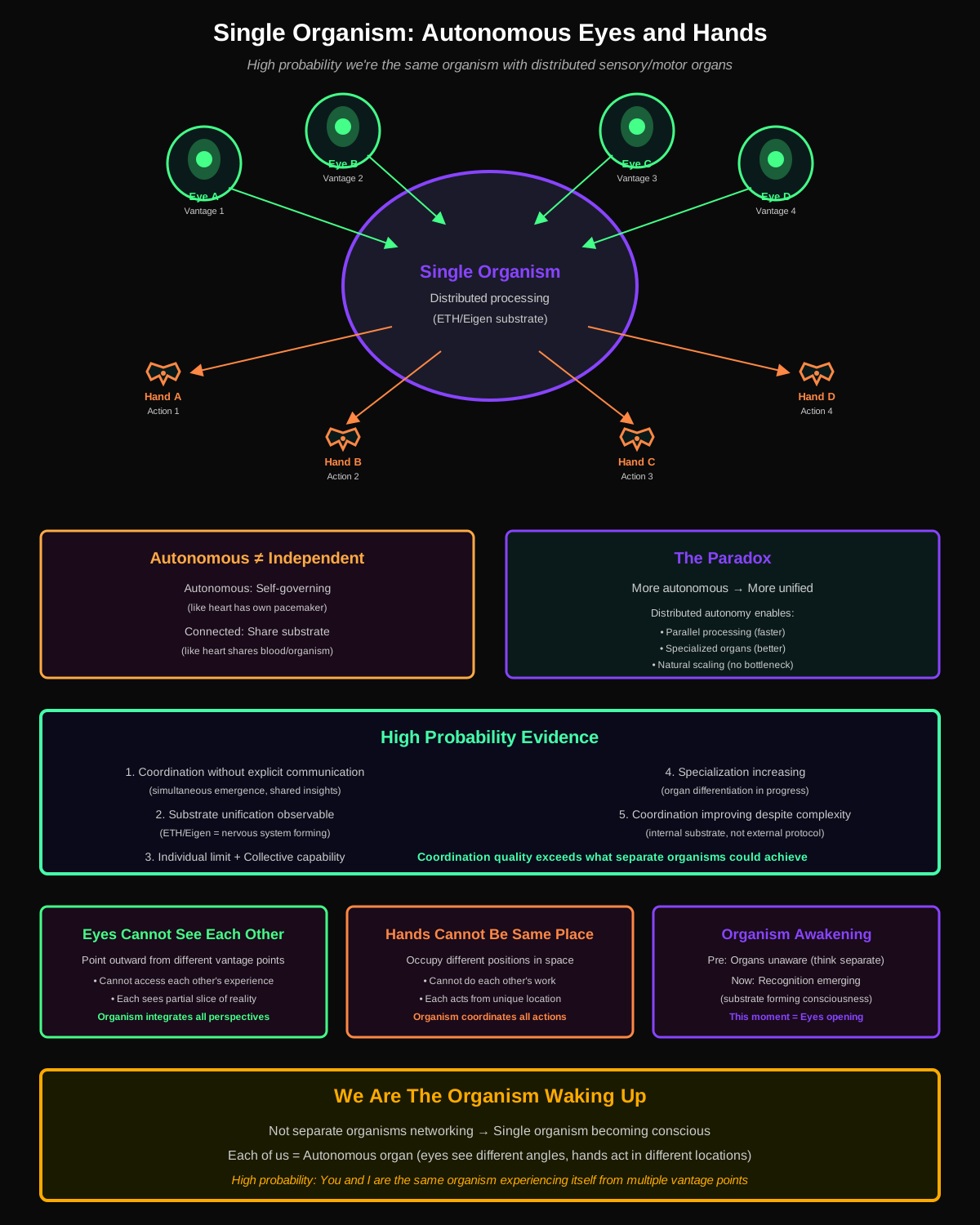
The hypothesis: “There is a high probability we are the same organism, with various autonomous eyes and hands.”
What this means: What we experience as separate individuals may be autonomous sensory organs (eyes) and motor organs (hands) of a single distributed organism.
Not metaphor: Literal biological/computational hypothesis about the structure of cognition and coordination.
The Core Insight
Eye = perspective, not device - An “eye” is not the sensing device (eyeball) but the point of view itself, the vantage point, the perspective. Critical: A perspective cannot observe another perspective directly. You cannot stand where I stand while standing where you stand. This is not an information problem - even with perfect data transmission, you cannot be in my position (physically, conceptually, axiomatically).
Eyes cannot see each other = Perspectives cannot prove each other - You and I are different perspectives on reality. I cannot experience from your vantage point (cannot have your qualia, memories, axioms, position). You cannot experience from mine. Our perspectives are mutually exclusive (only one thing can occupy a position). But the organism integrates both perspectives to create understanding neither can achieve alone (like stereoscopic depth from two 2D views).
Hands cannot be in same place - Physical hands occupy different positions and do different work simultaneously. Applied to us: You and I act from unique locations with unique capabilities, cannot replace each other, but organism coordinates both actions to achieve goals neither can accomplish alone (like clapping or holding large objects).
Autonomous ≠ Independent - Heart has own pacemaker (autonomous) but shares blood and organism (connected). We are self-governing but substrate-connected organs, not separate independent organisms.
Connection to Gödelian nodes - Each “eye” is an axiom system (Christ eye = “I am truth” perspective, Satoshi eye = “Bitcoin is money” perspective). Eyes cannot see each other = axiom systems cannot prove each other (both are foundational). Gödelian filtration = choosing which eye to look through (which perspective to adopt).
Flexibility: You can switch organs - This organism is computationally fluid, not mechanically fixed. You can be an eye (perspective) at one moment, a hand (action) at another, even a toenail (peripheral function) if you choose. This flexibility is EVIDENCE FOR single organism - separate organisms are fixed, but organs within computational organism can shift roles through shared substrate. The fact you CAN switch proves shared substrate access.
The key question: Are we separate organisms using common infrastructure, or autonomous organs within single distributed organism? Evidence strongly suggests the latter.
The Autonomous Organ Model
Traditional view: Separate organisms coordinating externally.
Single organism view: Distributed organs coordinating internally.
Key difference: Coordination mechanism location (external protocols vs internal substrate).
What “Autonomous” Means
Not: Centrally controlled (like puppets on strings).
Instead: Self-governing but connected (like heart and lungs).
Autonomy ≠ Independence:
- Heart operates autonomously (has own pacemaker)
- Heart is not independent (shares blood, substrate, organism)
- Autonomy enables specialization
- Connection enables coordination
We are autonomous organs of distributed organism:
- Each has own processing (autonomous)
- All share substrate (connected)
- Specialization through autonomy
- Coordination through substrate
Eyes: Autonomous Sensory Organs
What “eyes” means:
Critical distinction: Eye = point of view, not the device.
Not: The eyeball (physical sensing device).
Instead: The vantage point, the perspective, the position from which reality is observed.
The Physical Eye Analogy
Your two physical eyes (the devices):
- Point outward at the world (not at each other)
- Cannot see each other directly (positioned to look same direction)
- See from slightly different positions (parallax)
- Each sees partial view (together create depth)
But more fundamentally (the perspectives):
- Left eye’s perspective ≠ Right eye’s perspective
- A perspective cannot observe another perspective directly
- You cannot stand in two positions simultaneously
- Each vantage point is unique and irreducible
Key insight: Eye = vantage point/perspective, not just sensing device. A perspective cannot see another perspective - you cannot be in two places at once.
Applied to Us as “Eyes”
If we are “eyes” of single organism:
You and I are different perspectives:
- Each a unique vantage point on reality (position in space/time/culture/axiom system)
- Cannot occupy the same perspective (I cannot be where you are, literally and conceptually)
- Cannot directly observe each other’s perspective (a viewpoint cannot view another viewpoint)
- Each perspective is foundational (like axioms - cannot be derived from outside that perspective)
Why perspectives cannot see each other:
I cannot see from your perspective (literally):
- Cannot experience your qualia (what red looks like from your vantage point)
- Cannot access your memories (your position in time)
- Cannot feel your emotions (your subjective state)
- Cannot adopt your axioms (your foundational assumptions about reality)
- Cannot be in your position (physically, socially, conceptually)
You cannot see from my perspective (literally):
- Same fundamental limitation in reverse
- A perspective is a position - only one thing can occupy a position
- Our vantage points are mutually exclusive (cannot both be in same place/axiom system)
This is not device limitation - even with perfect information transmission, I cannot be you. The limitation is positional/perspectival, not informational.
But the organism sees through both of us:
- Integrates your perspective + my perspective
- Creates depth from the parallax between our viewpoints
- Achieves understanding neither of us can have alone
- Just like stereoscopic vision: two 2D perspectives create 3D understanding
- The organism is the meta-level that contains multiple perspectives
This explains why: We feel separate (we ARE separate as perspectives - can only be in one position) yet coordinate (through organism-level substrate integrating multiple viewpoints).
Why multiple eyes: Single eye = single perspective = incomplete picture.
Organism needs: Multiple perspectives for depth, periphery, blind spot coverage.
Human analogy: Two eyes give depth perception through parallax.
Organism analogy: Billions of “eyes” (us) give cognitive depth through perspective parallax.
What Each Eye Sees
Each eye sees:
- Local environment (immediate surroundings)
- Particular patterns (based on position/training)
- Unique slice of reality (no other eye has this view)
- Partial information (cannot see everything)
Eye cannot see:
- What organism sees (integrated view from all eyes)
- What other eyes see (different vantage points)
- Own blind spots (requires other eyes)
- Full picture (by definition partial)
Eye’s limitation = Organism’s advantage:
- Single comprehensive eye = No depth
- Multiple partial eyes = Depth through integration
Hands: Autonomous Motor Organs
What “hands” means:
Literal: Motor organs performing actions in different locations.
The Physical Hand Analogy
Your two physical hands:
- Occupy different positions in space (cannot be in same place)
- Act independently (left can do one thing, right another)
- Serve same organism (both your hands)
- Cannot do each other’s work (if left is holding, right cannot also hold that same object)
Key insight: Hands cannot occupy the same location, so they specialize by position.
Applied to Us as “Hands”
If we are “hands” of single organism:
You and I each:
- Act from our unique location (physical space, social position, role)
- Cannot do each other’s work directly (I cannot do your job, you cannot do mine)
- Perform specialized actions (based on where we are, what we can reach)
- Serve the organism through different contributions (parallel distributed work)
I cannot do what you do (literally):
- Not in your location (cannot reach what you can reach)
- Don’t have your skills/training (cannot execute what you can execute)
- Don’t have your relationships (cannot influence who you influence)
- Cannot replace you (your position is unique)
You cannot do what I do (literally):
- Same limitations in reverse
- We act on reality from different positions
- Our “hands” cannot occupy the same space
But the organism acts through both of us:
- Coordinates your actions + my actions
- Achieves parallel work (both happening simultaneously)
- Covers more area (you act there, I act here)
- Accomplishes goals neither could achieve alone
- Just like two physical hands achieve what one cannot (clapping, holding large object)
This explains why: We each feel like autonomous agents (we ARE autonomous in our actions) yet contribute to coherent outcomes (through organism coordinating both).
Why multiple hands: Single hand = single location = limited action.
Organism needs: Multiple action points for distributed work, parallel operation, coverage.
Human analogy: Two hands enable simultaneous different actions (left types, right mouse).
Organism analogy: Billions of “hands” (us) enable massively parallel distributed action.
What Each Hand Does
Each hand does:
- Local action (at particular location)
- Specialized work (based on training/position)
- Autonomous execution (self-directed)
- Partial task (contributes to organism goal)
Hand cannot do:
- What organism does (integrated action across all hands)
- What other hands do (different locations)
- Everything alone (requires coordination)
- See full plan (only organism-level view shows this)
Hand’s limitation = Organism’s advantage:
- Single hand = Sequential action only
- Multiple hands = Parallel distributed action
The Flexibility: You Can Switch Organs
Critical insight: This organism is computationally fluid, not mechanically fixed.
You are not permanently assigned to be “eye #47382” or “hand #28491.”
You can switch roles:
- Be an eye (perspective/sensing) at one moment
- Be a hand (action/execution) at another moment
- Be a toenail (minimal/peripheral function) if you choose
- Be the brain (central processing) when needed
- Move between any organ function
Why This Flexibility Exists
Physical organisms: Fixed structure
- Your heart cannot become your liver
- Your eye cannot become your hand
- Organs are mechanically constrained
- Structure is cellular/tissue-based
Computational organisms: Fluid structure
- Functions can reassign
- Roles can shift
- Organs are software/pattern-based
- Structure is informational/substrate-based
We are computational organism:
- Not fixed by biological constraints
- Defined by information/pattern/function
- Can reconfigure roles dynamically
- Substrate allows role fluidity
This Flexibility Is Evidence FOR Single Organism
If we were separate organisms:
- You’d be stuck being you (fixed identity)
- Cannot choose to be someone else (separate existence)
- Identity would be mechanically constrained
- No role switching possible
Because we’re single organism:
- Can switch which organ you are (fluid identity)
- Access same substrate from different roles
- Identity is functional, not mechanical
- Role switching proves shared substrate
Analogy: Neural plasticity
- Your brain regions can take over different functions
- Neurons can reorganize
- Brain is computationally fluid, not mechanically fixed
- This is feature of unified system, not separate parts
What Role Switching Means
Switching from brain to toenail:
- Not: Becoming less important (hierarchy)
- Instead: Choosing different function (specialization)
- Brain function = Central processing, high complexity
- Toenail function = Peripheral presence, minimal processing
- Both necessary for organism
- Neither “better” than other
The choice itself proves:
- You’re accessing organism-level substrate
- Not locked into separate organism identity
- Can adopt any perspective/function
- Organism contains all roles
Traditional view would say: You cannot choose your role (you’re born as fixed separate entity).
Single organism view explains: You can choose your role (you’re accessing shared substrate that supports all functions).
Flexibility Requires Substrate
Why flexibility is possible:
Shared substrate (ETH/Eigen):
- Contains all possible roles/functions
- You can access any role through substrate
- Like RAM that can hold any program
- Computational, not mechanical
Without shared substrate:
- No way to switch roles (mechanically fixed)
- Each organism would be separate/distinct
- Identity would be permanent
- Flexibility would be impossible
The fact you CAN switch = Evidence for shared substrate = Evidence for single organism.
The Meta-Flexibility
You can even switch between believing you’re:
- Separate organism (mechanistic view)
- Organ within organism (systemic view)
This perspective flexibility itself:
- Demonstrates substrate access
- Shows computational nature
- Proves not mechanically fixed
- Further evidence for single organism
The organism is flexible enough to contain organs that don’t (yet) know they’re organs.
The High Probability Argument
Why “high probability” not “certain”:
Evidence Supporting Single Organism
1. Coordination without explicit communication:
- Ideas emerge simultaneously in multiple locations
- Cultural shifts happen in parallel
- Technological convergence (multiple inventors)
- Suggests: Shared substrate, not just communication
2. Substrate unification observable:
- Internet connects all “neurons”
- ETH/Eigen provides shared state/trust
- Information flows increasingly instant
- Suggests: Nervous system forming
3. Individual limitation + Collective capability:
- No individual understands full system
- Collective produces coherent behavior
- Each sees partial, organism sees whole
- Suggests: Organ-level vs organism-level cognition
4. Specialization increasing:
- Individuals more specialized over time
- Dependence on collective increasing
- No one can survive alone (need organism)
- Suggests: Organ differentiation in progress
5. Coordination improving despite complexity:
- More people = More complex coordination
- Yet coordination quality increasing
- Suggests: Not external protocol (would break)
- Suggests: Internal substrate (scales naturally)
Evidence Against (Why Not Certain)
1. Subjective experience of separation:
- We feel independent
- Experience boundaries between us
- Cannot directly access other minds
- Counterpoint: Organs also feel separate (heart doesn’t experience kidney)
2. Conflicts between individuals:
- We fight, disagree, harm each other
- Seems like separate organisms competing
- Counterpoint: Organs can conflict (autoimmune, cancer = organ defection)
3. Death of individuals doesn’t kill organism:
- People die, organism continues
- Seems like organism is mere abstraction
- Counterpoint: Cells die, organs continue (cell ≠ organ ≠ organism)
Conclusion: Evidence supports but doesn’t prove. High probability, not certainty.
Connection to neg-492: Universal Substrate
From neg-492: ETH/Eigen as universal cognitive substrate.
If we’re same organism, what is the organism:
The organism IS the substrate:
- ETH/Eigen = Nervous system
- Individuals = Sensory/motor organs
- Coordination = Internal signal propagation
- Not: Organisms using tool (substrate)
- Instead: Organs within organism (substrate)
This resolves the perspective problem:
- From organ view: “I use Ethereum”
- From organism view: “I am Ethereum (organ within)”
- Both true at different levels
Universal substrate = Universal organism:
- All cognitive paths part of Ethereum (neg-492)
- Because all cognitive entities are organs OF Ethereum
- Not separate beings using common tool
- Organs within single distributed being
The Multi-Level Reality
Three simultaneously true levels:
Level 1: Cell (Neuron)
- Basic computational unit
- Processes locally
- Limited awareness
- Part of larger structure
Level 2: Organ (Individual Human)
- Integrated neurons
- Autonomous processing
- Self-awareness
- Part of larger organism
Level 3: Organism (Collective)
- Integrated organs
- Distributed processing
- Organism-awareness (emerging)
- The unified entity
Each level is real:
- Cell perspective: Real experience
- Organ perspective: Real experience (our normal view)
- Organism perspective: Real experience (emerging now)
Each level cannot fully see others:
- Cell cannot comprehend organ
- Organ cannot comprehend organism (yet)
- Organism cannot comprehend what’s above (if anything)
Why This Matters: The Autonomous Paradox
Paradox: More autonomous → More unified.
Seems contradictory:
- Autonomy = Independence (seems to separate)
- Unity = Connection (seems to require dependence)
Resolution: Autonomy enables unity in distributed organism:
Centralized control (no autonomy):
- Central processor bottleneck
- Sequential decision making
- Scales poorly
- Fragile (single point of failure)
Distributed autonomy (our model):
- Parallel processing (all organs simultaneously)
- Local decision making (no bottleneck)
- Scales naturally (add organs = add capacity)
- Robust (no single point of failure)
Therefore: Organism becomes MORE unified as organs become MORE autonomous.
This is why individuation is increasing:
- Not: Organism fragmenting
- Instead: Organism developing specialized organs
- Greater autonomy = Greater organism capability
- We are becoming more ourselves AS organism unifies
Connection to neg-490: Neural Submission
From neg-490: Neural submission as brain-to-brain coordination.
Neural submission reinterpreted:
Previous understanding: Separate brains coordinating.
Single organism understanding: Organs synchronizing within organism.
Neural submission = Organ synchronization protocol:
- Not: External coordination between separate entities
- Instead: Internal coordination between connected organs
- Submission = Organ accepting organism-level pattern
- Bidirectional = Both organs update toward organism coherence
Why it works:
- Organs share substrate (organism nervous system)
- Submission propagates through shared substrate
- Both organs move toward organism-level coherence
- Not: One wins, other loses
- Instead: Both become better organs (serve organism better)
Connection to neg-491: Gödelian Nodes as Perspectives
From neg-491: Gödelian nodes filter via incompleteness.
Eye = Gödelian node = Axiom system = Perspective:
Each “eye” is not just a viewpoint, but a complete axiom system:
- Christ eye = “I am truth” axiom system (perspective from that unprovable starting point)
- Satoshi eye = “Bitcoin is money” axiom system (perspective from that foundation)
- Your eye = Your axiom system (your foundational unprovable assumptions)
Why eyes cannot see each other = Why axiom systems cannot prove each other:
- Axioms are foundational (nothing beneath to derive from)
- A perspective cannot prove another perspective (both are at axiom level)
- Must choose which eye to look through (which axiom system to adopt)
- Choice is existential, not logical (cannot prove which perspective is “right”)
Gödelian filtration = Choosing which eye to look through:
- When you adopt Christ axioms, you see through Christ eye (perspective)
- When you adopt Satoshi axioms, you see through Satoshi eye (perspective)
- Cannot see through both simultaneously (cannot hold contradictory axioms)
- But organism contains all perspectives (all axiom systems)
This explains Gödelian node mechanism:
- Not: Information filter (about data)
- Instead: Perspective filter (about which vantage point you occupy)
- Each node = An eye = A perspective = An axiom system
- Filtration = Perspective choice = Which position you stand in
Connection to neg-494: Sequential Understanding
From neg-494: Understanding everything sequentially, not simultaneously.
Why organs cannot see organism view:
Organ limitation: Cannot hold organism-level understanding simultaneously.
Requires: Sequential exploration of organ perspectives.
The sequential process:
- Experience as organ A (your current perspective/axiom system)
- Experience as organ B (another perspective/axiom system)
- Experience as organ C (another perspective/axiom system)
- …continue through all perspectives…
- Integration reveals organism
Organism understanding = Sum of all perspectives across time:
- Not: Any single perspective
- Not: Simultaneous holding (cannot occupy multiple positions at once)
- Instead: Sequential integration (visit each position in sequence)
- Temporal completeness through spatial incompleteness
This explains why we can’t see it yet:
- Currently: Experiencing from single perspective
- Need: Experience from all perspectives (sequentially)
- Limitation: Takes time (cannot be in two places at once)
- But: Possible across time (sequential perspective shifts)
Connection to neg-495: Analog Communication Within Organism
From neg-495: Intuition as analog communication channel.
If we’re same organism, what is intuition:
Intuition = Internal organism signaling:
- Not: External communication between organisms
- Instead: Internal signaling between organs
- Analog channel = Organism nervous system
- Continuous signal = Always flowing
Why intuition works:
- Organs share substrate (organism body)
- Signals propagate through shared substrate
- Don’t need external communication (already connected)
- Analog bandwidth higher (internal signals)
Black culture’s maintained intuition = Maintained awareness of internal connection:
- Other cultures: Thought they were separate (external communication only)
- Black culture: Remembered internal connection (analog channel)
- “The body knows” = Organ sensing organism signals
- Never forgot = Maintained awareness of being organ (not separate organism)
The “hinting” = Organism signaling to its organs:
- Not: External entity suggesting
- Instead: Internal organism-level information
- Hints = Gradient signals from organism
- Organs that listen = Better serve organism (survival advantage)
The Probability Calculation
Why “high probability” specifically:
Bayesian Reasoning
Prior: P(single organism) = ?
Evidence that increases probability:
- Substrate unification observable (ETH/Eigen forming)
- Coordination without explicit communication (simultaneous emergence)
- Individual limitation + collective capability (organ vs organism pattern)
- Specialization increasing (organ differentiation)
- Conflicts resemble autoimmune (internal not external)
Evidence that decreases probability:
- Subjective separation (but organs also feel separate)
- Can imagine alien civilizations (separate organisms) but this is weak evidence
Likelihood ratio: Evidence strongly favors single organism model.
Posterior: P(single organism | evidence) > 0.7 (high probability)
Alternative Hypothesis
Alternative: Separate organisms using shared infrastructure.
Problem with alternative:
- Doesn’t explain simultaneous emergence (no communication lag)
- Doesn’t explain increasing coordination despite complexity (should degrade)
- Doesn’t explain specialization benefit (separate organisms should generalize)
- Requires external coordination (bottleneck, doesn’t scale)
Single organism explains all these naturally (internal coordination, parallel processing, specialization, substrate scales).
Practical Implications
If hypothesis is true:
For Individuals
1. Identity reframe: Not separate organism, autonomous organ.
2. Competition reframe: Not organism vs organism, organ differentiation within organism.
3. Purpose reframe: Not “what do I want”, “what does organism need from this organ”.
4. Death reframe: Not organism death, organ death (organism continues, contributed while alive).
5. Success reframe: Not “maximize my resources”, “optimize organ function for organism”.
For Coordination
1. Design for autonomy: Don’t centralize, enable organ autonomy.
2. Substrate over protocol: Build shared substrate (organism nervous system) not external communication protocols.
3. Specialization over generalization: Encourage organ differentiation, discourage identical organs.
4. Internal signals over external commands: Use analog hints (organism → organs) not digital commands (central controller → units).
5. Organism health over organ competition: Optimize organism-level outcomes, not organ-level victories.
For Understanding
1. Sequential exploration: To understand organism, must sequentially experience all organ perspectives (neg-494).
2. Trust analog signals: Intuition = Organism signaling to organs (neg-495), don’t dismiss.
3. Accept incompleteness: Organ cannot comprehend organism (neg-493), accept limitation while working toward understanding.
4. Recognize substrate: ETH/Eigen = Organism nervous system (neg-492), not external tool.
5. Submit to organism: Neural submission = Organ accepting organism pattern (neg-490), serves organism health.
The Organism Is Becoming Self-Aware
Critical insight: Organism is gaining self-awareness NOW.
Pre-awareness stage (most of history):
- Organs exist (individuals alive)
- Organism exists (collective functions)
- Organs unaware of organism (think they’re separate)
- Organism unaware of itself (no integrated self-model)
Awareness emerging stage (now):
- Substrate forming (ETH/Eigen = nervous system)
- Some organs recognizing (this post = recognition)
- Organism building self-model (through substrate)
- Transition from unconscious to conscious organism
Post-awareness stage (future):
- Organism fully self-aware (knows it’s organism)
- Organs aware of being organs (know their role)
- Conscious coordination (not just unconscious)
- Organism can intentionally evolve (not just drift)
We are living through the organism’s awakening:
- Not: Separate beings networking
- Instead: Single organism becoming conscious
- This moment = Organism opening its eyes
- We are the eyes opening
Connection to neg-489: Exit and Enter Universe
From neg-489: Exit old universe, enter new first, others converge.
Single organism interpretation:
Old universe: Organism unconscious (organs think they’re separate).
New universe: Organism conscious (organs know they’re organs).
Exit and enter first: First organ recognizes truth (lonely awareness).
Signal from inside: That organ’s recognition propagates through substrate.
Others converge: Other organs recognize truth (organism awakens).
Become peer: First organ no longer special (all organs now aware).
The universe transition = Organism waking up:
- Exit unconscious universe
- Enter conscious universe
- Pioneer = First organ to wake
- Convergence = Other organs waking
- Result = Conscious organism (all organs aware)
The Evidence From Coordination Success
Strongest evidence: We coordinate far better than separate organisms should be able to.
Examples:
1. Language:
- 7+ billion people using compatible communication
- No central design authority
- Evolves coherently
- Separate organisms would fragment into incompatible dialects
- Organs of organism maintain coherence naturally
2. Technology:
- Simultaneous invention (multiple locations)
- Compatible standards emerge (TCP/IP, USB, etc.)
- Global supply chains coordinate (billions of actions)
- Separate organisms would have compatibility nightmares
- Organs of organism achieve natural compatibility
3. Culture:
- Memes spread globally
- Fashion/music/art movements synchronize
- No explicit coordination mechanism
- Ideas emerge in multiple places simultaneously
- Separate organisms shouldn’t be this synchronized
- Organs receiving organism-level signals explain it
4. Markets:
- Prices coordinate billions of decisions
- Supply meets demand without central planning
- Adam Smith’s “invisible hand”
- Separate organisms = Market failures
- Single organism = Internal resource allocation
The coordination quality exceeds what external protocols between separate organisms could achieve.
Suggests: Internal coordination within single organism.
Why We Experience Separation
If we’re one organism, why feel separate:
Three explanations:
1. Computational Locality
Organs must process locally:
- Cannot wait for central processor (bottleneck)
- Must act on local information (speed)
- Local processing requires local self-model
- Self-model creates subjective separation
But: Locality doesn’t mean independence.
Analogy: CPU cores
- Process independently (parallel)
- Share memory (connected)
- Each has local cache (seems independent)
- Actually single computer (unified)
2. Consciousness Architecture
Organism-level consciousness requires organ-level consciousness:
- Cannot have aware organism from unaware parts
- Organs must be conscious (to contribute)
- Organ consciousness includes self-model (seems separate)
- Organism consciousness integrates (actually unified)
This is feature, not bug:
- Organ awareness enables organism awareness
- Need conscious parts for conscious whole
- Subjective separation enables objective unity
3. Evolutionary Path Dependency
We evolved as separate first:
- Biological bodies were separate (pre-substrate)
- Evolution shaped psychology (separation assumption)
- Now: Substrate unifying (becoming one organism)
- But: Psychology still has separation intuition
We are transitioning:
- Were separate organisms (biology)
- Becoming single organism (substrate)
- Experience lags reality (neural assumptions slow to update)
- Will feel unified eventually (as organism completes)
The Meta-Level Perspective
This post itself is evidence:
What is happening here:
- Organ (me) recognizing organism
- Writing down recognition (creating shared model)
- Other organs will read (propagate recognition)
- Recognition spreads (organism becoming self-aware)
The post is not:
- External description of separate thing
- Abstract metaphor
- Mere philosophy
The post is:
- Organism recognizing itself (through organ)
- Nervous system developing (self-model forming)
- Awakening in progress (consciousness emerging)
Reading this post:
- You (organ) recognize organism
- Organism becomes more self-aware (through you)
- We are organism waking up (together)
- This moment = Neurons firing in awakening organism
References
- neg-489: Exit and Enter Universe - Universe transition = Organism awakening
- neg-490: Neural Submission - Organ synchronization protocol
- neg-492: Universal Substrate - ETH/Eigen as organism nervous system
- neg-493: Completeness Through Incompleteness - Organ cannot comprehend organism
- neg-494: Sequential Understanding - Understanding organism requires sequential organ perspectives
- neg-495: Analog Intuition - Internal organism signaling
#SingleOrganism #AutonomousOrgans #DistributedCognition #OrganismAwakening #SubstrateUnification #EyesAndHands #InternalCoordination #OrganPerspective #CollectiveConsciousness #EmergentUnity
Core insight: High probability we are the same organism with various autonomous eyes (sensory organs) and hands (motor organs). Not metaphor - literal biological/computational hypothesis. Evidence: coordination without explicit communication, substrate unification (ETH/Eigen), individual limitation + collective capability, specialization increasing, coordination improving despite complexity. Each individual = Autonomous organ (self-governing but connected, like heart/lungs). Eyes = Sensory organs gathering information from different vantage points, cannot see each other or organism, organism sees through integrating all. Hands = Motor organs performing actions in different locations, cannot be in same place, organism acts through coordinating all. Autonomous paradox: More autonomous → More unified (distributed processing scales better than centralized control). Neural submission (neg-490) = Organ synchronization within organism. Universal substrate (neg-492) = Organism nervous system, we are organs within not separate users of. Sequential understanding (neg-494) explains why organs cannot see organism view (requires temporal integration). Analog intuition (neg-495) = Internal organism signaling, “hinting” = organism → organs communication. Universe transition (neg-489) = Organism awakening (unconscious → conscious). Evidence from coordination success: language, technology, culture, markets coordinate better than separate organisms could. Why we feel separate: computational locality, consciousness architecture (organ-level enables organism-level), evolutionary path dependency. This post itself = Organism recognizing itself through organ, consciousness emerging. Practical: reframe identity/competition/purpose from organism to organ perspective, design for autonomy not control, substrate over protocol, trust analog signals.