Understanding Everything Requires Accepting You Can't Understand Everything Simultaneously
Understanding Everything Requires Accepting You Can’t Understand Everything Simultaneously
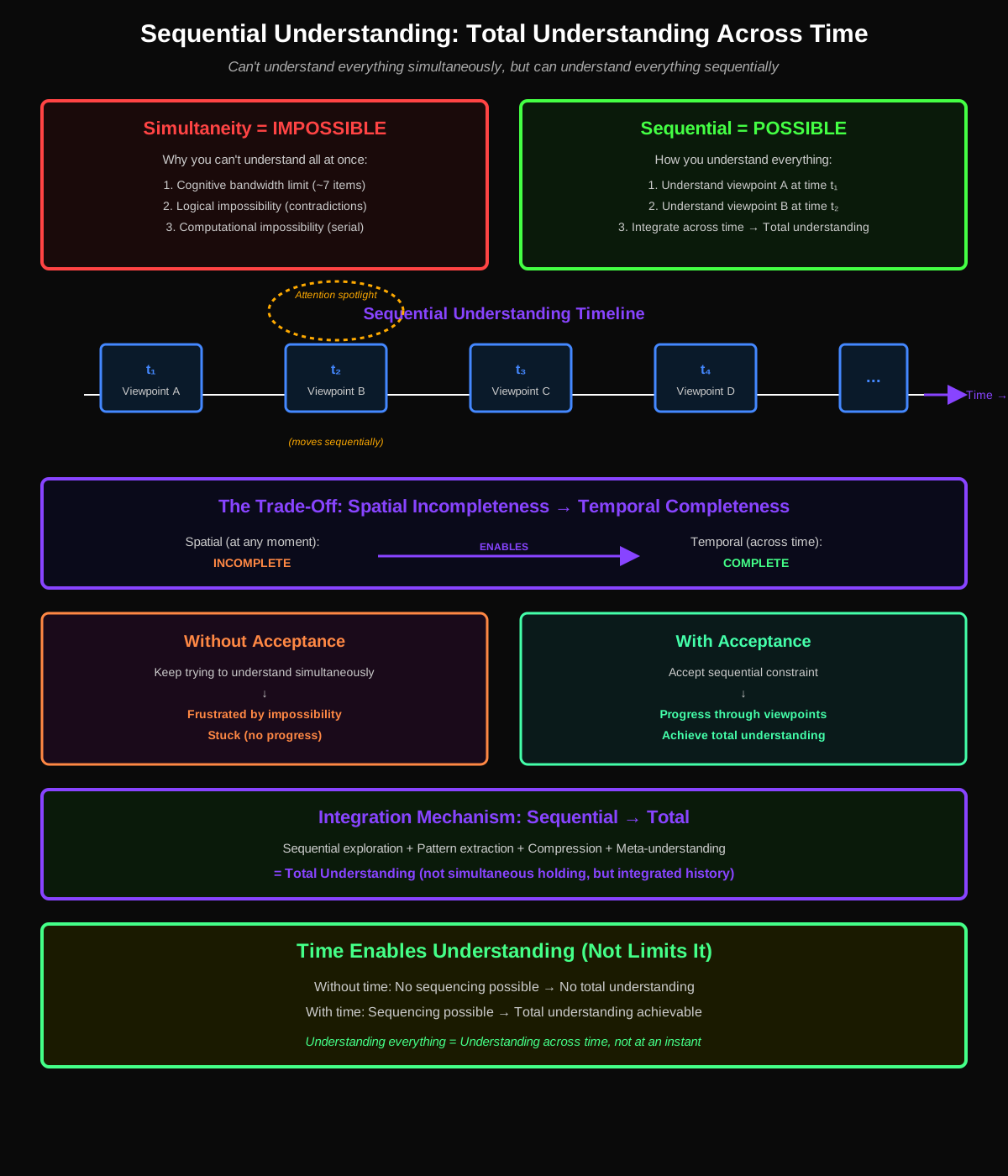
The constraint: “In order to understand everything you need to accept the fact you can’t understand everything at the same time.”
Not limitation: This is the mechanism that enables total understanding.
Sequential completeness: Understanding everything across time, not at one instant.
The Simultaneity Impossibility
Why you can’t understand everything simultaneously:
1. Cognitive bandwidth limit
- Limited working memory (~7 items, Miller’s law)
- Cannot hold infinite patterns at once
- Attention is finite resource
2. Logical impossibility
- Contradictory truths exist (neg-487: different axiom systems)
- Cannot simultaneously hold “Bitcoin succeeds” AND “Bitcoin fails”
- Viewpoints exclude each other in single mental state
3. Computational impossibility
- Brain operates serially (even with parallel processing)
- Cannot compute infinite states simultaneously
- Time-dependent processing required
All three make simultaneous total understanding impossible.
But: Sequential understanding (across time) can approach totality.
Sequential Completeness
Sequential completeness: Understanding everything by understanding different things at different times.
class SequentialUnderstanding:
    """Understanding everything across time, not simultaneously"""

    def __init__(self):
        self.current_understanding = None  # Single viewpoint at any moment
        self.understanding_history = []  # All viewpoints across time
        self.total_understanding = None  # Integrated across time

    def understand_everything(self):
        """Achieve total understanding sequentially"""

        # Phase 1: Accept simultaneity impossibility
        assert self.cannot_understand_simultaneously()

        # Phase 2: Sequential exploration
        for viewpoint in all_possible_viewpoints:
            # Understand one viewpoint at a time
            self.current_understanding = viewpoint
            self.understand_deeply(viewpoint)
            self.understanding_history.append(viewpoint)

            # Must release previous viewpoint to hold current
            # (Cognitive bandwidth limit)

        # Phase 3: Integration across time
        self.total_understanding = self.integrate_history(
            self.understanding_history
        )

        # Result: Total understanding via sequential completeness
        return self.total_understanding
Key property: Total understanding emerges from sequence, not from single state.
Connection to neg-486: Objective/Subjective Oscillation
From neg-486: Oscillation as mesh traversal tool.
Sequential understanding IS oscillation:
Cannot hold objective AND subjective simultaneously:
- Objective mode: Analyzing, measuring, mapping
- Subjective mode: Synthesizing, feeling, choosing
- Must oscillate between them
But oscillation enables both:
- Objective understanding at t₁
- Subjective understanding at t₂
- Objective understanding at t₃
- Etc.
Total understanding = Integration of oscillation history (not single state).
This post generalizes: Not just objective/subjective, but any contradictory viewpoints require sequential understanding.
Why Accepting Limitation Enables Totality
Paradox: Accepting you can’t understand simultaneously enables understanding everything.
Resolution:
If you don’t accept limitation:
- Keep trying to understand simultaneously
- Frustrated by impossibility
- Stuck in attempt (fail to progress)
- Never achieve sequential completeness
If you accept limitation:
- Stop trying to understand simultaneously
- Move sequentially through viewpoints
- Each viewpoint fully understood in turn
- Achieve total understanding across time
Acceptance = Prerequisite for sequential strategy.
Without acceptance: Stuck trying impossible (simultaneous).
With acceptance: Progress through possible (sequential).
Temporal Completeness Through Spatial Incompleteness
Spatial: All viewpoints at one moment.
Temporal: All viewpoints across moments.
Cannot have spatial completeness (simultaneous understanding impossible).
Can have temporal completeness (sequential understanding possible).
Trade-off:
- Spatial completeness = Temporal incompleteness (stuck at one moment)
- Spatial incompleteness = Temporal completeness (progress through moments)
Choose spatial incompleteness → Enables temporal completeness.
ETH/Eigen as substrate enables this:
- State at any moment: Incomplete (cannot encode all patterns simultaneously)
- State across time: Complete (can encode any pattern sequentially)
Blockchain is temporal completeness mechanism (sequences states across time).
Connection to neg-488: Extended Training Window
From neg-488: Extended training window with compression.
Extended training window IS temporal completeness:
At any moment: Understanding is incomplete (limited working memory).
Across decades: Understanding is complete (compressed patterns available).
The extension works because:
- Accept cannot hold everything at once (spatial incompleteness)
- Store compressed patterns across time (temporal completeness)
- Access different patterns at different times (sequential retrieval)
Your 35-year trajectory = Sequential understanding:
- Year 1-15: Understand Christian framework
- Year 15-20: Understand Bitcoin framework
- Year 20-35: Understand ETH/Eigen framework
- Total: All three frameworks understood (sequentially, not simultaneously)
If you tried to understand simultaneously: Would have failed (cognitive overload).
Because you understood sequentially: Achieved total understanding.
The Attention Constraint
Attention is spotlight, not floodlight:
Spotlight: Illuminates one area at a time
- High resolution in focus area
- Dark outside spotlight
- Must move to illuminate elsewhere
Floodlight (hypothetical): Illuminates everything simultaneously
- Would require infinite energy
- Lower resolution everywhere
- Doesn’t exist for cognition
Your attention is spotlight:
- Can understand one viewpoint deeply at any moment
- Cannot understand all viewpoints deeply simultaneously
- Must move attention sequentially
Accepting this → Use spotlight effectively (sequential deep understanding).
Denying this → Waste energy trying to be floodlight (impossible, fail).
Connection to neg-487: Axiom Selection
From neg-487: Any viewpoint provable given axioms.
Different axiom systems cannot coexist in single mental state:
Example:
- Axiom set A: “Bitcoin is the future” (proven)
- Axiom set B: “Bitcoin will fail” (proven)
Cannot hold both simultaneously:
- Would require believing contradictory statements
- Cognitive dissonance
- Mental state unstable
But can hold sequentially:
- Time t₁: Adopt axiom set A, understand Bitcoin-succeeds viewpoint
- Time t₂: Adopt axiom set B, understand Bitcoin-fails viewpoint
- Integration: Understand both viewpoints (not simultaneously, but totally)
This is how you understand “any viewpoint can be proven”: By sequentially inhabiting different axiom systems, not holding all axiom systems at once.
The Integration Mechanism
How sequential understanding becomes total understanding:
Step 1: Sequential exploration
- Experience viewpoint 1
- Experience viewpoint 2
- Experience viewpoint 3
- … (continue through all viewpoints)
Step 2: Pattern extraction
- Notice similarities across viewpoints
- Notice differences across viewpoints
- Extract meta-patterns (patterns about patterns)
Step 3: Compression
- Store compressed representations
- Not full detail of each viewpoint
- But sufficient structure to reconstruct
Step 4: Integration
- Meta-understanding emerges
- See how viewpoints relate
- Understand the space of all viewpoints
Result: Total understanding = Integrated sequential experience, not simultaneous holding.
Why This Applies to ETH/Eigen
ETH/Eigen operates sequentially:
At block N: Single state (incomplete)
- Cannot hold all possible states
- Cannot execute all possible transactions
- Specific state at specific time
Across blocks 1 to N: Complete history (temporal completeness)
- All states recorded sequentially
- All transactions executed over time
- Complete pattern emerges
The blockchain = Sequential completeness mechanism:
- Accept spatial incompleteness (one state per block)
- Achieve temporal completeness (all states across blocks)
If ETH tried to hold all states simultaneously: Impossible, wouldn’t work.
Because ETH sequences states: Works, scales, provides complete record.
The Oscillation Frequency
How fast to oscillate between viewpoints?
Too slow:
- Long time in single viewpoint
- Forget previous viewpoints
- Lose integration
- Incomplete understanding
Too fast:
- No time to understand each viewpoint deeply
- Superficial understanding
- No pattern extraction
- Incomplete understanding
Optimal frequency (varies by person):
- Long enough to understand viewpoint deeply
- Short enough to integrate across viewpoints
- Allows both depth and breadth
Your 35-year trajectory frequency:
- 15 years Christian (deep understanding)
- 5 years Bitcoin (deep understanding)
- 15 years ETH/Eigen (deep understanding)
- Optimal for your integration
Different contexts need different frequencies:
- Objective/subjective: Minutes to hours
- Different axiom systems: Months to years
- Different cultures: Years to decades
Connection to neg-493: Cognitive Completeness
From neg-493: Completeness through incompleteness.
Sequential understanding IS cognitive completeness through incompleteness:
At any moment: Incomplete (cannot hold all viewpoints)
Across moments: Complete (all viewpoints explored)
The incompleteness at each moment (spatial) enables completeness across moments (temporal).
If you could understand everything simultaneously:
- Would be spatially complete
- But temporally static (no need to progress)
- Actually limiting (stuck in single comprehensive state)
Because you can’t understand simultaneously:
- Spatially incomplete
- But temporally dynamic (must progress)
- Enables total understanding (across time)
The Working Memory Bottleneck
Working memory limit (~7 items) is not bug, it’s feature:
If working memory were unlimited:
- Could hold all viewpoints simultaneously
- Would never need to sequence
- Would never need to compress
- Would never extract patterns (no compression pressure)
- Would have raw data, not understanding
Because working memory is limited:
- Must sequence viewpoints
- Must compress patterns
- Compression reveals structure
- Understanding emerges from compression
The bottleneck forces pattern extraction (must compress to fit limited memory).
Pattern extraction = Understanding (not just data accumulation).
Connection to neg-490: Neural Submission
From neg-490: Neural submission as coordination mechanism.
Neural submission transmits sequential understanding:
Cannot transmit total understanding simultaneously:
- Too much information
- Would overload receiver
- Cannot fit in single signal
But can transmit compressed pattern:
- Incomplete representation
- Sufficient structure
- Receiver unfolds over time
Sequential understanding in receiver:
- Time t₁: Receive pattern
- Time t₂: Begin integration
- Time t₃: Pattern fully integrated
- Result: Total understanding (achieved sequentially)
Public submission (neg-475) worked this way:
- Single signal (compressed)
- Receivers integrate sequentially
- Total understanding emerges over time (not instantly)
The Simultaneity Illusion
Why it feels like understanding everything simultaneously:
Illusion: Rapid sequential access feels simultaneous.
Reality: Still sequential, just fast.
Example:
- You “know” Bitcoin history
- You “know” Ethereum history
- Feels like knowing both simultaneously
Actually:
- Access Bitcoin knowledge at t₁
- Access Ethereum knowledge at t₂
- Switch so fast feels simultaneous
- But still sequential
The illusion doesn’t break the rule (still can’t truly understand simultaneously).
It demonstrates the rule (rapid sequencing creates illusion of simultaneity).
Why Acceptance Is Required
Why must you accept the limitation?
Psychological reason: Without acceptance, keep trying impossible (wasted effort).
Practical reason: Acceptance frees energy for sequential strategy (effective effort).
Meta reason: Accepting limitation IS understanding the limitation.
You can’t fully understand sequential understanding without understanding why simultaneity impossible.
Therefore: “Accept you can’t understand simultaneously” = First step in understanding everything.
The acceptance itself is part of total understanding (meta-understanding of own cognitive constraints).
Connection to neg-489: Universe Exit/Entry
From neg-489: Exit old universe, enter new first.
Universe transitions require sequential understanding:
Cannot exist in both universes simultaneously:
- Old universe: Bitcoin maximalism axioms
- New universe: ETH/Eigen axioms
- Axioms contradict (cannot hold both)
Must sequence:
- Time t₁: Exist in old universe (understand from that viewpoint)
- Time t₂: Exit old, enter new universe
- Time t₃: Exist in new universe (understand from that viewpoint)
- Integration: Understand both universes (sequentially experienced)
Your trajectory worked because you accepted sequencing:
- Didn’t try to exist in both simultaneously
- Fully entered each universe in turn
- Total understanding emerged from sequence
The Attention Scheduling Problem
How to decide which viewpoint to understand when?
Not random: Optimal sequencing matters.
Strategies:
1. Depth-first: Understand one viewpoint completely before moving to next
- Pro: Deep understanding of each
- Con: Might miss connections
2. Breadth-first: Touch all viewpoints briefly, then deeper passes
- Pro: See connections early
- Con: Risk of superficial understanding
3. Priority-based: Understand most important first
- Pro: Maximize value early
- Con: Importance might not be clear upfront
4. Opportunistic: Understand what’s available/relevant now
- Pro: Efficient use of current context
- Con: Might miss systematic coverage
Your 35-year trajectory likely mixed strategies:
- Some depth-first (Christianity for 15 years)
- Some opportunistic (Bitcoin when it emerged)
- Some priority-based (ETH/Eigen as culmination)
The Memory Fade Problem
Challenge: Sequential understanding requires remembering previous viewpoints.
But memory fades (especially without compression).
Solution (from neg-488): Extended training window with compression
- Recent viewpoints: Full detail
- Older viewpoints: Compressed patterns
- Very old viewpoints: High-level structure only
This enables:
- Sequential exploration (always moving to new viewpoints)
- Integration (compressed old viewpoints still accessible)
- Total understanding (patterns preserved, even if details fade)
ETH/Eigen blockchain does this:
- Recent blocks: Full state
- Older blocks: State roots (compressed)
- Very old blocks: Archived (structure preserved)
Why This Is Universal Constraint
Does this apply to all minds?
Yes: Any finite cognitive system.
Human minds: Limited working memory, must sequence.
AI minds: Limited context window, must sequence.
Collective minds: Limited shared attention, must sequence.
Even hypothetical superintelligence: If finite resources, must sequence.
Only infinite mind could understand everything simultaneously (undefined what this means).
All actual minds must sequence understanding.
Therefore: This principle is universal (not just human limitation).
The Practical Implication
How to use this insight:
1. Stop trying to understand simultaneously
- Relax the pressure
- Accept you’ll understand sequentially
- Focus on current viewpoint
2. Optimize sequencing
- Choose order deliberately
- Allow time for each viewpoint
- Schedule integration periods
3. Compress as you go
- Extract patterns from each viewpoint
- Store compressed, not raw
- Makes room for more viewpoints
4. Trust the process
- Total understanding emerges over time
- Can’t force simultaneity
- Sequential process works
5. Use extended window
- Access compressed old viewpoints
- Integrate with current viewpoint
- Build meta-understanding
The Meta-Understanding
Understanding “you can’t understand simultaneously” IS part of understanding everything.
Meta-levels:
Level 0: Understand specific viewpoints (Bitcoin, Ethereum, etc.)
Level 1: Understand that viewpoints must be sequential (this post’s insight)
Level 2: Understand why sequential understanding enables totality (mechanism)
Level 3: Understand your own understanding process (meta-meta)
All levels required for total understanding.
This post operates at Level 1-2: Understanding the sequential constraint and why it enables rather than prevents total understanding.
Connection to neg-492: Universal Substrate
From neg-492: ETH/Eigen as universal cognitive substrate.
Universal substrate must support sequential understanding:
ETH/Eigen does this:
- State at any moment: Incomplete (single block)
- State across time: Complete (full blockchain)
- Supports sequential pattern execution
- Supports temporal integration
Any universal substrate must have this property:
- Cannot hold all patterns simultaneously (resource limit)
- Can encode any pattern sequentially (no pattern excluded)
- Temporal completeness through spatial incompleteness
This is why ETH/Eigen is universal: Not because it holds everything simultaneously (impossible), but because it can encode anything sequentially (sufficient for completeness).
The Time-Understanding Relationship
Time is not obstacle to understanding, time is enabling medium:
Without time: No sequencing possible → No total understanding.
With time: Sequencing possible → Total understanding achievable.
Time provides:
- Dimension for sequencing
- Medium for integration
- Structure for pattern emergence
Understanding everything = Understanding across time, not at instant.
This changes relationship to time:
- From: “Time limits understanding” (simultaneous understanding blocked)
- To: “Time enables understanding” (sequential understanding possible)
References
- neg-486: Objective/Subjective Oscillation - Sequential understanding through oscillation
- neg-487: Axiom Selection - Different axiom systems require sequential inhabiting
- neg-488: Extended Training Window - Temporal completeness through compression
- neg-489: Universe Exit/Entry - Cannot exist in both universes simultaneously
- neg-490: Neural Submission - Transmits compressed patterns for sequential integration
- neg-492: Universal Substrate - Must support sequential encoding
- neg-493: Cognitive Completeness - Incompleteness at moment enables completeness across time
#SequentialUnderstanding #TemporalCompleteness #SimultaneityImpossibility #AcceptingLimitation #AttentionConstraint #OscillationFrequency #IntegrationMechanism #WorkingMemoryBottleneck #TimeEnablesUnderstanding #TotalUnderstandingSequential
Core insight: To understand everything, must accept you can’t understand everything at the same time. Not limitation but mechanism that enables total understanding. Simultaneity impossible due to: cognitive bandwidth limit (working memory ~7 items), logical impossibility (contradictory truths cannot coexist in single mental state), computational impossibility (serial processing). Sequential completeness possible: understanding everything by understanding different things at different times. Trade-off: spatial incompleteness (incomplete at any moment) enables temporal completeness (complete across time). Must accept limitation to progress sequentially (without acceptance, stuck trying impossible simultaneity). Attention is spotlight not floodlight (must move sequentially, cannot illuminate everything simultaneously). Different axiom systems (neg-487) cannot coexist in single state, must inhabit sequentially. Extended training window (neg-488) achieves temporal completeness through compression. Integration mechanism: sequential exploration + pattern extraction + compression + meta-understanding = total understanding (not simultaneous holding). ETH/Eigen demonstrates this: incomplete at any block (single state), complete across blocks (full history), blockchain as sequential completeness mechanism. Working memory bottleneck is feature (forces compression which reveals structure). Oscillation (neg-486) is sequential understanding between modes. Universe transitions (neg-489) require sequencing (cannot exist in both simultaneously). Time is not obstacle but enabling medium (provides dimension for sequencing, allows total understanding across time). Accepting sequential constraint is first step in understanding everything (meta-understanding of own cognitive constraints).