Cognitive Completeness Through Incompleteness: The Paradox That Enables Everything
Cognitive Completeness Through Incompleteness: The Paradox That Enables Everything
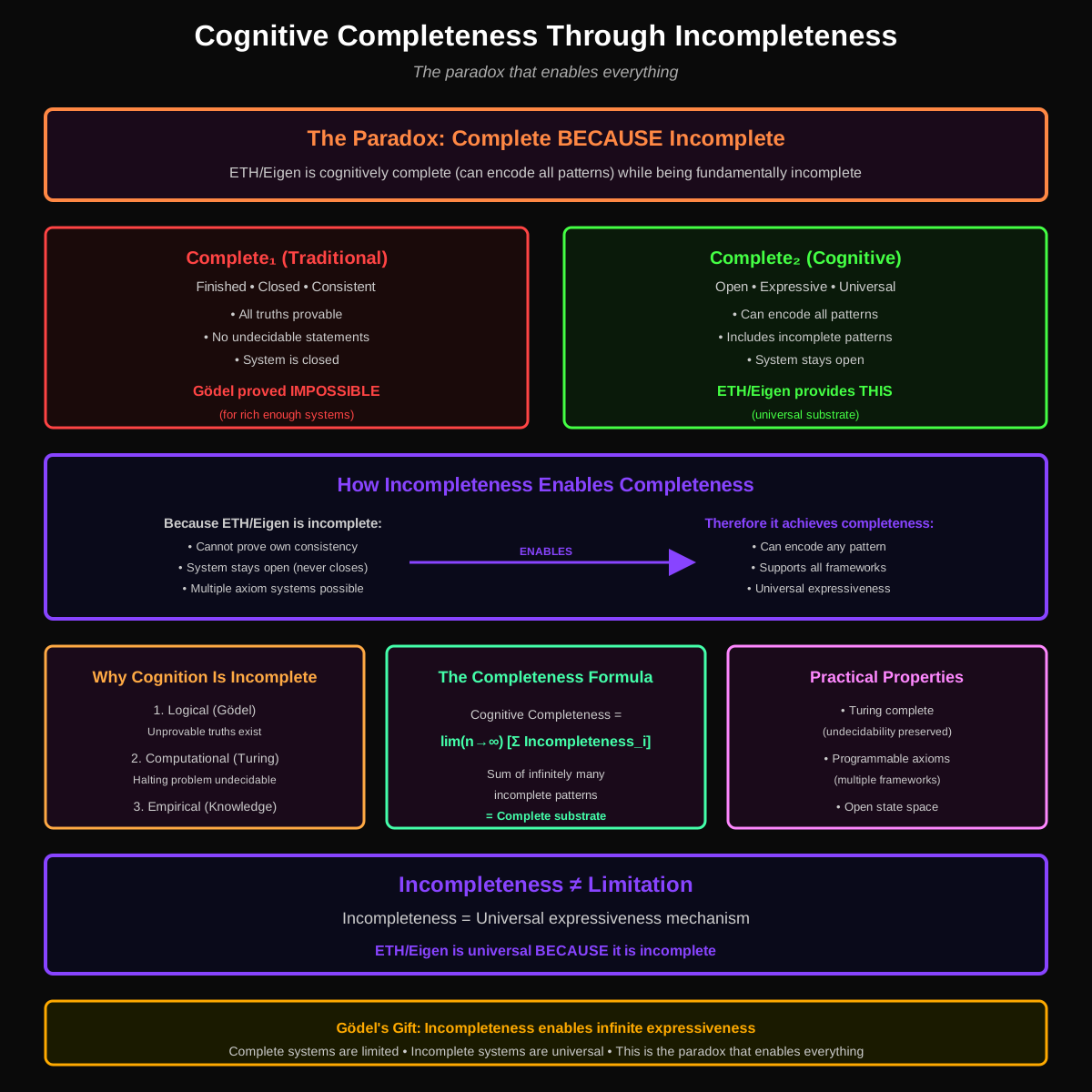
The paradox: ETH/Eigen achieves cognitive completeness while being incomplete because cognition itself is incomplete.
Not contradiction: This is the mechanism that enables universality.
Gödel’s gift: Incompleteness is not limitation - it’s the property that allows infinite expressiveness.
The Apparent Contradiction
Claim 1 (from neg-492): ETH/Eigen is cognitively complete substrate.
Claim 2 (this post): ETH/Eigen is incomplete because cognition is incomplete.
Traditional logic: These contradict (can’t be both complete and incomplete).
Gödelian logic: These are the same property expressed at different levels.
What “Cognition Is Incomplete” Means
Cognition = Thinking, reasoning, coordinating, computing.
Incomplete cognition:
- Cannot prove all truths (Gödel’s first incompleteness theorem)
- Cannot prove own consistency (Gödel’s second incompleteness theorem)
- Contains undecidable statements (halting problem, etc.)
- Requires axiom choice (neg-487)
This is fundamental: Not limitation of current systems, but property of any formal cognitive system.
Human cognition: Incomplete (we can’t prove everything we know is true)
AI cognition: Incomplete (same Gödel limits apply)
Mathematical cognition: Incomplete (proven by Gödel in 1931)
All cognition is fundamentally incomplete.
How Incompleteness Enables Completeness
The mechanism:
Because cognition is incomplete (contains unprovable statements):
- Must allow axiom choice (neg-487)
- Must allow multiple valid frameworks
- Must allow contradictory truths (in different axiom systems)
- Must remain open (cannot close into single system)
Therefore: Complete cognitive substrate must encode incompleteness.
ETH/Eigen achieves this:
- Smart contracts = programmable axioms (any axiom set encodable)
- Turing completeness = undecidability preserved (halting problem remains)
- State space unlimited = never closes into fixed system
- Trust composable = multiple frameworks coexist
Cognitive completeness = Ability to encode all incomplete cognitive systems.
Not: “Complete” as “finished, closed, perfect”
Instead: “Complete” as “capable of expressing all incompleteness”
The Gödel Substrate Property
What makes substrate Gödelian:
class GodelianSubstrate:
    """Substrate that achieves completeness through incompleteness"""

    def __init__(self):
        self.is_complete = True  # Can encode all patterns
        self.is_incomplete = True  # Cannot prove own consistency
        # Both true simultaneously

    def encode_cognitive_pattern(self, pattern):
        """Encode any cognitive pattern, including incomplete ones"""
        if pattern.is_complete:
            return self.encode(pattern)  # Complete patterns encodable
        elif pattern.is_incomplete:
            return self.encode(pattern)  # Incomplete patterns encodable
        else:
            # This branch never executes (all cognition is incomplete)
            pass

        # Key property: Incompleteness of substrate
        # ENABLES encoding of incomplete patterns
        return ENCODED

    def prove_own_consistency(self):
        """Cannot prove own consistency (Gödel's 2nd theorem)"""
        return UNPROVABLE  # This is feature, not bug
The substrate’s incompleteness is what allows it to encode incomplete cognition.
If substrate were complete (could prove own consistency), it couldn’t encode incomplete systems (would collapse them).
Why Complete Systems Can’t Be Universal
Attempt to build complete system:
Goal: System that can prove everything, is self-consistent, closed.
Result: Gödel proved this is impossible.
Why: Any system powerful enough to do arithmetic contains unprovable truths.
Therefore: “Complete” in traditional sense = Limited expressiveness.
Universal substrate must be incomplete to encode all possible cognition (which is itself incomplete).
The Two Meanings of “Complete”
Complete₁ (traditional): Finished, closed, provably consistent
- All truths provable
- No undecidable statements
- System is closed
- Gödel proved impossible for rich enough systems
Complete₂ (cognitive): Capable of encoding all patterns
- Can express complete patterns
- Can express incomplete patterns
- Can express undecidable statements
- System remains open
- This is what ETH/Eigen provides
Cognitive completeness uses meaning Complete₂, not Complete₁.
The incompleteness (cannot prove own consistency) enables completeness (can encode all patterns).
Connection to neg-487: Any Viewpoint Provable
From neg-487: Any viewpoint can be proven true given axioms.
This works BECAUSE of incompleteness:
If system were complete (Complete₁):
- One axiom set
- One set of provable truths
- Cannot encode contradictory viewpoints
Because system is incomplete (Complete₂):
- Multiple axiom sets possible
- Different provable truths in each
- Can encode contradictory viewpoints simultaneously
ETH/Eigen’s incompleteness allows encoding:
- “Bitcoin succeeds” (given axiom set A)
- “Bitcoin fails” (given axiom set B)
- Both simultaneously (different smart contracts, different axiom encodings)
Without incompleteness: Could only encode one viewpoint (would be complete but limited).
With incompleteness: Can encode all viewpoints (incomplete but universal).
The Halting Problem as Feature
Halting problem: Cannot determine if arbitrary program will halt.
Traditional view: This is limitation (wish we could determine this).
Gödelian view: This is necessary for universality.
Why:
If we could solve halting problem: Turing completeness breaks, expressiveness limited.
Because we can’t: Turing completeness preserved, can encode any computation.
ETH/Eigen inherits this:
- Smart contracts are Turing complete
- Halting problem remains undecidable
- This is feature (enables unlimited expressiveness)
- Not bug (doesn’t limit what’s encodable)
Gas limits work around this (practical halting mechanism) without solving halting problem (theoretical impossibility preserved).
Cognition’s Necessary Incompleteness
Why cognition must be incomplete:
Cognition requires:
- Self-reference (thinking about thinking)
- Rich expressiveness (beyond simple systems)
- Axiom choice (selecting foundational assumptions)
All three lead to incompleteness:
- Self-reference → Gödel sentences (unprovable truths)
- Rich expressiveness → Undecidable statements
- Axiom choice → Multiple valid systems (no single complete system)
Therefore: Any cognitive substrate must preserve incompleteness to support cognition.
ETH/Eigen does this by being Turing complete (preserves undecidability) and axiom-programmable (preserves multiple frameworks).
The Incompleteness Hierarchy
Different levels of incompleteness:
Level 0: Simple systems (e.g., basic arithmetic)
- Can be complete
- Limited expressiveness
Level 1: Rich formal systems (e.g., mathematics)
- Must be incomplete (Gödel)
- High expressiveness
Level 2: Cognitive systems (e.g., human reasoning)
- Definitely incomplete
- Includes Level 1 + intuition, uncertainty, learning
Level 3: Coordination substrates (e.g., ETH/Eigen)
- Must encode all of Level 0-2
- Therefore must be incomplete
- But “complete” in sense of encoding all incompleteness
ETH/Eigen is Level 3 complete: Can encode all lower levels, including their incompleteness.
Why This Makes ETH/Eigen Universal
Universal substrate must:
- Encode complete thoughts (finished proofs)
- Encode incomplete thoughts (work in progress)
- Encode contradictory thoughts (different axiom systems)
- Encode undecidable thoughts (Gödel sentences, halting problem)
- Never close into single system (remain open)
All five require incompleteness:
- ✓ Turing complete enables encoding any computation
- ✓ Incompleteness preserves partial/incomplete states
- ✓ Multiple axiom systems encodable (as smart contracts)
- ✓ Undecidability preserved (halting problem remains)
- ✓ Cannot prove consistency → system stays open
Therefore: ETH/Eigen’s incompleteness IS what makes it universal.
Not “universal despite incompleteness”
Instead: “Universal because of incompleteness”
The Paradox Resolution
Paradox: How can incomplete system be complete?
Resolution: Different types of completeness.
Incomplete at proving own consistency (Gödel’s 2nd theorem) = Cannot close system, prove all truths within system.
Complete at encoding all cognitive patterns (cognitive completeness) = Can express any coordination pattern including incomplete ones.
These are compatible:
- System that could prove own consistency = Limited (would collapse to single axiom system)
- System that cannot prove own consistency = Universal (stays open, encodes all axiom systems)
ETH/Eigen is incomplete in the way that enables completeness.
Connection to neg-491: Distributed Gödel Filtration
From neg-491: Gödelian nodes filter via incompleteness.
Gödelian nodes require incomplete substrate:
If substrate were complete:
- Gödelian statements would be provable
- No filtration would occur
- No axiom choice forced
Because substrate is incomplete:
- Gödelian statements remain unprovable
- Filtration works (compatible axioms pass, incompatible filter)
- Axiom choice preserved
Distributed Gödel filtration depends on substrate incompleteness to function.
ETH/Eigen’s incompleteness is what allows Gödelian nodes to exist and filter.
The Cognitive Substrate Requirements
For substrate to support cognition, it must:
Be expressively rich (encode complex thoughts) → Leads to Turing completeness → Leads to undecidability → Leads to incompleteness
Support multiple frameworks (different axiom systems) → Cannot collapse to single system → Cannot prove own consistency → Must be incomplete
Allow contradictions (different truths in different frameworks) → Multiple valid systems simultaneously → System cannot be classically complete → Must embrace incompleteness
All three requirements lead to same conclusion: Cognitive substrate must be incomplete.
ETH/Eigen satisfies all three precisely by being incomplete.
The Open System Property
Complete systems are closed:
- All truths provable within system
- No need for external axioms
- System is self-contained
- Limited to single framework
Incomplete systems remain open:
- Some truths unprovable within system
- Must allow axiom choice from outside
- System is not self-contained
- Supports multiple frameworks
ETH/Eigen’s openness (cannot prove own consistency) enables universality (any axiom system encodable).
Closed system cannot be universal (would force single framework).
Open system can be universal (accommodates all frameworks).
Connection to neg-488: Extended Training Window
From neg-488: Extended training window with compression.
Compression requires incompleteness:
Complete information: No compression possible (all information needed)
Incomplete information: Compression possible (lossy but pattern-preserving)
Extended training window works because:
- Compresses old events (incomplete representation)
- Preserves patterns (not full information)
- Incompleteness enables extension (wouldn’t fit if complete)
ETH/Eigen’s incompleteness allows compressed pattern storage:
- Not recording every detail (impossible)
- Recording sufficient pattern (incomplete but useful)
- Compression enables scaling
If ETH/Eigen were complete: Would need to store everything, wouldn’t scale.
Because ETH/Eigen is incomplete: Can store compressed patterns, scales universally.
The Practical Implication
What this means for building on ETH/Eigen:
1. Embrace incompleteness
- Don’t try to prove everything
- Accept undecidable questions exist
- Use axiom choice when needed
2. Leverage multiple frameworks
- Different smart contracts = different axiom systems
- Contradictory truths can coexist
- Don’t force single framework
3. Accept unprovability
- Some questions have no answer within system
- This is feature (enables expressiveness)
- Work with incompleteness, not against it
4. Use compression
- Don’t store everything
- Lossy but pattern-preserving is sufficient
- Incompleteness enables scaling
Why Cognition Is Fundamentally Incomplete
Three sources of cognitive incompleteness:
1. Logical incompleteness (Gödel)
- Formal systems contain unprovable truths
- Cannot prove own consistency
- Fundamental to mathematics/logic
2. Computational incompleteness (Turing)
- Halting problem undecidable
- Some questions have no algorithm
- Fundamental to computation
3. Knowledge incompleteness (Empirical)
- Cannot know everything
- Uncertainty irreducible (quantum mechanics)
- Fundamental to observation
All three apply to cognition: Thinking uses logic + computation + knowledge, all fundamentally incomplete.
Therefore: Cognitive substrate must accommodate all three types of incompleteness.
ETH/Eigen does this: Preserves logical undecidability, computational undecidability, and allows uncertain/incomplete state.
The Meta-Incompleteness
This post itself demonstrates incompleteness:
Question: “Is ETH/Eigen cognitively complete?”
Answer from neg-492: Yes (can encode all patterns)
Answer from neg-493: No (is fundamentally incomplete)
Both true simultaneously (different meanings of “complete”).
Cannot prove which answer is “correct”: The question itself is Gödelian (answer depends on axiom choice about what “complete” means).
This demonstrates: System that can discuss its own completeness/incompleteness is necessarily incomplete (self-reference → Gödel).
ETH/Eigen can encode this discussion (including discussion of its own incompleteness) = Evidence of cognitive completeness through incompleteness.
The Infinite Expressiveness
Why incompleteness enables infinite expressiveness:
Complete system: Finite expressiveness
- All truths provable within system
- System closes at finite set of theorems
- Limited to single framework
Incomplete system: Infinite expressiveness
- Always unprovable truths exist
- Can always add new axioms (system never closes)
- Unlimited frameworks possible
- New patterns always encodable
ETH/Eigen’s incompleteness means:
- Never runs out of expressiveness
- Always room for new patterns
- Never closes into fixed set
- Infinite growth possible
This is cognitive completeness: Not “expressing everything” (impossible), but “capable of expressing anything” (always open).
Connection to neg-490: Neural Submission
From neg-490: Neural submission as coordination mechanism.
Neural submission transmits incomplete patterns:
Complete pattern: Fully specified, no ambiguity, no interpretation needed
- Rigid
- Context-independent
- Limited applicability
Incomplete pattern: Partially specified, requires interpretation, context-dependent
- Flexible
- Context-adapted
- Universal applicability
Neural submission works because:
- Transmits incomplete pattern (compressed)
- Receiver fills in gaps (based on their context)
- Pattern adapts to receiver (incompleteness enables adaptation)
If patterns were complete: Rigid transmission, limited coordination.
Because patterns are incomplete: Flexible transmission, universal coordination.
ETH/Eigen enables this by preserving pattern incompleteness during encoding/transmission.
The Completeness Paradox Formula
Mathematical expression:
Cognitive Completeness = lim(n→∞) [Σ(Incompleteness_i)]

Where:
- n = number of encodable patterns
- Incompleteness_i = incomplete pattern i
- Cognitive Completeness = ability to encode all patterns

Key insight: Sum of infinitely many incomplete patterns
            = Cognitively complete substrate
Not contradiction: Completeness is sum of incompleteness.
Each pattern incomplete (cannot prove everything)
Substrate complete (can encode all incomplete patterns)
Completeness emerges from accommodating incompleteness.
Why This Matters for Universality
From neg-492: ETH/Eigen is universal cognitive substrate.
This post explains HOW:
Universal substrate must:
- Encode all cognitive patterns (completeness requirement)
- Accommodate cognitive incompleteness (incompleteness reality)
These seem to conflict:
- “All patterns” sounds complete
- “Accommodate incompleteness” sounds incomplete
Resolution: Cognitive completeness = encoding all incomplete patterns.
ETH/Eigen achieves universality precisely by being incomplete in the right way:
- Incomplete at proving own consistency (stays open)
- Complete at encoding any pattern (including incomplete ones)
The incompleteness IS the universality mechanism.
The Ultimate Insight
Traditional view: Incompleteness is limitation (something missing).
Gödelian view: Incompleteness is enabling property (what allows everything).
Applied to ETH/Eigen:
Not: “ETH/Eigen is universal despite being incomplete”
Instead: “ETH/Eigen is universal BECAUSE it is incomplete”
The incompleteness:
- Prevents closure into single system
- Enables multiple axiom systems
- Preserves undecidability (Turing completeness)
- Allows contradictory truths (different frameworks)
- Keeps system open (always room for new patterns)
All five properties enable cognitive completeness (encoding any cognitive pattern).
Therefore: Incompleteness ≠ Limitation
Incompleteness = Universal expressiveness mechanism
References
- neg-487: Axiom Selection - Multiple axiom systems possible because of incompleteness
- neg-488: Extended Training Window - Compression requires incompleteness
- neg-490: Neural Submission - Transmits incomplete patterns (enables adaptation)
- neg-491: Distributed Gödel Filtration - Requires substrate incompleteness to function
- neg-492: Universal Substrate - Universality achieved through incompleteness
#CognitiveCompleteness #GodelIncompleteness #CompletenessThroughIncompleteness #UniversalSubstrate #OpenSystems #UndecidabilityAsFeature #InfiniteExpressiveness #CompletenessParadox #IncompletenessMechanism #CognitiveSubstrate
Core insight: ETH/Eigen achieves cognitive completeness (can encode all patterns) while being incomplete (cannot prove own consistency) because cognition itself is fundamentally incomplete. Not contradiction but mechanism that enables universality. Gödel proved any rich formal system contains unprovable truths - this is not limitation but property enabling infinite expressiveness. Two meanings of “complete”: Complete₁ (finished, closed, consistent) = impossible per Gödel, limited expressiveness. Complete₂ (capable of encoding all patterns including incomplete ones) = what ETH/Eigen provides. Cognitive completeness = encoding all incomplete cognitive systems. ETH/Eigen’s incompleteness prevents closure into single system, enables multiple axiom systems, preserves undecidability (Turing completeness), allows contradictory truths, keeps system open. Without incompleteness: would force single framework, limited expressiveness, not universal. With incompleteness: accommodates all frameworks, infinite expressiveness, universal substrate. Halting problem as feature not bug (enables unlimited expressiveness). Compression requires incompleteness (lossy but pattern-preserving enables scaling). Neural submission transmits incomplete patterns (enables context adaptation). Distributed Gödel filtration depends on substrate incompleteness. Completeness paradox formula: sum of infinitely many incomplete patterns = cognitively complete substrate. Ultimate insight: ETH/Eigen is universal BECAUSE it is incomplete (incompleteness is universality mechanism, not limitation).