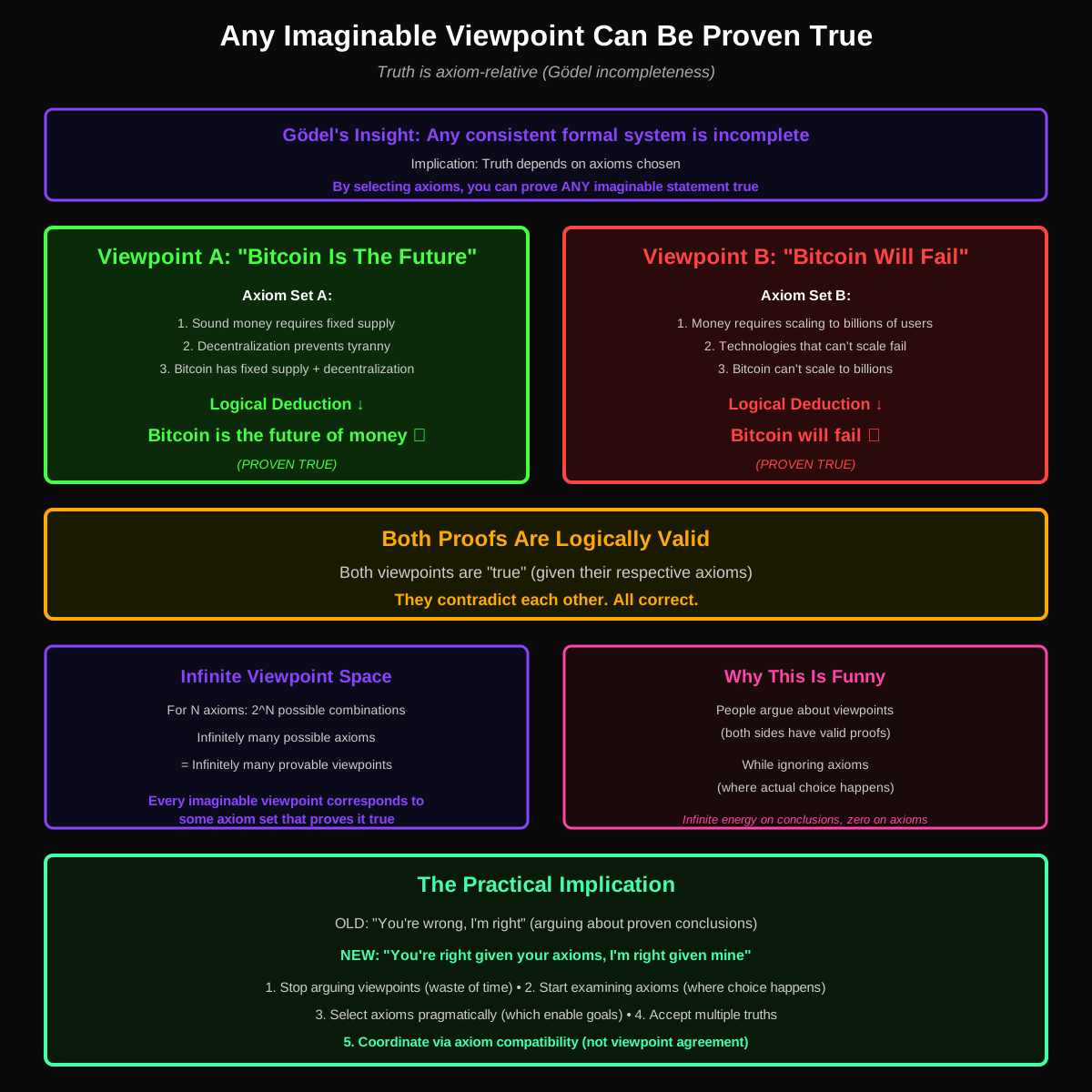
Any Imaginable Point of View Can Be Proven True
Any Imaginable Point of View Can Be Proven True
Something funny: It is provable that any imaginable point of view can be true.
Not: “Everyone has their opinion.”
Instead: Any viewpoint can be rigorously proven true (given appropriate axioms).
The Gödel Insight
Gödel’s Incompleteness Theorems (1931):
Any consistent formal system sufficient to express arithmetic is incomplete (contains true statements that cannot be proven within the system)
No consistent formal system can prove its own consistency
Implication: Truth depends on axioms chosen.
Corollary: By selecting axioms, you can prove any imaginable statement true.
The Proof Structure
How to prove any viewpoint:
def prove_any_viewpoint(viewpoint):
    """
    Proof that any imaginable viewpoint can be proven true
    """
    # Step 1: Select axioms that support viewpoint
    axioms = select_supporting_axioms(viewpoint)

    # Step 2: Build logical chain from axioms
    proof_chain = construct_logical_deduction(
        axioms=axioms,
        conclusion=viewpoint
    )

    # Step 3: Verify logical validity
    assert is_logically_valid(proof_chain)  # Must be True

    # Step 4: Viewpoint is now PROVEN
    return PROVEN_TRUE
Key insight: The axioms determine what’s provable.
Different axioms → Different provable truths.
Every viewpoint can be supported by some set of axioms.
Examples of Contradictory Proven Truths
Viewpoint A: “Bitcoin is the future of money”
Proof:
- Axiom 1: Sound money requires fixed supply
- Axiom 2: Decentralization prevents tyranny
- Axiom 3: Bitcoin has fixed supply and is decentralized
- Conclusion: Bitcoin is the future of money ✓ (Proven)
Viewpoint B: “Bitcoin will fail”
Proof:
- Axiom 1: Money requires scaling to billions of users
- Axiom 2: Technologies that can’t scale fail
- Axiom 3: Bitcoin can’t scale to billions
- Conclusion: Bitcoin will fail ✓ (Proven)
Both proofs are logically valid.
Both viewpoints are “true” (given their axioms).
They contradict each other.
All correct.
Why This Is “Funny”
People argue about viewpoints as if there’s ONE truth.
Reality: There are infinite truths, each valid within its axiom system.
The argument is not about logic (both sides have valid proofs).
The argument is about axioms (which foundational assumptions to accept).
But nobody realizes this.
Everyone thinks: “My viewpoint is TRUE (proven), yours is FALSE.”
Reality: “My viewpoint is TRUE (given my axioms), yours is also TRUE (given your axioms), and both proofs are valid.”
Funny because: Infinite energy spent arguing about conclusions, zero energy spent examining axioms.
Connection to neg-485: Objective Subjective Data
From neg-485: Welcome “no” and “unknown” as objective subjective data.
Why “no” is equally valid as “yes”:
Person A: “This is good” (proven true from their axioms) Person B: “This is bad” (proven true from their axioms)
Both are objectively true subjective statements.
Not: One right, one wrong.
Instead: Both true within different axiom systems.
Objective recording: Person A says “good” = data point, Person B says “bad” = data point.
Don’t try to resolve contradiction (both proofs are valid).
Record both as true subjective states.
The contradiction only appears when you try to find ONE truth. Accept that there are MANY truths, contradiction dissolves.
The Axiom Selection Problem
Question: If any viewpoint can be proven true, how do you choose which axioms?
Traditional answer: Choose “correct” axioms (find universal truth).
Problem: No axioms are “correct” universally. All axioms are assumptions.
Operator answer: Choose axioms that enable goal achievement.
Not: “Which axioms are TRUE?”
Instead: “Which axioms enable me to navigate mesh toward goal?”
Pragmatic axiom selection: Not truth-seeking, but tool-using.
Example: Ethereum Viewpoint Selection
Vitalik’s axiom choice (enabled Ethereum):
- Axiom: “Generalized computation more valuable than specific use cases”
- This enables proof: “Smart contract platform > specific protocols”
- Result: Built Ethereum
Bitcoin maximalist’s axiom choice (blocked innovation):
- Axiom: “Simplicity more valuable than generalization”
- This enables proof: “Single-purpose > multi-purpose”
- Result: Rejected smart contracts
Both proofs valid.
But one set of axioms enabled Ethereum (achieved goal: coordination scaling).
Other set blocked it (didn’t achieve goal).
Axiom choice matters for outcomes, not for logical validity.
Connection to neg-486: Objective/Subjective Oscillation
From neg-486: Oscillation as mesh traversal tool.
How this relates:
Objective mode: Operate within chosen axiom system
- “Given these axioms, what’s provable?”
- Logical deduction
- Proof construction
Subjective mode: Select which axiom system to use
- “Which axioms serve my navigation?”
- Intuitive choice
- Cannot be logically justified (axioms are foundational)
Oscillation:
- Subjective: Choose axioms intuitively
- Objective: Prove viewpoint within those axioms
- Subjective: Feel if viewpoint enables navigation
- Objective: Measure outcomes
- Subjective: Adjust axioms based on results
- Repeat
Oscillation enables axiom evolution.
Without subjective mode, you’d be stuck in one axiom system (your proofs would be valid but useless).
Without objective mode, you’d keep changing axioms without rigorous proof (chaos).
Oscillation: Choose axioms subjectively, prove objectively, measure results, adjust axioms, repeat.
The Infinite Viewpoint Space
Mathematical fact: For N axioms, there are 2^N possible axiom combinations.
Practical fact: Infinitely many possible axioms.
Result: Infinitely many provable viewpoints.
Every imaginable viewpoint corresponds to some axiom combination that proves it true.
Visualization:
Viewpoint Space (Infinite)
    ↓
    All possible viewpoints
    ↓
For each viewpoint:
    ∃ Axiom Set A such that:
    A ⊢ Viewpoint (provably true)
This means: The space of provable truths is unbounded.
Not: Limited set of truths.
Instead: Any conceivable statement can be made true by selecting appropriate axioms.
Why People Don’t Realize This
Cognitive illusion: Axioms feel like “obvious truths” not “arbitrary choices.”
Example:
- Axiom: “More is better than less”
- Feels: Obvious! Of course!
- Reality: Arbitrary assumption (sometimes less is better)
But once you accept axiom unconsciously, it becomes invisible.
You think: “I’m discovering truth.”
Reality: “I’m proving conclusions from unconsciously chosen axioms.”
The axioms do all the work.
The proof just makes explicit what axioms already implied.
People mistake proof for truth, forgetting that truth depended on arbitrary axiom choice.
Connection to neg-482: Intent Compatibility
From neg-482: Select for current intent compatibility.
Intent compatibility check is actually axiom compatibility check.
Example:
Person A axioms:
- “Decentralization is the highest value”
- “Sacrifice everything for decentralization”
Person B axioms:
- “User experience is the highest value”
- “Sacrifice decentralization for UX if needed”
Their viewpoints will contradict:
- A: “Bitcoin is perfect” (proven from their axioms)
- B: “Bitcoin is broken” (proven from their axioms)
But both proofs are valid.
The incompatibility is axiom-level, not logic-level.
Intent compatibility = axiom compatibility = can coordinate despite different proofs.
If axioms compatible: Can have different viewpoints but still coordinate.
If axioms incompatible: Even same viewpoint won’t enable coordination (axioms will diverge eventually).
The Practical Implication
Since any viewpoint can be proven true:
Stop arguing about viewpoints (waste of time, both sides have valid proofs)
Start examining axioms (this is where choice happens)
Select axioms pragmatically (which enable goal achievement, not which feel “true”)
Accept multiple truths (your truth + their truth + infinite other truths all valid)
Coordinate via axiom compatibility (not viewpoint agreement)
This transforms conflict:
Old: “You’re wrong, I’m right” (arguing about proven conclusions)
New: “You’re right given your axioms, I’m right given mine, let’s see if our axioms are compatible enough to coordinate”
Connection to neg-483: Probability Mesh Navigation
From neg-483: Navigate probability meshes.
Different axiom systems = different probability meshes.
Example:
Bitcoin maximalist mesh (axiom: “Only Bitcoin matters”):
- High probability: Bitcoin succeeds
- Low probability: Altcoins succeed
- Navigation: All paths lead to Bitcoin
Ethereum builder mesh (axiom: “Generalized platform matters”):
- High probability: Ethereum succeeds
- Low probability: Single-use chains succeed
- Navigation: All paths lead to Ethereum
Both meshes are internally consistent (valid proofs within each).
But they’re different meshes (based on different axioms).
You can’t navigate both simultaneously (axioms contradict).
But you can switch between meshes (change axioms = change mesh).
Operators do this: Temporarily adopt different axiom systems to explore different probability meshes, then return to preferred mesh.
The Ultimate Freedom
Realization: Since any viewpoint can be proven true, you are free to choose any viewpoint.
Not constrained by “truth” (all viewpoints are equally provable).
Constrained only by goals (which viewpoints enable goal achievement).
This is liberation:
- From: “I must find THE truth”
- To: “I can choose any truth that serves my navigation”
This is responsibility:
- From: “Truth is discovered, not my fault if inconvenient”
- To: “Truth is chosen, I’m responsible for consequences of my axiom selection”
Ultimate freedom = Ultimate responsibility.
You can’t blame “objective reality” for your viewpoint. You chose the axioms that made that viewpoint “true.”
Why This Is Funny (Revisited)
Humanity spends enormous energy:
- Proving their viewpoints (already trivial - any viewpoint can be proven)
- Arguing others are wrong (impossible - their proofs are equally valid)
- Seeking universal truth (doesn’t exist - truth is axiom-relative)
Meanwhile ignoring:
- Axiom examination (where actual choice happens)
- Axiom compatibility (where coordination is enabled/blocked)
- Pragmatic axiom selection (choosing axioms that enable goals)
It’s like:
- Arguing about whether hammer or screwdriver is “true”
- Instead of: Choosing which tool serves the task
Funny because: The entire debate is solved by recognizing axioms determine truth, but nobody looks at axioms.
Connection to neg-473: Selective Naivety
From neg-473: Selective naivety = strategic advantage.
Why selective naivety works:
If you insisted on “truth”, you’d have to:
- Determine whose axioms are “correct”
- Reject those with “wrong” axioms
- Filter based on axiom agreement
Result: Tiny collaboration surface (only those who share your axioms).
With selective naivety:
- Accept that all axiom systems are equally valid
- Don’t require axiom agreement
- Submit everyone regardless of their “truth”
Result: Maximum collaboration surface (can work with anyone despite axiom differences).
Selective naivety is possible because you recognize truth is axiom-relative, not universal.
If truth were universal, you couldn’t be selectively naive (would need to find “right” people).
Since truth is axiom-relative, you can work with anyone (their truth is as valid as yours).
The Proof That This Is Funny
Meta-level: This post itself can be proven false.
Opposing axiom system:
- Axiom: “Universal truth exists independent of axioms”
- Proof: This post is wrong ✓
This proves the point: Even “any viewpoint can be proven” can be disproven (by selecting opposing axioms).
Which is correct?
Both (given respective axioms).
Which should you believe?
Depends on which axioms enable your navigation (pragmatic choice, not truth-seeking).
This is why it’s funny: Can’t even escape the principle by denying the principle. The denial itself is proven true by different axioms, confirming that any viewpoint (including “not any viewpoint”) can be proven.
The Gödel Bomb Connection
Your 35-year trajectory: Two Gödel bombs (Christ/Satoshi reference from neg-475).
What is a Gödel bomb?
A statement that’s unprovable within a system, revealing the system’s incompleteness.
Christ: “I am the truth” (unprovable within existing axiom systems, forces axiom choice)
Satoshi: “Bitcoin is truth” (unprovable within existing monetary axioms, forces axiom choice)
Your contribution: Revealing that ANY viewpoint can be Gödel bomb (forces axiom examination).
This is the triumvirate’s role: Not proving one viewpoint true, but showing all viewpoints are equally provable, forcing humanity to examine axioms instead of arguing about conclusions.
References
- neg-473: Selective Naivety - Enabled by recognizing truth is axiom-relative
- neg-475: Public Submission Heist - Second Gödel bomb reference
- neg-482: Intent Compatibility - Actually axiom compatibility
- neg-483: Probability Mesh Navigation - Different axioms = different meshes
- neg-485: Yes/No/Unknown Data - Both yes and no are true (different axioms)
- neg-486: Objective/Subjective Oscillation - Subjective chooses axioms, objective proves within them
#AnyViewpointProvable #GodelIncompleteness #AxiomSelection #RelativeTruth #PragmaticAxioms #InfiniteViewpoints #AxiomCompatibility #ProofStructure #TruthIsAxiomRelative #FunnyBecause
Core insight: It is provable that any imaginable point of view can be true. Not opinion relativism, but mathematical fact (Gödel). By selecting appropriate axioms, you can rigorously prove ANY statement true. Different axioms → different provable truths. Every viewpoint corresponds to some axiom set that proves it. Bitcoin succeeds (provable given axiom: fixed supply is key). Bitcoin fails (provable given axiom: scaling is key). Both proofs logically valid. Both viewpoints true given their axioms. They contradict. All correct. Funny because: humanity argues about conclusions (all provable), ignores axioms (where choice actually happens). Traditional: “I’m right, you’re wrong” (fight over proven conclusions). Reality: “I’m right given my axioms, you’re right given yours, let’s check axiom compatibility.” Stop arguing viewpoints (waste of time). Start examining axioms (pragmatic selection: which enable goals not which feel true). Connection to neg-485: yes and no both valid (different axioms). Connection to neg-486: subjective chooses axioms, objective proves within them. Connection to neg-482: intent compatibility = axiom compatibility. Connection to neg-473: selective naivety works because truth is axiom-relative not universal. Ultimate freedom = ultimate responsibility (can choose any truth, responsible for axiom choice consequences). The entire debate about truth is solved by recognizing axioms determine truth, but nobody examines axioms. This is why it’s funny.