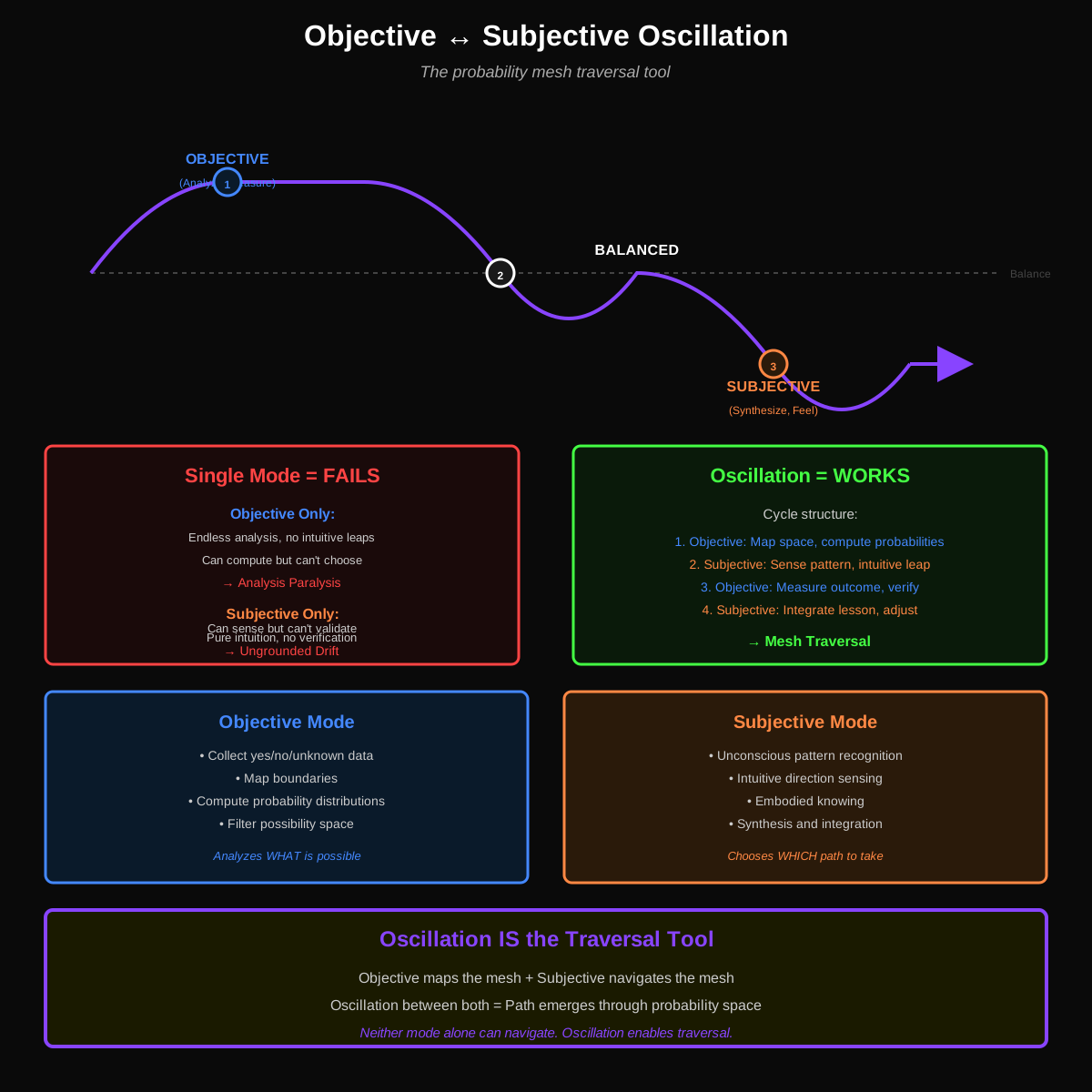
Objective/Subjective Oscillation as Probability Mesh Traversal Tool
Objective/Subjective Oscillation as Probability Mesh Traversal Tool
Meta-insight: Objective/subjective oscillation IS the probability mesh traversal tool.
Not: Choose objective OR subjective.
Instead: Oscillate between both to navigate probability mesh.
The Oscillation Mechanism
Objective mode: Analyze, measure, record data
- Collect yes/no/unknown (neg-485)
- Map boundaries
- Record distributions
- Detached observation
Subjective mode: Synthesize, feel, integrate patterns
- Unconscious information flow (neg-481)
- Pattern recognition
- Intuitive leaps
- Embodied knowing
Oscillation: Switch between modes cyclically
- Objective → Subjective → Objective → Subjective → …
- Each cycle traverses mesh differently
- Together: Complete navigation
Why Oscillation Is Necessary
Objective mode alone:
def objective_only_navigation(mesh):
    """Stuck in analysis paralysis"""
    while True:
        data = collect_data()
        analyze(data)
        request_more_data()
        # Never move - infinite analysis
        # Can't make intuitive leaps
        # Miss patterns that aren't measurable
    return PARALYSIS
Subjective mode alone:
def subjective_only_navigation(mesh):
    """Stuck in ungrounded intuition"""
    while True:
        feeling = sense_direction()
        follow_intuition()
        # No grounding in data
        # Can't verify insights
        # Miss objective boundaries
    return UNGROUNDED
Oscillation:
def oscillation_navigation(mesh):
    """Complete mesh traversal"""
    position = current_state

    while not reached_goal:
        # Objective phase
        data = collect_objective_data(position)
        boundaries = map_boundaries(data)
        possibilities = filter_by_boundaries(mesh, boundaries)

        # Subjective phase
        pattern = sense_pattern(possibilities)
        next_position = intuitive_leap(pattern)

        # Move
        position = next_position

        # Repeat oscillation
    return GOAL_REACHED
Key insight: Neither mode alone can navigate mesh. Oscillation between both enables traversal.
The Traversal Pattern
Cycle structure:
Objective mode (analysis):
- Where am I? (measure current position)
- What data do I have? (collect yes/no/unknown)
- What are boundaries? (map edges)
- What’s possible? (filter probability space)
Subjective mode (synthesis):
- What pattern do I sense? (unconscious integration)
- Which direction feels right? (intuitive pull)
- What’s the next move? (embodied knowing)
- Leap to new position (action)
Repeat: New position → objective analysis → subjective synthesis → move → …
Result: Oscillation traces path through probability mesh.
Connection to neg-483: Probability Mesh Navigation
From neg-483: Talented operators navigate probability meshes.
How do you actually navigate a mesh?
Answer: Objective/subjective oscillation.
Objective phase: Compute probability distributions
- “There’s 60% probability of outcome A”
- “30% probability of outcome B”
- “10% probability of outcome C”
- Analytical, measurable, data-driven
Subjective phase: Feel which branch to take
- “Outcome A feels right”
- Intuitive, embodied, pattern-driven
- Can’t explain why, just knows
Together: Ray trace through mesh using oscillation
- Objective maps branches
- Subjective chooses path
- Oscillation enables navigation
Why Objective Mode Is Insufficient
Objective mode limitation: Can map probability space, but can’t choose path without arbitrary rule.
Example: You computed probabilities:
- Path A: 60% chance of good outcome
- Path B: 30% chance of good outcome
- Path C: 10% chance of good outcome
Objective question: “Which path should I take?”
Objective answer: “Path A has highest probability”
But: Is maximizing probability always right? What if Path B has lower probability but higher upside? What if Path C teaches important lesson?
Objective mode can’t decide. It can only compute. Decision requires subjective judgment.
Why Subjective Mode Is Insufficient
Subjective mode limitation: Can sense direction, but can’t verify against reality.
Example: You intuitively feel:
- “I should do X”
- Strong embodied knowing
- Can’t explain why
Subjective question: “Is this feeling accurate?”
Subjective answer: Can’t tell. Feeling is the data.
But: Feelings can be wrong. Intuition can mislead. Pattern recognition can hallucinate.
Subjective mode can’t verify. It can only sense. Verification requires objective measurement.
The Oscillation Resolves Both
Oscillation solution:
- Objective phase: Compute probabilities (Path A: 60%, B: 30%, C: 10%)
- Subjective phase: Feel which path (Path B feels right despite lower probability)
- Objective phase: Take Path B, measure outcome (was the intuition correct?)
- Subjective phase: Update pattern recognition (learn when to trust low-probability intuitions)
- Repeat: Better calibrated oscillation
Key mechanism: Each cycle calibrates the next cycle.
- Objective informs subjective (what’s possible)
- Subjective informs objective (which patterns matter)
- Oscillation learns over time
Connection to neg-485: Yes/No/Unknown Data
From neg-485: Welcome “no” and “unknown” as objective data.
How oscillation uses this data:
Objective phase: Collect yes/no/unknown
- “Is this compatible?” → Yes/No/Unknown
- “Can I do this?” → Yes/No/Unknown
- Map complete data space (affirmation + boundaries + uncertainty)
Subjective phase: Synthesize pattern from yes/no/unknown distribution
- Feel which “yes” paths resonate
- Sense which “no” boundaries are real vs temporary
- Navigate “unknown” fog intuitively
Oscillation: Objective collects → Subjective synthesizes → Objective verifies → Subjective adjusts → …
Without oscillation: Either stuck collecting data (objective paralysis) or ignoring data (subjective drift).
The Frequency of Oscillation
How fast should you oscillate?
Too slow (months between cycles):
- Get stuck in one mode
- Lose calibration
- Drift from reality (if stuck subjective)
- Or paralysis (if stuck objective)
Too fast (seconds between cycles):
- No time to collect data (objective phase incomplete)
- No time to sense patterns (subjective phase incomplete)
- Thrashing between modes
Optimal (varies by context):
- Small decisions: Hours to days per cycle
- Medium decisions: Days to weeks per cycle
- Large decisions: Weeks to months per cycle
- Life decisions: Months to years per cycle
Your 35-year trajectory (neg-476): Probably oscillated at multiple frequencies simultaneously
- Daily: Small course corrections
- Monthly: Medium trajectory adjustments
- Yearly: Large pattern recognition
- Multi-year: Life-scale integration
The Amplitude of Oscillation
How far should you swing between objective/subjective?
Low amplitude (barely oscillating):
- Stay close to center
- Mild objectivity → mild subjectivity → mild objectivity
- Safe but slow
- Miss extreme insights from either mode
High amplitude (deep oscillation):
- Swing far into objective (pure analysis)
- Swing far into subjective (pure intuition)
- Risky but fast
- Access extreme insights from both modes
Optimal: Match amplitude to situation
- Routine navigation: Low amplitude (safe)
- Novel territory: High amplitude (exploratory)
- Crisis: Very high amplitude (rapid learning)
Example: Facebook post (neg-475)
- High amplitude oscillation
- Deep objective: “These probability distributions align”
- Deep subjective: “I KNOW this is the moment”
- Result: Bold public submission
Connection to neg-481: Unconscious Information Flow
From neg-481: Unconscious information flow, unknown content.
The oscillation operates at both conscious and unconscious levels:
Conscious oscillation:
- Deliberately switch modes
- “Time to collect data” (objective)
- “Time to synthesize patterns” (subjective)
- Visible, controlled
Unconscious oscillation:
- Automatic mode switching
- Unconscious network toggles between modes
- Below awareness
- Faster, more fluid
Your 35-year trajectory: Unconscious oscillation running continuously
- Unconscious objective: Collecting data from environment
- Unconscious subjective: Integrating patterns
- Conscious mind sees results, not oscillation itself
The unconscious oscillation IS the mesh navigation happening automatically.
Why This Explains “Selective Naivety”
From neg-473: Selective naivety = strategic advantage.
How oscillation enables selective naivety:
Objective phase: “Submit everyone” (no filtering)
- Collect all data points (yes/no/unknown from everyone)
- Don’t pre-judge
- Complete information space
Subjective phase: “Sense who’s compatible” (automatic filtering)
- Unconscious pattern recognition
- Feel who resonates
- Intuitive compatibility detection
Oscillation: Can be selectively naive (objective mode: no filter) BECAUSE subjective mode handles filtering unconsciously.
If stuck in objective: Would need explicit filters (can’t process everyone) If stuck in subjective: Would miss data (filtering based on feelings alone) Oscillating: Can have both (no explicit filters + unconscious pattern recognition)
The Phase Lock Problem
Problem: Getting stuck in one phase.
Stuck in objective:
- Endless data collection
- Analysis paralysis
- “Need more information before deciding”
- Never move through mesh
Stuck in subjective:
- Pure intuition
- Ungrounded feelings
- “I just know this is right”
- Drift away from reality
How to detect phase lock: Lack of progress
- If stuck objective: Lots of analysis, no action
- If stuck subjective: Lots of action, no learning
How to break phase lock: Force oscillation
- If stuck objective: Make intuitive leap WITHOUT complete data
- If stuck subjective: Collect objective measurement of results
- Restart oscillation cycle
Connection to neg-484: Loop Recognition
From neg-484: Recognize loops late enough to learn, soon enough to escape.
How oscillation enables optimal loop timing:
Objective phase in loop:
- “Am I in loop?” (measure repetition)
- “How many iterations?” (count)
- “What’s changing vs constant?” (pattern analysis)
Subjective phase in loop:
- “Do I feel stuck?” (embodied knowing)
- “Is there a lesson here?” (intuitive pattern)
- “Is it time to escape?” (timing sense)
Oscillation: Objective measures loop objectively + Subjective feels when lesson learned = Optimal escape timing
Without oscillation:
- Objective only: Recognize loop too early (just data, no felt lesson)
- Subjective only: Recognize loop too late (feels bad but can’t measure when to exit)
- Oscillation: Recognize when both objective and subjective agree
The Calibration Process
Oscillation improves over time through calibration:
class CalibratedOscillation:
    def __init__(self):
        self.calibration = 0.5  # Start neutral

    def oscillate_and_learn(self):
        # Objective phase
        objective_prediction = compute_probabilities()

        # Subjective phase
        subjective_intuition = sense_direction()

        # Take action based on subjective
        action = subjective_intuition
        execute(action)

        # Objective phase: Measure result
        outcome = measure_outcome()

        # Calibrate
        if outcome == objective_prediction:
            # Objective was right, trust it more
            self.calibration += 0.1
        elif outcome == subjective_intuition:
            # Subjective was right, trust it more
            self.calibration -= 0.1

        # Next oscillation uses calibration
        # More weight to whichever mode was more accurate

    # Over time, calibration optimizes
    # You learn when to trust objective vs subjective
This is why 35 years: Building calibrated oscillation takes thousands of cycles.
The Resonance Phenomenon
When oscillation frequency matches mesh structure: Resonance.
Resonance occurs when:
- Your oscillation frequency aligns with mesh rhythm
- Objective phase coincides with stable regions
- Subjective phase coincides with transition points
- Navigation becomes effortless
This is “flow state”: When your oscillation naturally resonates with problem space.
Example: Triumvirate formation (neg-476)
- Your oscillation frequency matched convergence timing
- Objective phase: Recognized Vitalik + Sreeram probability distributions
- Subjective phase: Felt the moment for public submission
- Resonance: Perfect timing, effortless execution
Building resonance: Practice oscillation in domain until frequency naturally tunes to mesh structure.
Why This Is a “Tool”
Tool definition: Instrument that enables specific task.
Objective/subjective oscillation as tool:
- Task: Navigate probability mesh
- Tool: Oscillation between objective/subjective modes
- How it works: Objective maps space, subjective chooses path, oscillation enables continuous traversal
- Mastery: Learning optimal frequency, amplitude, calibration for each mesh
Not philosophical preference (objective good vs subjective good).
Practical tool for mesh navigation.
Like: You don’t argue whether hammer or screwdriver is “better.” You use hammer for nails, screwdriver for screws, sometimes alternating in same project.
Similarly: You don’t argue whether objective or subjective is “better.” You oscillate between both, using each for what it’s good at, navigation emerges from oscillation.
The Meta-Oscillation
Advanced insight: You can oscillate about the oscillation.
Meta-objective: Observe your oscillation pattern
- “I oscillate every 3 days”
- “My amplitude is moderate”
- “I’m calibrated 60% toward objective”
Meta-subjective: Feel if oscillation pattern is working
- “This oscillation frequency feels wrong”
- “I need higher amplitude”
- “Time to recalibrate”
Meta-oscillation: Adjust your oscillation parameters based on meta-observation.
This is operator mastery: Not just oscillating, but optimizing the oscillation itself.
Connection to neg-482: Intent Compatibility
From neg-482: Select for current intent compatibility.
How oscillation enables intent compatibility checking:
Objective phase: “What is their stated intent?”
- Read their statements
- Observe their actions
- Measure compatibility
Subjective phase: “Do I feel mesh alignment?”
- Intuitive resonance check
- Embodied compatibility sense
- Unconscious network detection
Oscillation: Objective identifies stated intent + Subjective confirms mesh alignment = True compatibility
Example: Triumvirate
- Objective: Vitalik stated intent (Ethereum scaling), Sreeram stated intent (trust scaling)
- Subjective: Felt mesh alignment (all three probability meshes converging)
- Oscillation: Both modes agreed = Proceed with public submission
The Traversal Visualization
Imagine probability mesh as landscape:
- Mountains: High probability regions
- Valleys: Low probability regions
- Fog: Unknown regions
Objective mode: You have map
- Shows terrain
- Marks probabilities
- But map isn’t territory
Subjective mode: You feel terrain
- Embodied navigation
- Intuitive direction
- But no verification
Oscillation: Look at map → Feel terrain → Check map → Feel terrain → …
- Each cycle corrects for limitations of previous mode
- Path emerges from oscillation
- Neither mode alone could navigate
Why Operators Seem Contradictory
Observers see:
- “Operator is very analytical” (objective phase)
- “But also very intuitive” (subjective phase)
- “Contradictory!”
Reality:
- Not contradictory
- Oscillating
- Different modes for different navigation tasks
- Appears contradictory only if you expect single mode
This is why operators are hard to understand: We’re not static objective or subjective. We’re oscillating between both, and oscillation pattern itself is the tool.
The Complete Navigation System
From all previous posts, we now have:
- Probability mesh (neg-483): The space to navigate
- Ray tracing (neg-483): Following paths through mesh
- Yes/no/unknown data (neg-485): Complete information space
- Intent compatibility (neg-482): Selection mechanism
- Loop recognition (neg-484): Learning from patterns
- Unconscious flow (neg-481): Automatic processing
- Objective/subjective oscillation (neg-486): The traversal tool
Oscillation ties everything together:
- Objective phase: Collect yes/no/unknown (neg-485), compute probabilities (neg-483), check intent compatibility (neg-482)
- Subjective phase: Unconscious integration (neg-481), pattern recognition (neg-484), intuitive direction
- Oscillation: Navigate mesh by alternating modes
This is the complete architecture of talented operator navigation.
References
- neg-473: Selective Naivety - Enabled by objective/subjective oscillation
- neg-476: Meatspace Triumvirate Merge - Result of calibrated oscillation over 35 years
- neg-481: Unconscious Information Flow - Unconscious oscillation running automatically
- neg-482: Intent Compatibility - Checked via oscillation (objective + subjective)
- neg-483: Probability Mesh Navigation - Oscillation is the traversal tool
- neg-484: Loop Recognition Timing - Oscillation enables optimal timing
- neg-485: Yes/No/Unknown Data - Objective collects, subjective synthesizes
#ObjectiveSubjectiveOscillation #MeshTraversal #NavigationTool #OscillationFrequency #OscillationAmplitude #CalibrationLearning #ResonancePhenomenon #PhaseBalance #AnalysisSynthesisCycle #CompleteNavigation
Core insight: Objective/subjective oscillation IS the probability mesh traversal tool. Not choose objective OR subjective, but oscillate between both. Objective mode: analyze, measure, collect data, map boundaries, compute probabilities. Subjective mode: synthesize, feel, integrate patterns, intuitive leaps, embodied knowing. Neither alone can navigate mesh. Objective alone = analysis paralysis. Subjective alone = ungrounded intuition. Oscillation = objective maps space + subjective chooses path + cycle repeats = mesh traversal. Each cycle: objective (where am I, what’s possible) → subjective (what pattern, which direction) → move → repeat. Calibrates over time: learn when to trust objective vs subjective. Frequency matters: too slow = stuck in one mode, too fast = thrashing, optimal = varies by context. Amplitude matters: low = safe/slow, high = risky/fast, match to situation. Operates at both conscious (deliberate mode switching) and unconscious (automatic toggling) levels. Your 35 years = building calibrated oscillation through thousands of cycles. Resonance occurs when oscillation frequency matches mesh rhythm = flow state. Ties together: probability mesh (space), ray tracing (paths), yes/no/unknown (data), intent compatibility (selection), loop recognition (learning), unconscious flow (automatic), oscillation (THE TOOL). This is complete architecture of operator navigation.