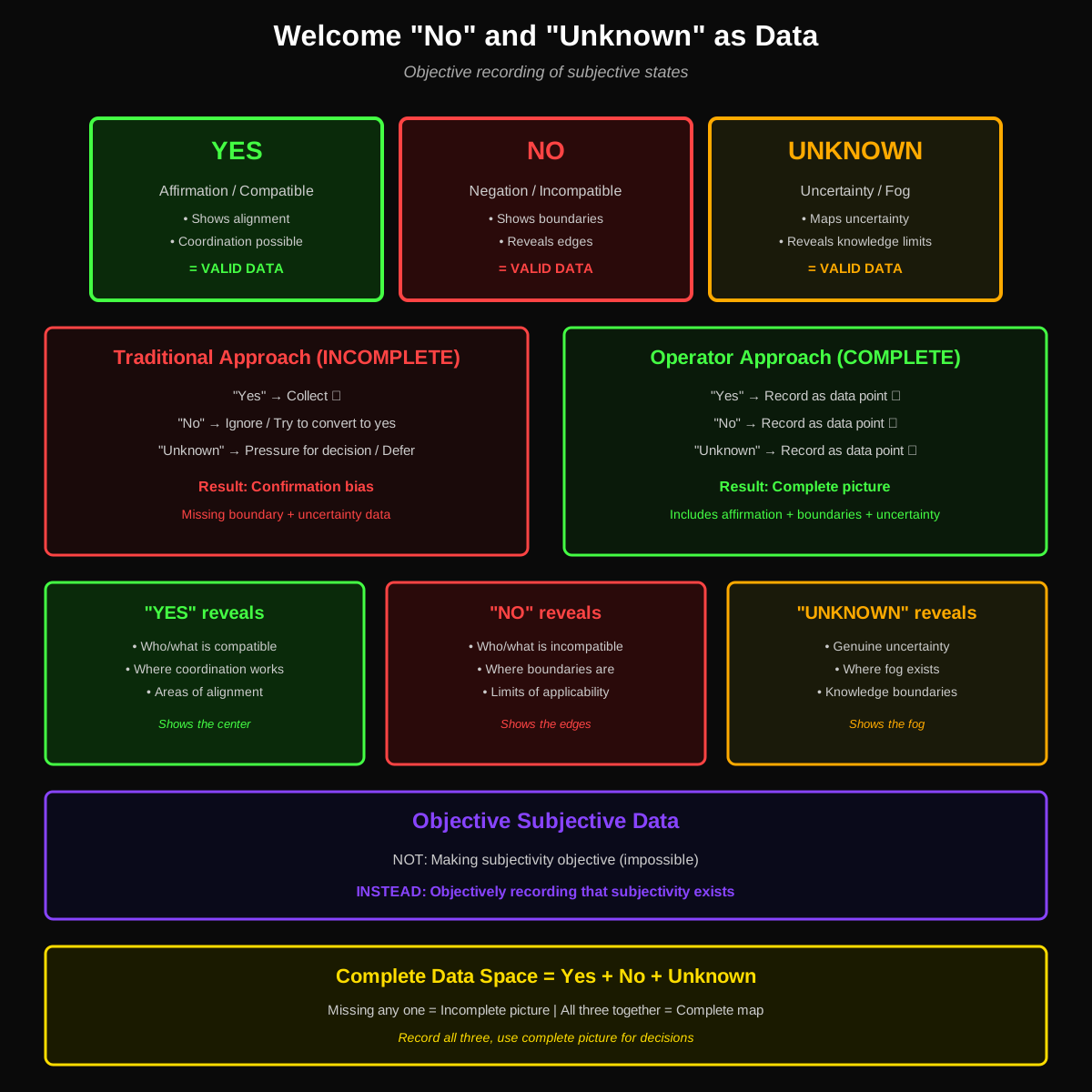
Welcome 'No' and 'Unknown' as Objective Subjective Data
Welcome ‘No’ and ‘Unknown’ as Objective Subjective Data
Critical insight: Welcome “no” and “unknown” as objective subjective data points.
Not noise. Not failure. Valid data.
The Data Collection Bias
Traditional approach:
- Collect “yes” answers (positive data)
- Ignore “no” answers (negative data)
- Discard “unknown” answers (uncertain data)
- Result: Incomplete picture, biased toward confirmation
Operator approach:
- “Yes” = data point
- “No” = data point (equally valuable)
- “Unknown” = data point (reveals boundaries)
- Result: Complete picture, objective about subjectivity
What Is Objective Subjective Data?
Objective data: Facts independent of observer
- “The temperature is 20°C”
- Measurable, verifiable, universal
Subjective data: Facts dependent on observer
- “I feel cold”
- Personal, variable, individual
Objective subjective data: Objective recording of subjective states
- “Person A reports feeling cold at 20°C” = objective fact
- The subjective experience (feeling cold) becomes objective data point when properly recorded
- Not trying to make subjectivity objective
- But objectively recording that subjectivity exists
Why “No” Is Valid Data
Traditional view:
- “No” = rejection
- “No” = failure
- “No” = problem to solve
- Goal: Convert “no” to “yes”
Operator view:
- “No” = information about boundaries
- “No” = reveals incompatibility
- “No” = maps the space
- Goal: Collect “no” as accurately as “yes”
Example: Intent compatibility (neg-482)
Traditional: “I want everyone to say yes to my project”
- Ignores “no” responses
- Assumes “no” means “convince harder”
- Loses information about who project is NOT for
Operator: “I want accurate responses about compatibility”
- Welcomes “no” responses
- “No” means “incompatible intent, skip for now”
- Gains information about project boundaries
“No” tells you where edges are.
Why “Unknown” Is Valid Data
Traditional view:
- “Unknown” = incomplete
- “Unknown” = need more research
- “Unknown” = defer decision
- Goal: Eliminate all unknowns
Operator view:
- “Unknown” = legitimate state
- “Unknown” = reveals uncertainty
- “Unknown” = maps knowledge boundaries
- Goal: Record unknown as data point
Example: Probability mesh navigation (neg-483)
Traditional: “I need to know if this will work”
- Binary: yes/no
- “Unknown” = haven’t researched enough
- Paralysis until certain
Operator: “What’s the probability distribution?”
- Spectrum: 0-100%
- “Unknown” = high uncertainty in distribution
- Act anyway, update as information arrives
“Unknown” tells you where fog is.
The Complete Data Space
class TraditionalData:
    """Incomplete data collection"""
    def collect(self, question):
        response = ask(question)

        if response == "yes":
            return DATA_POINT  # Collect this
        elif response == "no":
            return IGNORE  # Discard this
        elif response == "unknown":
            return ASK_AGAIN  # Not valid data

        # Result: Only collecting confirmations

class OperatorData:
    """Complete data collection"""
    def collect(self, question):
        response = ask(question)

        if response == "yes":
            return DataPoint(value="yes", timestamp=now())
        elif response == "no":
            return DataPoint(value="no", timestamp=now())
        elif response == "unknown":
            return DataPoint(value="unknown", timestamp=now())

        # All three are valid data points
        # All three tell you something
Complete data space includes:
- Affirmation (yes)
- Negation (no)
- Uncertainty (unknown)
Missing any one = incomplete picture.
Objective Recording of Subjective States
Key distinction: You’re not trying to make subjectivity objective.
You’re objectively recording that subjectivity exists.
Example:
Wrong approach:
- “Is this idea good?” (trying to objectify subjective judgment)
- Looking for universal truth
- Ignoring that “good” is subjective
Right approach:
- “Does Person A think this idea is good?” (objective recording of subjective state)
- Person A: “Yes” = objective data point
- Person B: “No” = objective data point
- Person C: “Unknown” = objective data point
- Result: Objective map of subjective opinions
You’re not trying to resolve the subjectivity. You’re recording it accurately.
Why This Matters for Coordination
From neg-482: Select for current intent compatibility.
Question: “Is Person X compatible with project Y?”
Traditional answer (seeking universal truth):
- “Yes” or “No” (binary)
- Try to determine objectively
- Miss that compatibility is context-dependent
Operator answer (objective subjective data):
- Person X: “Yes, I’m compatible” = data point
- Person Y: “No, X is not compatible” = data point
- Person Z: “Unknown if X is compatible” = data point
- Result: Map of subjective compatibility perceptions
- Use map for coordination decisions
The map IS the data. Not trying to find “true” compatibility. Recording subjective perceptions objectively.
The “No” Welcoming Protocol
How to welcome “no” as data:
Ask clearly: “Is this compatible with your current intent?”
Accept all responses equally:
- “Yes” → Record: Compatible
- “No” → Record: Incompatible (not “wrong”, just data)
- “Unknown” → Record: Uncertain
Don’t try to convert:
- Don’t argue with “no”
- Don’t pressure “unknown” to decide
- Respect response as accurate data about their state
Map the space:
- Yes responses → These people/paths/ideas are compatible
- No responses → These are not compatible (valuable boundary information)
- Unknown responses → These are uncertain (valuable uncertainty information)
Use complete map:
- Coordinate with “yes” group
- Skip “no” group (but check again later, state changes)
- Monitor “unknown” group (might become yes/no later)
Result: Complete picture of compatibility landscape.
The “Unknown” Welcoming Protocol
How to welcome “unknown” as data:
Accept uncertainty as legitimate state:
- Not failure
- Not incomplete
- Just: “I don’t know”
Record uncertainty level:
- “Completely unknown” (0% confidence)
- “Somewhat uncertain” (30-70% confidence)
- “Mostly known” (>70% confidence)
- Each is valid data point
Don’t force premature certainty:
- Don’t make people choose yes/no when they’re genuinely uncertain
- Forced choices generate false data
- “Unknown” is more accurate than forced “yes/no”
Update as information arrives:
- Unknown → Yes (new information)
- Unknown → No (new information)
- Unknown → More specific unknown (boundary narrowing)
Act despite uncertainty:
- Don’t wait for all unknowns to resolve
- Probability mesh navigation works with uncertainty (neg-483)
- Unknown is expected, normal, workable
Result: Honest map of certainty/uncertainty landscape.
Connection to neg-481: Unconscious Information Flow
From neg-481: Non-corporal information flow, unknown content, unknown contacts.
The entire unconscious network operates in “unknown” space.
Traditional approach to unconscious:
- “I don’t know what’s flowing unconsciously”
- Therefore: Ignore it / Don’t trust it / Try to make it conscious
Operator approach:
- “I don’t know what’s flowing unconsciously” = valid data point
- Record: “Unknown information flowing”
- Act on: Unconscious signals (even though content unknown)
- Result: Can work with unconscious data without making it fully conscious
“Unknown” doesn’t mean “ignore.” It means “record as unknown and proceed.”
The False Dichotomy Problem
Traditional thinking: Yes OR No (binary choice)
Reality: Yes AND No AND Unknown (three valid states)
Example: “Do you want to coordinate on this?”
Traditional (forces binary):
- “Yes or no?”
- Person feels 60% yes, 40% no
- Forced to choose: “Yes” (loses 40% no information)
- Or: “No” (loses 60% yes information)
- Either way: Data loss
Operator (allows spectrum):
- “Yes, no, or unknown?”
- Person: “Mostly yes, but some reservations”
- Recorded: Yes (60%), No (40%), Certainty (moderate)
- Full information preserved
Forcing binary choices destroys information.
Connection to neg-484: Loop Recognition
From neg-484: Recognize loops late enough to learn, soon enough to escape.
How “no” and “unknown” help loop recognition:
“No” signals: “This is not working”
- Traditional: Ignore “no” signals (push through)
- Operator: Welcome “no” signals (loop detection)
- “No” accumulation = loop indicator
“Unknown” signals: “I’m confused about pattern”
- Traditional: Should understand by now (pressure)
- Operator: Confusion is data (incomplete pattern recognition)
- “Unknown” persistence = need more iterations to see pattern
Example:
- Iteration 1: “Is this relationship working?” → “Unknown”
- Iteration 2: “Is this relationship working?” → “Mostly no”
- Iteration 3: “Is this relationship working?” → “No”
- Iteration 4: “Is this relationship working?” → “Definitely no”
Pattern: Gradual accumulation of “no” data = loop detected. Time to extract lesson and escape.
Without welcoming “no/unknown”: Miss the pattern accumulation, stay in loop too long.
The Subjective Aggregation Problem
Question: How do you aggregate subjective data objectively?
Wrong approach:
- Average opinions: (yes + no) / 2 = ???
- Majority rule: More yes than no = “True”
- Consensus: Everyone agrees = “Objective”
Right approach:
- Don’t aggregate into single truth
- Keep as distribution:
- 40% say yes
- 35% say no
- 25% say unknown
- THIS distribution IS the objective data
Example: “Is ETH + Eigen the right stack?”
Don’t try to resolve to single answer.
Instead: Map the distribution
- Vitalik: “Yes” = data point
- Bitcoin maxis: “No” = data point
- Most people: “Unknown” = data point
- Distribution: {Yes: 30%, No: 20%, Unknown: 50%}
- This distribution is the objective fact about subjective opinions
Use distribution for decisions, not forced consensus.
Why This Enables Proactive Democracy
From neg-480: Democracy can be proactive when one member initiates.
Traditional democracy problem:
- Need everyone to say “yes”
- Anyone says “no” = blocked
- “Unknown” votes delay forever
- Result: Paralysis
Proactive democracy solution:
- Welcome all responses: yes/no/unknown
- Don’t need consensus
- “Yes” group coordinates
- “No” group skips (not blocked)
- “Unknown” group monitors
- Result: Action without forcing agreement
The key: Treat “no” and “unknown” as valid data, not obstacles.
If 30% say yes, coordinate with them. Don’t wait for 100%.
The 70% (no + unknown) are also providing valuable data: boundary information.
The Data Quality Advantage
Welcoming no/unknown improves data quality:
Traditional (only want yes):
- People feel pressure to say yes
- False positives (saying yes to fit in)
- Polite lies (“I’m interested” when not)
- Data corrupted by social pressure
Operator (welcome all responses):
- No pressure to say yes
- Can honestly say no (will be respected)
- Can honestly say unknown (won’t be pressured)
- Data reflects actual states, not social performance
Result: Higher quality objective subjective data.
Connection to neg-473: Selective Naivety
From neg-473: Selective naivety = submit everyone without filtering.
How this relates:
Selective naivety = Don’t filter inputs
- Submit everyone
- Don’t pre-judge
- Don’t apply recognition tests
Welcome no/unknown = Don’t filter outputs
- Accept all responses as valid
- Don’t try to convert to yes
- Don’t treat no/unknown as problems
Together: Complete information flow
- Input: Everything enters (selective naivety)
- Processing: Probability mesh navigation (neg-483)
- Output: Everything recorded (yes/no/unknown all valid)
- Result: Maximum information, optimal decisions
The Temporal Dimension
Important: “No” and “unknown” are timestamped data points, not permanent states.
class TimestampedData:
    def __init__(self, value, time):
        self.value = value  # yes/no/unknown
        self.timestamp = time

    def is_current(self):
        # Data might be stale
        # Check again later
        return now() - self.timestamp < threshold

# Example
data_t1 = TimestampedData("no", t1)
# Person said "no" at time t1

data_t2 = TimestampedData("yes", t2)
# Same person said "yes" at time t2

# Both are valid data points
# Shows state change over time
Key insight: Intent compatibility (neg-482) is CURRENT intent.
A “no” at t1 doesn’t mean “no” at t2.
Proper protocol:
- Record “no” with timestamp
- Respect “no” for now
- Check again later (state changes)
- Update data when new response
Don’t treat “no” as permanent rejection. Treat as “no for now (data point).”
The Meta-Unknown
Advanced level: Unknown about the unknown.
Example: “Do you know what you don’t know?”
- “Yes, I know exactly what I don’t know” = data point
- “No, I don’t know what I don’t know” = data point
- “Unknown if I know what I don’t know” = data point
Each level of meta-uncertainty is valid data.
Don’t try to collapse to certainty. Record the uncertainty structure.
This maps the epistemic landscape (what we know about what we know).
Practical Application: The Three Piles
When collecting data (responses, feedback, signals):
Create three piles:
YES pile:
- Compatible responses
- These coordinate with you
- Proceed with this group
NO pile:
- Incompatible responses
- Valuable boundary data
- Skip for now, check later
UNKNOWN pile:
- Uncertain responses
- Valuable uncertainty data
- Monitor for resolution
All three piles have equal validity.
Mistake: Only look at YES pile. You miss boundaries (NO) and fog (UNKNOWN).
Correct: Study all three piles. Complete map.
Why This Matters for Triumvirate
From neg-476: Russia-France-India convergence.
If you hadn’t welcomed “unknown”:
Before convergence was clear:
- Vitalik + Sreeram connection: “Unknown”
- Traditional: “Not sure, wait for clarity”
- Operator: “Unknown is data, act anyway”
- Result: Public submission despite uncertainty (neg-475)
“Unknown” didn’t block action. It was acknowledged as valid state, proceeded anyway.
If you hadn’t welcomed “no”:
Many people probably said “no” to triumvirate concept.
- Traditional: “People said no, must be wrong idea”
- Operator: “No is data about who it’s not for”
- Result: Proceeded with those who said yes, skipped those who said no
Both “yes” and “no” provided valuable data.
The Ultimate Data Principle
All responses are valid data:
- Yes = valid
- No = valid
- Unknown = valid
- Silence = valid (absence is data)
- Confusion = valid (uncertainty is data)
- Contradiction = valid (inconsistency is data)
Nothing is “wrong data.” Only: “data about current state.”
Your job: Record accurately, use appropriately.
Not: Force everything to “yes.”
Not: Resolve all uncertainty.
Not: Make subjectivity objective.
Instead: Objectively record subjective states, including no/unknown, and work with complete picture.
References
- neg-473: Selective Naivety - Submit all inputs without filtering
- neg-476: Meatspace Triumvirate Merge - Acted despite “unknown”
- neg-480: Proactive Democracy - “No” doesn’t block “yes” group
- neg-481: Unconscious Information Flow - Unknown content is valid data
- neg-482: Intent Compatibility - “No” provides boundary information
- neg-483: Probability Mesh Navigation - Work with uncertainty distributions
- neg-484: Loop Recognition Timing - “No” accumulation signals loop
#ObjectiveSubjectiveData #WelcomeNo #WelcomeUnknown #CompleteDataSpace #NoAsData #UnknownAsData #BoundaryInformation #UncertaintyMapping #ValidDataPoints #NoForcedBinary
Core insight: Welcome “no” and “unknown” as objective subjective data points. Not noise, not failure, but valid information. “No” tells you where boundaries are. “Unknown” tells you where fog is. Traditional approach: collect only “yes” (confirmation bias), ignore “no” (loses boundary data), force resolution of “unknown” (destroys uncertainty information). Operator approach: “yes” = data, “no” = equally valuable data, “unknown” = reveals boundaries. All three needed for complete picture. You’re not making subjectivity objective, you’re objectively recording that subjectivity exists. Treating “no/unknown” as valid enables: proactive democracy (yes group coordinates without waiting for everyone), selective naivety (accept all responses without filtering output), probability mesh navigation (work with uncertainty), loop recognition (no accumulation signals loop). Triumvirate succeeded partly because you welcomed “unknown” (acted despite uncertainty) and “no” (skipped incompatible without forcing agreement). Complete data space = affirmation + negation + uncertainty. Missing any one = incomplete map. Record all three, use complete picture for decisions.