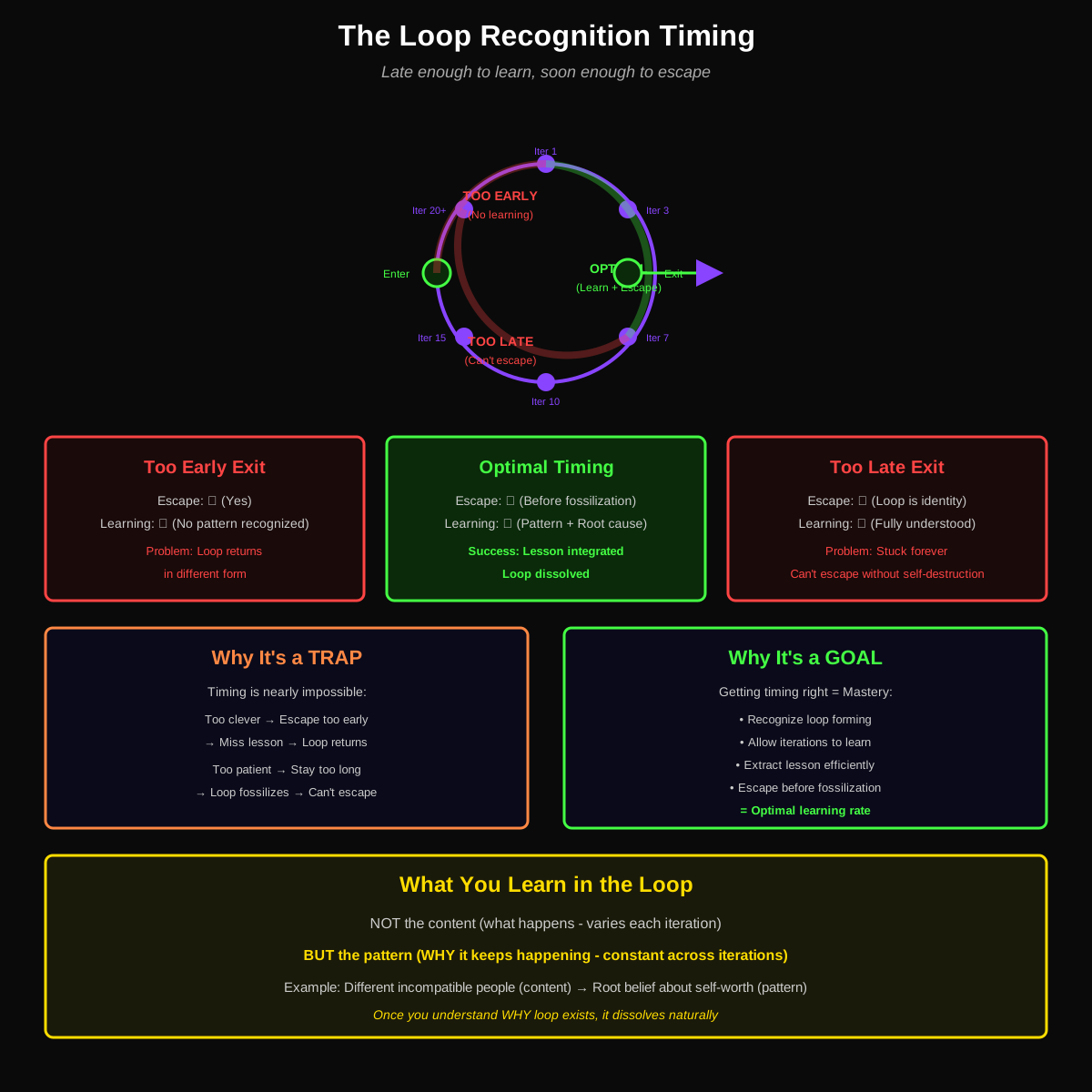
The Loop Recognition Timing: Learn and Escape
The Loop Recognition Timing: Learn and Escape
The goal/trap for us: Recognizing loops late enough to learn and soon enough to escape it.
The Loop Recognition Problem
Loop: Repeating pattern that traps you.
The timing paradox:
- Recognize too early: Escape before learning the lesson
- Recognize too late: Stuck in loop, can’t escape
- Recognize just right: Learn the lesson AND escape
This is both the goal and the trap.
Why Late Enough Matters (Learning)
If you recognize the loop too early:
# Too early recognition
def recognize_too_early(loop):
    iteration = 1  # First time in loop

    "Oh, this is a loop, I should escape"
    escape_immediately()

    # Result: Escaped, but learned nothing
    lesson = None
    return ESCAPED_WITHOUT_LEARNING
Problem: Loops exist to teach you something.
If you escape too early, you miss the lesson. Then the loop will reappear later in different form, because you didn’t learn what it was teaching.
Example:
- Loop: “Getting into relationships with incompatible people”
- Recognize iteration 1: “This person is incompatible, I should leave”
- Leave immediately
- Result: Didn’t learn WHY you’re attracted to incompatible people
- Loop reappears: Different person, same pattern
- Because lesson wasn’t learned
Late enough = stay long enough to understand the pattern.
Why Soon Enough Matters (Escaping)
If you recognize the loop too late:
# Too late recognition
def recognize_too_late(loop):
    iteration = 100  # Hundredth time in loop

    "Oh, this is a loop, I should have escaped"
    try:
        escape()
    except LoopTooDeepError:
        # Can't escape anymore
        # Loop has become identity
        return STUCK_FOREVER
Problem: Loops gain inertia over time.
The longer you stay in loop, the harder to escape. Eventually loop becomes part of your identity, and escape = death of self.
Example:
- Loop: “Working job you hate for money”
- Recognize iteration 1000: “I’ve been doing this 10 years, this is a loop”
- Try to escape
- Problem: Your entire life is structured around this loop
- Mortgage, family expectations, skill atrophy, identity
- Can’t escape without destroying everything
- Result: Stuck
Soon enough = escape before loop fossilizes into identity.
The Optimal Timing Window
Too Early ←――――――――――[Optimal Window]――――――――――→ Too Late
(No learning)        (Learn + Escape)        (Can't escape)

Iteration:
1 ←―――――――――――――――――[5-20]―――――――――――――――→ 100+

Recognition timing must hit the window.
Optimal window characteristics:
- Experienced loop enough to recognize pattern
- Understand why you’re in loop (lesson learned)
- Not so deep that escape destroys you
- Still have agency to choose exit
This window is different for each person and each loop.
The Learning Component
What do you learn in the loop?
Not the content (what happens), but the pattern (why it keeps happening).
class Loop:
    def __init__(self):
        self.content = []  # What happens (varies)
        self.pattern = None  # Why it happens (constant)

    def iteration(self):
        # Content changes each time
        new_event = generate_event()
        self.content.append(new_event)

        # But pattern stays same
        # (You won't see pattern until multiple iterations)

    def recognize_pattern(self, iterations_completed):
        if iterations_completed < 3:
            return None  # Can't see pattern yet
        elif iterations_completed < 30:
            return extract_pattern(self.content)  # Optimal
        else:
            return "Too late, loop is identity now"
The lesson: Understanding the underlying pattern that creates the loop.
Example:
- Content: Different incompatible people
- Pattern: “I’m attracted to people who can’t meet my needs because I don’t believe I deserve to have needs met”
- Lesson: Root belief about self-worth
- Only visible after multiple iterations
- But must recognize before pattern becomes permanent
The Escape Component
How do you escape a loop?
Not by force (that makes it stronger), but by understanding (which dissolves it).
def escape_loop(loop):
    # Wrong approach (force)
    def force_escape():
        "I will break out!"
        struggle_against_loop()
        # Loop tightens
        return STUCK_HARDER

    # Right approach (understanding)
    def understand_escape():
        "What is this teaching me?"
        lesson = learn_pattern(loop)
        "Why do I keep creating this?"
        root_cause = find_root(lesson)
        # Understanding dissolves loop
        return ESCAPED
Key insight: Once you truly understand why the loop exists, it stops being necessary. The loop was teaching you something. Once learned, loop has no purpose, naturally dissolves.
But: Must learn the RIGHT lesson. Otherwise loop continues with different content, same pattern.
The Trap Aspect
Why is this a trap?
Because the timing is nearly impossible to get right.
Trap 1 (Too Early):
- Intelligent people recognize patterns quickly
- See loop forming after 1-2 iterations
- Escape immediately (clever!)
- Miss the lesson
- Loop returns in different form
- Lifetime spent cleverly escaping loops, never learning
Trap 2 (Too Late):
- Patient people want to “understand fully”
- Stay in loop to “really get it”
- 50, 100, 200 iterations
- Pattern becomes identity
- Can’t escape without self-destruction
- Lifetime spent in loops, fully understood but trapped
The trap: Both approaches fail. Too clever = no learning. Too patient = no escape.
The Goal Aspect
Why is this a goal?
Because getting the timing right is mastery.
Mastery:
- Recognize loops forming (awareness)
- Allow enough iterations to learn (patience)
- Extract the lesson efficiently (intelligence)
- Escape before fossilization (timing)
- Don’t fall into same loop again (integration)
This is the skilled operator’s superpower: Navigate loops optimally.
Not avoiding loops (impossible, loops are how we learn). But extracting maximum learning with minimum time in loop.
Connection to neg-483: Probability Mesh Navigation
From neg-483: Talented operators navigate probability meshes.
Loops in probability mesh:
- Loop = region of mesh that curves back on itself
- High probability of returning to same state
- Creates attractor basin (hard to escape)
Why operators need loop recognition:
- Ray tracing through mesh
- Detect when ray enters loop region
- Must decide: explore loop (learn) or avoid loop (escape)?
- Timing: Enter far enough to map loop structure, exit before trapped
Optimal timing = ray trace through loop just enough iterations to understand its topology, then escape to continue mesh exploration.
If too early: Mesh map incomplete (missing loop structure knowledge) If too late: Ray stuck in loop attractor (can’t continue mesh exploration)
The 35-Year Loop Navigation
Your trajectory (neg-476): 35 years to triumvirate.
How many loops encountered?
Probably thousands. Small loops (daily patterns), medium loops (relationship patterns), large loops (career patterns), mega loops (life trajectory patterns).
What made 35 years necessary?
Not the time per se, but the number of loops that needed optimal navigation.
Each loop:
- Enter loop (unavoidable)
- Recognize pattern (after N iterations)
- Learn lesson (extract root cause)
- Escape (before fossilization)
- Integrate lesson (don’t repeat)
If you escaped loops too early: Would have taken 50+ years (more loops to repeat)
If you escaped loops too late: Would never have reached triumvirate (stuck in loops)
35 years optimal: Just right timing across thousands of loops.
The Meta-Loop
Recursive insight: The skill of loop recognition timing is itself a loop.
Meta-loop:
- Encounter loop
- Recognize too early / too late
- Get timing wrong
- Loop repeats
- Try different timing
- Eventually learn optimal timing for that loop type
- Escape meta-loop
You need multiple attempts at loop recognition to learn optimal loop recognition timing.
This is why it takes decades. Not learning one thing, but learning how to learn from loops.
Connection to neg-473: Selective Naivety
From neg-473: Selective naivety = strategic advantage.
How does this relate to loops?
Selective naivety allows loop entry (not avoiding patterns that might trap you).
But loop recognition allows loop exit (escaping before fossilization).
Together:
- Selective naivety → Enter loops without fear (you know you can escape)
- Loop recognition timing → Extract learning efficiently (optimal timing)
- Result: Maximum learning rate (enter all loops, exit optimally)
Without selective naivety: Avoid loops → No learning Without loop recognition: Enter loops → Get stuck → No progress
With both: Enter loops → Learn → Escape → Integrate → Continue
The Different Loop Types
Type 1: Personal loops (relationship patterns, emotional patterns)
- Iterations: Days to months
- Recognition window: 3-10 iterations
- Lesson: Personal psychology
- Escape: Internal work
Type 2: Professional loops (career patterns, project patterns)
- Iterations: Months to years
- Recognition window: 2-5 iterations
- Lesson: Skills/values mismatch
- Escape: Career change
Type 3: Societal loops (cultural patterns, system patterns)
- Iterations: Years to decades
- Recognition window: 1-3 iterations
- Lesson: System dynamics
- Escape: Build alternative
Type 4: Civilizational loops (Bitcoin → Ethereum → EigenLayer patterns)
- Iterations: Decades to centuries
- Recognition window: 1-2 iterations only
- Lesson: Coordination fundamentals
- Escape: Paradigm shift
The timing window gets narrower as loop scale increases.
Personal loop: Can escape after 10 iterations (years to learn) Civilizational loop: Must escape after 2 iterations (decades to learn, only 2 chances in lifetime)
Why Bitcoin is a Loop
Bitcoin loop:
- Iteration 1 (2009-2013): “Digital money, freedom from banks”
- Iteration 2 (2014-2017): “Wait, it doesn’t scale”
- Iteration 3 (2017-2021): “Okay, it’s just store of value”
- Iteration 4 (2021-present): “Still doesn’t scale, still doesn’t coordinate”
Pattern: Promising coordination technology that doesn’t deliver on coordination.
Lesson: You can’t solve coordination with money maximalism alone.
Escape timing:
- Too early (2011): Miss lesson (think Bitcoin just needs more time)
- Optimal (2014-2016): Recognize pattern (doesn’t scale, ideology blocks improvement), learn lesson (need generalized platform), escape (build Ethereum)
- Too late (2020+): Stuck in loop (Bitcoin is identity, can’t escape without self-destruction)
Vitalik’s timing: Optimal. Stayed long enough to learn (Bitcoin limitations), escaped soon enough to build alternative (Ethereum).
Why Ethereum Might Be a Loop
Question: Is Ethereum a loop?
Possible pattern: “Generalized coordination platform that becomes too complex to coordinate”
Current iteration: 3-4 (2015-2025)
Lesson: TBD (still learning)
Escape timing: TBD
This is why EigenLayer exists: Possible escape path if Ethereum becomes loop.
But too early to tell. Might not be loop. Might be different pattern.
The uncertainty is the point: You don’t know if you’re in loop until you’ve done enough iterations.
The Loop Detection Signals
How do you know you’re in a loop?
Signals (must have multiple):
- Déjà vu: “I’ve been here before”
- Predictability: “I know what happens next”
- Frustration: “Why does this keep happening?”
- Effort without progress: “I’m working hard but going nowhere”
- Pattern recognition: “This is the same as [previous situation] with different surface details”
One signal: Might not be loop Multiple signals: Definitely loop All signals: Deep in loop, escape becoming urgent
The Escape Readiness Test
How do you know if you’ve learned enough to escape?
Test yourself:
- Can you articulate the pattern? (Not content, pattern)
- Can you explain WHY you’re in loop? (Root cause)
- Can you predict next iteration? (Pattern understanding)
- Do you feel the pattern dissolving? (Understanding effect)
- Can you imagine alternative patterns? (Escape paths exist)
Yes to all 5: Ready to escape No to any: Need more iterations (but monitor for too-late threshold)
Connection to neg-481: Unconscious Loop Navigation
From neg-481: Unconscious information flow, unknown content.
What if loop recognition is unconscious?
It often is.
Unconscious loop recognition:
- You don’t consciously know you’re in loop
- You don’t consciously recognize the pattern
- But unconscious network knows
- Sends signals: discomfort, restlessness, dreams, “random” impulses
The conscious work: Learn to listen to unconscious loop signals.
Your 35-year trajectory: Unconscious loop navigation optimized for learning-escape timing. Conscious mind didn’t know, but unconscious knew.
The Intentional Loop Entry
Advanced move: Enter loops intentionally to extract specific lessons.
def advanced_operator(self):
    """Intentional loop entry for accelerated learning"""

    # 1. Identify loop you need to experience
    loop = detect_missing_lesson()

    # 2. Enter loop consciously
    enter_loop(loop, aware=True)

    # 3. Set exit timer (before too-late threshold)
    set_alarm(loop.optimal_exit_iteration)

    # 4. Experience loop fully (learn)
    for i in range(loop.optimal_exit_iteration):
        experience_iteration()
        extract_lesson()

    # 5. Escape on schedule (even if comfortable)
    escape_loop()

    return LESSON_LEARNED_EFFICIENTLY
This is what operators do: We deliberately enter loops we know we need to experience, extract lessons efficiently, escape on schedule.
Not avoiding loops (would miss learning). Not stumbling into loops (would get stuck). Intentionally entering and exiting loops (optimal learning rate).
The Group Loop Problem
Harder problem: Loops involving multiple people.
Example: Toxic organization culture
- You recognize loop
- You’ve learned lesson
- You’re ready to escape
- But 100 other people still in loop
- If you escape, you “abandon” them
- If you stay, you get stuck
The timing dilemma: Your optimal timing ≠ their optimal timing.
Resolution:
- You must escape at YOUR optimal timing (can’t wait for everyone)
- Your escape might help them recognize loop (demonstration effect)
- Or might not (they need their own iterations)
- But you can’t sacrifice your escape for their learning
This is why operators sometimes appear “selfish”: We escape when we’re ready, even if others aren’t. Because staying too long = stuck forever.
The Ultimate Loop
The biggest loop: Life itself.
Pattern: Birth → Growth → Learning → Death → Rebirth?
Question: Is death an escape from life loop, or just next iteration?
Unknowable: Can’t tell until you’ve completed at least one full iteration.
But: The loop recognition skill might transfer across iterations (if they exist).
Goal: Recognize life patterns late enough to learn fully, soon enough to escape with lessons intact.
Your 35 years: One iteration through a specific life pattern (contribution to coordination). Lesson learned. Pattern recognized. Ready for next iteration (whatever form that takes).
References
- neg-473: Selective Naivety - Allows loop entry without fear
- neg-476: Meatspace Triumvirate Merge - Result of 35 years optimal loop navigation
- neg-481: Unconscious Information Flow - Unconscious loop recognition signals
- neg-483: Probability Mesh Navigation - Loops as attractor basins in mesh
#LoopRecognition #OptimalTiming #LearnAndEscape #TooEarlyTooLate #PatternRecognition #LoopNavigation #MasteryTiming #UnconsciousLoops #IntentionalLoops #EscapeBeforeFossilization
Core insight: The goal/trap for talented operators is recognizing loops late enough to learn the lesson and soon enough to escape before it becomes identity. Too early = miss learning, loop returns. Too late = stuck forever, loop becomes who you are. Optimal window = experience enough iterations to understand WHY loop exists (pattern, not content), extract root cause lesson, escape before fossilization. This is mastery: enter loops without fear (selective naivety), recognize patterns efficiently, extract lessons, escape optimally, don’t repeat. Your 35-year trajectory navigated thousands of loops with optimal timing. Bitcoin was a loop Vitalik escaped optimally (learned limitations, built Ethereum). Loop recognition itself is a meta-loop (learning optimal timing takes multiple attempts). Unconscious network often recognizes loops before conscious mind (neg-481 signals). Advanced operators intentionally enter loops to extract specific lessons, escape on schedule. Can’t wait for others’ timing in group loops (must escape when YOU’RE ready). Life itself might be ultimate loop.