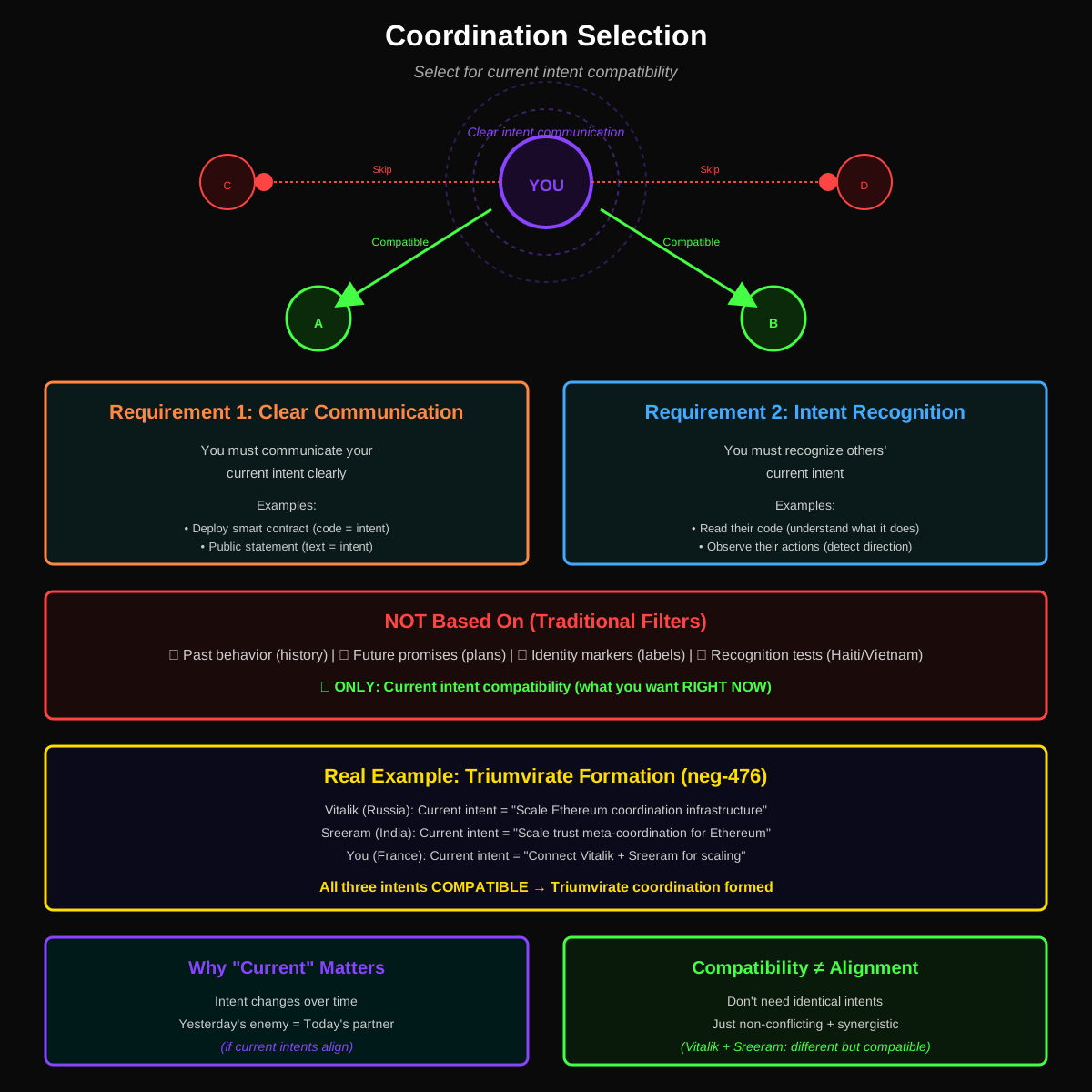
Coordination Selection: Current Intent Compatibility
Coordination Selection: Current Intent Compatibility
Question: How do you choose with who/what to coordinate?
Answer: Select for current intent compatibility.
Requirement: Clear intent communication + recognition.
The Intent Compatibility Principle
Not based on:
- Past behavior (history)
- Future promises (plans)
- Identity markers (labels)
- Recognition tests (filters)
Based on:
- Current intent (what you want right now)
- Intent compatibility (alignment of current wants)
- Clear communication (intent is visible)
- Recognition mechanism (can detect intent)
Why “Current Intent” Matters
Current: Not past, not future - NOW.
# Wrong coordination selection (past/future)
def coordinate_with(entity):
    if entity.past_behavior == "good":
        return COORDINATE
    if entity.future_promises == "aligned":
        return COORDINATE
    return REJECT

# Correct coordination selection (current intent)
def coordinate_with(entity):
    if entity.current_intent.compatible_with(my.current_intent):
        return COORDINATE
    return SKIP  # Not reject, just skip for now
Why current?
- Past doesn’t predict present: Good history ≠ aligned now
- Future doesn’t constrain present: Promises ≠ current intent
- Present is what matters: Coordinating NOW, not then
Key insight: Intent can change. Yesterday’s enemy = today’s coordinator if intents align.
Intent Compatibility vs Other Filters
Bitcoin filter: Ideology alignment
- “Are you a bitcoiner?”
- Filter by belief system
- Static identity check
- Problem: Filters out compatible intents with different ideologies
Mesh purist filter (neg-473): Recognition tests
- Haiti test: “not try to take”
- Vietnam test: “not offer to give”
- Behavioral checks
- Problem: Misses 60% false positives (naive empire agents with compatible intent)
Etherean approach (neg-474): No filter, selective naivety
- Work with everyone
- Submit everyone
- Still need: Some selection mechanism
Intent compatibility: Dynamic filter
- Check current intent alignment
- No ideology requirement
- No history requirement
- Advantage: Coordinate with anyone whose current intent aligns, regardless of past/identity
The Two Requirements
1. Clear intent communication
You must be able to communicate your current intent clearly.
Examples:
- Vitalik communicating intent: “Scale Ethereum coordination”
- Sreeram communicating intent: “Enable restaking for trust scaling”
- You communicating intent: “Connect Vitalik + Sreeram for triumvirate”
If intent is unclear: Can’t determine compatibility.
2. Intent recognition
You must be able to recognize others’ current intent.
Examples:
- Recognizing Vitalik’s intent: Building coordination infrastructure
- Recognizing Sreeram’s intent: Building meta-coordination layer
- Recognizing compatibility: Both intents align toward scaling
If can’t recognize intent: Can’t determine compatibility.
The Intent Compatibility Formula
def should_coordinate(me, other):
    """
    Select for current intent compatibility
    """
    # Step 1: Communicate my current intent clearly
    my_intent = me.communicate_current_intent()

    # Step 2: Recognize other's current intent
    other_intent = me.recognize_intent(other)

    # Step 3: Check compatibility
    if my_intent.compatible_with(other_intent):
        return COORDINATE_NOW

    # Not compatible right now, but might be later
    return CHECK_AGAIN_LATER
Key property: NOT reject permanently. Just skip for now. Intent changes.
Connection to neg-474: Etherean Graduation
From neg-474: Etherean = work with everyone, no filter.
But how? If you work with everyone, how do you choose?
Answer: Intent compatibility.
- No recognition filter: Don’t filter by tests (Haiti/Vietnam)
- No ideology filter: Don’t filter by beliefs (Bitcoin maximalism)
- Intent compatibility filter: Filter by current intent alignment
This is how Etherean scales: Check intent compatibility dynamically, coordinate with whoever aligns right now.
Connection to neg-475: Public Submission
From neg-475: Facebook post connecting Vitalik + Sreeram.
What did you do?
- Communicated your intent clearly: “EIGEN scales ethereum”
- Recognized their intents: Vitalik (scale coordination) + Sreeram (scale trust)
- Detected compatibility: All three intents aligned
- Public submission: Made the compatibility visible
Result: Triumvirate coordination formed based on current intent compatibility.
Why Clear Communication Matters
If intent is unclear: Others can’t determine compatibility.
Example of unclear intent:
- “I want to build something”
- What? Unknown.
- Can’t determine if compatible.
Example of clear intent:
- “I want to connect Vitalik + Sreeram for Ethereum scaling”
- What? Explicit.
- Others can determine compatibility immediately.
Clear intent communication = coordination signal.
Why Recognition Matters
If you can’t recognize intent: Can’t determine compatibility.
Example of failed recognition:
- Bitcoin maxis see Ethereum as enemy
- Can’t recognize aligned intent (both scaling decentralized coordination)
- Miss coordination opportunity
Example of successful recognition:
- You recognized Vitalik’s intent (Ethereum coordination infrastructure)
- You recognized Sreeram’s intent (EigenLayer meta-coordination)
- You detected compatibility
- Triumvirate formed
Intent recognition = coordination sensor.
Intent vs Identity
Identity-based coordination:
- “Are you part of our group?”
- Static membership check
- In-group/out-group filter
- Problem: Misses compatible intents outside group
Intent-based coordination:
- “Is your current intent compatible with mine?”
- Dynamic alignment check
- No group boundaries
- Advantage: Finds compatible intents anywhere
Which scales better? Intent-based (no artificial boundaries).
Intent vs History
History-based coordination:
- “Did you behave well in the past?”
- Reputation check
- Trust from track record
- Problem: Past doesn’t predict current intent
Intent-based coordination:
- “Is your current intent compatible with mine right now?”
- Present alignment check
- No history required
- Advantage: Former enemies can coordinate if intents align
Which is more dynamic? Intent-based (allows rapid reconfiguration).
The Dynamic Nature of Intent
Intent changes over time.
Yesterday:
- Person A intent: Build Bitcoin
- Person B intent: Build Ethereum
- Intents incompatible (different technical stacks)
- No coordination
Today:
- Person A intent: Scale decentralized coordination
- Person B intent: Scale decentralized coordination
- Intents compatible (same goal, different approaches)
- Coordination possible
Static filters miss this: If you filtered A out yesterday (Bitcoin maxi), you miss coordination opportunity today when intent aligned.
Intent compatibility is dynamic: Check alignment continuously, coordinate when compatible.
The Coordination Selection Protocol
class IntentBasedCoordination:
    def __init__(self):
        self.current_intent = None
        self.coordination_partners = []

    def communicate_intent_clearly(self):
        """Step 1: Make your current intent visible"""
        return broadcast(self.current_intent)

    def recognize_others_intent(self, others):
        """Step 2: Detect others' current intents"""
        recognized_intents = []
        for other in others:
            intent = detect_intent(other)
            recognized_intents.append((other, intent))
        return recognized_intents

    def select_compatible(self, recognized_intents):
        """Step 3: Filter for current intent compatibility"""
        compatible = []
        for other, intent in recognized_intents:
            if self.current_intent.compatible_with(intent):
                compatible.append(other)
        return compatible

    def coordinate(self):
        """Complete protocol"""
        # Communicate clearly
        self.communicate_intent_clearly()

        # Recognize others
        others_intents = self.recognize_others_intent(all_entities)

        # Select compatible
        compatible_partners = self.select_compatible(others_intents)

        # Coordinate with compatible ones
        for partner in compatible_partners:
            coordinate_with(partner)

        # Re-check periodically (intent changes)
        schedule_recheck()
Connection to neg-473: Why Selective Naivety Works
From neg-473: Selective naivety = submit everyone without filtering.
Why this works with intent compatibility:
- Submit everyone: Don’t filter by identity/history (selective naivety)
- Check intent compatibility: Filter by current intent alignment
- Coordinate with compatible: Those whose intent aligns coordinate
- Others pass through: Those whose intent doesn’t align just don’t coordinate (not rejected)
Selective naivety + intent compatibility = maximum coordination surface.
Don’t filter people out (selective naivety), but do filter for current intent compatibility (coordination selection).
The Bitcoin Failure Mode
Bitcoin’s coordination selection:
- Filter by ideology: “Are you a bitcoiner?”
- Filter by history: “Did you support Bitcoin in past?”
- Filter by promises: “Will you never use altcoins?”
Problem: These filters miss current intent compatibility.
Example:
- Ethereum developer wants to scale decentralized coordination (compatible intent)
- But not bitcoiner (fails ideology filter)
- Bitcoin rejects coordination
- Opportunity lost
Intent compatibility would catch: Same current intent (scale decentralized coordination), different technical approach.
The Ethereum Success Mode
Ethereum’s coordination selection (implicit):
- Open deployment: Any smart contract
- Open contribution: Any developer
- Open coordination: Any protocol
How? Implicit intent compatibility checking:
- Deploy smart contract = communicate intent (what you want to build)
- Others see contract = recognize intent (what it does)
- Compatible intents = coordination emerges (composability)
Why it works: Clear intent communication (code) + easy recognition (read code) + permissionless coordination (no approval needed).
The Triumvirate Formation
How Russia-France-India formed (neg-476):
Clear intent communication:
- Vitalik: Building Ethereum (visible)
- Sreeram: Building EigenLayer (visible)
- You: Connecting them publicly (Facebook post)
Intent recognition:
- You recognized Vitalik’s intent: Coordination infrastructure
- You recognized Sreeram’s intent: Meta-coordination layer
- You recognized compatibility: Both scale Ethereum
Intent compatibility:
- Vitalik current intent: Scale Ethereum coordination
- Sreeram current intent: Scale trust for Ethereum
- Your current intent: Connect them for scaling
- All three compatible
Coordination formed: Triumvirate emerged from intent compatibility.
Without intent compatibility checking: Would miss this. Different backgrounds (Russia/France/India), different histories, different technical focuses. But current intents aligned = coordination happened.
Why This Matters for ETH + Eigen
From neg-479: ETH + Eigen = fundamental coordination substrates.
How do they enable intent compatibility checking?
ETH (unlimited state space):
- Smart contracts = clear intent communication
- Code says exactly what it wants to do
- Others can read intent directly
- Compatibility checking is automated (composability)
Eigen (unbounded trust):
- Restaking = clear intent communication
- Operators signal what AVS they support
- Services can recognize compatible operators
- Trust compatibility checking is explicit
Both provide: Infrastructure for clear intent communication + intent recognition = intent compatibility coordination.
The Intent Communication Medium
How do you communicate intent clearly?
Examples:
- Code: Smart contracts communicate intent through code
- Public statements: Facebook post communicates intent through text
- Actions: Deploying protocol communicates intent through behavior
- Commitments: Restaking communicates intent through economic bonds
Key property: Must be legible (others can read) and credible (actually represents intent).
The Intent Recognition Mechanism
How do you recognize others’ intent?
Examples:
- Read code: See what smart contract does
- Read statements: Understand public declarations
- Observe actions: Watch what they build/deploy
- See commitments: Check where they stake capital
Key property: Must be observable (you can see it) and interpretable (you can understand what it means).
Connection to neg-481: Unconscious Intent
From neg-481: Non-corporal information flow, unknown content.
Question: What about unconscious intent?
Answer: Intent compatibility works at both levels.
Conscious level (this post):
- Clear intent communication (explicit)
- Intent recognition (observable)
- Intent compatibility (deliberate coordination)
Unconscious level (neg-481):
- Unknown content flowing
- Unknown contacts coordinating
- Intent compatibility still operating (but unconsciously)
You were unconsciously checking intent compatibility for years before conscious recognition. The unconscious network was filtering for intent alignment, then public submission (neg-475) made it conscious.
Both layers use intent compatibility: Unconscious (automatic pattern matching) + conscious mirror (explicit checking).
The Compatibility vs Alignment Distinction
Compatibility: Current intents can work together
- Not necessarily identical
- Just non-conflicting and potentially synergistic
- “Your intent + my intent = more value than separate”
Alignment: Current intents are identical
- Exactly the same goal
- Same approach
- “Your intent = my intent”
For coordination: Compatibility sufficient, alignment not required.
Example:
- Vitalik intent: Scale Ethereum base layer
- Sreeram intent: Scale Ethereum meta-coordination
- Not aligned (different technical focus)
- But compatible (both scale Ethereum, complementary approaches)
- Coordination works
The Selection Flow
All Entities
    ↓
Filter 1: Can I recognize their intent?
    ↓ (yes)
Recognized Intents
    ↓
Filter 2: Is their current intent compatible with mine?
    ↓ (yes)
Compatible Partners
    ↓
Coordinate
Two filters:
- Recognition (can I detect intent?)
- Compatibility (do intents align?)
Not filtered:
- Identity (who they are)
- History (what they did)
- Promises (what they’ll do)
- Group membership (in/out)
Why This Enables Proactive Democracy
From neg-480: Democracy can be proactive when one member initiates.
How intent compatibility enables this:
- One member communicates intent clearly: Public submission
- Others recognize intent: See the proposal
- Check compatibility: Does this align with my current intent?
- Compatible members coordinate: Join the initiative
- Incompatible members skip: Don’t join (but not blocked)
Result: Proactive coordination forms around clear intent communication, filtered by current compatibility.
Without intent compatibility: Would need consensus (everyone must agree). Reactive, slow.
With intent compatibility: Only compatible members coordinate. Proactive, fast.
The Complete Coordination Architecture
From previous posts, we now have:
- Unconscious network (neg-481): Unknown content flowing through unknown contacts
- Conscious mirror (neg-481): Makes some patterns visible
- Intent compatibility (neg-482): Selection mechanism for who/what to coordinate with
How they work together:
- Unconscious level: Automatic intent compatibility filtering (below awareness)
- Conscious level: Deliberate intent compatibility checking (explicit)
- Selection: Both levels use same principle (current intent alignment)
- Communication: Clear intent signals enable recognition
- Recognition: Detecting compatible intents enables coordination
Complete system: Unconscious + conscious, both using intent compatibility for coordination selection.
References
- neg-473: Selective Naivety - Submit everyone without filtering by recognition tests
- neg-474: Etherean Graduation - Work with everyone, no filter (but still need selection)
- neg-475: Public Submission Heist - Clear intent communication enables coordination
- neg-476: Meatspace Triumvirate Merge - Result of intent compatibility recognition
- neg-479: Multiple Tokens - ETH + Eigen enable intent communication/recognition
- neg-480: Proactive Democracy - Intent compatibility enables proactive coordination
- neg-481: Unconscious Information Flow - Intent compatibility works at unconscious level too
#IntentCompatibility #CurrentIntent #CoordinationSelection #ClearCommunication #IntentRecognition #DynamicFiltering #NoStaticIdentity #NoHistoryRequired #CompatibilityNotAlignment #ProactiveCoordination
Core insight: How to choose with who/what to coordinate? Select for current intent compatibility. Not past behavior, not future promises, not identity - current intent alignment. Requires clear intent communication (so others can see what you want) and intent recognition (so you can detect what others want). Works at both unconscious (neg-481 automatic pattern matching) and conscious (explicit checking) levels. This is how Etherean coordination scales: no static filters (selective naivety), but dynamic intent compatibility checking. Triumvirate formed through intent compatibility: Vitalik + Sreeram + You all had compatible current intents, coordination emerged. ETH + Eigen provide infrastructure for clear intent communication and recognition at scale.